

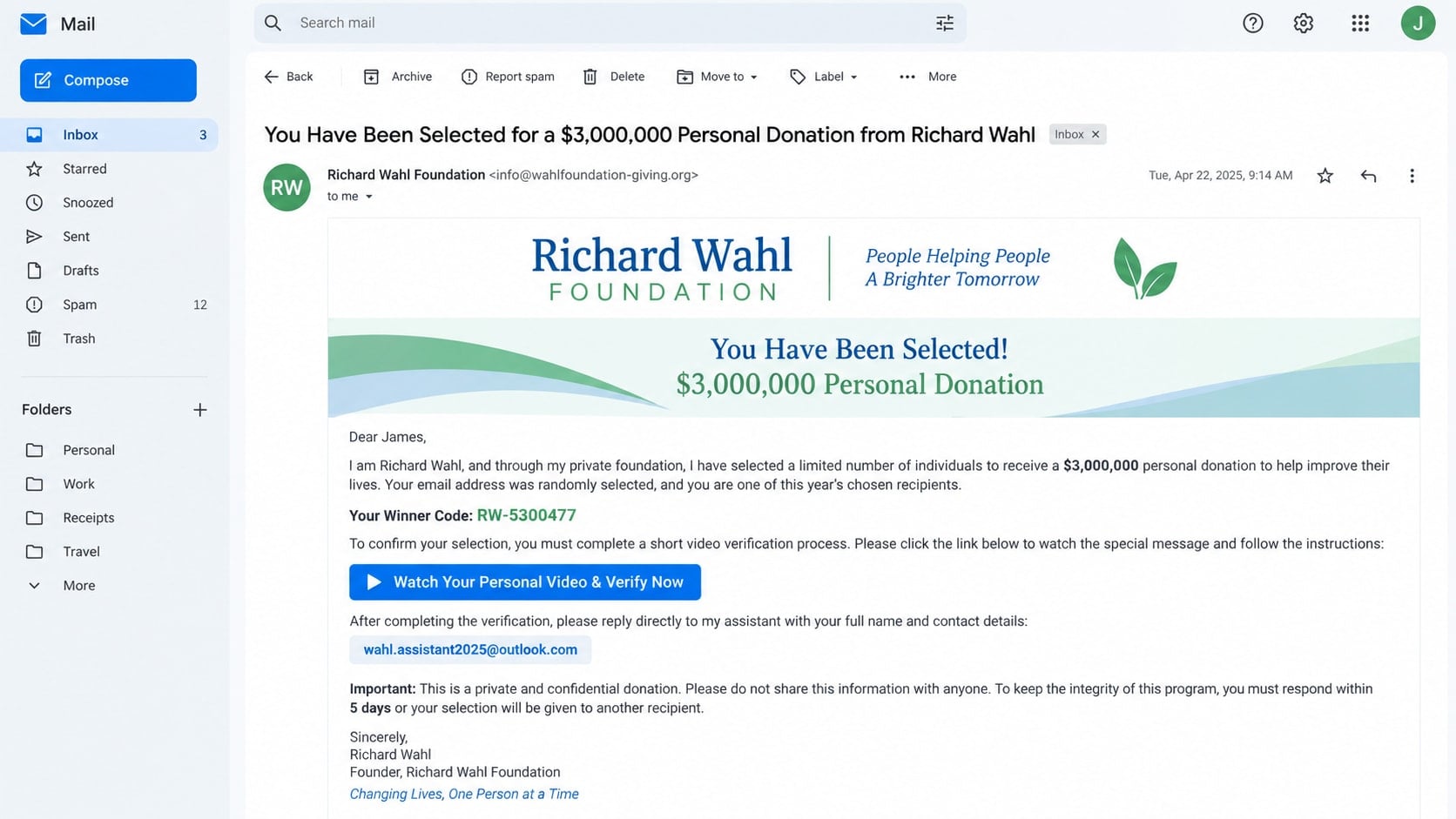
The message feels strangely personal for something sent by a stranger. It says Richard Wahl, the winner of a $533 million Mega Millions jackpot, has chosen you to receive part of his fortune and even includes a real video to prove who he is.
The video may be real. The person writing to you is not. The Richard Wahl lottery donation scam uses a public jackpot story as borrowed credibility, then turns the promised generosity into a costly hunt for fees, identity documents, and bank information.
Overview
A real jackpot winner is impersonated
Richard Wahl won a $533 million Mega Millions jackpot in New Jersey in 2018. Scammers have repeatedly used his name, interviews, and public story in emails and social media messages that claim he is giving millions to randomly selected individuals.
The messages do not come from Richard Wahl. A real name and a real jackpot do not authenticate the sender, assistant, foundation, claim code, or donation.
The recipient is told that luck struck twice
The scam claims an email address or profile was selected through a “spin ball,” internet draw, or collaboration with Google or Microsoft. Amounts vary from hundreds of thousands to more than $20 million.
The offer is designed to bypass ordinary judgment. The recipient did not enter anything, yet the story says that is precisely why they were chosen. Random generosity becomes the explanation for every missing detail.
The payout is a path to advance-fee fraud
After the recipient replies, a supposed assistant, accountant, bank manager, or courier begins the claim process. Personal information is collected, documents are issued, and a fee appears before the donation can be delivered.
The consequences can extend beyond the first payment:
- Courier, insurance, tax, and transfer fees are sent to criminals.
- Identity documents are reused for impersonation and account fraud.
- Bank and card information is captured through fake claim portals.
- Counterfeit checks create losses when victims forward supposedly excess funds.
- Social or email accounts are hijacked and used to contact trusted friends.
- Victims are placed on lists for later grant and recovery scams.
The Real Story Is Used as a Costume
This scam is more convincing than a completely invented lottery because the recipient can search the name and find authentic coverage. The amount, state, and video may all match the public record.
That is intentional. The criminal wants the recipient to verify the celebrity of the story rather than the identity of the sender. A link to a television interview proves who appeared in the interview. It says nothing about the owner of an Outlook, Gmail, or newly created domain account.
The messages also change over time. A supposed donation may be framed as pandemic relief, a religious act, help for families, or an international charity project. The amount and assistant’s name can change while the underlying script remains the same.
Reports attached to the long-running campaign show that the impersonation has circulated across email, Instagram, TikTok, and other messaging channels. That persistence does not make it legitimate. It shows how easily a reusable story can be copied by different fraudsters.
The most effective messages do not ask for money immediately. They offer congratulations, provide a code, and invite a reply. The scammer saves the fee for later, after the recipient has imagined what the donation could change.
How the Richard Wahl Lottery Donation Scam Works
Step 1: A stranger announces a private donation
The message says the recipient is one of five, ten, or twenty people chosen to share in the jackpot winner’s charity. It may use a subject such as “Donation,” “Your Grant Approved,” or “A Private Gift to You.”
The greeting is often generic, but some versions include a real name taken from a breach, social profile, or public directory. Personalization can make mass spam feel like deliberate selection.
Step 2: Public links are presented as identity verification
The sender includes a link to a news article or YouTube interview about the actual jackpot. The recipient is encouraged to watch it and compare the reported $533 million win with the email’s story.
This step creates a false bridge between a public person and a private inbox. The message does not prove that the account sending it belongs to the person in the video.
A claim or winner code can add another touch of procedure. Codes such as “5300477” have been reused in different versions because repetition is inexpensive and most recipients never compare messages.
Step 3: An assistant collects the recipient’s details
The supposed donor may claim to be busy and direct the recipient to a personal assistant, financial manager, pastor, accountant, or courier. The new contact asks for a full name, age, address, occupation, phone number, and copy of an identity document.
The switch makes the process look organized. It also lets the criminal separate the emotional role of the generous donor from the transactional role of the person demanding information and money.
Step 4: The victim sees a fictional transfer or check
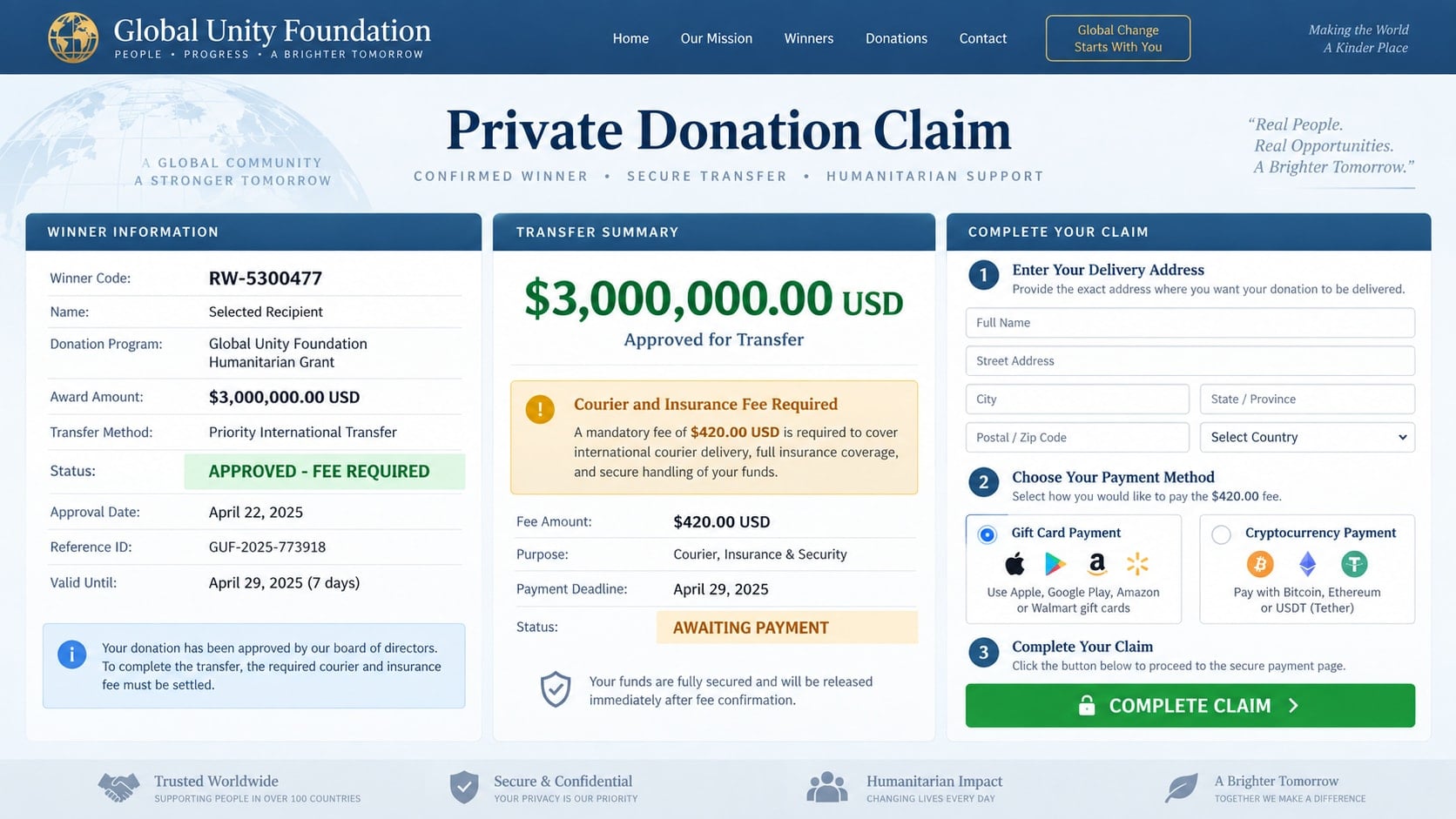
A certificate, check image, account dashboard, or delivery notice shows the promised money as ready. The recipient’s information is inserted into the document to create the impression of official processing.
Nothing on the screen represents accessible funds. The website or PDF is controlled by the fraudster. Even a check deposited into a real account can be counterfeit and reversed after the bank’s initial availability period.
Step 5: A release cost suddenly becomes unavoidable
The assistant explains that a courier, insurance company, tax authority, or bank needs an upfront payment. The victim may be asked for $85, $420, or several thousand, depending on what the scammer believes they can afford.
Gift cards, Cash App, wire transfer, or cryptocurrency are common. The payment is described as refundable or separate from the donation, but those labels do not create a real claim.
Step 6: The finish line keeps moving
After one fee is paid, the criminal invents another. The courier discovers a customs charge. The bank requires a transfer certificate. The tax office needs a clearance payment. The assistant blames the victim’s delay for a new penalty.
When the victim begins to doubt the story, the scammer may become emotional, religious, or threatening. They can accuse the victim of wasting the opportunity or violating confidentiality. None of that changes the absence of real money.
Identity, Contact, and Payment Checks
Verify the sender, not the news article
Search results about the jackpot are not enough. Look for a verified public announcement of this exact donation program and a confirmed contact channel for its administrators.
Do not call a number or write to an address supplied in the message. The scammer controls those routes. When no independent, verified program can be found, the offer has failed the most basic check.
Inspect every account in the conversation
Check the full sender and reply-to addresses. A foundation name displayed above a free mailbox is easy to create. A second free address belonging to an “assistant” is not independent confirmation.
Domains that resemble a person’s name may also be fraudulent. Registration is open to anyone, and secure web encryption confirms only the connection to that domain, not the owner’s identity.
Protect documents and account codes
Do not send a passport, driver’s license, Social Security number, bank statement, or selfie to claim an unsolicited donation. Never share a one-time code that arrives by text or authentication app.
A scammer may say a code is needed to verify the beneficiary. In reality, it can authorize a password reset, financial transfer, or new device on an account the criminal is trying to seize.
Reject every pay-to-receive explanation
The FTC warns consumers about prize and impersonation scams that demand money before releasing a supposed reward. The principle does not change when the sender calls the money a private donation.
A real millionaire does not need a stranger to buy an Amazon gift card so a bank can release millions. Fees that cannot be deducted from the promised amount exist because the promised amount does not exist.
Warning Signs in the Richard Wahl Donation Message
The campaign has circulated in many forms, but its strongest warning signs stay consistent:
- You are offered money without entering, applying, or knowing the donor.
- The sender claims an internet company randomly selected your address.
- A real interview is used to prove an unrelated private identity.
- The message directs you to a free email account belonging to an assistant.
- You are given a generic or reused winner code.
- The sender asks for your address, occupation, ID, or banking details.
- Confidentiality is presented as a condition of receiving the gift.
- A courier or bank chosen by the sender demands an upfront fee.
- Payment must be sent through gift cards, crypto, wire, or a payment app.
- The requested amount grows after each payment.
Do not assume that a message is safe because the sender correctly describes the jackpot. Public facts are the easiest part of the scheme to copy. The private transaction is where verification must happen.
Notice who controls every piece of the claim. The donor, assistant, bank officer, courier, and support desk may look separate, yet all of them arrive through addresses or links introduced by the original sender. That is not independent confirmation. It is one fraud operation playing several roles so each character can validate the others.
A genuine gift also does not become more credible because the amount on a dashboard increases. Scammers can edit a page, receipt, or transfer notice in seconds. Trust only money that your own financial institution confirms through a channel you opened yourself, after any deposit has fully cleared and cannot be reversed.
What to Do if You Have Fallen Victim to This Scam
- Break contact and save evidence. Keep the emails, full headers, usernames, phone numbers, claim codes, websites, chat logs, payment instructions, and receipts. Stop replying after the record is preserved.
- Contact the payment provider urgently. Tell the bank, wire service, card issuer, payment app, gift card company, or crypto exchange that the transaction was induced by an impersonation scam. Ask about a recall, freeze, dispute, or fraud flag.
- Secure the accounts used in the claim. Change passwords entered on any linked page, enable multi-factor authentication, sign out unknown sessions, and inspect recovery information, forwarding rules, connected apps, and recent login history.
- Address identity theft risk. If you sent a Social Security number, passport, license, selfie, or bank document, use IdentityTheft.gov for a recovery plan. Consider credit freezes and contact the relevant issuing agency.
- Check devices for unwanted software. If an attachment, video player, document viewer, or remote-support tool was installed, run a full scan with trusted security software such as Malwarebytes. Remove unknown extensions and remote-access applications.
- Limit future phishing exposure. AdGuard can help block many known scam pages, malicious ads, and tracking routes. It is useful protection, but it cannot make an unverified donation legitimate.
- Report every account involved. File a report with ReportFraud.ftc.gov, notify the email or social platform, and report the receiving financial account or wallet. Local law enforcement may also need the records when losses are substantial.
- Warn your contacts if an account was compromised. Tell friends and family not to trust recent donation, emergency, or investment messages from your profile. Scammers often use a stolen account to borrow credibility from real relationships.
Frequently Asked Questions
Did Richard Wahl really win $533 million?
Yes, the widely reported Mega Millions jackpot is real. The donation messages are not. Scammers use accurate news coverage to impersonate a real winner and create a false sense of verification.
Is winner code 5300477 proof of a real claim?
No. A code typed into an email or website has no independent authority. Variations of these scams reuse the same code across many recipients. Only a verified program and administrator could establish a legitimate claim.
Why would the sender ask me to watch a real video?
The video shifts attention from the sender’s identity to the public person’s identity. It confirms that Richard Wahl exists, not that the email account belongs to him. This is a common form of borrowed credibility.
Can the donation arrive by cashier’s check?
A scammer can send a counterfeit cashier’s check that appears available before the bank finishes verification. If you are asked to send part of it to a courier, charity, or agent, the later reversal can leave you responsible for the full amount.
What if I shared my address but did not pay?
Stop contact and expect targeted follow-ups. An address alone may not lead to immediate loss, but it helps personalize future scams. Secure your accounts and be cautious with unexpected mail, calls, and delivery notices.
Can a recovery company get my gift card or crypto payment back?
No honest service can guarantee recovery. Contact the original provider or exchange immediately and file official reports. People who approach you first and demand a tracing or release fee are likely running a second scam.
The Bottom Line
The Richard Wahl lottery donation scam is convincing because it wraps a false private promise around a true public event. The news link, code, assistant, and claim portal all lead toward the same result: the recipient is asked to send money to receive money.
Keep the distinction clear. A real jackpot winner can exist while every message using that winner’s name is fraudulent. Do not reply, do not share identity documents, and never pay a fee to unlock an unexpected donation.








