

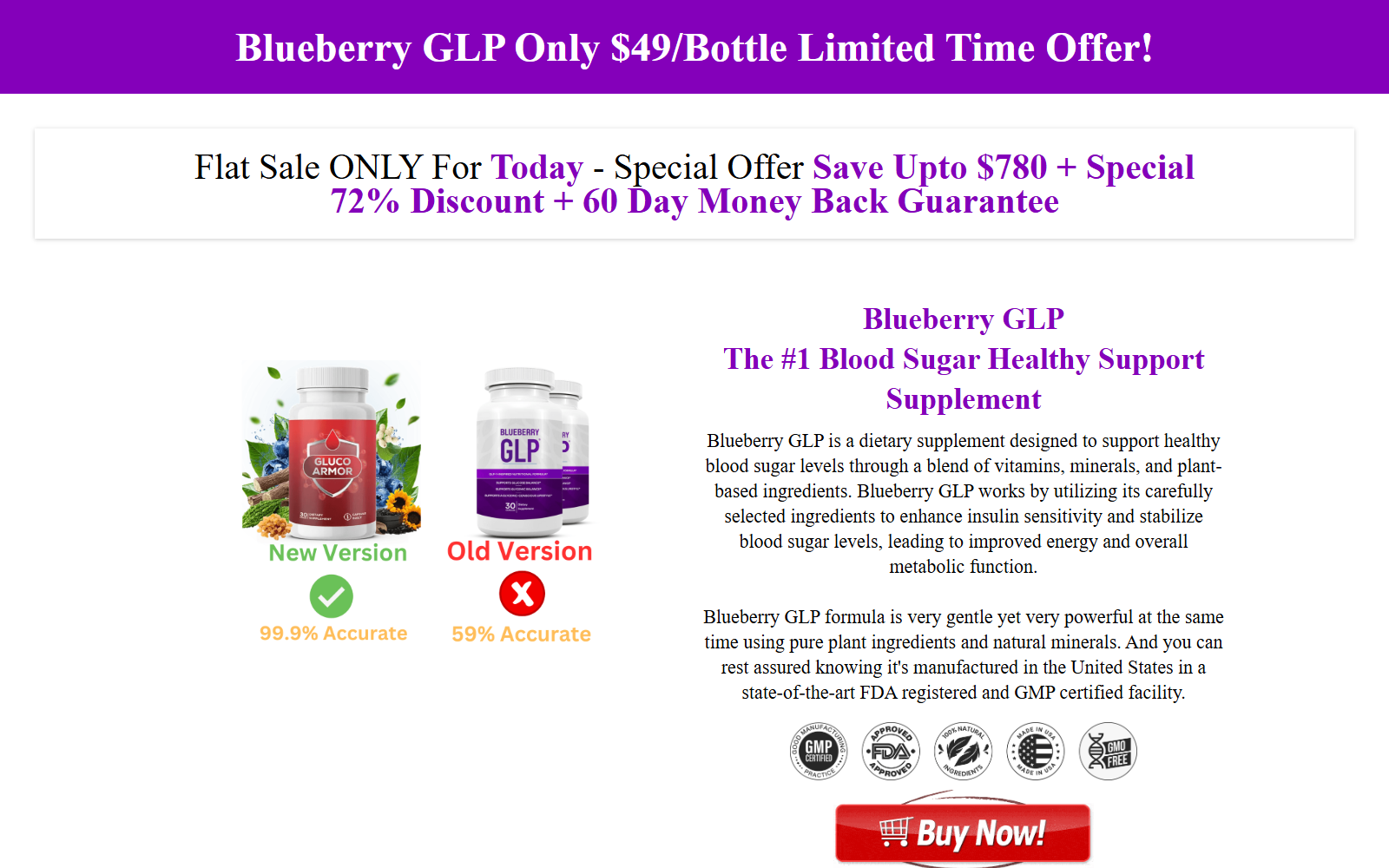
Blueberry GLP borrows the language of modern weight-loss medicine while presenting itself as a colorful natural blood-sugar supplement.
Its page offers dramatic savings and confident results, but the formula changes as readers move through the same website.
Overview
What Blueberry GLP claims to offer
Blueberry GLP is marketed for blood-sugar balance, weight management, energy, appetite control, mental clarity, and broader metabolic wellness.
The opening discussion describes vitamins, minerals, Cocoa Bean Extract, and Bitter Melon Fruit Extract as key components.
Later, the FAQ attributes the product’s action to chicory inulin, resistant potato starch, and three named probiotic organisms.
Those are not minor wording differences. They describe fundamentally different formulas and mechanisms.
Why the inconsistencies are serious
People taking medication for diabetes or blood pressure need an accurate label, not a sales page that changes ingredients between sections.
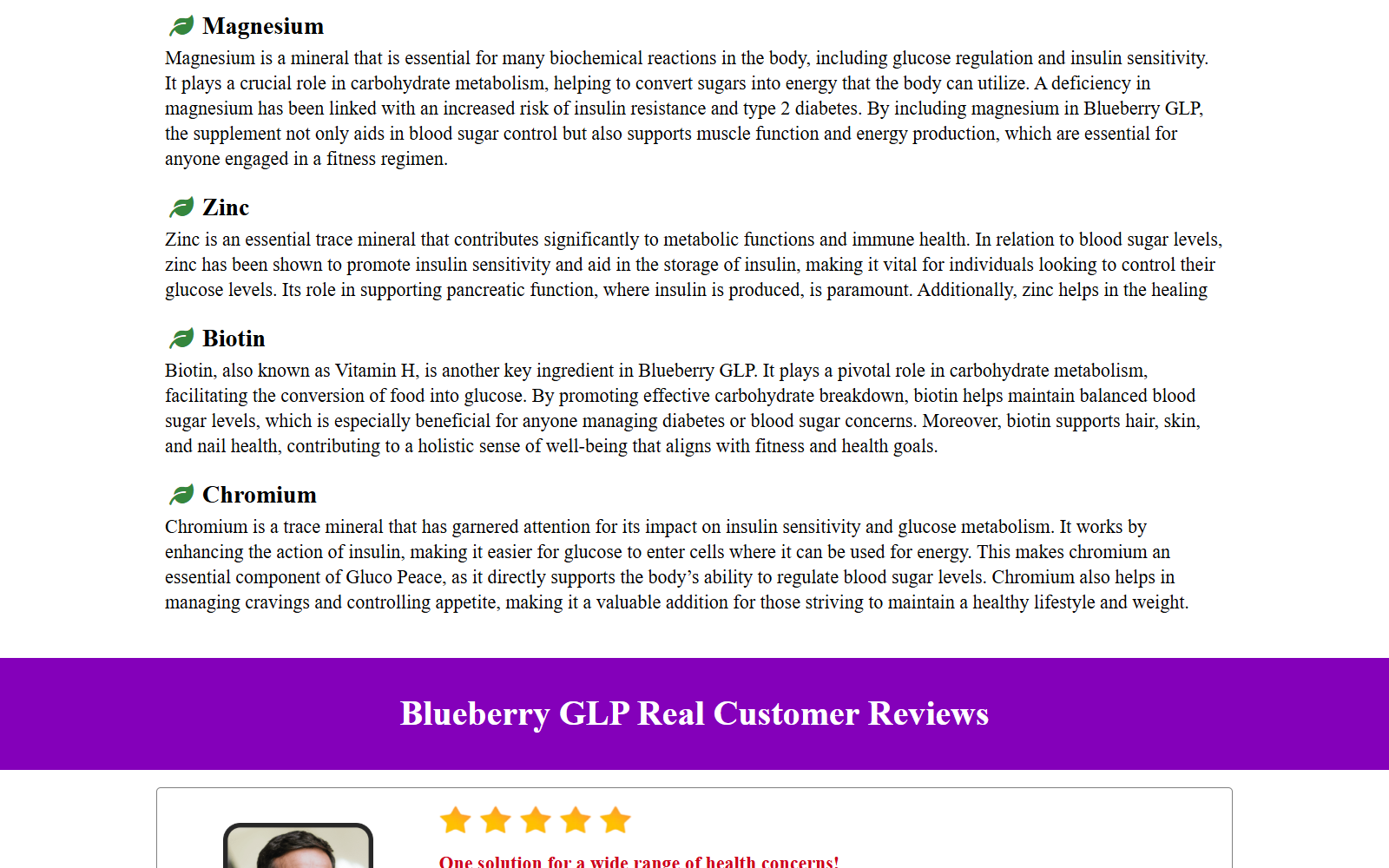
The chromium paragraph even calls the mineral an essential component of “Gluco Peace,” which is another product name.
That copy-paste mistake shows the material was not reviewed carefully enough for a health-sensitive offer.
The page also features a testimonial suggesting someone might lower glucose enough to stop prescription medicine.
Our evidence-based conclusion
Blueberry GLP has severe credibility problems, but its current page says the order does not renew automatically.
- The ingredient narrative changes within one website.
- A paragraph mistakenly names the unrelated Gluco Peace product.
- Sales buttons route through an external promotional domain.
- The page claims 93% of customers choose six bottles.
- Its strongest testimonial discusses potentially stopping prescription medication.
- The displayed $49 price applies to a multi-bottle package.
- The FAQ promises a one-time purchase without surprise charges.
We found enough to reject the sales pitch as unreliable, but not enough to state that every purchase creates an undisclosed refill plan.
The proven issue is a poorly controlled health funnel making consequential claims with contradictory product information.
Is Blueberry GLP Legit or a Scam?
Blueberry GLP is presented as a purchasable supplement, and an order may result in physical capsules arriving.
The central question is whether the delivered product matches a coherent, honestly described formula.
The official page fails that basic test because its upper ingredient discussion and lower FAQ do not describe the same composition.
Copy naming Gluco Peace indicates material was reused from another campaign without adequate editing.
This matters more than a spelling mistake. Formula accuracy influences allergy checks, interaction questions, storage, dosage, and informed consent.
The external order link adds another layer because visitors leave blueberryglp.us before payment.
We therefore consider the offer deceptive and too risky to recommend.
However, the page’s explicit one-time-order statement prevents us from honestly calling it a confirmed autoship operation without contrary billing evidence.
The Formula Contradicts Itself
The first formula centers on common nutrients
The ingredient section discusses vitamin C, vitamin E, magnesium, zinc, biotin, and chromium.
Elsewhere, Cocoa Bean Extract and Bitter Melon Fruit Extract appear as important plant-based components.
This version sounds like a conventional capsule combining micronutrients with botanical extracts.
The FAQ describes a microbiome product
Farther down, the mechanism suddenly depends on inulin, resistant potato starch, Akkermansia muciniphila, Bifidobacterium infantis, and Clostridium butyricum.
That would be a distinctly different prebiotic and probiotic formulation.
The FAQ also says the opened bottle should be refrigerated to preserve probiotic quality, advice absent from the earlier formula discussion.
The Gluco Peace error reveals reused copy
Within the chromium description, Blueberry GLP disappears and “Gluco Peace” takes its place.
This is strong evidence that at least part of the page was copied from sales material for another blood-sugar supplement.
Customers cannot safely infer which wording, label, or product version is authoritative.
The Health Claims Could Influence Medication Decisions
Blueberry GLP positions itself around glucose management, a medical issue that many customers already treat with prescriptions.
Its copy links ingredients to insulin sensitivity, pancreatic function, carbohydrate metabolism, appetite control, hypertension, and weight loss.
The page does not present a controlled trial of the finished formula demonstrating those combined outcomes.
More troublingly, a featured testimonial says glucose fell from above 200 to between 123 and 140.
The same story imagines lowering sugar enough to get off prescription medication.
A disclaimer cannot fully neutralize a prominent narrative encouraging that idea.
Stopping or reducing diabetes medication without clinical supervision can produce dangerous glucose changes.
Anyone considering a supplement should show the physical label to the professional managing their condition.
The Price Presentation Rewards a Large First Order
Blueberry GLP advertises a headline price of $49 per bottle and savings reaching $780.
The page repeatedly emphasizes a 72% discount, a 60-day guarantee, and limited-time availability.
Those numbers make the offer feel exceptional before shoppers can verify a normal market price.
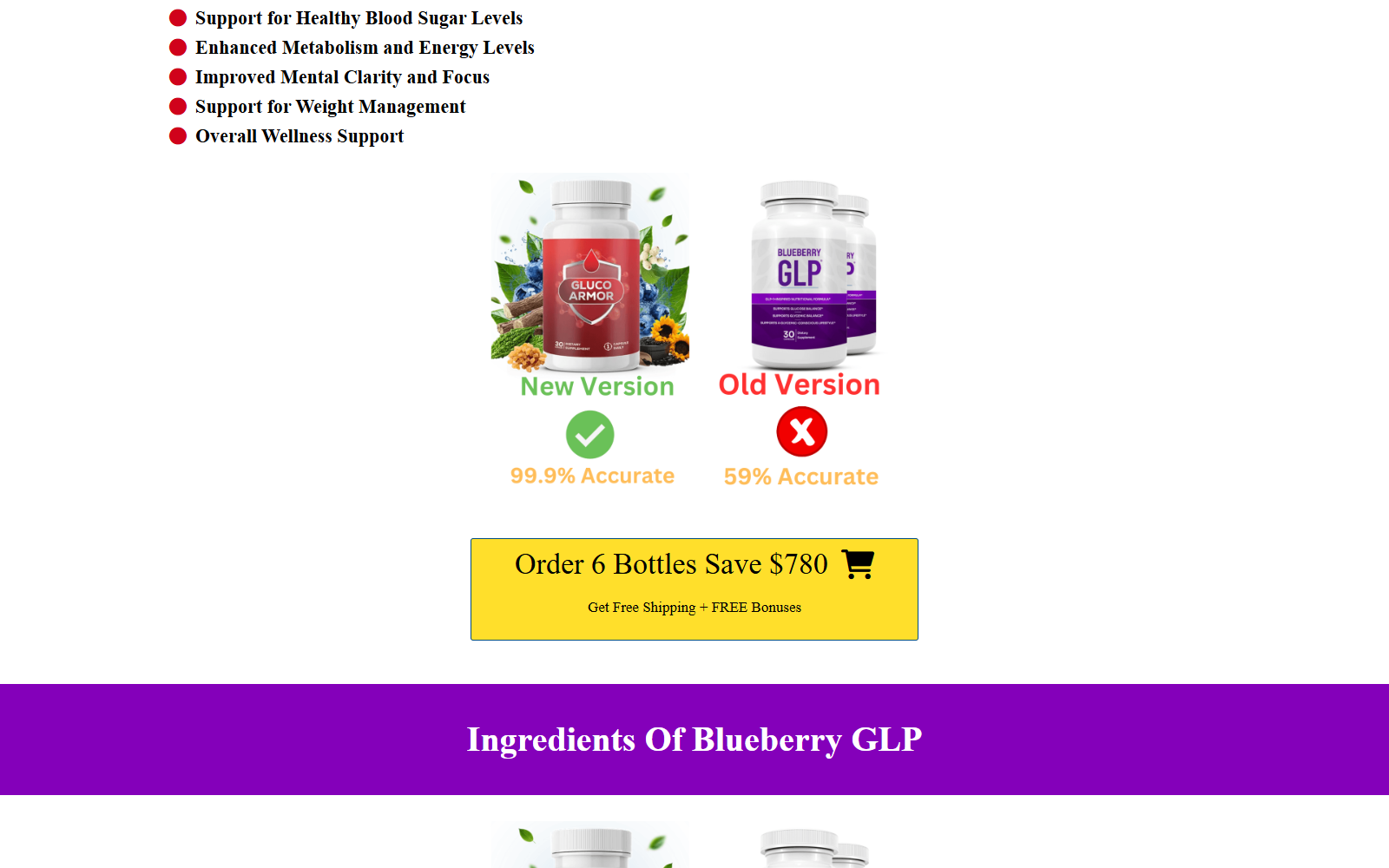
The ordering language says 93% of customers select six bottles, which is the campaign’s preferred package.
A popularity claim can create social pressure, particularly when the site does not reveal how that statistic was calculated.
Buyers must distinguish the unit price from the total card authorization.
A $49 headline can still lead to a multi-bottle charge several times larger.
How the Blueberry GLP Funnel Works
Step 1: The name echoes the GLP-1 conversation
“GLP” immediately reminds many readers of widely discussed prescription weight-loss and diabetes treatments.
The supplement does not need to make an explicit equivalence for that association to shape expectations.
Step 2: Natural ingredients promise an easier path
The page offers plants, vitamins, minerals, fibers, and probiotics as a gentle route to glucose and weight support.
This framing appeals to people worried about medication cost, injections, side effects, or long-term treatment.
Step 3: Disease-adjacent testimonials provide the emotional proof
Customer stories discuss measured glucose, blood pressure, energy, weight, and prescription hopes.
Specific numbers sound persuasive, but seller-selected testimonials cannot establish typical outcomes or medical safety.
Step 4: A steep discount makes delay feel expensive
The visitor sees $49, 72% off, $780 saved, and a limited-time message before understanding the inconsistent formula.
Urgency redirects attention from verification toward preserving a supposed bargain.
Step 5: The preferred package uses social proof
The campaign says 93% choose six bottles and ties that choice to free shipping.
No independent checkout data is offered to confirm the percentage.
Step 6: A third-party path receives the purchase click
Order links pass through an external promotional domain rather than remaining entirely on blueberryglp.us.
The checkout must be reviewed independently for merchant identity, quantity, total, recurring terms, and refund conditions.
Step 7: The FAQ denies hidden renewals
The page states that payment is one-time and has no automatic charges.
Customers should retain that statement because any later debit would require separate, clearly documented consent.
A Copied Product Name Changes the Investigation
Marketing pages sometimes contain harmless typographical errors, but inserting a rival product name is different.
It indicates the writer adapted an existing supplement template and failed to replace every reference.
That finding helps explain why Blueberry GLP appears to possess two incompatible ingredient stories.
One campaign may have borrowed a vitamin-and-mineral article, while another section came from a probiotic GLP-1 pitch.
We cannot determine from the page which bottle formula, if any, matches either narrative.
The only reliable ingredient document would be the legible Supplement Facts panel on the delivered, sealed product.
Even that label does not prove advertised benefits. It only establishes what the manufacturer claims the bottle contains.
Independent testing would be needed to verify identity, strength, contamination, and consistency.
Evidence the Blueberry GLP Seller Should Provide
First, the seller should publish one definitive Supplement Facts panel matching every bottle currently shipped.
Second, it should explain whether the formula contains vitamins and botanicals, probiotics and fibers, or both groups.
Third, any human study should identify participants, comparison methods, dose, duration, measured outcomes, and complete results.
Fourth, the merchant should substantiate the 93% package statistic and clarify whether affiliate purchases were included.
Finally, safety guidance should address medication interactions without relying on a short disclaimer buried beneath promotional testimonials.
None of these requests is excessive for a product marketed around blood glucose.
Company, Address, and Fulfillment Checks
The page identifies a brand more clearly than a business
Blueberry GLP appears throughout the marketing, but the responsible legal entity is not given equal prominence.
Consumers need the company accepting payment, its contact details, jurisdiction, and expected statement descriptor before ordering.
A copyright line alone does not answer those questions.
The click path changes domains
Sales links leave the branded site for an outside marketing or checkout path.
Domain changes can be legitimate, yet they should not obscure who receives money or which terms govern.
Take a fresh screenshot after every redirect because the final merchant may differ from the advertising publisher.
Manufacturing badges require supporting details
The page says the product is manufactured in the United States in an FDA-registered, GMP-certified facility.
It does not prominently identify the facility or connect those claims to a batch certificate.
We found no proof supporting a Chinese-manufacturing allegation, so the documented problem remains unverifiable origin rather than a specific foreign source.
Return logistics may not identify the seller
A warehouse on a return label can merely provide fulfillment for many independent campaigns.
It does not automatically manufacture the capsules, write the advertising, or control refunds.
Ask support to explain each role and provide one accountable company contact before sending a valuable return.
Is Blueberry GLP a Refill Trap?
The available page says no. It describes the transaction as a one-time purchase without renewals or hidden charges.
We found no direct checkout record proving that a recurring option is secretly preselected.
Therefore, labeling every Blueberry GLP order an autoship scam would not be supported by present evidence.
Other billing issues remain plausible and important.
The buyer may mistake a per-bottle figure for the entire charge, authorize more units than intended, or receive an unfamiliar merchant descriptor.
Return conditions may also be stricter than the phrase “no questions asked” suggests.
Monitor the card, but base any dispute on what happened: unauthorized recurrence, excess quantity, non-delivery, mismatch, or broken refund promise.
Warning Signs Before Buying Blueberry GLP
- The product name capitalizes on interest in GLP-1 treatments.
- Two incompatible ingredient systems appear on one page.
- The text mistakenly identifies Gluco Peace as the product.
- Testimonials discuss prescription-level health outcomes.
- The seller presents disease-adjacent claims without product-specific trials.
- The $49 headline does not necessarily equal the final total.
- A 93% popularity claim lacks independent verification.
- Purchase buttons leave the branded domain.
- Corporate and manufacturing identities remain difficult to verify.
No responsible consumer should overlook that collection merely because the page offers a guarantee.
What to Do if You Bought Blueberry GLP
- Do not change medication. Continue prescribed treatment unless the clinician managing your glucose or blood pressure gives different instructions.
- Photograph the delivered label. Capture Supplement Facts, directions, warnings, lot, manufacturer, seal, and expiration information before opening.
- Compare both advertised formulas. Document whether the bottle matches the vitamin section, probiotic FAQ, neither version, or an entirely different composition.
- Preserve the billing promise. Save the one-time-order wording, package total, receipt, redirect chain, refund statement, and card descriptor.
- Contact the merchant in writing. Request cancellation, legal seller details, return authorization, and confirmation that no future debit is scheduled.
- Use traceable returns. Keep photographs and tracking showing exactly what was mailed, where it went, and when delivery occurred.
- Escalate unauthorized transactions. Tell the card issuer whether the problem is recurrence, duplicate billing, wrong quantity, non-delivery, or a missing refund.
- Check for unwanted software. Run Malwarebytes if advertising pages triggered downloads, browser alerts, extensions, or redirects outside the expected checkout.
- Reduce malicious advertisements. AdGuard can block many deceptive ad chains, though financial recovery still requires merchant or bank action.
- Report dangerous medical marketing. Provide exact screenshots to regulators and advertising platforms, especially material encouraging unsupervised prescription changes.
Frequently Asked Questions
Does Blueberry GLP contain vitamins or probiotics?
The website describes both incompatible versions. Only the physical Supplement Facts panel can show what the delivered bottle claims to contain.
Is Blueberry GLP the same as a GLP-1 prescription?
No evidence on the page establishes equivalence to prescription GLP-1 medicines. The similar naming should not guide treatment decisions.
Why does the website mention Gluco Peace?
The chromium paragraph appears to contain copy reused from another product. This error further undermines confidence in the formula description.
Does Blueberry GLP charge monthly?
The current FAQ says the transaction is one-time. Verify the final checkout and retain the statement in case later activity contradicts it.
Can this supplement help me stop diabetes medication?
Do not use a testimonial to make that decision. Only a qualified clinician with appropriate monitoring should adjust diabetes treatment.
What does the 60-day guarantee cover?
The page promises refunds for unused product, but buyers should obtain written details about timing, opened bottles, authorization, shipping, and deductions.
The Bottom Line
Blueberry GLP cannot consistently explain its own formula. The Gluco Peace mistake and conflicting ingredient systems make its health claims fundamentally unreliable.
The reviewed page denies automatic renewal, so that accusation is unproven. Its verified medical, editorial, checkout, and identity problems are already serious enough.
Anyone who ordered should protect their health first, document the bottle and transaction, monitor billing, and demand a written remedy for every mismatch.








