

Search for Prime Age and one page offers a pink Vitamin C serum, while another describes capsules for gut and skin health.
Both look polished enough to be official, which is precisely why the differences deserve careful investigation.
Overview
One name is attached to different product types
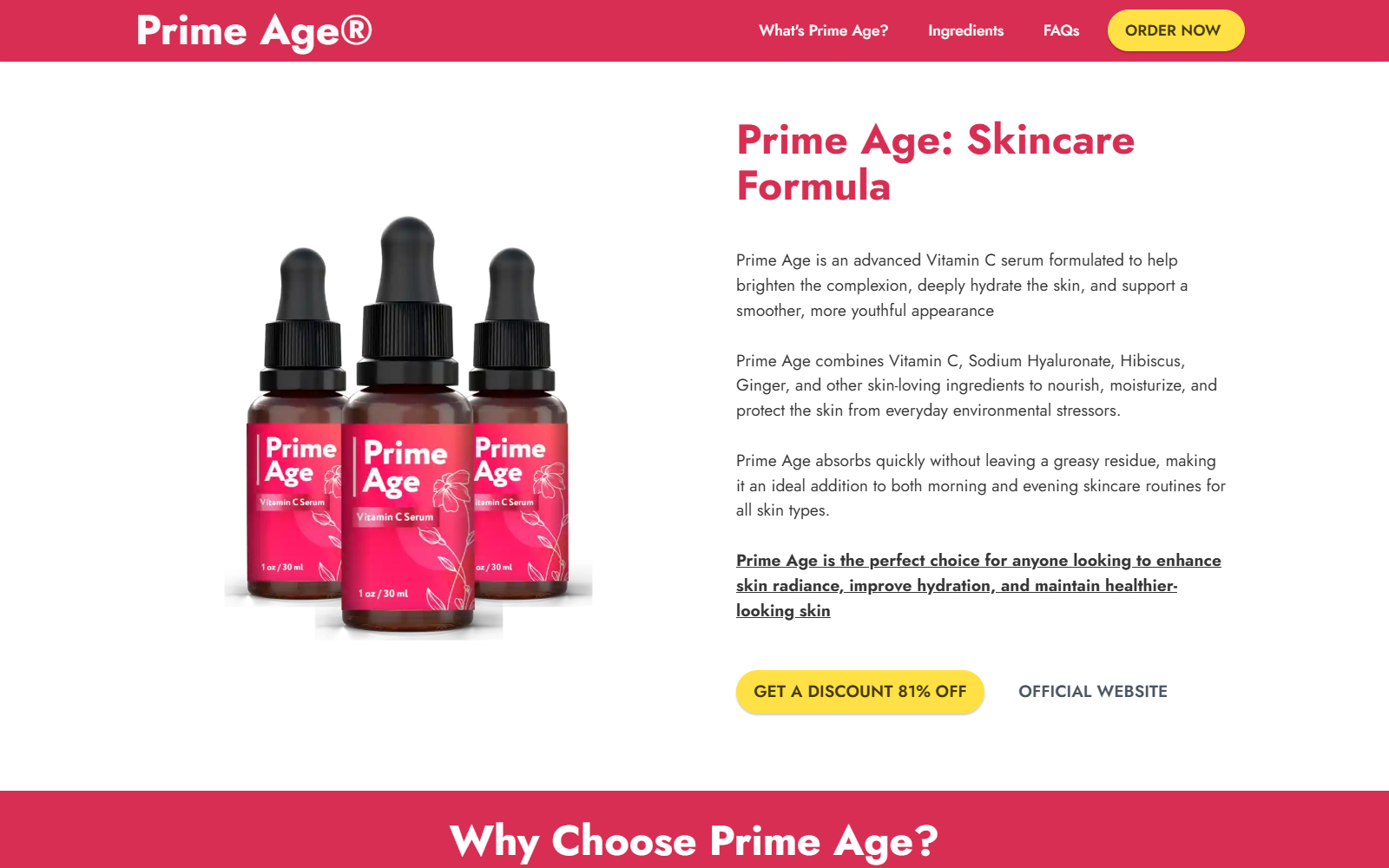
Priimeage.com, spelled with two consecutive “i” characters, sells Prime Age as a topical Vitamin C serum.
Other official-looking domains market Prime Age as an ingestible supplement containing probiotics, minerals, algae, mushroom, ginger, hibiscus, or pink salt.
A serum and a capsule are not packaging variations. They require different directions, warnings, ingredient standards, and safety decisions.
No clear brand history on the reviewed pages explains which version came first or who authorizes these competing presentations.
The serum funnel has its own inconsistencies
The serum page calls Prime Age an “advanced Vitamin C serum” and lists topical ingredients such as sodium hyaluronate and phenoxyethanol.
Elsewhere, the same page refers to a “100% natural supplement,” bottles, packages, and health results in direct-response language.
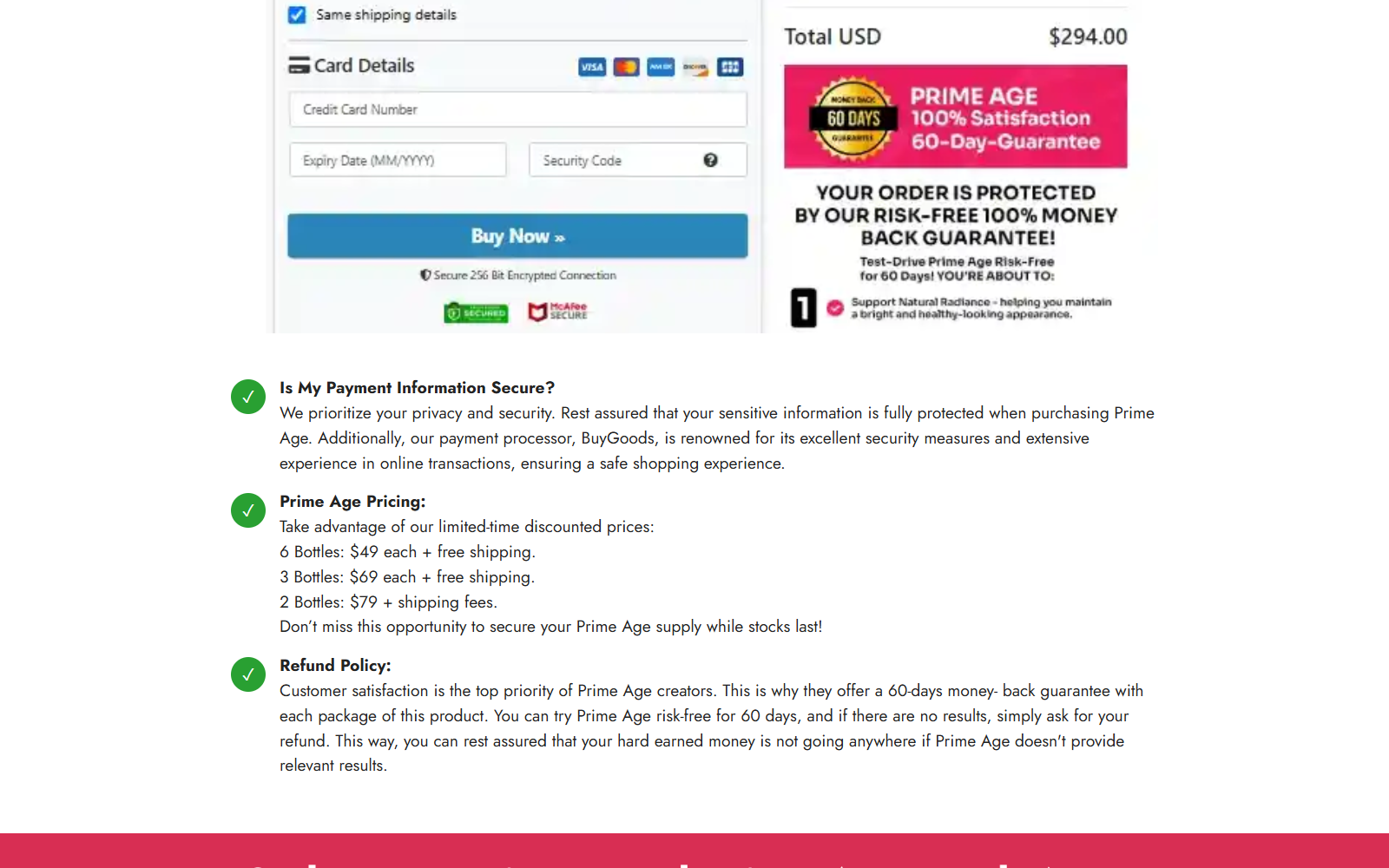
Its pricing uses the familiar two, three, and six-bottle layout, culminating in a $294 order.
That template appears designed for ingestible supplement campaigns even though the pictured Prime Age product is applied to skin.
What our Prime Age investigation established
The brand identity is too fragmented for consumers to know which “official” page or product should be trusted.
- Priimeage.com promotes a topical Vitamin C serum.
- Other Prime Age domains describe an ingestible skin-and-gut formula.
- The capsule ingredients differ across official-looking pages.
- The serum page sells two, three, or six bottles.
- The six-bottle total displayed is $294.
- Some syndicated promotions publish generic shared support details.
- Guarantee wording is not consistent across the wider domain family.
We did not find evidence proving every Prime Age transaction includes automatic refills.
The verified danger is product confusion combined with aggressive multibottle marketing and no obvious central authority.
Is Prime Age Legit or a Scam?
Prime Age is not one clearly defined offer.
The name currently points shoppers toward products that differ in route of use, formula, website, claims, and commercial presentation.
A physical serum may arrive from one page, while another visitor expects capsules intended to influence digestion and skin from within.
That inconsistency prevents a simple legitimacy verdict for the brand as a whole.
It also creates a realistic impersonation risk. A shopper cannot easily distinguish an authorized seller from an affiliate, clone, or unrelated operator.
The topical site provides ingredients and a guarantee, but it still lacks the accountability expected for a $294 package.
We consider the wider Prime Age marketing ecosystem unsafe to navigate and unsuitable for a purchase.
The conclusion rests on demonstrable conflicts, not on an unsupported claim that every bottle is counterfeit or every charge repeats.
The Serum and Supplement Stories Cannot Both Define One Formula
The topical version belongs in a skincare routine
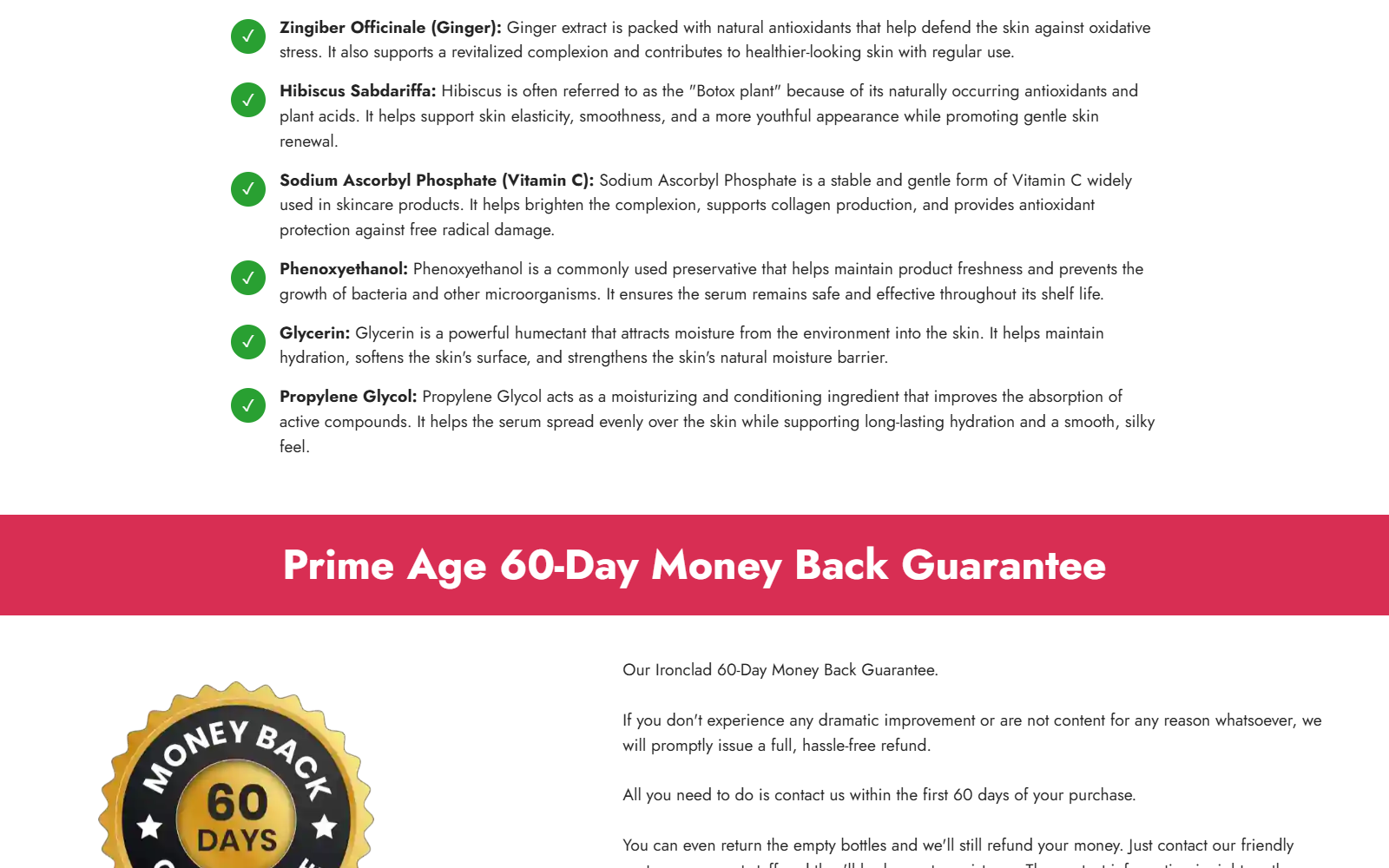
The serum presentation lists Vitamin C, sodium hyaluronate, hibiscus, ginger, phenoxyethanol, glycerin, and propylene glycol.
It says Prime Age absorbs without greasy residue and can be used during morning and evening skincare routines.
Those instructions clearly describe external application.
The capsule version tells an inside-out wellness story
Other pages call Prime Age a gut-and-skin supplement with probiotics, Korean Pink Salt, Egyptian Blue Algae, Okinawan Mushroom, ginger, and hibiscus.
Those ingredients imply swallowing capsules and claim digestive, metabolic, and complexion benefits.
They cannot be reconciled with a topical dropper bottle through ordinary reformulation language.
Brand ambiguity creates a direct safety problem
Instructions for a serum should never be borrowed for capsules, and ingestible dosage advice should never be applied to topical cosmetics.
A customer relying on the wrong webpage could misunderstand use, allergies, storage, interactions, or expected side effects.
The physical label and merchant confirmation become essential, but neither resolves who controls the Prime Age name.
The Pricing Looks Recycled from Supplement Funnels
The reviewed serum page places a dropper bottle into a direct-response package grid.
Six bottles cost $49 each with free shipping, producing a $294 total.
Three bottles are shown at $69 each, while two bottles cost $79 each plus shipping.
Those figures mirror the exact tiering used by numerous unrelated supplement campaigns.
A standard pricing template is not proof of shared ownership, but it suggests the campaign was assembled from reusable sales components.
“81% off,” limited stock, and a 60-day promise make the offer appear urgent and low-risk.
Shoppers should ask whether the regular price is genuine and whether the merchant has a record of honoring opened-product returns.
How the Prime Age Funnel Works
Step 1: The campaign begins with a broad anti-aging desire
Prime Age promises brighter skin, smoother texture, deep hydration, and a more youthful appearance.
Other versions expand the same desire into digestion, metabolism, and internal wellness.
Step 2: Scientific ingredient names create legitimacy
The serum page uses chemical and botanical names associated with familiar skincare formulations.
The capsule pages switch to probiotics, algae, salts, mushrooms, and plant extracts, preserving a scientific tone while changing the product.
Step 3: An “official” label discourages further searching
Several domains use official-style titles, trademarks, and confident brand language.
Because multiple sites make similar claims, the word “official” cannot independently establish authorization.
Step 4: Discount framing pushes a package decision
The serum site highlights 81% off and directs visitors toward two, three, or six bottles.
Per-unit prices make the largest package look economical while requiring the highest immediate payment.
Step 5: The guarantee softens concerns
A 60-day money-back statement suggests the customer can experiment without meaningful risk.
Real protection depends on deadlines, authorization, opened-container rules, return postage, and the merchant’s responsiveness.
Step 6: Search results scatter support across domains
After ordering, a consumer searching the brand may encounter the wrong formula or an unrelated support channel.
This fragmentation can derail cancellations, return requests, and safety questions.
Step 7: Billing must be judged by the final checkout
The visible funnel emphasizes packages, but recurring terms are not clearly established across every Prime Age version.
Only the final authorization can show whether a particular order is one-time, subscription-based, or accompanied by optional continuity terms.
“Official Website” Is Not Evidence of Ownership
Search engines can display any page whose creator places “official” in a title.
The word does not prove trademark ownership, manufacturing control, regulatory status, or a relationship with other same-name domains.
Prime Age illustrates the problem unusually well.
One page is titled as the official website for an advanced Vitamin C serum.
Other pages make the same official-style claim for a capsule supporting gut balance and skin appearance.
Some reproduce nearly identical formula descriptions across different domains, which may indicate affiliate syndication or copied campaigns.
Consumers should look for a consistent legal entity, registered mark, policy owner, support domain, and checkout merchant.
Prime Age does not currently present those signals in a unified, easily verifiable way.
How to Identify the Exact Prime Age Offer
Start with the full domain, including its spelling. Priimeage.com contains two consecutive “i” characters, a detail easily overlooked in advertisements.
Next, record whether the pictured container has a dropper, capsule count, gummy count, or another dosage form.
Read the directions. Words such as apply, massage, or avoid eyes indicate a topical cosmetic rather than a swallowed supplement.
Compare the ingredient panel with the marketing. A serum label should not be explained through probiotic or mineral capsule claims.
Identify the merchant on the payment page and note whether that name appears anywhere in the privacy and refund documents.
Search the support number and email carefully, but do not assume matching search results belong to the same operator.
Check the package total. The emphasized unit figure may represent one item inside a larger prepaid bundle.
Save the guarantee version shown during checkout because another Prime Age site may publish different conditions.
Finally, photograph what arrives before opening it. The package should match the ordered route, quantity, ingredients, and seller information.
Any mismatch should pause use and trigger a documented request for clarification or return authorization.
That simple checklist also prevents support staff from redirecting the customer between unrelated websites.
Could Prime Age Involve Automatic Refills?
We found discussion online describing Prime Age as a possible subscription-style offer, but public claims alone are not transaction evidence.
The reviewed serum page focuses on prepaid packages and does not clearly demonstrate a mandatory monthly renewal.
Therefore, this article does not state that all Prime Age buyers are enrolled automatically.
The initial order still presents billing risks.
A visitor may read $49 as the transaction price when it is actually the per-unit amount within a six-bottle package.
Different sites may also use different merchants, descriptors, policies, and checkout defaults.
Take screenshots immediately before submitting payment and inspect the authorization line for recurring frequency or future shipment language.
If the merchant cannot explain the product type and billing schedule, do not complete the order.
Company, Address, and Fulfillment Checks
No central company clearly controls every Prime Age version
The pages share a product name but do not consistently identify one accountable owner.
A legitimate licensing network could explain multiple sellers, yet the customer-facing material does not provide that explanation.
Without it, consumers cannot know which operator is responsible for a particular promise.
Support details appear generic or inconsistent
Syndicated Prime Age promotions list shared supplement-support emails and different telephone numbers.
A generic service address may handle legitimate campaigns, but it does not prove ownership of the brand.
Buyers should test the exact contact shown at checkout before authorizing a large package.
Published addresses may represent return logistics
One promotion identifies a return location in Largo, Florida.
That may be a fulfillment facility rather than a headquarters, laboratory, or manufacturer.
An address receiving parcels does not validate ingredient claims or establish who wrote the advertisements.
Origin claims remain unverified
We found no reliable proof that either Prime Age version is mass-produced in China.
The legitimate question is why named manufacturing, lot-level testing, and seller relationships are not easy to verify.
Criticism should focus on those documented gaps rather than assigning a country without evidence.
Warning Signs Before Buying Prime Age
- The same brand name describes both topical serum and ingestible capsules.
- Several websites call themselves official.
- Ingredient lists differ materially across the domain family.
- The serum page occasionally uses supplement-style wording.
- Pricing follows a widely reused 2/3/6-bottle template.
- The largest visible commitment reaches $294.
- Guarantee and support details vary among promotions.
- A return address may belong only to a logistics provider.
- No single brand authority resolves the conflicting presentations.
This pattern makes accidental purchase from the wrong Prime Age campaign far too easy.
What to Do if You Bought Prime Age
- Identify what you ordered. Determine whether the receipt promises serum, capsules, or another form, then compare it with the delivered package.
- Preserve the exact domain. Save the address, title, formula, package selection, checkout, guarantee, confirmation, and payment descriptor.
- Do not use a mismatched product. If route, ingredients, or directions differ, keep it sealed and request written clarification.
- Contact the merchant on the receipt. Avoid unrelated Prime Age sites. Ask the charging company for cancellation and return instructions.
- Confirm future billing. Require a written statement explaining whether the order is one-time and whether additional shipments are scheduled.
- Document the return. Photograph contents and packaging, obtain authorization, use tracking, and retain delivery confirmation.
- Use card protections when necessary. Dispute unauthorized recurrence, wrong quantity, materially different goods, non-delivery, or an unissued promised refund.
- Inspect your device. Run Malwarebytes if the advertising chain initiated suspicious downloads, notification prompts, or unexpected browser changes.
- Block deceptive ad chains. AdGuard can reduce exposure to malicious redirects, but order cancellation still requires direct financial action.
- Report the specific operator. Give authorities the exact domain, merchant descriptor, amount, and product form instead of reporting the ambiguous name alone.
Frequently Asked Questions
Is Prime Age a serum or a supplement?
Both versions are promoted on official-looking sites. Priimeage.com shows a topical serum, while other domains describe ingestible gut-and-skin capsules.
Are the Prime Age websites operated by one company?
We could not verify a single entity controlling every version. Do not assume matching names establish common ownership.
Why does the serum page sell six bottles?
The site uses a direct-response package template with lower per-unit pricing for larger quantities. Six units produce the displayed $294 total.
Does Prime Age include automatic shipments?
We did not confirm a universal autoship condition. Inspect the specific checkout and ask the named merchant to confirm billing frequency in writing.
Can the 60-day guarantee be trusted?
It is only as useful as its written conditions and merchant response. Verify deadlines, opened-product eligibility, postage, authorization, and deductions before buying.
Is Prime Age manufactured in China?
We found no reliable evidence proving that claim. The defensible concern is the absence of clear, consistent, verifiable manufacturing information.
The Bottom Line
Prime Age has a basic identity failure. Shoppers encounter the same name on incompatible topical and ingestible products presented as official.
Automatic refills are not established for every offer, but formula confusion, domain proliferation, generic support, and aggressive bundles make the ecosystem unsafe.
A responsible buyer should avoid Prime Age until one verifiable company explains every authorized product, website, checkout, manufacturer, and return policy.








