

Cartivex arrives with polished green graphics, confident medical language, and a promise that sore joints can feel young again.
Before ordering a six-month supply, however, buyers should look beyond the bottle and examine the unusual details surrounding this offer.
Overview
What Cartivex is supposed to do
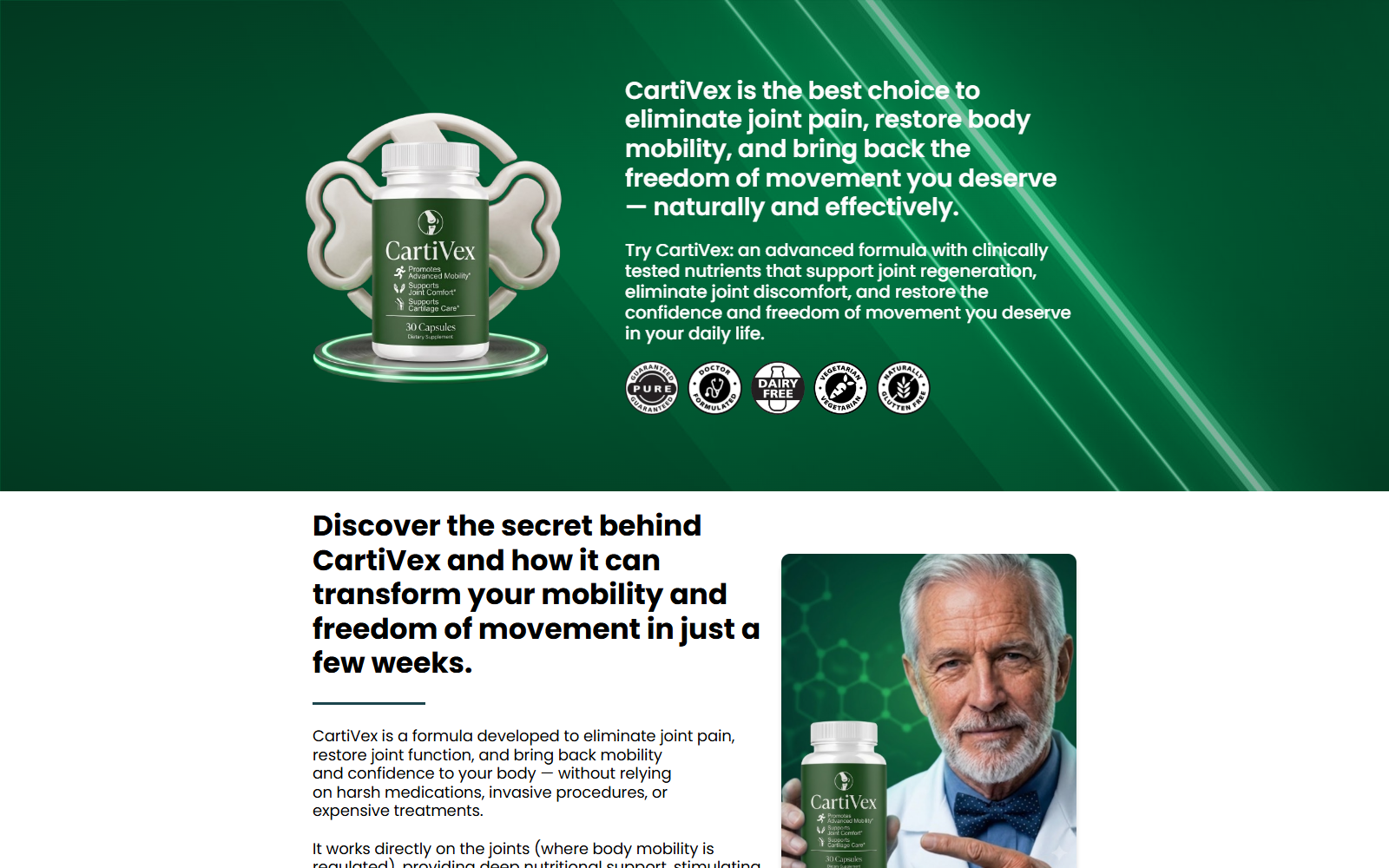
Cartivex is marketed as a joint-support supplement containing turmeric extracts, Coleus forskohlii, and BioPerine black pepper extract.
The page says this combination reduces inflammation, protects cartilage, restores mobility, and addresses the root causes of joint discomfort.
Those are broad promises for a dietary supplement, especially because the page repeatedly uses treatment-like language rather than modest nutritional support wording.
No product-specific clinical trial is presented proving that the finished Cartivex formula regenerates cartilage or eliminates persistent joint pain.
Why the offer deserves closer scrutiny
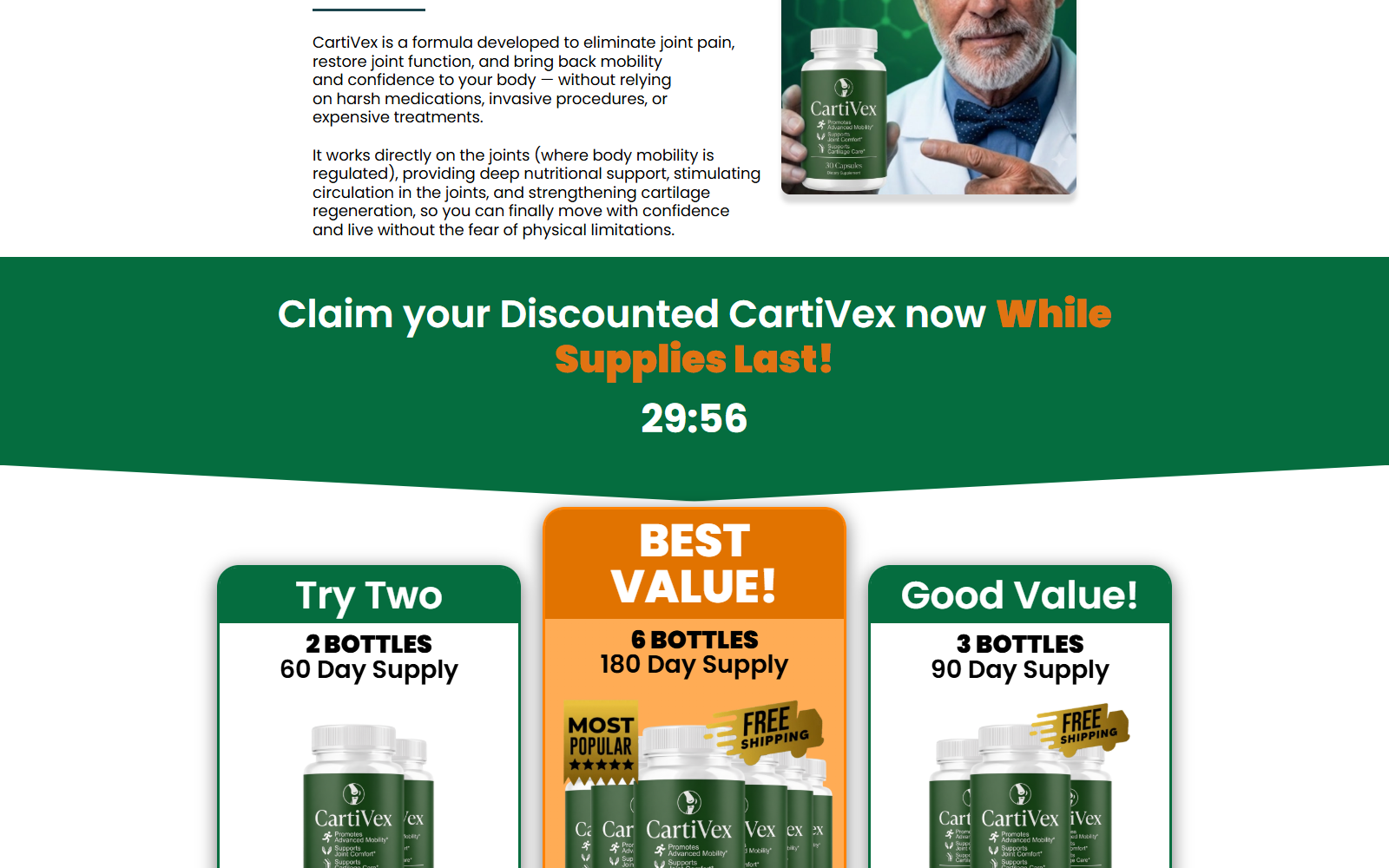
The sales page pushes bundles costing $158, $207, or $294 while a countdown and low-stock warnings encourage a quick decision.
It also says 97% of customers choose six bottles and displays a claimed total of 21,469 reviews.
Those impressive figures appear inside seller-controlled marketing. The page does not provide an independent platform where readers can verify the underlying reviews.
The product imagery is polished, but an image filename visible in the page code includes “Gemini_Generated_Image,” a sign that generative tools helped create assets.
What our Cartivex investigation found
The current evidence raises serious transparency concerns, but it does not prove every Cartivex order becomes an automatic subscription.
- The reviewed page explicitly describes the purchase as a one-time order.
- Its visible order buttons did not contain ordinary destination links when inspected.
- The site name in technical metadata is the generic “My Cart.”
- Its page language alternates between joint, nerve, brain, and blood-pressure themes.
- A separate same-name store has policies discussing installations, cartons, finishes, and projects.
- That separate store publishes a malformed contact address containing two email domains.
- The six-bottle package requires a $294 commitment before any personal experience exists.
These findings make Cartivex a high-risk purchase even without claiming a hidden refill plan that the reviewed page specifically denies.
The clearest concern is a sales system built to maximize the first transaction while leaving basic seller accountability difficult to verify.
Is Cartivex Legit or a Scam?
We could not verify enough reliable business information to recommend Cartivex as a trustworthy joint supplement.
The landing page may deliver a physical bottle, yet delivery alone would not validate its health claims, testimonials, discounts, or corporate presentation.
Calling every purchase an automatic-refill scam would overstate the available evidence. The FAQ says there are no renewals, hidden fees, or surprise charges.
That statement should be preserved before payment because it becomes useful evidence if a later charge contradicts the advertised terms.
The offer still resembles a disposable direct-response funnel: dramatic promises, seller-controlled proof, large bundles, urgency, and limited verifiable identity.
Our conclusion is straightforward. Cartivex presents enough material inconsistencies that buyers should avoid ordering until the seller provides independently checkable answers.
The Medical Claims Go Far Beyond Ordinary Joint Support
“Regeneration” is a powerful word
Cartilage regeneration is not a casual wellness benefit. It describes a biological outcome that requires strong product-specific evidence.
The page does not show a controlled human trial using the exact Cartivex formula at the advertised daily dose.
Research involving turmeric or another individual ingredient cannot automatically prove that this particular blend repairs damaged joints.
Formulation, dose, purity, absorption, participant selection, and study design all affect whether a result applies to a commercial bottle.
Symptom relief is presented like a predictable result
The copy tells readers they can eliminate stiffness, swelling, tenderness, and persistent discomfort while regaining confidence in movement.
Real joint pain can arise from arthritis, injury, infection, gout, nerve problems, or conditions requiring prompt medical assessment.
A supplement page cannot determine the cause. Delaying evaluation because an advertisement promises a natural fix may worsen an untreated problem.
Testimonials are not independent clinical evidence
The featured stories describe striking improvements within weeks and attach names, ages, locations, star ratings, and “verified purchase” labels.
Those design elements create credibility, but the page offers no transparent review system showing purchase records, moderation rules, or unfavorable feedback.
Even a genuine personal story cannot predict another person’s result. Testimonials are selected narratives, not a substitute for rigorous testing.
The Cartivex Pricing Funnel
Cartivex does not lead with a small trial bottle. Its first visible options begin at two bottles for $158 plus shipping.
The middle package costs $294 for six bottles and is labeled “best value,” “most popular,” and the largest discount.
A three-bottle alternative costs $207. This layout makes the largest purchase appear financially sensible beside deliberately expensive smaller packages.
The alleged regular totals, including $1,074 for six bottles, create enormous savings on paper.
Yet a crossed-out price is not evidence that ordinary customers regularly paid that amount for the same product.
Consumers should judge the actual checkout total, not the difference between a sales price and an unverified reference price.
How the Cartivex Sales Funnel Works
Step 1: An emotional promise meets a familiar health problem
The funnel begins with ordinary fears: painful stairs, stiff mornings, reduced independence, and missing activities with family.
It then frames Cartivex as a direct answer, using confident language before the visitor has seen a complete evidence package.
Step 2: Scientific vocabulary gives the pitch authority
Ingredient names, absorption language, inflammation pathways, and references make the presentation feel research-driven.
However, the critical question is whether the finished formula produced the promised outcomes in a transparent human study.
Step 3: Dramatic stories reduce hesitation
Customers are shown people who supposedly returned to gardening, walking, holding cups, and playing with grandchildren.
The stories answer emotional objections, but their placement and verification remain controlled entirely by the seller.
Step 4: Bonuses make a bottle bundle feel larger
Digital guides cover nerve recovery, vitamins, nighttime habits, and personalized routines.
One bonus even mentions high blood pressure and blurred vision, concerns that should not be handled through a generic download.
Step 5: Anchoring makes six bottles look economical
The shopper sees large crossed-out totals beside lower package prices and a prominent “best value” label.
This comparison encourages evaluation against the seller’s anchor rather than competing products, medical evidence, or a modest first purchase.
Step 6: Urgency pressures the visitor toward checkout
Countdowns, “last chance” language, and stock warnings imply that pausing may mean losing the offer.
A legitimate purchasing decision should survive enough time to read policies, contact support, and discuss ingredients with a clinician.
Step 7: The written one-time claim becomes crucial
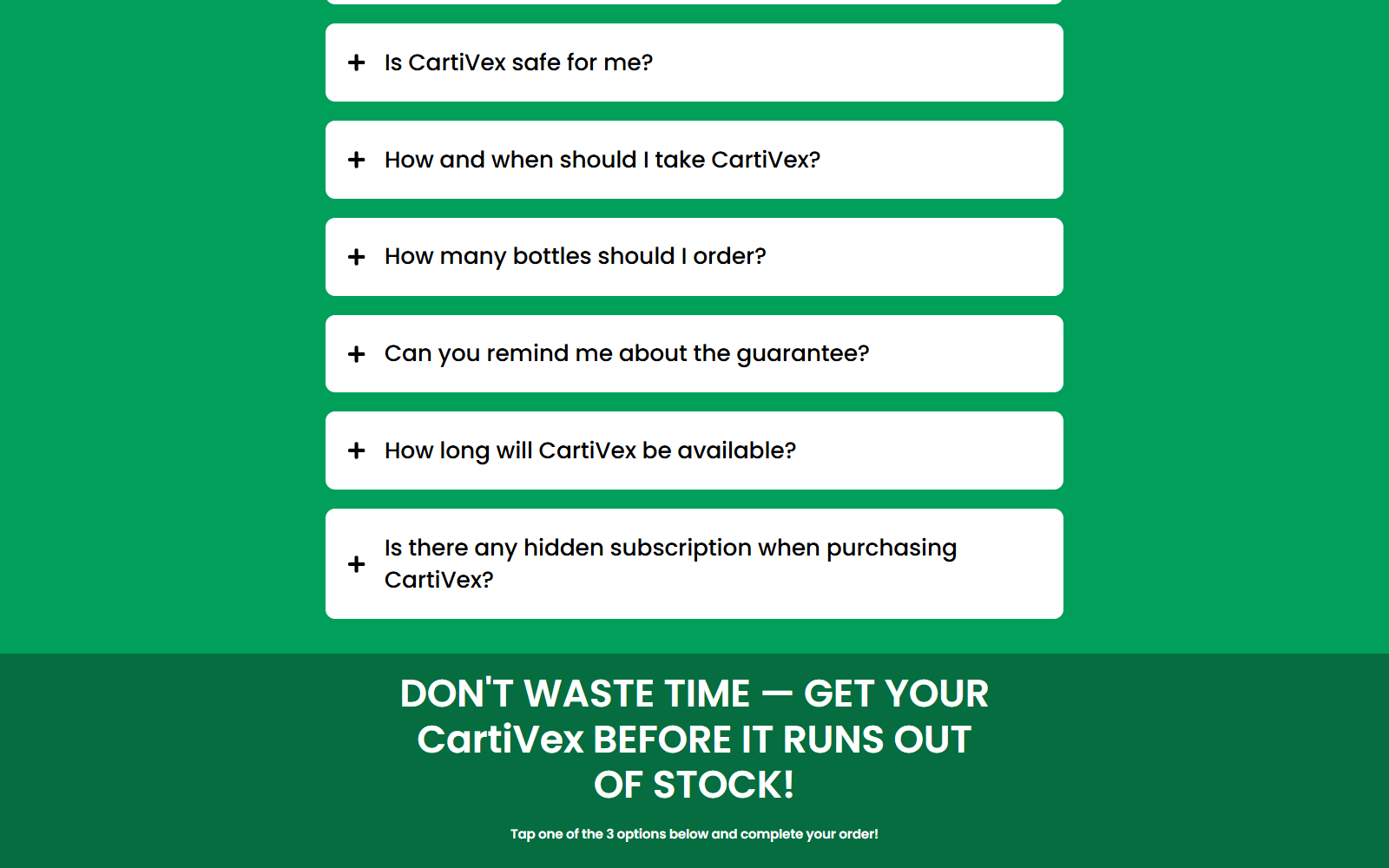
The FAQ says Cartivex is a one-time purchase without automatic renewals.
Save that statement, the selected quantity, and the final total because they define what the customer reasonably agreed to buy.
The “Official” Page Has Unusual Technical and Editorial Errors
The site title shown to browsers is “Home – My Cart,” not a polished Cartivex corporate identity.
Its technical metadata also uses a Portuguese-Brazil locale despite a sales pitch aimed at United States shoppers.
Neither detail proves fraud. Together, they suggest a quickly assembled template rather than a mature health brand.
Some copy drifts into unrelated territory, including peripheral nerves, brain protection, blood pressure, and blurred vision.
That topic switching looks less like a carefully reviewed joint formula and more like material reused from other supplement campaigns.
The visible “ADD TO CART” elements lacked normal destination links during our inspection.
A broken button might be a temporary coding mistake, but it prevents buyers from checking the actual merchant before committing.
Never assume the brand on a landing page is the legal entity appearing on a receipt or card statement.
Company, Address, and Fulfillment Checks
The landing page does not clearly identify the contracting seller
A product name, copyright line, and support email are not the same as a verifiable legal company.
Buyers should see the entity accepting payment, its jurisdiction, physical contact details, and the name expected on the card statement.
Cartivex does not present those facts with the clarity expected before a $294 health-product order.
A separate Cartivex-branded store creates more confusion
Another website using the Cartivex name lists an address in Flint, Texas and a telephone number.
We cannot establish that this separate store operates the supplement funnel, so it should not be treated as the same legal seller.
Its existence nevertheless makes identity checks harder because a search can lead consumers to unrelated or inconsistently branded pages.
The policy text looks copied from another type of business
Pages on that separate store discuss installations, project conditions, cartons, colors, finishes, and restocking charges.
Those subjects make little sense for a bottle of joint capsules and indicate recycled terms that were not carefully adapted.
One contact string appears as “info@support@cartivexbrand.com,” which is not a valid ordinary email address.
A return address would not prove manufacturing origin
A warehouse can receive packages for many unrelated brands while knowing nothing about formulation or advertising.
We found no reliable evidence proving Cartivex is manufactured in China, so that claim should not be made as fact.
What remains missing is independently verifiable manufacturing identity, lot documentation, and a clear relationship among marketer, merchant, and fulfillment provider.
Could Cartivex Become a Refill or Billing Problem?
The current page says no hidden subscription exists. That wording weighs against declaring the offer an established autoship plan.
Still, direct-response buyers should monitor statements because billing problems can involve quantity disputes, duplicated orders, or a descriptor they do not recognize.
The most immediate Cartivex risk is the large initial bundle. A shopper expecting one bottle may misunderstand a package card showing per-bottle pricing.
Always read the final quantity and total. A highlighted “$49” can describe each bottle while the card receives a $294 charge.
Do not rely on a screenshot of the sales panel alone. Preserve the checkout confirmation and every policy visible when payment occurs.
If any later recurring debit appears, dispute it using the seller’s own one-time-order promise and the absence of consent for renewals.
Warning Signs to Check Before Ordering Cartivex
- The page uses “eliminate” and “regeneration” language without showing product-specific trials.
- Large packages are emphasized before a simple one-bottle evaluation.
- Seller-controlled testimonials are presented as verified without an independent review trail.
- A claimed 21,469-review total cannot be audited through the page.
- Countdown and scarcity messages pressure visitors to decide quickly.
- Generic site metadata weakens the appearance of an established brand operation.
- Visible buttons did not expose a standard checkout destination during inspection.
- Related search results may lead to unrelated Cartivex-branded policy pages.
One warning can have an innocent explanation. The combined pattern is what makes the offer unsuitable for an impulsive purchase.
What to Do if You Bought Cartivex
- Save the complete order record. Keep the confirmation, quantity, final total, product page, one-time-payment statement, guarantee, emails, and card descriptor.
- Check exactly what was charged. Compare the authorized amount with the settled transaction and inspect pending duplicates after several business days.
- Ask the merchant for written clarification. Request the legal seller name, shipment status, cancellation terms, return address, and confirmation that no recurring plan exists.
- Do not refuse delivery without instructions. Some merchants require a return authorization. Obtain the procedure in writing before mailing or rejecting anything.
- Track every returned package. Photograph the contents, label, and sealed bottles. Use a service providing delivery confirmation and retain the receipt.
- Contact the card issuer promptly. Explain any unauthorized amount, extra quantity, nonexistent refund, or recurring charge using precise dates and documents.
- Discuss health concerns with a professional. Stop using the product and seek medical guidance if symptoms appear or prescribed treatment was changed.
- Secure the device used for payment. Run Malwarebytes if the funnel prompted downloads, notifications, or unusual browser behavior. Remove anything it flags.
- Reduce aggressive advertising. AdGuard can block many intrusive ads and malicious redirects, but it cannot cancel orders or reverse a card transaction.
- Report demonstrably deceptive conduct. Send accurate records to consumer-protection authorities and the advertising platform, avoiding claims you cannot document.
Frequently Asked Questions
Is Cartivex proven to regenerate cartilage?
We found no transparent product-specific clinical trial demonstrating that the finished Cartivex formula regenerates cartilage in customers.
Does Cartivex enroll buyers in automatic refills?
The reviewed sales page says the order is one-time and has no automatic renewals. Save that statement and monitor subsequent card activity.
Why can a $49 offer result in a $294 charge?
The $49 figure is presented as a per-bottle price inside the six-bottle package. The package total shown is $294.
Are the Cartivex customer reviews independently verified?
The testimonials and review count appear on seller-controlled pages. We did not find a transparent independent verification trail for the displayed total.
Is cartivexbrand.com the company selling the supplement?
We could not confirm that relationship. Its unrelated policy language means consumers should not assume two same-name domains share one legal operator.
Should I replace arthritis treatment with Cartivex?
No. Do not stop prescribed treatment because of a sales page. Ask a qualified clinician about persistent pain and possible ingredient interactions.
The Bottom Line
Cartivex combines ambitious medical promises with oversized bundles, unverifiable social proof, hurried sales tactics, and unclear seller accountability. Those problems justify avoiding the offer.
The page denies automatic renewals, so a refill scam is not established. The documented concern is a high-pressure $158 to $294 funnel with too many unanswered questions.
Consumers who already ordered should preserve the one-time-payment promise, monitor billing, follow written return instructions, and challenge any charge that exceeds their authorization.








