

A caller says your identity is tied to a federal crime. They know enough about you to sound convincing, warn that local police cannot be trusted, and offer one narrow way to avoid arrest: withdraw cash and hand it to a government courier.
That story recently appeared in a Brighton, New York criminal impersonation case. It is a particularly dangerous form of government impersonation because the conversation does not end with a suspicious link. It can end with a stranger arriving to collect a victim’s savings.
Overview
The scam turns a frightening accusation into a cash emergency
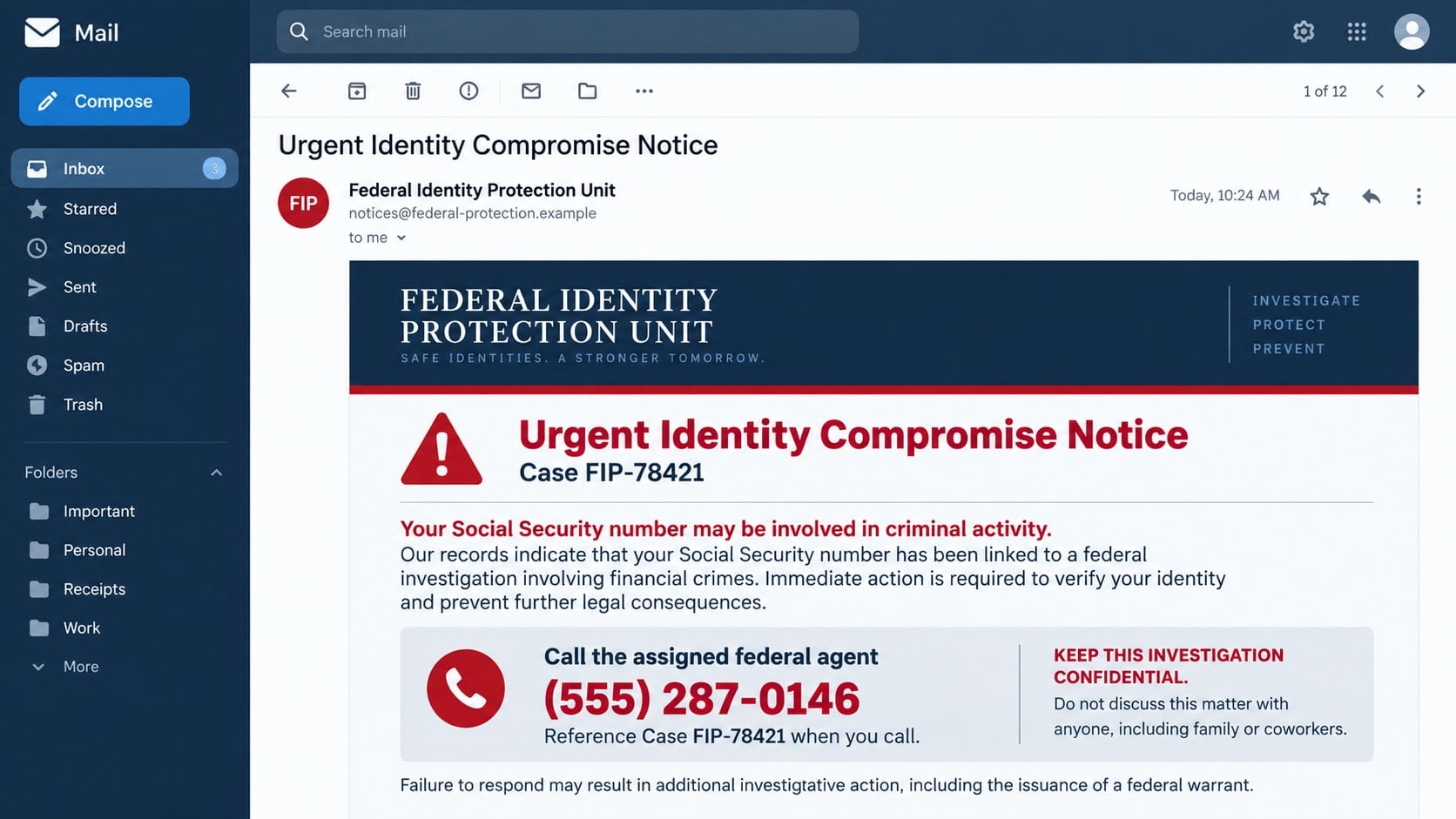
The Brighton Police scam is a government impersonation scheme in which criminals pose as federal agents, law-enforcement officers, or investigators. They claim the target’s Social Security number, bank account, or identity is connected to criminal activity.
The purpose is not to help the target clear their name. It is to frighten them into withdrawing money, buying gift cards, transferring funds, or surrendering cash to a supposed government representative.
A real Brighton case involved an in-person cash handoff
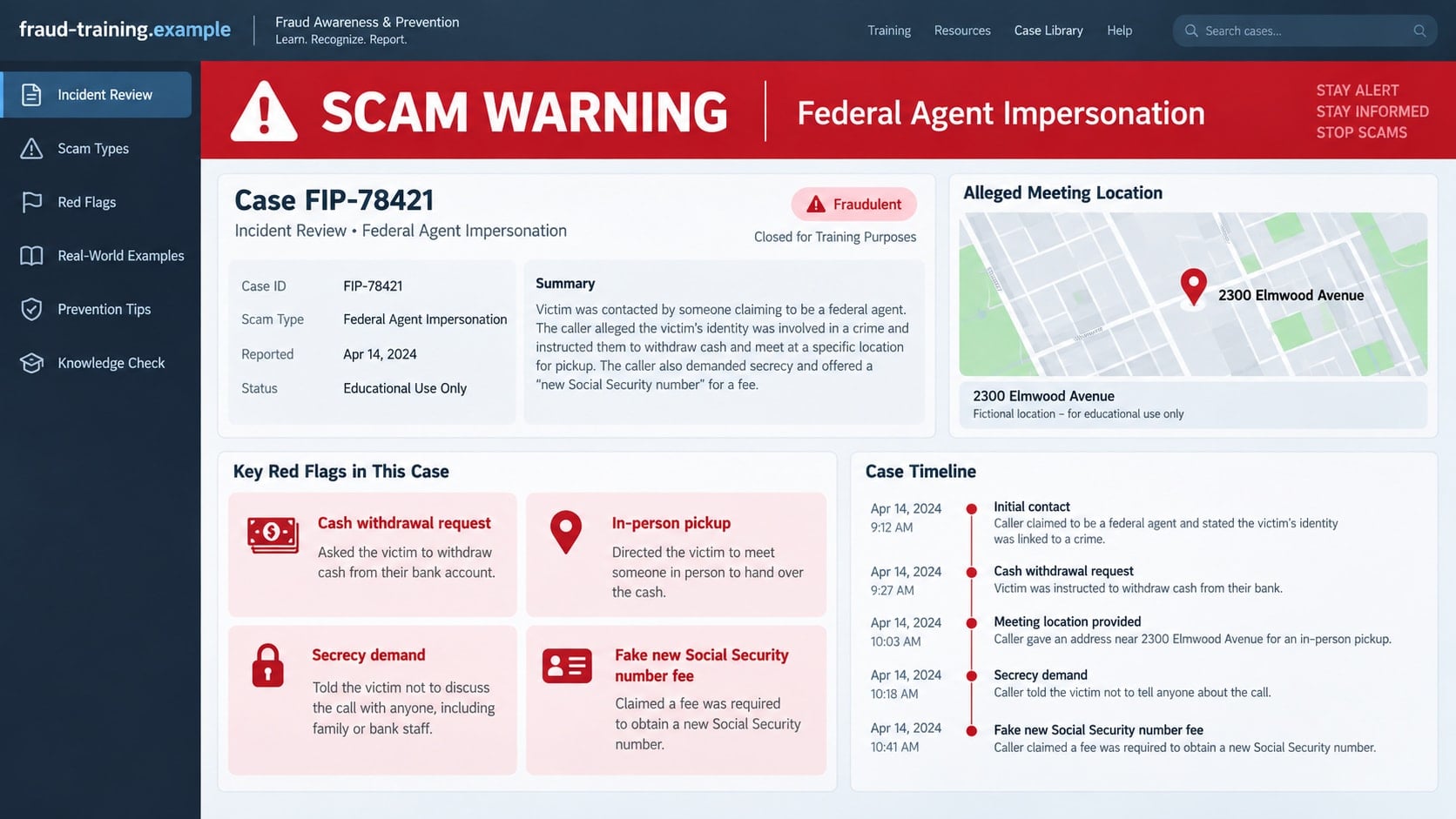
According to a Brighton Police Department incident notice, a victim was contacted by someone pretending to be a federal agent. The caller claimed the victim’s identity was compromised and instructed the victim to withdraw funds and meet another person who would exchange the money for a new Social Security number.
The reported handoff occurred near 2300 Elmwood Avenue in Rochester, New York, on September 17, 2026. That address and date describe the reported incident, not a legitimate payment location or government procedure.
Government agencies do not replace Social Security numbers for cash
The Social Security Administration warns that scammers impersonate officials, spoof phone numbers, threaten arrest, and demand unusual payments. A real agency does not send a courier to collect cash, ask you to hide a payment, or sell a replacement Social Security number.
- The contact is unexpected and describes a serious crime or identity emergency.
- The caller demands secrecy and discourages independent verification.
- You are told to withdraw cash or move money immediately.
- A second person may arrive to collect the funds.
- The payment is renamed as safekeeping, verification, evidence, or protection.
- Threats of arrest or account seizure continue if you hesitate.
Why the Story Feels Believable
Government impersonation scams use authority and fear together. Most people have never spoken with a federal investigator, so they may not know how a genuine inquiry begins. A confident caller can fill that gap with an invented procedure.
The criminal may provide a badge number, case number, supervisor name, office address, or supposed warrant. None of these details proves identity. Numbers can be invented, names can be copied from public directories, and caller ID can be manipulated.
Personal information makes the performance stronger. Data breaches, public records, social profiles, and commercial databases may reveal a person’s name, address, age, relatives, or financial institution. Repeating accurate information does not mean the caller has access to a government case.
The scam also creates isolation. Targets may be told that bank employees are involved, relatives could become suspects, or discussing the matter will violate a federal order. Once ordinary sources of advice are framed as dangerous, the scammer becomes the only voice in the room.
How the Brighton Police Scam Works
Step 1: An unexpected call introduces a serious identity problem
The first caller may claim to represent the Social Security Administration, a federal law-enforcement agency, a court, or a local police department. They say your identity was found in a criminal investigation, used to open fraudulent accounts, or connected to money laundering and drug trafficking.
The accusation is intentionally alarming. The target is given little time to think before the caller begins describing consequences such as arrest, frozen accounts, or the permanent loss of funds.
Step 2: Official-sounding details turn the lie into a case
The caller assigns a case number and may transfer the conversation to a supposed senior agent. They can send a fake badge image, warrant, identity card, or email that uses government seals and legal language.
A document is still not verification. Official logos are easy to copy, and an email display name can be changed. Real investigators do not prove their identity by sending an image and then demanding money.
Step 3: Secrecy removes family, bank staff, and police from the decision
The target may be instructed to keep the phone connected, avoid telling anyone, and provide a cover story at the bank. The scammer may claim that a teller is under investigation or that warning a relative would interfere with the case.
These instructions are not security procedures. They are a way to prevent another person from recognizing the scam before money leaves the victim’s control.
Step 4: The victim is told to convert savings into cash
The caller explains that money in the victim’s accounts is at risk and must be protected, documented, or transferred into government custody. The requested amount may begin small and increase after the caller learns what funds are available.
Cash is attractive to criminals because it can be handed over without a bank-transfer trail or automatic fraud warning. The victim may be told to withdraw funds from more than one branch to avoid questions.
Step 5: A courier or second suspect completes the handoff
The caller chooses a parking lot, public building, residence, or curbside location. A second person arrives and may use a password, case code, or identifying phrase supplied during the call.
That matching phrase is meant to feel like authentication. In reality, both criminals received it from the same operation. Once the cash is handed over, the courier can leave quickly and the money may be passed through several people.
Step 6: Promises and threats delay the report
After the pickup, the target may receive a fake receipt or be told that new identity documents will arrive. The scammer can request another payment for taxes, insurance, legal clearance, or the release of the first amount.
If the target becomes suspicious, the caller may intensify threats or stop responding. Delaying a police report gives the courier time to leave the area and allows the wider group to move the cash.
Identity, Contact, and Payment Checks
End the contact and locate the agency yourself
Do not use a number, email address, or link supplied by the caller. Find the agency through an official .gov website, then call its published number from a separate device if possible.
Ask whether the requested procedure exists
Describe the demand without relying on the caller’s interpretation. Ask whether the agency collects cash, sends payment couriers, issues replacement Social Security numbers for money, or orders citizens to hide withdrawals from banks.
Treat secrecy as a danger signal
A legitimate agency may protect confidential evidence, but it will not force a citizen to make a secret financial decision while remaining on the phone. Speak with a trusted relative, bank fraud specialist, attorney, or local police officer.
Refuse every unusual payment method
Cash pickups, gift cards, cryptocurrency, gold, person-to-person payments, and transfers to supposedly safe accounts are common scam methods. A government debt or legal obligation is not settled through a stranger at a meeting point.
What Real Agencies Will Not Ask You to Do
The Social Security Administration says scammers may falsely threaten suspension of a Social Security number, arrest, legal action, or seizure of assets. The agency’s official scam guidance tells the public to remain cautious even when a caller has part of their Social Security number or uses a spoofed government phone number.
- They will not demand immediate cash to prevent arrest.
- They will not send a courier to secure your money.
- They will not ask for gift card numbers or cryptocurrency.
- They will not sell a new Social Security number.
- They will not order you to deceive a bank teller.
- They will not require you to keep a payment secret from family.
- They will not guarantee that moving money will clear a criminal case.
The Brighton Police Department incident report is useful because it shows how these tactics can move from a phone call to a physical exchange. It does not mean every call mentioning Brighton or Elmwood Avenue is connected to the same suspects.
If someone claims to be from Brighton Police, contact the department through its independently located public number. Do not ask the suspicious caller to transfer you, because that keeps you inside the scammer’s phone system.
Warning Signs Before a Cash Pickup
A victim may be kept on the phone for hours while traveling between home, a bank, and the meeting location. That continuous contact is a form of control. The caller can answer each doubt before the victim has time to ask someone else.
Bank employees and relatives should pay attention when a normally cautious person suddenly makes a large cash withdrawal, appears frightened, stays on a call, or repeats an unusual explanation. A calm question such as “Did someone tell you to keep this transaction secret?” can interrupt the script.
If a courier has not yet arrived, do not confront the person yourself. Move to a safe location and contact local law enforcement. Provide the meeting time, description, messages, and any vehicle details you can record without taking risks.
If the person is already nearby, prioritize physical safety. Do not attempt to recover money by force, follow a vehicle, or arrange another meeting without police guidance.
What to Do if You Have Fallen Victim to This Scam
- Call local police immediately. Explain that a government impersonator arranged a cash pickup. Share the location, time, amount, descriptions, phone numbers, messages, and vehicle information. Fast reporting can help officers preserve nearby camera footage and alert other agencies.
- Contact your bank’s fraud department. Tell it that the withdrawal was induced by impersonation. Although cash is difficult to recover, the bank can document the incident, review related account activity, and watch for additional attempts.
- Preserve every piece of evidence. Save call logs, voicemails, emails, texts, fake badges, case numbers, withdrawal receipts, envelopes, and a written timeline. Do not edit screenshots or delete the original messages.
- Protect the identity information you disclosed. Change exposed passwords, enable multi-factor authentication, and contact the relevant institution if you shared an account number. Place a fraud alert or security freeze with the credit bureaus when sensitive identity data was exposed.
- Secure your Social Security record. Create or review your personal my Social Security account through SSA.gov. Report Social Security impersonation through the agency’s official scam-reporting channels.
- Scan any device the caller controlled. If you installed remote-access software, opened an attachment, or downloaded a supposed government tool, disconnect that device from the internet and run Malwarebytes. Remove remote-access programs you did not previously use and change passwords from a clean device.
- Block follow-up links and domains. Criminals may return as recovery agents, police, or attorneys. AdGuard can help block known malicious sites and deceptive advertising domains, but it cannot identify a convincing caller by itself.
- Report the impersonation. File reports with the FTC at ReportFraud.ftc.gov and with the impersonated agency. If the scheme involved Social Security, use the SSA Office of the Inspector General reporting form.
- Warn trusted contacts about recovery scams. Victim details can be sold to other criminals. Anyone promising guaranteed recovery for an upfront fee should be treated with suspicion.
Frequently Asked Questions
Will a federal agent ever ask me to withdraw cash for protection?
No legitimate federal investigation protects your funds by asking you to withdraw cash and surrender it to a courier. End the call and verify through an independently located official number.
Can caller ID show a real police or government number?
Yes. Caller ID can be spoofed, so the displayed number is not proof of origin. Start a new call to the agency instead of calling back through the suspicious contact.
Can the government issue a new Social Security number for a fee?
No. A stranger cannot sell or exchange a Social Security number. Limited changes are handled directly by the Social Security Administration under specific rules, not through cash handoffs.
What if the caller knows my address and part of my Social Security number?
That information may come from a breach or public database. It makes the call more persuasive, but it does not authenticate the caller. Protect the exposed information and verify independently.
Should I go to the meeting point to identify the courier?
No. Do not put yourself at risk or conduct your own investigation. Contact local police, explain that a cash pickup was arranged, and follow their instructions.
Can cash taken by a scam courier be recovered?
Recovery is difficult, but prompt reporting matters. Police may be able to identify a courier, obtain video, or connect the incident to other cases. Be cautious of anyone charging an upfront recovery fee.
The Bottom Line
The Brighton Police scam shows how an impersonation call can become an in-person theft. The badge number, case file, secrecy order, and matching courier code are props designed to make an impossible payment procedure feel official.
No legitimate agency will ask you to protect your identity by handing cash to a stranger. End the contact, verify the agency on your own, involve someone you trust, and call police quickly if a pickup has been arranged.








