

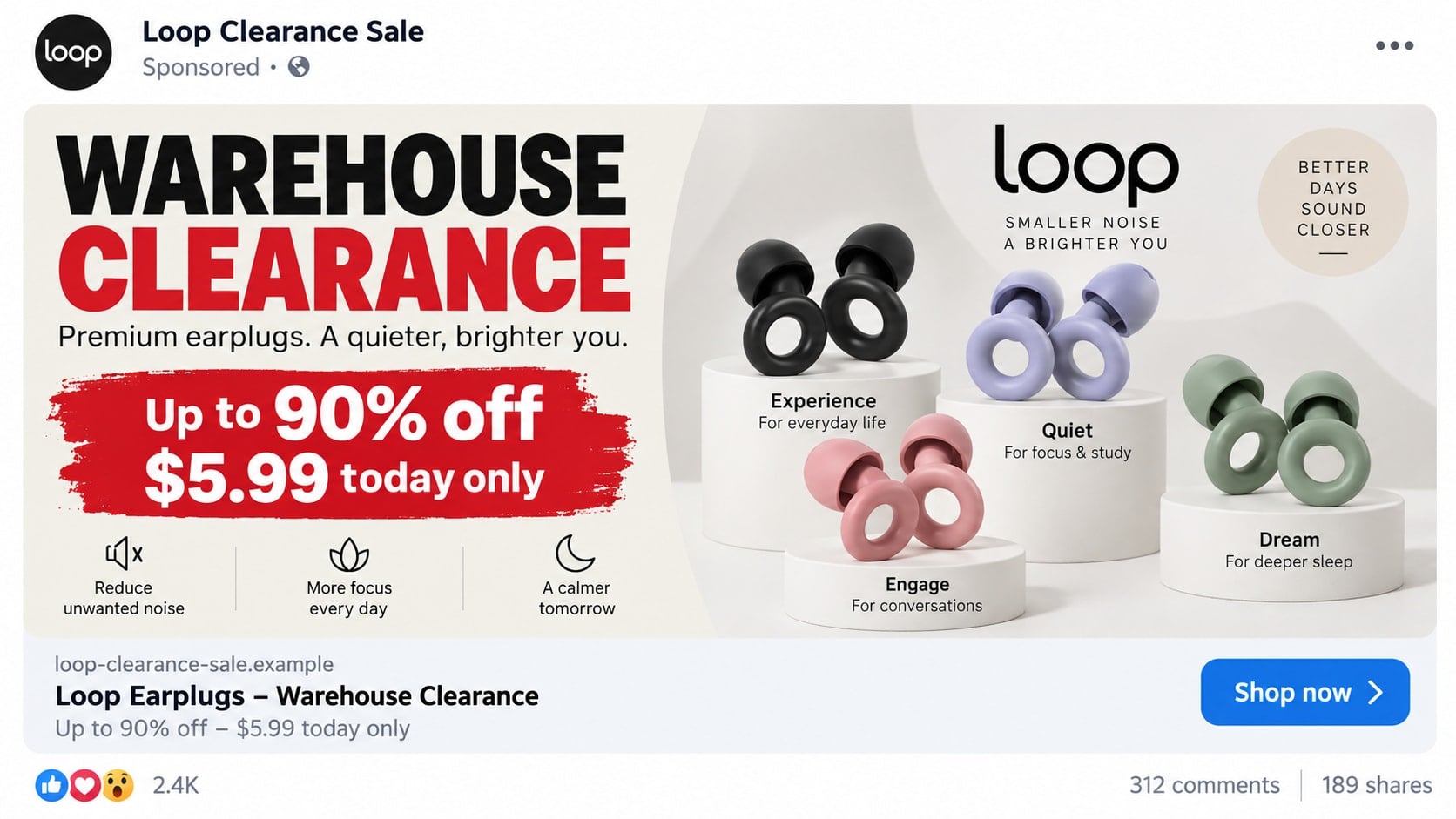
A sponsored post promises popular Loop Earplugs for $5.99 in a warehouse clearance. The colors look right, the product photos are familiar, and a bold 90% off banner says the stock will disappear today.
The Loop Earplugs sale scam is convincing because it borrows a real product and wraps it in a discount that shoppers want to believe. The seller behind the checkout is the part the ad tries to keep invisible.
Overview
The promotion imitates a recognizable hearing-protection brand
Fraudulent ads reuse Loop-style product shapes, colors, photography, names, and marketing language. The offer may be described as a warehouse closing, anniversary event, archive clearance, damaged-box sale, or final stock liquidation.
The real brand has warned that unauthorized websites and listings misuse its identity. A familiar product image therefore does not establish that the advertiser has any relationship with Loop.
The price is designed to overpower normal caution
A price such as $5.99 can feel low enough to risk without research. The ad may compare it with a much higher crossed-out amount and add a countdown, limited-stock label, or hundreds of reactions to create social proof.
Deep discounts can be legitimate, but the seller must still be verified. A bargain shown by an unknown domain is not authenticated by the brand name printed above it.
The checkout can collect more than the advertised price
Some victims may receive nothing, while others could receive an unrelated or lower-quality item. A fraudulent checkout can also capture names, addresses, phone numbers, email addresses, and payment-card details for additional misuse.
- The ad arrives through a sponsored social post or copied account.
- The domain is not an official Loop sales channel.
- The advertised discount is unusually large and time-limited.
- Product photos and reviews may be copied from legitimate pages.
- Shipping fees or other charges appear late in checkout.
- Contact, returns, and legal seller details are missing or inconsistent.
A Real Product Does Not Make the Store Real
Brand impersonation works by separating the thing a shopper recognizes from the merchant actually taking payment. The product can be real, the photographs can be accurate, and the page can still belong to an unauthorized operator.
Fraudulent storefronts often copy an entire catalog rather than inventing products. That approach saves time and makes image-search results appear reassuring because the same photos exist on legitimate websites.
Loop’s official fraud detection statement tells customers to use official channels or verified sellers and to be cautious with unfamiliar stores, extreme prices, weak contact information, and suspicious payment methods.
Legitimate promotions can occur. The important distinction is where the offer is published, who processes the order, and whether the brand recognizes the seller.
How the Loop Earplugs Sale Scam Works
Step 1: A sponsored ad presents a dramatic clearance
The campaign appears in a social feed with polished product graphics and a short explanation for the low price. “Warehouse clearance” and “final day” are common stories because they make a 70% to 90% reduction feel temporary rather than impossible.
The social account can be newly created, compromised, or named to resemble an official outlet. Paid placement only means someone purchased advertising space. It does not mean the platform verified the merchant’s authorization.
Step 2: The click opens a copied storefront
The landing page may reproduce product categories, lifestyle images, color selectors, star ratings, and claims found on authentic retail pages. A domain containing words such as “loop,” “earplugs,” “sale,” or “outlet” adds another layer of imitation.
Small navigation links may lead nowhere, while the shopping path works perfectly. That imbalance reveals the page’s priority: moving visitors from advertisement to payment with minimal distraction.
Step 3: Urgency makes comparison shopping feel costly
Countdown clocks, inventory meters, pop-up purchase notices, and “reserved for 10 minutes” messages encourage the shopper to finish before checking the seller. The timer may reset after a refresh, showing that the deadline is only visual pressure.
Bundles and extra pairs can be added automatically or promoted as the last chance to preserve the discount. The original low-risk purchase quietly becomes a larger order.
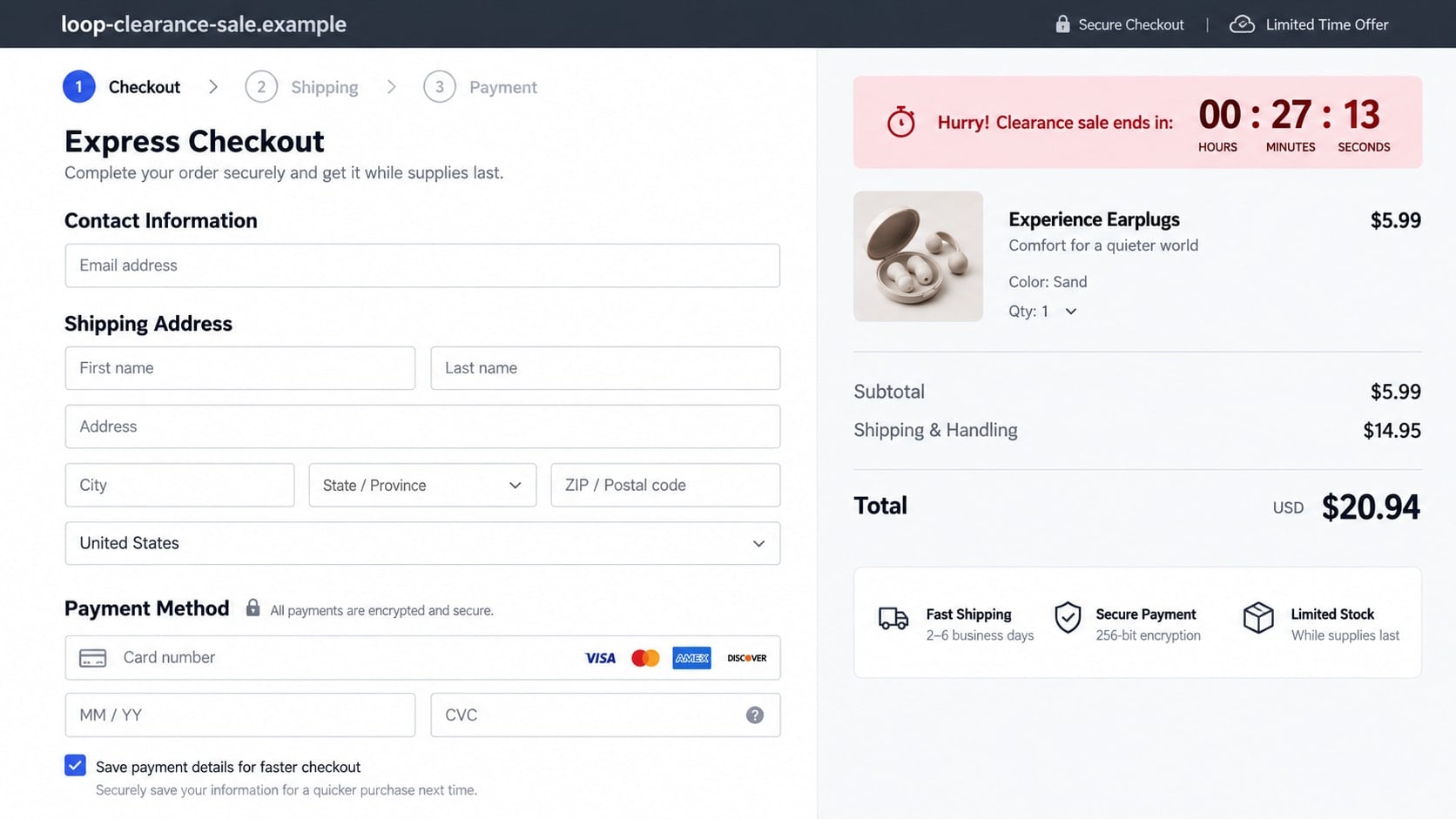
Step 4: Checkout collects contact and payment information
The shopper enters an email address, delivery address, phone number, card number, expiration date, and security code. A padlock icon or the word “secure” can appear even when the merchant itself is fraudulent.
The checkout may add $14.95 shipping to a $5.99 item, switch currencies, or present a final total different from the advertisement. A criminal site may also test the card or reuse the details elsewhere.
Step 5: Confirmation replaces meaningful seller support
After payment, the victim may receive a generic order number and an automated message. The listed support address can bounce, send templates, or insist that the parcel has already entered processing.
Tracking may remain at “label created,” point to an unrelated shipment, or show a small package delivered in the same postal area. A delivery scan does not prove that the advertised goods were sent.
Step 6: The store disappears or disputes become exhausting
The domain can vanish after the advertising campaign ends. A nearly identical store may appear under another name, using the same template, catalog, discount story, and customer-service scripts.
If something arrives, it may not match the listing. The seller can then demand costly international return shipping, offer a small partial refund, or delay until the card dispute window becomes harder to use.
How to Tell a Real Promotion From an Impersonation
Do not use the ad’s own links to prove the ad is genuine. Open a fresh tab, find the official site independently, and look for the promotion there.
Compare the domain character by character. Extra words, swapped letters, unusual subdomains, and unrelated endings are important even when the page design looks professional.
Check whether a marketplace listing identifies the actual seller. A product being displayed on a recognized platform does not automatically mean it is sold by the brand or an authorized merchant.
Finally, compare the price and return terms. A legitimate archive event may discount older colors, but it should still have accountable contact information, clear fulfillment, and a return path tied to the seller.
Identity, Contact, and Payment Checks
The brand name and legal seller must match
Look in the footer, terms, privacy policy, checkout, receipt, and card statement for the business accepting the order. An unexplained company name or missing legal identity means the recognizable brand is only decoration.
Search the named seller separately. Do not assume that a copied trademark creates authorization.
The address should lead to an accountable operation
Check whether the address belongs to the claimed company, a shared mailbox, a residence, an unrelated warehouse, or a location copied from another site. A return depot is not proof of headquarters or brand ownership.
Missing suite details and conflicting countries across policy pages are useful warning signs.
Support should work before payment
Send a specific question about sizing, warranty, shipping origin, or returns before ordering. A real retailer should answer clearly rather than returning a generic template that could apply to any product.
Check whether the email domain matches the store and whether the listed phone number is connected to the named business.
Payment protections matter more than checkout badges
Prefer a credit card with dispute rights. Avoid sellers demanding gift cards, cryptocurrency, wires, or direct payment-app transfers, since those routes provide limited recovery options.
A browser padlock encrypts data sent to a website. It does not confirm that the operator will deliver genuine merchandise.
Warning Signs on a Fake Clearance Page
- The same “closing sale” remains available after the timer reaches zero.
- Every color and model is discounted by nearly the same amount.
- Customer reviews contain repeated wording or unrelated photographs.
- The About page describes a different product category or company.
- Policy pages contain another store name, currency, or jurisdiction.
- Social links are broken, empty, or lead to newly created profiles.
- Only the purchase buttons work reliably across the website.
Any one defect can be a careless design mistake. A cluster of identity, pricing, policy, and contact problems is a reason to leave the store.
What Can Happen After a Fake Order
Non-delivery is only one possible outcome. A small parcel can be used to create a tracking record, even when its contents have no connection to the earplugs shown in the advertisement.
A low-quality lookalike may arrive with different materials, packaging, fit, or acoustic performance. Without an accountable seller, warranty service and product support may not be available through Loop.
The email address and telephone number entered at checkout can become targets for additional messages. A fake carrier may request a redelivery payment, or a “customs” notice may claim another small fee is required.
Card data can be tested with an inexpensive transaction before a larger attempt. Transaction alerts are useful because a charge unrelated to the advertised store may be the first visible sign.
Some operators answer complaints with a partial-refund negotiation. They offer 10% or 20% back, argue that returns are too expensive, and hope the buyer gives up the card dispute.
Others provide an overseas address and require tracked return shipping that costs more than the product. Do not spend additional money until the card issuer explains what evidence and return effort the dispute requires.
Public complaints can also attract recovery impostors. Anyone promising to retrieve the payment for an upfront fee should be treated as a separate scam risk.
Keep the original confirmation rather than relying only on the seller’s online account area. That dashboard can be changed or removed, while the saved receipt preserves the stated item, price, and delivery promise.
If a tracking page asks for card details again, close it and check the number directly on the carrier’s recognized website. Delivery companies do not need the original card security code to show parcel movement.
Continue monitoring the statement after a replacement order or refund claim. Criminal merchants may submit charges under a descriptor that looks unrelated to the storefront name.
What to Do if You Have Fallen Victim to This Scam
- Save the order evidence immediately. Capture the advertisement, domain, product page, checkout total, confirmation, policies, and every message. The site may disappear without notice.
- Notify the card issuer. Explain that the merchant may be impersonating a known brand. Ask whether the card should be replaced and how to dispute non-delivery, counterfeit goods, or an incorrect amount.
- Watch for small test charges. Review pending activity and enable transaction alerts. Report unfamiliar attempts instead of waiting for a larger debit.
- Change reused account credentials. If the store asked you to create an account and that password exists elsewhere, replace it everywhere, starting with email and financial services.
- Inspect the device with Malwarebytes. Run an updated Malwarebytes scan if you downloaded a coupon, tracking application, browser extension, or file from the store. A card purchase alone does not prove the device is infected.
- Let AdGuard reduce repeat exposure. AdGuard can block many deceptive ad destinations and tracking requests used to follow shoppers across campaigns. Still verify each retailer before entering payment details.
- Do not pay a second fee for delivery or refunds. Fraudsters may follow up with fake customs charges, redelivery notices, or recovery offers. Confirm shipment questions with the carrier through its official site.
- Report the advertisement and domain. Use the social platform’s fraud-reporting controls, notify the real brand, and submit the loss to the FTC or the appropriate consumer authority.
- Keep any received item and packaging. Photographs of labels, contents, and quality can support a dispute. Follow the card issuer’s instructions before paying for a return to an unverified address.
Frequently Asked Questions
Are all Loop Earplugs discounts fake?
No. Legitimate promotions can appear through official channels and verified sellers. The risk comes from an unknown operator using copied branding and an extreme discount to collect payment.
Is $5.99 proof that a store is fraudulent?
Price alone is not conclusive, but a dramatic reduction combined with an unfamiliar domain, countdown pressure, and weak seller information is a serious warning pattern.
What might arrive from a fake sale site?
Outcomes vary. The buyer may receive nothing, an unrelated low-value item, or a product that does not match the listing. Do not assume every suspicious order has the same result.
Does HTTPS mean the checkout is safe?
No. HTTPS protects the connection, not the honesty of the merchant. Scam stores can obtain certificates and display padlock icons like other websites.
Should I return a questionable product?
Ask the card issuer what evidence and return attempt are required. Do not send more money or ship to a different address without preserving the seller’s written instructions.
How can I report a copied Loop advertisement?
Report the ad to the platform, preserve its account and destination URL, and contact Loop through the official website. Include screenshots without engaging the advertiser.
The Bottom Line
The Loop Earplugs sale scam uses a real product’s popularity to make a $5.99 clearance look credible. What matters is not how accurate the photographs are, but whether the domain, seller, support, and payment trail belong to an authorized retailer.
Leave countdown pressure behind and verify the promotion through an independent official channel. If the seller cannot be identified before checkout, the discount is not worth the risk to your card and personal information.








