

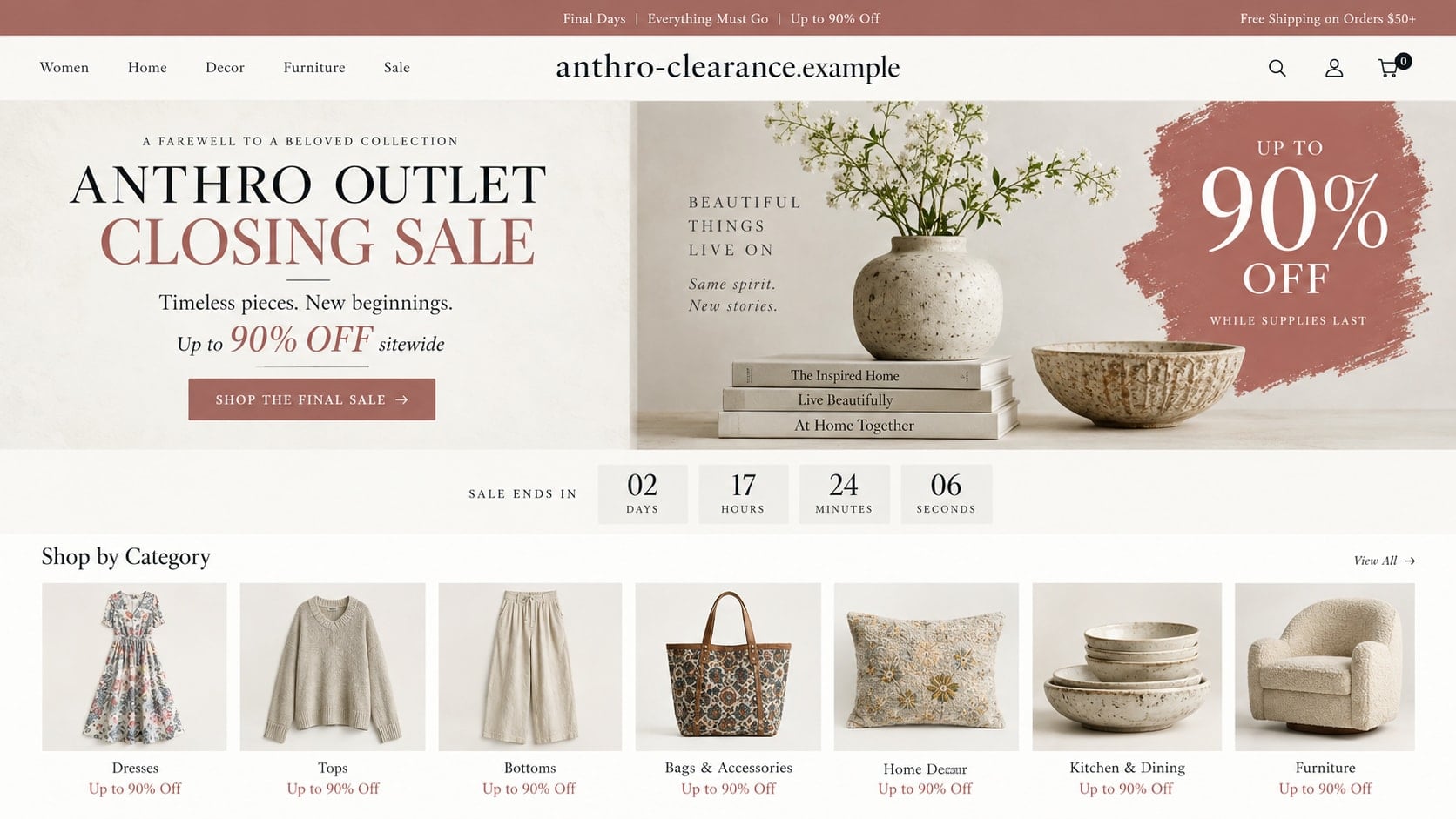
An elegant ad announces an Anthropologie outlet closing sale with dresses, furniture, and home decor marked up to 90% off. The page looks carefully styled, the product photography is polished, and a timer says the final inventory is almost gone.
The Anthropologie sale scam does not need to invent a desirable catalog. It only needs to copy one, attach it to an unrelated checkout, and make shoppers feel that researching the seller means missing the deal.
Overview
The fake outlet copies a premium retail identity
Fraudulent stores can reuse fashion photographs, furniture images, category names, typography, and color palettes associated with Anthropologie. The page may call itself an “Anthro Outlet,” “official clearance,” “warehouse closing,” or “final days” event.
Visual similarity is not proof of ownership. The images may have been taken from legitimate product pages while the domain, checkout, and payment recipient belong to someone else.
An extreme discount turns browsing into a countdown
Offers of 80% or 90% off expensive furniture, cookware, dresses, and decor create a powerful fear of missing out. A countdown clock, low-stock message, free gift, or sitewide coupon narrows the time available for questions.
The discount may be applied automatically, making a cart worth hundreds appear to cost less than one normal item. That dramatic contrast encourages a quick card entry.
The operator, not the copied catalog, determines the outcome
A shopper might receive nothing, a low-value substitute, a fake tracking event, or an item unlike the listing. The checkout can also expose contact and card information to an unidentified merchant.
- The advertisement appears in a social feed from an unfamiliar account.
- The destination is not the retailer’s established website.
- Nearly every category is discounted by an implausible amount.
- A closing story and resetting timer create artificial urgency.
- The legal seller is absent or changes across policy pages.
- Support cannot connect the order to official account history.
Why the Fake Store Can Look So Convincing
Modern store templates make it easy to reproduce a professional layout. A fraudulent operator can add search, category menus, shopping carts, currency selectors, and responsive mobile pages without building a retail business behind them.
Copied product photography does most of the persuasive work. Shoppers recognize the style and assume the website displaying it must have the right to sell those products.
The false closing story explains several suspicious features at once. It makes an enormous discount sound temporary, suggests limited customer service, and pressures visitors to accept “final sale” terms.
A real retailer may hold promotions, but official customer-service pages, order history, returns, and current offers remain connected to the same established domain and business identity.
How the Anthropologie Sale Scam Works
Step 1: A social ad borrows real merchandise
The campaign uses attractive photos of dresses, bags, furniture, bedding, or cookware, often taken from current or popular collections. A high crossed-out price is placed beside a much smaller “today” amount.
The account may contain only a few posts or use a name close to the brand. Reactions and comments can be fabricated, purchased, filtered, or copied, so popularity inside the ad is not reliable verification.
Step 2: A lookalike domain presents an outlet story
The click opens a polished site with words such as “anthro,” “outlet,” “clearance,” or “warehouse” in the address. The domain may be newly registered or unrelated to the company shoppers think they are visiting.
Headers, product grids, and promotional bars imitate the official store. Footer pages may be thin, generic, copied from another shop, or written for a different country and product category.
Step 3: Scarcity turns a wish list into a rushed cart
The site claims that sizes and colors are selling out while a timer counts down. Pop-ups may announce purchases by other shoppers, creating the impression that hesitation will cost the deal.
Free gifts or additional discounts can appear only after the cart reaches a threshold. Instead of testing the store with one item, the buyer is nudged into submitting a larger order.
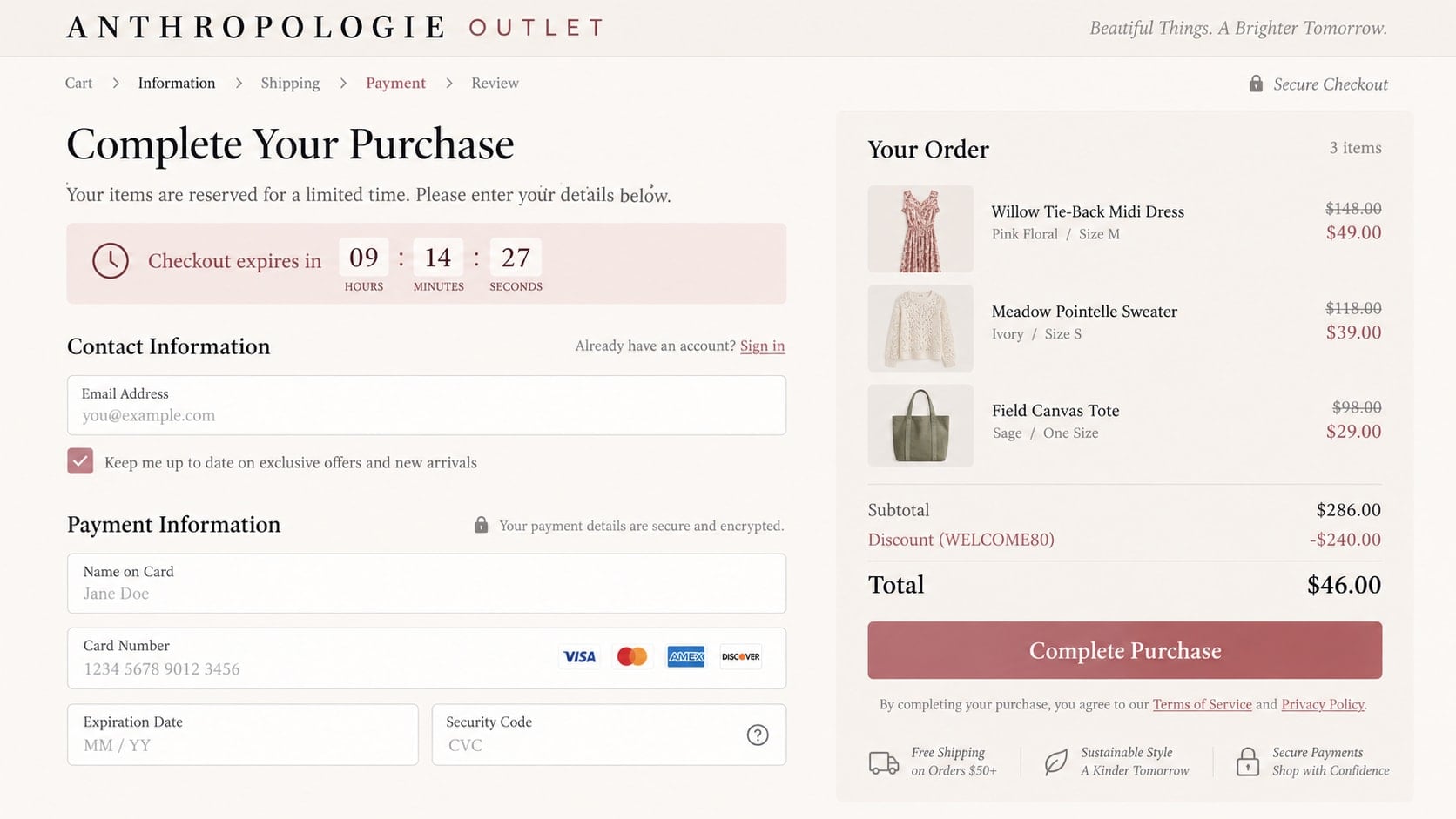
Step 4: The checkout captures valuable personal data
The victim enters a name, email address, delivery address, phone number, and card details. Even if no order is fulfilled, that information can support card fraud, targeted phishing, and fake delivery messages.
A discount code may reduce a $286 subtotal to $46, which looks like confirmation that the advertised sale is working. The bargain says nothing about who receives the card information.
Step 5: A weak confirmation delays suspicion
The store may issue an order number and send an automated receipt from a generic address. For several days, the buyer sees “processing” messages or receives excuses about warehouse volume.
A tracking number can refer to an unrelated parcel, a label that never moves, or a low-cost shipment delivered somewhere in the same area. Tracking data must match the carrier, destination, weight, and order.
Step 6: Refund requests meet a different identity
Support may answer under another store name, offer only a small refund, or demand that an unsuitable item be returned overseas at the buyer’s expense. The advertised brand may have no record of the purchase.
When complaints increase, the fake domain can disappear. The same operator may reopen the template with a new retailer, seasonal event, and web address.
How to Verify an Anthropologie Promotion
Open the official website independently rather than following the advertisement. The official Anthropologie customer-service area provides order status, returns, current promotions, and documented contact methods tied to genuine purchases.
Look for the advertised event inside that official environment. A separate “outlet” domain should not be assumed genuine merely because its design uses the same fonts and photographs.
Compare individual prices. If popular current products are all marked down by 90%, ask why an unknown site obtained that inventory and why the established retailer is not announcing the same liquidation.
Contact official support with the domain and screenshot when uncertain. Do not ask the suspicious store to verify itself.
Identity, Contact, and Payment Checks
Find the company that will appear on the statement
Read the terms, privacy page, receipt, and payment screen for a legal seller name. If the checkout never identifies the company taking the money, the brand presentation is not accountable.
An unrelated merchant descriptor should be investigated before payment, not explained away afterward.
Test the address rather than admiring the storefront
Map any listed business or return location and compare it with the claimed operation. A mailbox, residence, unrelated shop, or generic logistics depot does not establish an official outlet.
Conflicting addresses across terms and returns pages suggest that the policies were assembled from multiple templates.
Use official support to check the order path
A genuine order should be visible through the retailer’s recognized order-status system or customer account. A confirmation page on an unrelated domain cannot create that record.
Reach support through contact information obtained independently, and never send identity documents to a social account promising a refund.
Choose a payment method with dispute rights
A credit card usually offers stronger protections for non-delivery or misrepresented goods than gift cards, cryptocurrency, wires, or person-to-person transfers. Refuse any checkout that insists on irreversible payment.
Security badges can be copied. The financial relationship and merchant identity are what matter.
Red Flags Hidden in the Fine Print
Scam pages often look strongest at the top and weakest in their policies. Slow down once the design has made its first impression.
- The returns page names a different store or support email.
- Delivery estimates conflict between checkout and shipping terms.
- The privacy policy lists an unrelated country or company.
- Every sale is described as final despite broad refund claims elsewhere.
- The contact page offers only a form with no business details.
- Social icons lead to empty pages or unrelated accounts.
- The countdown restarts whenever the site is reopened.
These inconsistencies matter because policies reveal who is expected to fulfill the sale and solve problems. If that identity cannot survive a basic check, do not submit an order.
The Follow-Up Scams That May Arrive Later
The checkout gives an operator several pieces of fresh information at once. The name, address, email, telephone number, chosen products, and order total can make later phishing messages unusually convincing.
A fake shipping update may use the real order number and claim that a small address-correction or customs payment is required. The apparent accuracy comes from the fraudulent checkout, not from the carrier.
Another message may say the card failed and ask the shopper to pay again through a different page. Before doing anything, review the card account and contact the issuer through its recognized number.
Complaint posts can attract accounts pretending to be Anthropologie support. These impostors offer immediate refunds, then request one-time codes, bank login details, or identity documents in a private conversation.
A supposed refund check may also be sent for too much money. The recipient is instructed to deposit it and return the difference, but the original check can later be rejected as fraudulent.
Fraudsters may sell contact information to other campaigns. Expect unrelated parcel alerts, shopping offers, account warnings, and calls that reference recent online purchases.
Keep the evidence from the original order available when assessing follow-ups. Matching personal details do not make a new sender legitimate when the source of those details was the scam itself.
Parcel messages deserve special care because the victim really is waiting for a delivery. Enter the tracking code manually on the carrier’s official site rather than opening a shortened link in a text.
If a person claiming to be support calls unexpectedly, end the call and use the customer-service route published on the genuine retail website. Caller ID names can be spoofed and should not decide trust.
Family members who share the card or delivery address should also know about the incident. A follow-up caller may reach someone else in the household and use the order details to sound credible.
What to Do if You Have Fallen Victim to This Scam
- Create a complete record of the purchase. Save the ad, account name, website address, product listings, policies, receipt, confirmation, tracking, and support conversation before any page changes.
- Call the card issuer using the number on the card. Report possible brand impersonation and ask about replacing the card. Explain whether the problem is an unauthorized amount, missing merchandise, or goods unlike the description.
- Check for additional merchant activity. Turn on alerts and examine pending transactions. Fraudulent checkouts may be followed by small tests, foreign charges, or recurring attempts.
- Secure accounts created during checkout. Change any reused password and review email for unfamiliar forwarding rules or password-reset notices. Use a password manager to create unique replacements.
- Use Malwarebytes if the site delivered software. Run a full Malwarebytes scan after opening a suspicious attachment, coupon installer, tracking program, or browser add-on. Ordinary browsing does not automatically mean the system is infected.
- Add AdGuard as a preventive layer. AdGuard can filter many malicious advertising and tracking requests associated with repeat shopping campaigns. It cannot authenticate a merchant, so seller research remains essential.
- Do not trust a social-media refund helper. Impostors monitor public complaints and may request a banking code, identity image, or upfront recovery payment. Use the retailer and payment provider’s official channels only.
- Photograph anything that arrives. Capture the package, label, tracking number, contents, size, and defects. Keep the materials until the card issuer says they are no longer needed.
- Report the campaign. Flag the advertisement and account on the platform, notify Anthropologie through its recognized contact page, and report financial harm to consumer-protection authorities.
Frequently Asked Questions
Does Anthropologie have legitimate sales?
Yes. A real retailer can offer promotions and clearance items. Confirm them on the official website or through documented customer service rather than an unfamiliar advertising link.
Is an “Anthro Outlet” domain automatically official?
No. Anyone can register a domain containing a brand-like word. Authorization must be supported by the official retailer, legal seller identity, and recognized order system.
Why are the product photos identical to real listings?
Images can be copied easily from legitimate stores, catalogs, and social accounts. Accurate photography proves where the picture came from, not who operates the checkout.
What if the tracking says delivered?
Ask the carrier to confirm the destination and shipment details. Scammers may use unrelated or low-value shipments, so a delivery scan should be matched to your actual order.
Can I dispute a card charge if something cheap arrived?
Potentially. Contact the issuer, describe how the item differs from the listing, and provide photographs and correspondence. Follow its instructions about returns and evidence.
Should I send my ID to obtain a refund?
Do not send identity documents to an unverified seller or social account. Ask the card issuer what information is truly required for the dispute process.
The Bottom Line
The Anthropologie sale scam places copied fashion and home imagery behind an unrelated outlet domain, then uses a 90% discount to rush shoppers into checkout. A beautiful storefront cannot substitute for a verifiable merchant.
Confirm promotions inside the official retail environment, examine the company and policies, and use protected payment methods. If the seller cannot be identified without relying on its own claims, close the page.








