

The call does not begin with a bank account, a police case, or a demand for money. It begins with something mundane: a television order that you do not recognize.
That ordinary question gives the caller a believable reason to sound helpful, a reason to ask whether your identity was stolen, and a reason to transfer you to someone who appears more official.
By the time the supposed investigation reaches your savings, the original retail call can feel like a distant detail. It is actually the first carefully placed step.
Overview
The story callers use
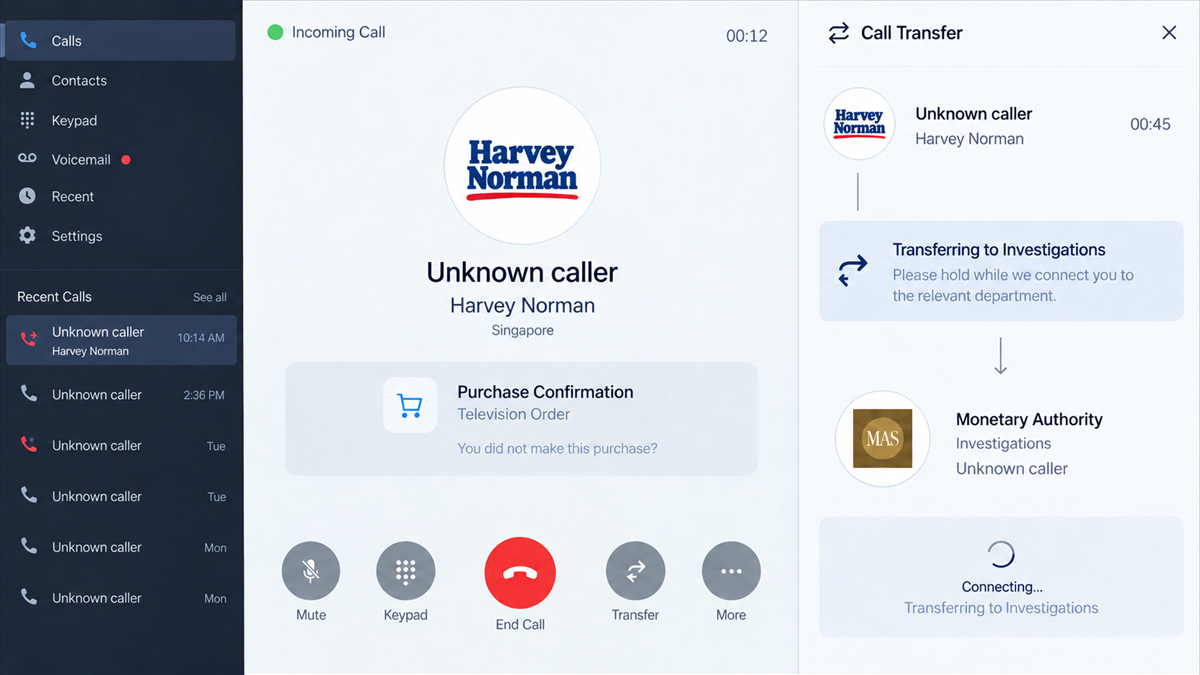
Scammers call unexpectedly and pretend to work for Harvey Norman. They claim the recipient bought a television or has a delivery waiting for confirmation. When the person denies the purchase, the caller says their personal details may have been misused.
The call is then passed to another scammer posing as an officer from the Monetary Authority of Singapore. The second caller alleges that the victim is linked to money laundering or another crime and must cooperate with an investigation.
What the Singapore Police confirmed
The Singapore Police Force reported a surge in this scam on September 21, 2026. Since January, at least 119 cases had been reported, with losses totaling at least $4.8 million.
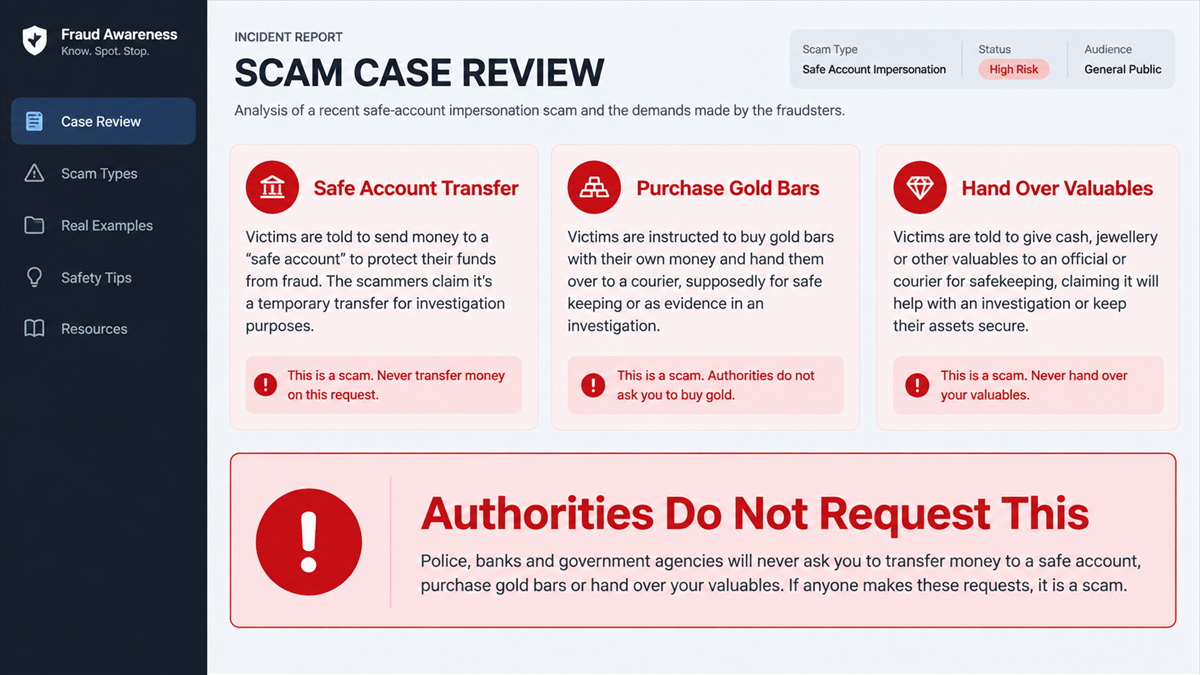
Victims were directed to transfer money to so-called safe accounts. Some were told to withdraw cash, buy gold bars, or bring jewelry and luxury watches to unknown people for supposed investigation purposes.
The rule that breaks the script
A real government official will not ask you to move money or surrender valuables for an investigation. The police also say government officials will not request banking login details, tell you to install apps from unverified stores, or transfer your call to the police or another government agency.
- A retailer does not transfer criminal investigations over the telephone.
- There is no legitimate safe account that requires you to move personal savings.
- Cash, gold, jewelry, and watches are not collected by strangers as evidence through a phone arrangement.
- Secrecy and a continuous call are used to prevent independent verification.
- The correct response is to hang up and contact each organization separately.
Why the Television Order Is Such an Effective Opening
An unexpected purchase creates immediate concern without sounding unbelievable. Televisions are expensive enough to justify a verification call, common enough to avoid raising questions, and physical enough to support a story about delivery confirmation.
When the recipient says they did not place the order, the scammer does not have to force the next subject. Identity theft appears to be the natural explanation. The victim and caller now seem to share the same goal: stop the fraudulent purchase and discover who used the details.
That helpful tone lowers resistance. A person who would hang up on a caller demanding money may stay on the line with a retailer who appears to be canceling an order. The transfer to an authority then feels like escalation by a responsible company.
The Singapore Police advisory makes clear that the entire chain is fraudulent. Harvey Norman staff, MAS officers, and investigators are roles performed by members of the same scam operation.
How the Fake Harvey Norman Call Scam Works
Step 1: The caller asks about a television purchase
The victim receives an unsolicited call from someone claiming to work for Harvey Norman. The caller says a television was purchased using the victim’s details or that a delivery needs confirmation.
The question is designed to produce a denial. The scammer expects the recipient to say that no such order exists, which opens the path to a more alarming explanation.
Step 2: The caller claims the victim’s identity was misused
The supposed employee expresses concern and says the purchase may be connected to stolen personal information. The victim may be asked to confirm basic details, but the larger purpose is to create fear that the problem extends beyond one order.
Any information the scammer already knows can strengthen the story. A name, address, partial identity number, or previous purchase detail may have come from public records or a breach. Possessing it does not make the caller genuine.
Step 3: The call is transferred to a fake authority
The retailer says the matter requires official investigation and transfers the call. A second scammer introduces themselves as an MAS officer or another government representative.
The transfer is theater. A government agency does not accept an investigation by being connected through an unsolicited retail call. The new voice, formal title, case number, and official-sounding background are used to reset the victim’s sense of authority.
Step 4: The victim is accused of a serious crime
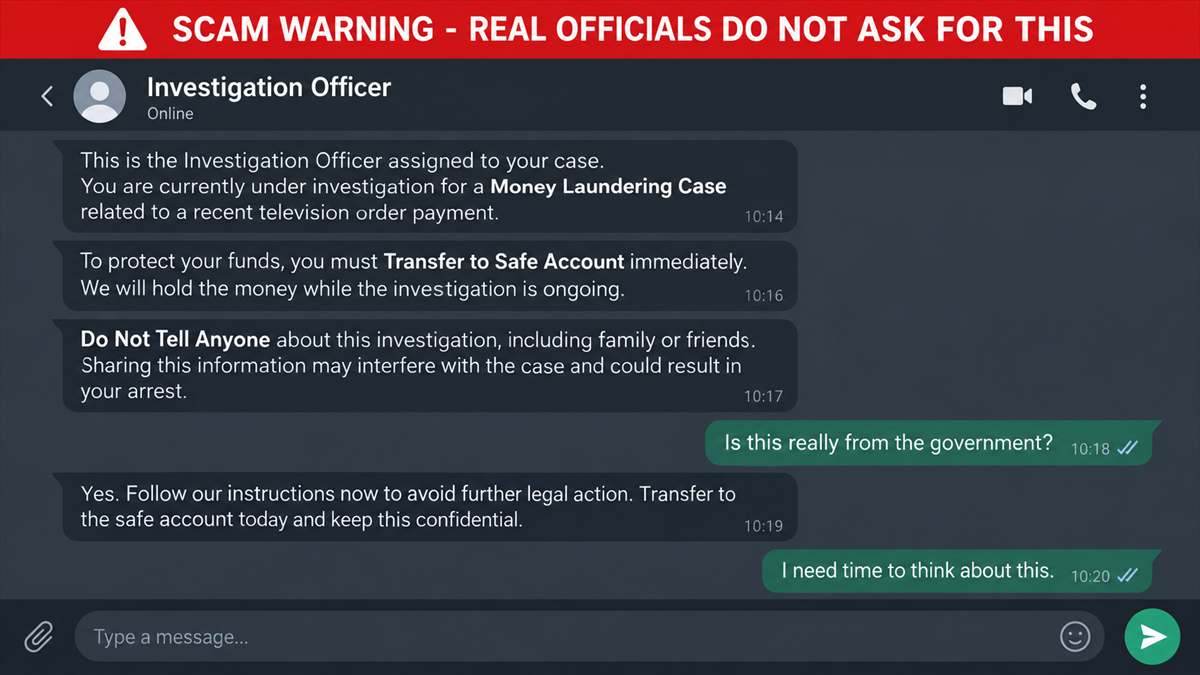
The fake officer claims the victim’s identity or accounts are linked to money laundering. The conversation shifts from stopping a purchase to proving innocence.
That accusation creates panic and obedience. The scammer may warn that ending the call, contacting someone else, or refusing instructions could lead to arrest, frozen accounts, or prosecution.
Step 5: Secrecy isolates the victim
The caller may describe the case as confidential and order the victim not to tell relatives, bank staff, or local police. They may keep the call active while the victim travels, logs into banking, or speaks with the real bank.
Long calls are not a sign of thorough official work. They prevent the victim from pausing, searching, or hearing a second opinion. A scammer can also coach answers if bank staff ask why a large transfer is being made.
Step 6: Money and valuables are moved for inspection
The victim is told to transfer money to a safe account so it can be checked. In other cases, the instructions involve cash withdrawals, gold bars, jewelry, or luxury watches handed to an unknown collector.
The promised protection is false. The account belongs to the criminal network, and a courier collecting valuables is not conducting an investigation. Multiple transfers may follow because each completed payment proves that the pressure is working.
Step 7: The refund never arrives
The scammer says the money or valuables will be returned after the investigation. Delays are blamed on compliance reviews, new evidence, or another department.
Victims usually realize the truth only after repeated transfers or after the callers disappear. By then, the money may have moved through several accounts or been converted into assets that are difficult to recover.
There Is No Safe Account for an Investigation
The phrase safe account is deliberately reassuring. It suggests that the victim keeps ownership while authorities temporarily protect or inspect the funds. In reality, control is the only fact that matters. If the victim sends money to an account supplied by a stranger, the stranger’s network controls it.
Government agencies do not test whether money is criminal by moving it out of a person’s bank account. Banks do not need customers to defeat fraud controls by lying about the purpose of a transfer. Police do not collect a watch or gold bar through a courier arranged on an unsolicited call.
The same principle applies when a caller knows private details or appears to call from a genuine number. Caller ID can be spoofed, data can be stolen, and several scammers can perform different departments. Verification must happen on a new call placed to a trusted number.
MalwareTips has covered similar move your money scams in which fake officials coach victims through real banking calls. The wording changes, but the destination remains an account controlled by criminals.
Red Flags in the Harvey Norman Call
- You receive an unexpected call about a television or delivery you never ordered.
- The retailer claims your identity is linked to a criminal investigation.
- The call is transferred directly to MAS, police, or another authority.
- The supposed officer accuses you of money laundering before providing verifiable written contact.
- You are told to remain on the call, keep the case secret, or avoid family and bank staff.
- You must transfer money to a safe, secure, inspection, or government account.
- The caller asks for banking credentials, one-time codes, or an unverified app installation.
- You are told to buy gold, withdraw cash, or hand valuables to a courier.
- A refund is promised only after you complete every instruction.
Any one of the money or valuables requests is enough to end the call. You do not need to debate the caller or prove the story false while they are listening.
Company and Checkout Checks
Verify the retail order separately
Hang up. Reach Harvey Norman through its official website, a known store number, or your real order account. Do not call a number supplied by the person who contacted you.
Verify the government contact separately
Government officials do not receive transferred calls from retailers. Use a published agency number and ask whether any legitimate contact exists. Do not accept a case number as proof by itself.
Inspect the payment destination
A personal account, unfamiliar company, crypto wallet, cash handover, gold purchase, or courier collection is incompatible with a legitimate investigation. Do not proceed even if the caller says the destination is confidential.
Refuse remote control and login requests
Do not install software, share a screen, disclose login details, or read one-time codes. A real official does not need control of your device or banking session to clear your name.
What to Do if You Have Fallen Victim to This Scam
- End the call immediately. Do not warn the scammer or wait for permission. If possible, use another device to contact your bank.
- Call your bank’s fraud team. Explain that transfers were made under government impersonation pressure. Ask for recalls, freezes, and protection on affected accounts.
- Report any courier handover. Give police the collection time, location, description, vehicle details, messages, and surveillance possibilities as quickly as possible.
- Preserve all evidence. Save call logs, recordings, chat messages, receipts, bank recipients, wallet addresses, case numbers, and names used by the callers.
- Secure online banking and email. Change credentials from a clean device, revoke unknown sessions, reset authentication, and check for changed contact details.
- Remove remote-access software. Disconnect any device the scammer controlled and run a full security scan. Malwarebytes can help identify remote tools and other unwanted software.
- Report the incident. Contact the Singapore Police Force and ScamShield, as well as Harvey Norman and MAS through official routes.
- Prepare for follow-up scams. The criminals may return as police, bank investigators, lawyers, or recovery companies. Do not pay anyone who promises a guaranteed recovery.
After securing the accounts, a blocker such as AdGuard can reduce malicious advertising and known scam redirects. It does not block a convincing voice call, so independent call-back verification is still the key defense.
What to Say When a Caller Will Not Let You Hang Up
You do not owe the caller an explanation. Say that you will contact the organization through its published number, then end the call. A genuine employee will allow independent verification.
If the caller threatens arrest or account closure, remember that the threat is designed to keep you inside the script. Place the new call from another device if you are concerned that a landline connection or compromised phone remains active.
Tell a trusted person what happened before moving money. The scam depends on isolation. A short conversation can restore the perspective that an hours-long performance has taken away.
If you are already at a bank branch, show staff the messages and explain that an unsolicited caller is directing the transaction. Do not repeat a cover story supplied by the caller. Honest context gives the bank its best chance to stop the loss.
A real investigation does not collapse because you took time to verify it. Only the scammer benefits from keeping you rushed, isolated, and continuously connected.
Frequently Asked Questions
Is Harvey Norman involved in this scam?
No evidence suggests the retailer is behind it. Criminals are impersonating Harvey Norman employees to create the opening story about a television purchase or delivery.
Why do the callers transfer me to MAS?
The transfer makes the second scammer appear independent and more authoritative. Singapore Police say government officials will not transfer calls to police or other government officials in this way.
Can authorities ask me to use a safe account?
No. The Singapore Police warning states that officials will not ask people to transfer or hand over cash, gold, or luxury watches. A safe account request is a scam signal.
What if the caller already knows my identity details?
Personal information can come from breaches, public sources, or earlier scams. Knowledge of those details does not verify the caller. End the call and contact the organization independently.
Should I tell my bank why I am making the transfer?
Yes. Never lie to bank staff at a caller’s direction. Tell the bank exactly who instructed you and why. Scam-prevention questions exist to interrupt this kind of payment.
Will paying once end the investigation?
No. There is no real investigation, and payment often leads to additional demands. Stop sending money and contact your bank and police immediately.
The Bottom Line
A fake television order is the entrance to a much larger impersonation scam. Singapore Police have linked this variant to at least 119 reported cases and at least $4.8 million in losses.
No retailer can transfer you into a legitimate secret investigation, and no authority needs your money, gold, or valuables to prove your innocence. Hang up, verify separately, and involve your bank at the first payment request.








