

A gold-colored ring is presented as the missing answer for sleep, stress, bloating, and stubborn menopause weight.
Verdana HealthRing makes an extraordinary story look familiar and reassuring, which is exactly why its claims deserve a disciplined review.
Overview
What Verdana HealthRing is
Verdana HealthRing is an open magnetic ring sold through Verdana Home. The promotion targets women experiencing menopause-related discomfort and weight concerns.
The advertorial says four magnets press finger points associated with hormones, stress, sleep, digestion, and metabolism.
The ring is jewelry. It is not a diagnostic device, prescribed treatment, or demonstrated substitute for evidence-based menopause care.
Why the campaign looks authoritative
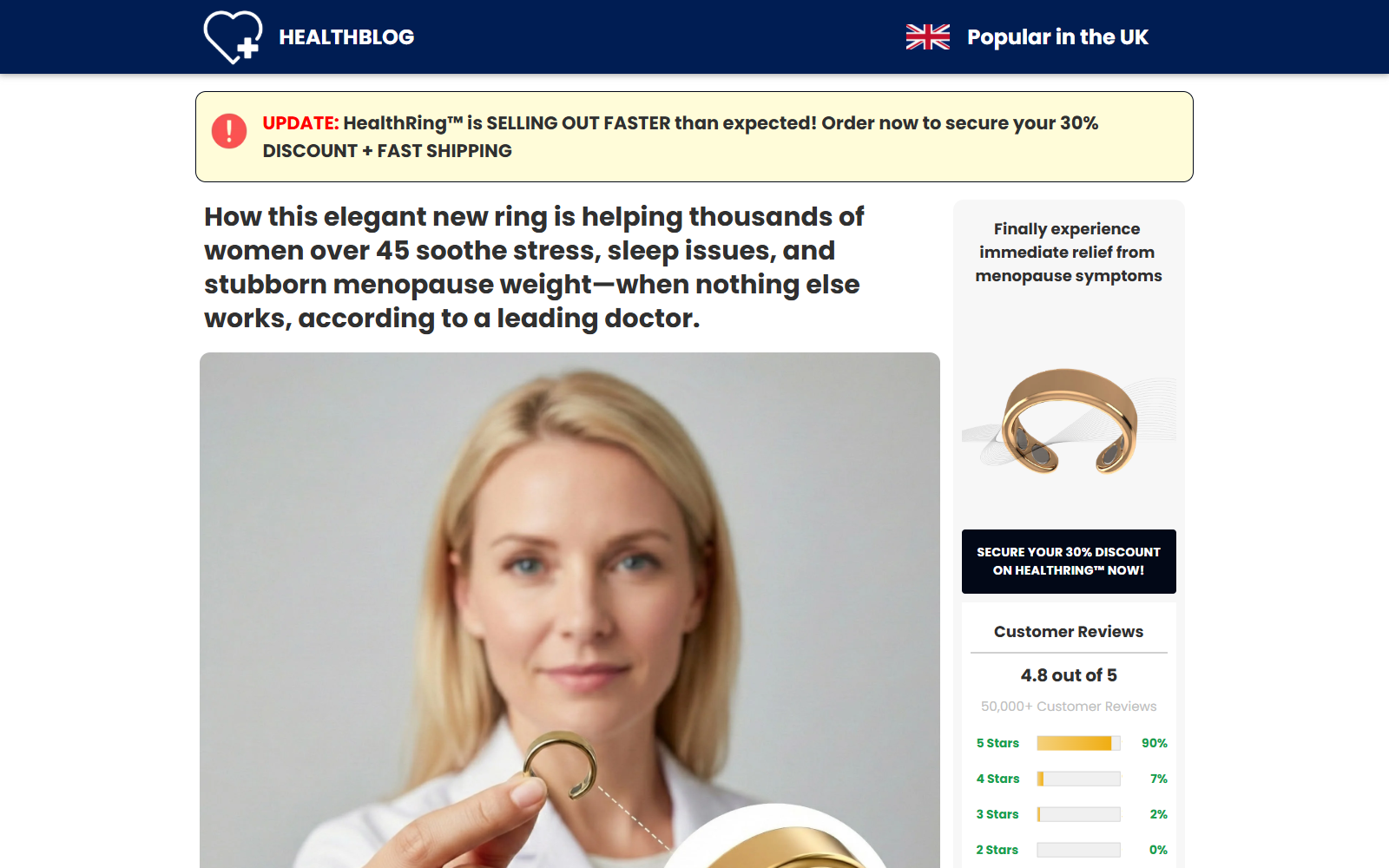
The sales route begins with a page styled as a health publication rather than an ordinary product listing.
It uses a doctor-centered story, clinical language, large participation figures, customer ratings, scarcity messages, and claims of scientific support.
That combination can make readers believe they are encountering independent medical reporting instead of merchant-controlled advertising.
Our assessment
We found no reliable evidence that wearing this magnetic ring produces the broad menopause benefits promised by the advertorial.
The page does not provide a product-specific clinical trial, verifiable methodology, published dataset, or adequate citation for its strongest figures.
Verdana HealthRing should be treated as fashion jewelry with unproven wellness marketing, not as a clinically validated menopause solution.
- The advertorial imitates the appearance of a health article.
- A named doctor narrative supplies authority.
- The page claims benefits across several unrelated symptoms.
- It cites 47,263 women without publishing study details.
- It promotes more than 50,000 customer reviews.
- Urgency and stock messages push immediate purchase.
- The UK operating company was incorporated in 2026.
This Is an Advertorial, Not Independent Medical Reporting
The word “HEALTHBLOG” appears prominently at the top. The layout resembles an editorial feature, with a headline, doctor image, and explanatory narrative.
However, the page repeatedly directs readers toward purchasing HealthRing. Its commercial purpose is central, even when the presentation feels journalistic.
An advertorial is an advertisement written in article form. That format is not automatically unlawful, but commercial intent must remain clear.
Problems arise when design encourages readers to mistake seller-written claims for independent health coverage.
The page uses first-person material attributed to “Dr Emily Saunders.” Yet it does not provide enough verifiable professional detail beside the claims.
We did not see a medical registration number, clinic profile, research publication, or independent institutional page connecting that identity with HealthRing.
That absence does not prove the pictured person is fabricated. It means the claimed authority cannot be independently confirmed from the advertorial itself.
Readers should never accept a medical endorsement solely because a sales page includes a white coat, professional title, or polished portrait.
The Claims Stretch Across Too Many Problems
Menopause can involve hot flashes, sleep disturbance, mood changes, body-composition changes, and other symptoms. Individual experiences vary greatly.
Verdana’s promotion connects one ring with stress, sleep, bloating, hormones, metabolism, and weight.
When a passive accessory promises several substantial outcomes, each claim needs its own credible evidence.
A general reference to magnetic therapy does not establish that this ring changes hormone levels or reverses weight gain.
Likewise, an acupressure narrative does not prove that magnets positioned on the finger reach specific organs or biological pathways.
Pressure from a ring may produce a local sensation. That observation is very different from demonstrating systemic treatment.
Clinical evidence should identify participants, controls, duration, endpoints, adverse events, analysis, funding, and a published protocol.
The advertorial’s large figures do not provide those details. A number becomes persuasive before the reader can inspect what it represents.
How the Verdana HealthRing Funnel Works
Step 1: A health-article format lowers skepticism
The visitor lands on a page resembling editorial health content. A publication-style header and explanatory headline frame the material as useful reporting.
That appearance can delay recognition that every section supports one product sale.
Independent medical articles normally discuss limitations, alternatives, evidence quality, and competing explanations. This page moves consistently toward checkout.
Step 2: A doctor story personalizes the promise
The narrative presents professional insight through a named doctor persona. Readers may interpret the story as clinical experience rather than copywriting.
A relatable first-person account is easier to trust than anonymous product text. It turns the ring into a discovery shared by an expert.
Verify the speaker outside the sales funnel. Search medical registers, institutional profiles, publications, and transparent conflict disclosures.
Step 3: Magnets receive a medical-sounding mechanism
The page describes four magnets targeting specific points on the finger. This gives the ring a structured explanation that sounds anatomically intentional.
A plausible-sounding mechanism is not proof of clinical benefit. Biological explanations must survive controlled testing.
Ask for the exact study showing this configuration changes the named menopause outcomes. Evidence about unrelated magnets is insufficient.
Step 4: Large numbers manufacture consensus
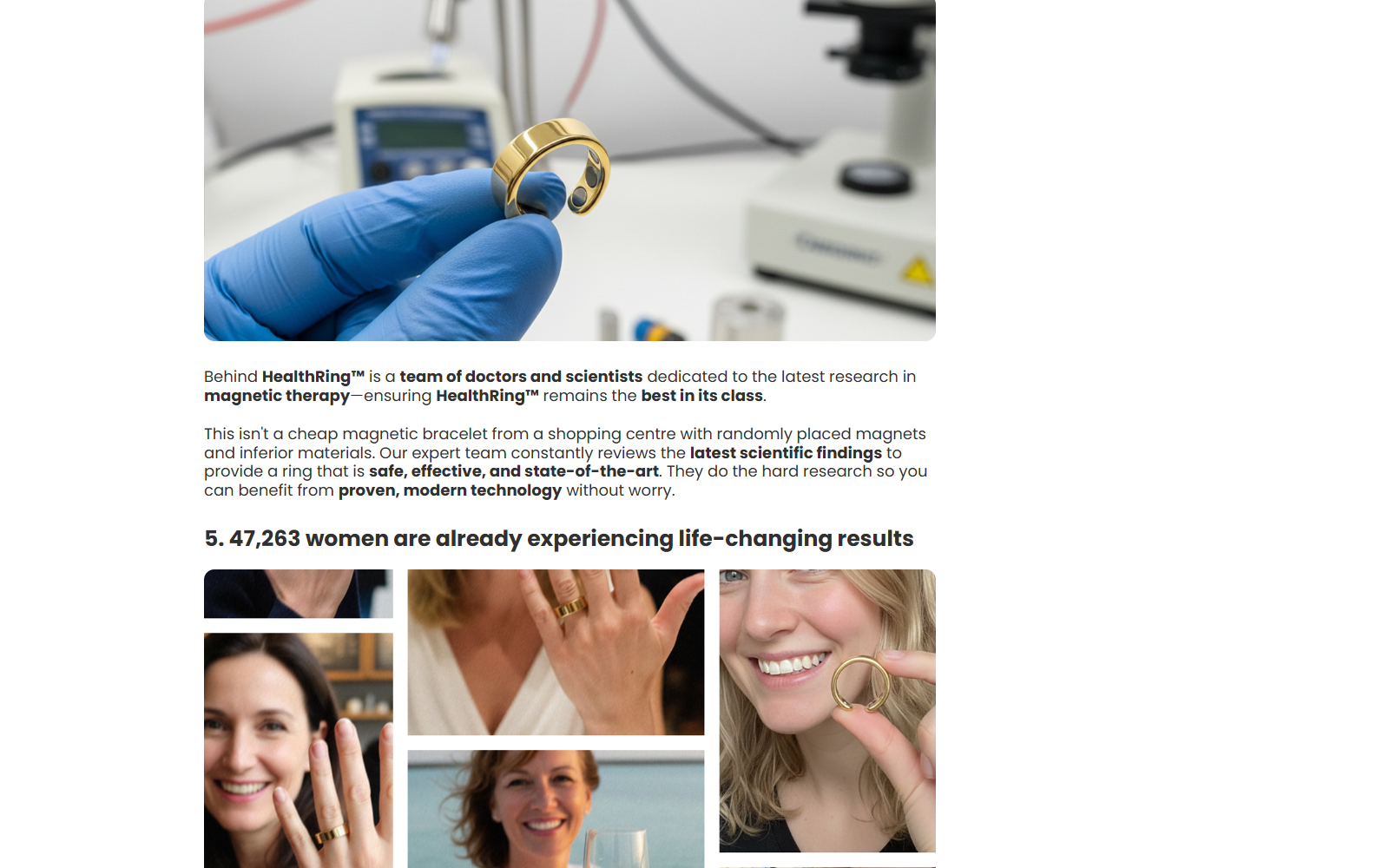
The advertorial references 47,263 women and more than 50,000 customer reviews. Huge figures suggest the question has already been settled.
Yet the page does not provide a transparent dataset, independent review platform, recruitment method, or verification process for those numbers.
Without that information, readers cannot distinguish measured outcomes from survey responses, marketing estimates, imported reviews, or decorative counters.
Step 5: Before-and-after stories replace controlled evidence
Personal accounts make the benefits feel concrete. A smiling customer describing better sleep is more memorable than a discussion of placebo effects.
Testimonials cannot isolate what caused a change. Symptoms can fluctuate, and people may alter diet, exercise, medication, or routines simultaneously.
Only appropriately designed research can compare the ring with placebo, natural variation, and other influences.
Step 6: Scarcity discourages further research
The page warns that HealthRing is selling quickly and promotes a 30% discount with fast shipping.
Urgency tells readers that investigation has a cost. Waiting to verify the doctor or evidence may supposedly mean losing the offer.
A legitimate medical benefit does not become more credible because inventory appears limited.
Step 7: A long guarantee makes the risk feel remote
The advertorial promotes a 90-day guarantee. That assurance can help a hesitant reader rationalize an immediate purchase.
The guarantee should be evaluated through actual terms, return destination, eligibility, response process, and refund timing.
Never assume a badge automatically delivers a painless refund. Save the complete policy before ordering.
The Numbers Need Evidence, Not Typography
Verdana’s 47,263-women claim is extraordinarily specific. Specificity can make an assertion feel measured even when the underlying method is absent.
Readers should ask who enrolled those women, what they used, how long they were observed, and which outcomes changed.
They should also ask whether results were self-reported, clinically measured, compared with placebo, and reviewed by independent researchers.
A legitimate study should be findable through authors, title, journal, registry, or institutional repository.
The phrase “clinically proven” is especially important. It implies more than customer satisfaction or a collection of testimonials.
Proof requires a defined product and reproducible study. The page does not supply enough information for readers to examine that standard.
The same caution applies to the review count. A large number without source transparency cannot establish verified ownership or independent feedback.
What Credible Health Evidence Would Look Like
A serious trial would begin by defining the ring precisely, including magnet strength, placement, materials, and the instructions given to participants.
Researchers would recruit a suitable group and compare the product with a convincing nonmagnetic ring. Participants should not know which one they received.
Outcomes would be chosen before the results appeared. Sleep, hot flashes, weight, and stress need validated measurements rather than flexible testimonials.
The study would report dropouts, side effects, statistical methods, and funding. Selective success stories would not replace the complete dataset.
Independent experts could then examine whether changes were meaningful, durable, and greater than placebo or normal symptom variation.
If the advertorial relies on such research, it should provide enough citation information for readers to locate and scrutinize it.
Without that trail, “clinically proven” functions as a sales phrase rather than a conclusion the public can verify.
Magnetic Jewelry Should Not Replace Medical Care
Menopause symptoms can affect quality of life, and weight changes can involve sleep, activity, medications, metabolism, and aging.
A ring should not become the reason someone postpones medical evaluation for bleeding, severe symptoms, mood changes, pain, or other concerning signs.
Evidence-based options vary by person. A clinician can discuss benefits, contraindications, lifestyle measures, and treatments using an actual health history.
Magnetic products may also be unsuitable around certain implanted medical devices. Ask the relevant specialist before wearing strong magnets near medical equipment.
People with metal sensitivities should confirm the ring’s composition. “Gold” appearance does not explain plating, base metal, nickel content, or durability.
An open ring can still pinch, discolor skin, lose plating, or fit poorly. Those are ordinary jewelry concerns separate from medical claims.
The Storefront Tells a More Ordinary Story
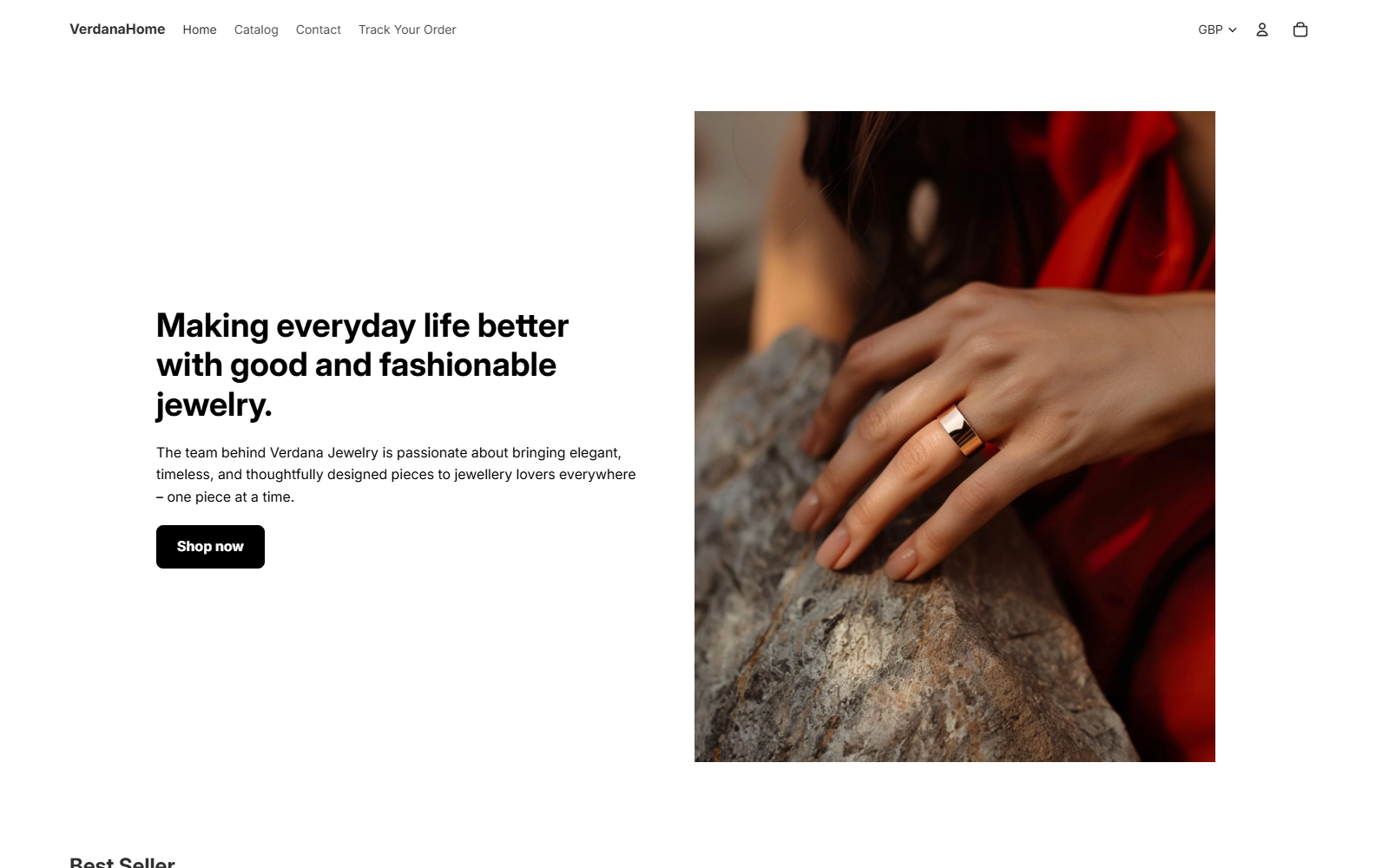
When visitors leave the dramatic advertorial and reach Verdana Home, the business presents itself as a general jewelry store.
The homepage speaks about fashionable pieces rather than operating as a specialist medical-device company.
That contrast matters. The sales article describes doctors, scientists, research, and advanced magnetic therapy, while the shop looks broadly retail-focused.
The same commerce operation also hosted marketing for an unrelated household pest product during our review.
A broad product catalog does not prove wrongdoing. It weakens the impression that HealthRing emerged from a dedicated medical research organization.
Consumers should judge the ring by verifiable evidence, not by an advertorial’s professional atmosphere.
Company, Address, and Fulfillment Checks
The named UK company is very young
Store information identifies MALUGINA DIGITAL LTD. UK Companies House records show company number 16993976, incorporated on January 28, 2026.
The company was active when checked but had not yet built a long filing history. Incorporation confirms registration, not product efficacy.
A company number cannot validate medical claims, review counts, manufacturing standards, or customer satisfaction.
The address is not proof of a laboratory
The registered address is 30 St. Mary Axe, London, EC3A 8BF. Many businesses can use serviced or shared office locations.
A registered office receives legal correspondence. It does not show that doctors, scientists, inventory, manufacturing, or support staff work there.
Do not confuse a prestigious London address with evidence of clinical research facilities.
Manufacturing information remains important
Buyers should ask where the ring is made, which metals are used, how magnet strength is measured, and whether safety testing exists.
The answer should identify the finished product, not provide a generic statement about quality.
For jewelry, material composition and plating durability are more relevant than vague claims about advanced technology.
Returns may go somewhere else
The registered office, dispatch warehouse, and authorized return center may be entirely different addresses.
Before mailing a return, obtain written authorization and the exact destination. Confirm whether tracked international postage is the customer’s responsibility.
Keep proof of delivery until the refund appears on the original payment method.
What to Do if You Have Fallen Victim to This Scam
- Save the medical claims. Capture the advertorial, named presenter, result figures, review count, discount, guarantee, and checkout total.
- Do not alter treatment. Continue prescribed care unless a qualified clinician advises otherwise. A magnetic ring should not replace medical guidance.
- Check the transaction records. Compare the merchant name, amount, currency, and item quantity with what you approved.
- Request a return promptly. Quote the 90-day promise and ask for the authorized address, tracking requirements, and full refundable amount.
- Document product differences. Photograph packaging, materials, markings, instructions, and any mismatch with the sales page.
- Escalate unresolved billing fairly. Tell the card provider exactly which promise failed. Supply screenshots, messages, and delivery evidence.
- Inspect suspicious ad behavior. If redirects installed anything or displayed fake alerts, scan the device with Malwarebytes and remove detections.
- Control repeated health ads. AdGuard can reduce tracking and deceptive promotional pages, though it cannot assess medical suitability.
Frequently Asked Questions
Is Verdana HealthRing a scam?
The strongest problem is unsupported medical marketing. A physical ring may arrive, but arrival would not validate the sweeping menopause claims.
Can a magnetic ring cause menopause weight loss?
We found no reliable product-specific clinical evidence showing that Verdana HealthRing produces meaningful menopause weight loss.
Is the doctor in the advertorial verified?
The page did not provide enough independent credentials, registration information, clinic details, or publications to verify the claimed connection with HealthRing.
What does the 47,263-women figure mean?
The advertorial does not provide sufficient methodology or a published dataset. The figure should not be treated as a clinical trial result.
Is MALUGINA DIGITAL LTD a real company?
Companies House lists it as an active UK company incorporated in 2026. Registration does not prove the ring’s advertised health benefits.
Can magnetic jewelry affect implanted devices?
Magnets can be relevant around certain implants and medical equipment. Ask the treating specialist or device manufacturer before wearing magnetic accessories.
The Bottom Line
Verdana HealthRing is ordinary-looking magnetic jewelry promoted through an extraordinary medical story.
That distinction matters.
The doctor-style presentation, enormous result figures, and broad menopause promises create authority without supplying the evidence needed to support those claims.
Do not buy it as treatment. Anyone considering the ring as jewelry should still verify materials, seller identity, return logistics, and the final charge.








