

A tiny black box that could win an entire Bitcoin block reward sounds irresistible. One Shot Miner builds its appeal around that improbable, technically possible moment.
The hardware appears to perform real hashing, but that is only the beginning of the buying decision. Price, probability, expectations, and return conditions matter far more.
Overview
Is One Shot Miner a real miner?
Yes, the entry-level device is marketed as a genuine solo Bitcoin miner. It makes guesses against the network’s mining problem rather than simulating activity.
That does not make it a practical income machine. Its computing power is microscopic beside industrial operations using specialized equipment at enormous scale.
The word “chance” does most of the work
Solo mining is winner-takes-all. If this little device happened to solve a block first, the operator could receive the block reward.
The same sentence hides the critical reality: an individual 1 MH/s miner is extraordinarily unlikely to do that. Possibility is not a meaningful earnings forecast.
What buyers are actually purchasing
For most owners, One Shot Miner is a hobby object, educational device, conversation piece, or always-running lottery ticket with electricity and network requirements.
Before ordering, understand these points:
- The basic model is measured around 1 MH/s, not industrial terahash levels
- The seller explicitly says rewards and income are not guaranteed
- The odds page says most users will never find a block
- Higher-priced models improve hashrate without creating predictable profit
- Returns are limited to 14 days and generally require an unused item
- Order cancellation may be available for only 60 minutes
The product is not automatically fraudulent because success is rare. The problem begins when advertisements let jackpot imagery overpower the statistical reality.
What One Shot Miner Actually Does
Bitcoin miners repeatedly test values while searching for a valid block hash. The network rewards the miner or pool that finds an acceptable result.
Mining power is measured in hashes per second. A million attempts sounds large until compared with a network performing an astronomical number each second.
The entry product advertises approximately 1 MH/s. That means around one million guesses per second under suitable conditions.
Modern Bitcoin mining hardware commonly operates in terahashes per second. One terahash equals one million megahashes, creating a vast performance gap.
One Shot Miner’s own explanation compares the experience with a lottery ticket. That comparison is unusually important because it frames the device honestly.
A buyer should therefore value the device without assuming any Bitcoin return. If the hardware itself is not worth the price, the jackpot should not rescue the purchase.
The Numbers Behind the Dream
Mining probability changes with global hashrate, difficulty, uptime, and the specific device’s actual performance. Any fixed lifetime-odds promise quickly becomes outdated.
The block subsidy shown in advertising can also change. Fees vary by block, and future halvings reduce the subsidy under Bitcoin’s established schedule.
A useful comparison begins with relative hashrate. The device’s share of the global total approximates its share of opportunities over long periods.
At 1 MH/s, that share is effectively invisible beside hundreds of exahashes. Randomness means a result is possible, not that waiting eventually guarantees one.
The “someone has to win” intuition is misleading. Industrial miners and pools hold overwhelmingly more tickets in every round.
Buying several units multiplies a tiny probability by the number purchased. Multiplication can still leave the practical chance extremely close to zero.
Electricity consumption may be low for the smallest model, but profitability also includes purchase price, connection stability, maintenance, and the opportunity cost of money.

How the One Shot Miner Offer Works
Step 1: The advertisement leads with the jackpot
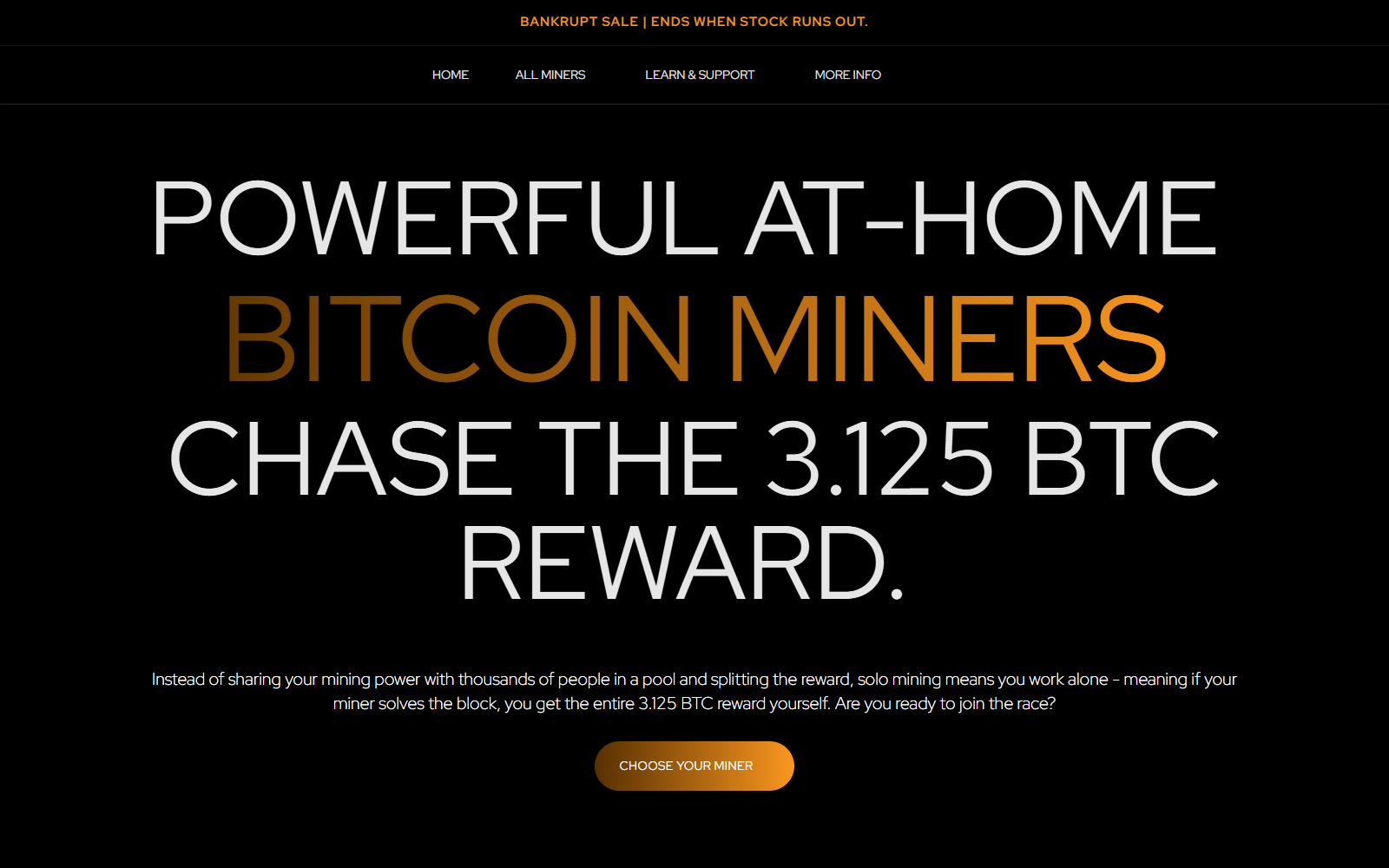
The strongest visual message is the 3.125 BTC reward. That figure naturally attracts more attention than hashrate, network difficulty, or expected value.
A viewer may remember the prize while forgetting the qualifying language. This imbalance is common in lottery-style marketing, even when disclaimers technically exist.
Step 2: The small device makes mining feel accessible
The product is simple enough for a desk and does not resemble a noisy industrial machine. Ease of use lowers the psychological barrier to buying.
That accessibility is real, yet convenience does not improve mathematical competitiveness. A friendly interface changes setup, not the network’s probability distribution.
Step 3: The entry price opens the funnel
The basic unit may appear inexpensive beside ordinary mining hardware. Once shoppers imagine the jackpot, the modest starting price can feel like harmless entertainment.
The store then presents bases, faster miners, bundles, and quantity deals. Each upgrade is framed as another increase in winning chances.
Step 4: Upsells turn probability into spending
A faster unit genuinely submits more hashes. However, the sales language can make relative improvement sound more valuable than the absolute chance warrants.
Twelve times an extremely remote possibility remains extremely remote. Buyers need the final probability, not only a multiplier detached from its starting point.
Step 5: The device runs continuously
After configuration, the miner joins solo-mining infrastructure and repeatedly submits work. A dashboard may show hashrate, uptime, and accepted shares.
Those indicators prove activity, not earnings. Shares can demonstrate participation without representing a claim on a pooled reward.
Step 6: Return limits arrive after experimentation
The published policy gives buyers 14 days after receipt, but eligibility generally requires the item to remain unused and in original condition.
The policy also mentions deductions when a product shows mining, configuration, or installation activity. That creates tension for anyone who discovers limitations by testing it.
Sale items are described as non-returnable. The site simultaneously uses prominent sale messaging, so shoppers should ask for written eligibility before purchasing.
Why This Is Not Conventional Cloud-Mining Fraud
Many mining scams sell nonexistent hashrate through dashboards displaying fabricated daily earnings. Victims deposit cryptocurrency but cannot withdraw their supposed balance.
One Shot Miner differs because it offers physical hardware and openly describes solo mining. Its odds page admits that most customers will never hit a block.
That distinction matters. Calling every low-probability product a scam would erase the difference between disclosed entertainment and concealed financial fraud.
Still, third-party advertisements may not preserve the seller’s nuance. Affiliates can lead with earnings language, “passive income,” or selective screenshots that create stronger expectations.
Evaluate the exact advertisement you saw. Save it before buying because social posts and video captions can change or disappear.
If an ad guarantees profit, daily Bitcoin, or quick payback, that promise conflicts with the site’s own disclaimer and the economics of a small solo miner.
Return, Cancellation, and Warranty Concerns
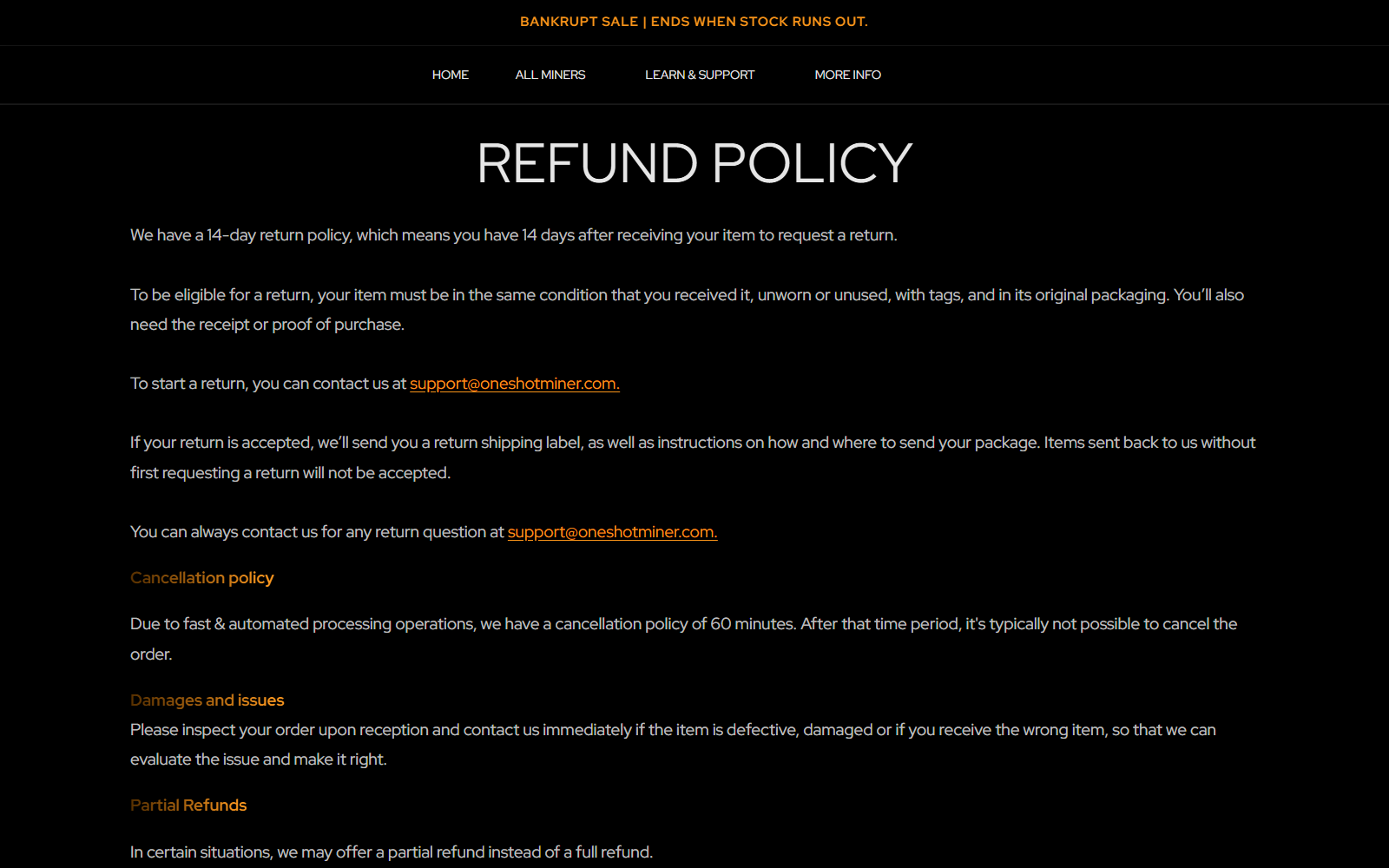
The current refund policy states a 14-day window. It requires an item in the condition received, with original packaging and proof of purchase.
A separate cancellation paragraph allows approximately 60 minutes before automated processing usually prevents cancellation. That is a narrow interval for reconsidering an impulse order.
The site advertises lifetime warranty language near shopping areas. Buyers should request the complete warranty terms, covered failures, exclusions, and shipping responsibilities.
Refund text says an accepted return receives a shipping label. Confirm whether the label cost is deducted and whether sale status affects eligibility.
The policy permits partial refunds for signs of mining activity, missing packaging, or other loss of value. Photograph the unopened parcel and every component.
Do not configure the device until support confirms in writing that testing will not eliminate your return rights. Keep that response with the order records.
Who Might Enjoy It, and Who Should Avoid It
A technically curious buyer may enjoy observing real Bitcoin mining without expecting revenue. The experience can illustrate networking, probability, and proof-of-work concepts.
A collector may also value the object as novelty hardware. That judgment is personal and does not depend on winning a block.
Avoid the purchase if you need reliable income, predictable payback, or a replacement for ordinary investing. The entry device cannot reasonably serve those goals.
People vulnerable to gambling behavior should be especially careful. Continuous “one more ticket” thinking can turn hardware upgrades into repeated speculative spending.
Parents buying for education should explain that dashboard activity is not money earned. Set a fixed budget and resist bundle pressure.
Anyone confused by wallet security, pool settings, or network configuration should learn those basics before connecting hardware to a cryptocurrency address.
How to Evaluate a Small Miner Without the Jackpot
Begin with verified hashrate at the wall, not the largest number in the product name. Independent measurements should include stability over several days.
Ask which chip is inside, what firmware runs, and whether the buyer controls pool and wallet configuration. Closed settings can limit educational usefulness.
Measure power consumption with an outlet meter. Even a low-watt device has a real annual cost when operating continuously.
Consider heat and noise in the intended room. Desktop hardware can become irritating if a small fan runs beside a bed or workspace.
Check whether the device supports standard solo pools or requires infrastructure controlled by the seller. Dependency can make hardware useless if that service closes.
Review firmware-update procedures and signatures. Cryptocurrency devices connected to local networks deserve the same security scrutiny as other Internet-connected equipment.
Do not enter a wallet seed phrase during setup. A miner needs a payout address, which can be shared without revealing spending keys.
Compare the purchase with an open-source hobby miner using the same chip. Documentation, community support, and repairability may matter more than presentation.
Calculate entertainment cost per month across the period you expect to use it. That produces a more honest budget than imagined Bitcoin earnings.
For investment exposure, buying cryptocurrency carries different risks but avoids pretending a novelty device has predictable mining economics.
For education, a simulator or shared pool may demonstrate concepts more clearly. Pool payouts show proportional contribution, while solo mining usually shows only activity.
Ask whether the dashboard distinguishes accepted work from a valid block. Confusing those measurements can make ordinary operation feel like accumulating rewards.
Finally, decide your maximum total spend before viewing bundles. Probability-based upsells are most persuasive after the first purchase feels emotionally committed.
A useful miner purchase remains satisfying after assuming zero payout. If that statement feels unacceptable, the product does not fit your goal.
Company, Address, and Fulfillment Checks
Identify the contracting seller
The storefront names One Shot Miner, yet its terms largely use the brand rather than presenting a clearly emphasized legal entity. Save the checkout receipt and descriptor.
Check the listed physical address
The site currently lists 1900 W Kirkwood Boulevard in Southlake, Texas. Confirm what operates there and whether returns are actually accepted at that location.
Test support before paying
Email support@oneshotminer.com with specific questions about used returns, sale exclusions, warranty shipping, and the card-statement name. Preserve the reply.
Confirm where the order ships and returns
A mailing address, warehouse, and legal headquarters can be different places. Obtain the authorized return destination before sending any parcel.
What to Do if You Have Fallen Victim to This Scam
This section applies when an advertisement guaranteed earnings, an unauthorized seller took payment, or the delivered product materially differed from the offer.
- Save the complete promotion. Capture the ad, landing page, stated hashrate, jackpot language, price, bundle selection, and every earnings claim.
- Compare the confirmation carefully. Check quantity, add-ons, shipping, taxes, and card descriptor. Report an incorrect order immediately.
- Use the seller’s written process. Contact support within 14 days, obtain authorization, and ask whether setup or sale status changes eligibility.
- Keep the hardware unchanged. Stop mining, preserve packaging, photograph serial numbers, and do not modify firmware while a return is being discussed.
- Dispute factual misrepresentation. If guaranteed income or false specifications drove the sale, show your bank the saved promise and seller response.
- Secure cryptocurrency information. Move funds if you disclosed a seed phrase. A mining seller never needs your wallet recovery words.
- Remove suspicious software. Run Malwarebytes if an unofficial installer, browser extension, or remote-access program accompanied the order.
- Block malicious promotions. AdGuard can reduce exposure to known deceptive advertising domains, but continue checking each seller independently.
- Report impersonators. Notify the legitimate brand when another site copies its name, and report the fraudulent page to its host and payment provider.
Frequently Asked Questions
Can One Shot Miner really win Bitcoin?
A working solo miner can theoretically find a block. For the smallest device, the practical probability is extraordinarily low and no reward is assured.
Is One Shot Miner passive income?
No. The seller disclaims guaranteed income, and the entry hashrate is not a credible foundation for predictable returns.
Does buying more miners guarantee a win?
No. Additional hashrate raises relative odds, but it cannot turn a remote random outcome into a guaranteed result.
Is the device the same as cloud mining?
No. It is physical hardware intended to perform hashing. Cloud-mining offers usually sell remote capacity controlled by someone else.
Can I return a configured miner?
The policy mentions possible deductions for configuration or mining activity. Obtain written approval and exact return terms before setting it up.
What should I calculate before ordering?
Compare hashrate, network scale, total cost, electricity, return restrictions, and the value of the hardware if it never earns anything.
The Bottom Line
One Shot Miner appears to be real hobbyist hardware, not a guaranteed-income machine. Its own odds page describes a lottery-like experience that most users never win.
Buy only if the device itself justifies the price as entertainment or education. Do not let a dramatic Bitcoin reward substitute for probability, policy, and budget.








