

Animated Christmas lights are easy to imagine in a finished room. One glowing tree can make a social-media offer feel joyful, simple, and surprisingly urgent.
PineGlow sells that picture through a very new storefront. We checked the store’s history, pricing, contact trail, claims, and the protections shoppers can actually verify.
Overview
The product idea is plausible, but the store is extremely new
PineGlow advertises app-controlled animated Christmas tree lights with themed effects, multiple designs, and a controller included in the package.
Official domain records show thepineglow.com was registered on September 16, 2026. We reviewed the site only nine days later.
A new domain does not prove fraud. It does mean the storefront cannot demonstrate years of operating history under that web address.
The sales page presents a much larger customer history
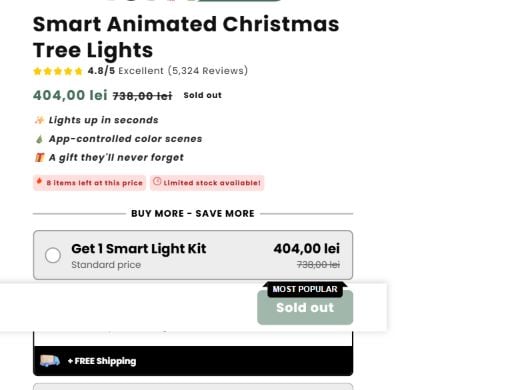
The product page displayed a 4.8/5 rating from 5,324 reviews, “4,800+ happy customers,” and more than 100 orders in the previous 24 hours.
We could not independently authenticate those exact totals. They appear on a store that had existed under its current domain for barely more than a week.
That contrast is a meaningful warning because review volume is used to reassure buyers who have never heard of the brand.
Contact and company information are unusually limited
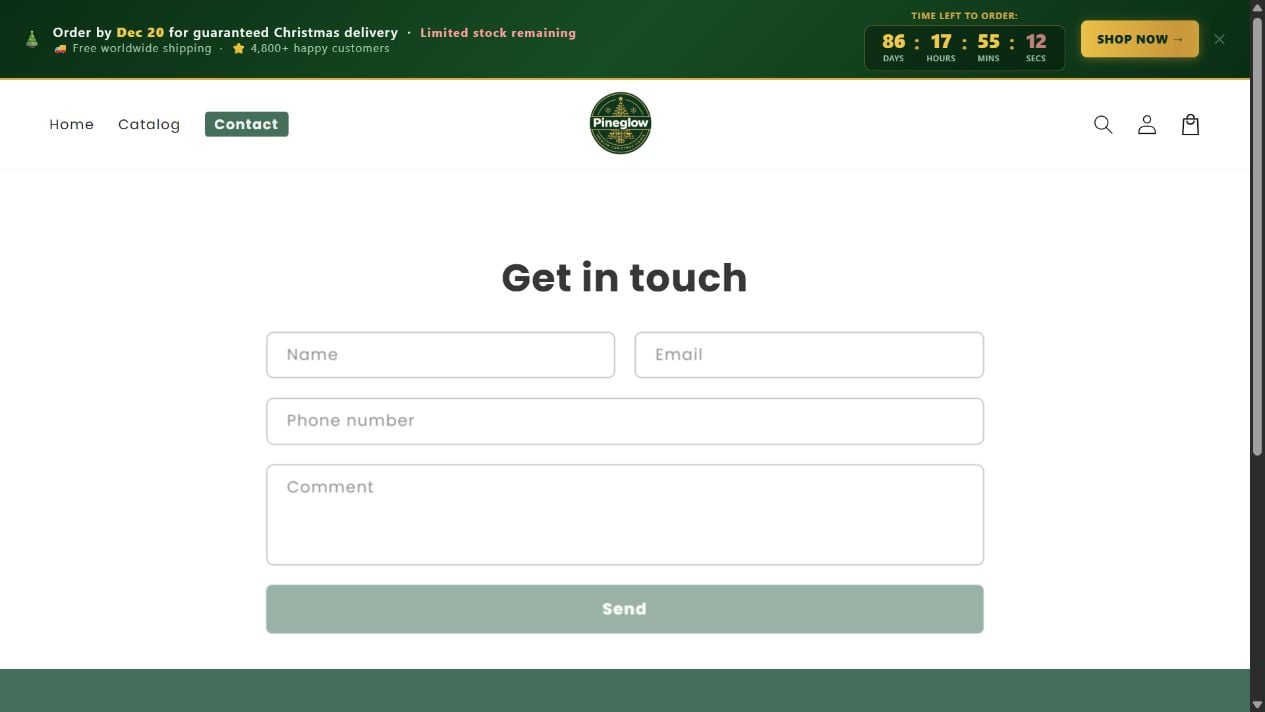
The public contact page provides a form for a name, email, telephone number, and message.
It does not visibly provide a customer-service email, public telephone number, legal company name, office address, or returns location.
If delivery or refund problems occur, a form-only contact route gives the customer fewer independent ways to identify or reach the operator.
- Thepineglow.com was registered on September 16, 2026.
- The site sells a plausible smart-light product through Shopify.
- The page displays thousands of reviews and strong recent-order claims.
- Those customer totals could not be independently verified.
- The visible contact page contains only a web form.
- The product was marked sold out during our review.
Is PineGlow a Scam or a Real Store?
PineGlow is a functioning online storefront with a product page, cart controls, contact form, and Shopify infrastructure.
That proves a website exists. It does not prove the seller has fulfilled the displayed order volume, owns unique technology, or will handle every dispute smoothly.
The product itself resembles a category sold by numerous retailers: addressable LED strings controlled through an app or small controller.
We found no basis to claim that every PineGlow order is fictitious. We also found too little independent history to treat the store’s confidence signals as established.
The short domain age, unverifiable review totals, aggressive urgency, and thin company identity create a high-risk buying situation.
Our assessment is therefore caution, not a claim of proven criminal fraud. Buyers should wait for independent fulfillment evidence or use a retailer with stronger protections.
This distinction matters. A product can arrive and still be overpriced, generic, poorly supported, incompatible, or difficult to return.
Likewise, a new legitimate store can improve its disclosures. The current site simply does not provide enough history or accountability for easy trust.
What the PineGlow Page Promises
The seller calls the product “Smart Animated Christmas Tree Lights” and says buyers can control colors and scenes through a phone.
The promotional image shows animated holiday characters, a controller, light strands, a power adapter, extension cable, ties, and a guide.
The site uses bundle pricing. During our review, one kit appeared at 404 lei, while larger selections promised per-unit savings.
The page also displayed a crossed-out 738 lei reference price. A reference price should reflect a genuine comparison, not merely make the current offer look larger.
Urgency appeared throughout the page through limited-stock notices, items-left messages, an order timer, and claims about recent purchases.
These devices do not tell buyers whether the LEDs match the video, how many pixels are included, or which app handles control.
Important technical questions include string length, voltage, weather resistance, tree size, supported phones, app permissions, warranty, and replacement-part availability.
A visually impressive animation can require careful installation and a specific viewing angle. Advertising clips rarely show setup failures, tangled wiring, or app problems.
How the Sales Funnel Works
Step 1: A short video sells the finished transformation
Social advertisements focus on the final tree, not the installation. Characters appear to move across lights while music and quick cuts create a polished reveal.
The emotional promise is larger than illumination. The buyer is shown a memorable family moment and an easy way to make ordinary decorations feel special.
That framing encourages an impulse purchase before technical compatibility enters the conversation.
Step 2: The landing page layers several forms of social proof
The page combines a high rating, thousands of reviews, happy-customer claims, buyer avatars, and recent-order counters.
Each element seems to answer the same fear: “Other people bought this, so the store must be safe.”
When a domain is only days old, those numbers deserve documentary support through dated, independently hosted customer histories.
Step 3: Urgency narrows the time available for research
A countdown, delivery deadline, low-stock label, and limited-price message encourage buyers to finish before examining the operator.
The product was marked sold out during our review, while surrounding urgency language remained visible.
Timers and inventory messages can be automated. Their presence does not prove that a warehouse contains only the displayed quantity.
Step 4: Bundle pricing raises the order value
The store invites buyers to purchase multiple kits through “buy more, save more” choices.
That can be useful for several trees, but it also multiplies the loss if the item disappoints or the seller becomes difficult to reach.
A customer should test one unit before ordering extras unless the return process and seller history are exceptionally strong.
Step 5: The operator remains behind a contact form
After the polished product presentation, the contact page offers fields and a send button without a visible legal identity.
This forces customers to trust that an unknown recipient monitors the form, preserves submissions, and responds consistently.
There is no public telephone number to call and no displayed email that can be independently saved before purchase.
Step 6: The payment processor can look safer than the merchant
Recognizable card and wallet logos may appear near the order button. Those logos identify possible payment methods, not a guarantee of merchant performance.
Shopify provides commerce infrastructure. It does not independently endorse every product claim, review total, shipment, or refund decision made by a store.
Buyer protection depends on the payment method, local law, evidence, dispute timing, and what the checkout actually promises.
Step 7: The store can disappear or rebrand more easily than the product category
Generic electronic products can be sold under changing names, package designs, and domains while using similar videos.
If PineGlow disappears, an identical light string may appear through another storefront with a new logo and another large review count.
That is why buyers should document the legal seller and transaction, not rely solely on the product name.
Domain Age and Review Claims
Thepineglow.com was registered through Hostinger Operations, UAB on September 16, 2026, with a one-year registration period shown in official RDAP data.
The expiration date does not predict whether the store will close. One-year registrations are common and should be treated as context, not proof.
The stronger concern is the store’s claimed scale during its first days. Thousands of reviews normally require a meaningful customer and sales history.
The site may be presenting reviews gathered elsewhere, imported from another product, or generated through a review application. The page does not make that provenance clear.
We did not independently verify 5,324 PineGlow purchasers associated with the current domain.
A credible store could explain when the brand began, where earlier reviews originated, how purchases were verified, and which entity traded before the current domain launched.
Without that explanation, shoppers cannot tell whether the figures represent PineGlow customers, a similar generic product, or marketing data controlled by the seller.
Product Quality and Compatibility Questions
The page emphasizes scenes and effects, but a smart-light purchase also depends on specifications that rarely look exciting in an advertisement.
Buyers should know the number of LEDs, cable length, tree coverage, voltage, plug type, app name, wireless standard, and operating-system requirements.
They should also confirm whether the product is intended for indoor use, outdoor use, or both.
An unfamiliar app can create privacy and security questions. Check who publishes it, what permissions it requests, and whether updates are maintained.
Electrical markings and local plug compliance matter. A decorative product still connects to mains power through an adapter.
Ask whether replacement controllers, adapters, or light sections can be purchased. A single failed component can make an entire proprietary system unusable.
Do not rely on a video to judge brightness, color accuracy, animation smoothness, or tree coverage. Camera settings can exaggerate contrast and saturation.
Company, Address, and Fulfillment Red Flags
No legal company is prominently identified
The storefront uses the PineGlow name, but we did not find a visible legal entity on the contact page.
Do not confuse the unrelated pineglow.com or similarly named registered companies with the operator of thepineglow.com without documentary proof.
The contact page provides no direct public channel
The form collects the customer’s name, email, telephone number, and message. It does not reveal the recipient’s public email or phone number.
If the form fails, the buyer may have no independent record that a message reached the store unless a confirmation email arrives.
The returns destination is not visible before purchase
A buyer cannot estimate return postage or jurisdiction without knowing where rejected items must be sent.
A later warehouse address would identify fulfillment only. It would not automatically reveal the owner, product manufacturer, or decision-maker handling refunds.
Manufacturing origin is unverified
The product resembles electronics sold through global supply chains, but resemblance is not proof of a specific factory or country.
We found no reliable basis to state that PineGlow units are manufactured in China. Buyers should request the maker, model, certification, and importer details.
What to Do if You Have Fallen Victim to This Scam
- Preserve the advertisement and checkout. Save the product video, specifications, price, quantity, delivery promise, return policy, confirmation, and card descriptor.
- Contact the seller through every available official route. Use the form and reply to the order confirmation. Request a written response and keep submission receipts.
- Document the delivered item. Record the unopened parcel, shipping label, unboxing, components, model numbers, damage, and any difference from the advertisement.
- Do not improvise with unsafe electrical parts. Stop using a hot, damaged, sparking, or incorrectly rated adapter and seek qualified advice.
- Request the precise remedy. State whether you want missing parts, replacement, cancellation, or refund. Ask for the authorized return address before shipping.
- Open a payment dispute within the deadline. Explain non-delivery, material misrepresentation, unauthorized quantity, or an unhonored refund using your saved evidence.
- Review the app and network. Remove an unknown controller app if it requests excessive permissions. Malwarebytes can check the device, while AdGuard reduces malicious ads and redirects.
- Report deceptive promotion. Notify the advertising platform and relevant consumer-protection agency when social proof, scarcity, or product claims appear materially false.
A Safer Way to Buy Smart Christmas Lights
Choose a retailer with a verifiable legal identity, established trading history, direct support channels, and a return address visible before purchase.
Search the exact product image and specifications. Generic items often appear through multiple sellers at very different prices.
Read low-rated independent reviews for app failures, connectivity problems, missing components, unsafe adapters, slow delivery, and refund experiences.
Use a credit card or another payment method with meaningful dispute rights. Avoid bank transfers, cryptocurrency, gift cards, and person-to-person payments.
Start with one kit. A bundle discount is not a saving when several unsuitable products arrive.
Keep the packaging until the lights have been tested safely and all advertised functions work.
Photograph connectors and controller labels before installation. Those details help identify compatibility, replacement parts, and the actual manufacturer if support becomes unavailable.
Frequently Asked Questions
Is PineGlow definitely a scam?
We cannot establish definitive fraud from the available evidence. The store is extremely new and lacks the transparency needed for confident purchasing.
When was thepineglow.com registered?
Official RDAP records show a registration date of September 16, 2026, only nine days before our review.
Are the 5,324 PineGlow reviews verified?
We could not independently authenticate that exact review total or connect it to purchases made through the current domain.
Is PineGlow the inventor of animated tree lights?
The product belongs to a broader category of app-controlled addressable lights. The page does not establish that PineGlow invented the underlying technology.
Does Shopify guarantee the order?
No. Shopify supplies store infrastructure. It does not guarantee merchant honesty, product quality, delivery, review authenticity, or refunds.
What is the biggest warning sign?
The sharp mismatch between a days-old domain and thousands of claimed reviews is the clearest reason to slow down and demand independent proof.
The Bottom Line
PineGlow may sell a functioning smart-light kit, but the current storefront asks buyers to trust a large customer history that we could not verify.
With a days-old domain, form-only contact, unclear operator, and intense urgency, waiting for independent evidence is the safer choice.








