

TheraWolf Pain Relief Balm has been appearing across social media and search results with promises of fast relief for joint, knee, back and muscle discomfort. Anyone who tries to research the product, however, quickly encounters something unusual: dozens of pages claiming to offer TheraWolf reviews, consumer reports, special discounts or access to an “official website,” many of them published on unrelated platforms rather than established health or consumer-review sites.
The balm itself is a real product, and many customers report positive experiences with it. The more important question is what happens around the purchase. Our investigation found recurring subscription options, a checkout funnel that customers repeatedly describe as heavy on upsells, affiliate campaigns paying substantial commissions for completed sales, unusually aggressive health claims and marketing terms that explicitly allow some promotional visuals to be created or modified with artificial intelligence.
None of these findings by itself proves that TheraWolf is a scam. Together, however, they explain why buyers should look beyond the advertisements and understand exactly what they are agreeing to before entering their payment information.
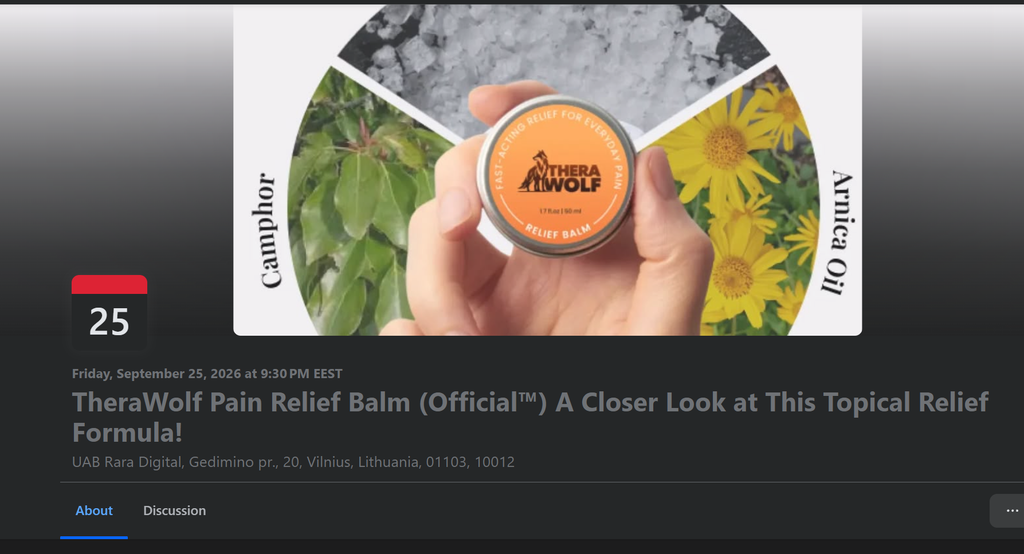
Overview of TheraWolf Pain Relief Balm
TheraWolf is marketed as a topical balm for people experiencing everyday joint and muscle discomfort. The main Therawolf.com sales page promotes it for areas including the knees, shoulders, back, neck, elbows, hips, wrists and ankles, while highlighting ingredients such as MSM and various botanical components.
The marketing language goes considerably further than simply describing a cooling or soothing balm. At the time of our review, the site displayed the claim that “89% of Customers Got Pain-Free” and described the formula as providing fast, lasting pain relief while reducing inflammation “at the source.” MSM is presented as an ingredient that helps reduce joint swelling and tenderness while supporting connective tissue repair.
These are meaningful health-related claims, particularly because consumers suffering from chronic knee, back or joint pain may interpret them as evidence that the product can address the underlying cause of their discomfort rather than simply produce a temporary soothing sensation.
TheraWolf’s own legal language is noticeably more cautious. Its current Terms and Conditions state that the products are not intended to diagnose, treat, cure or prevent a disease or medical condition and, for U.S. consumers, say that neither the products nor statements about them have been evaluated by the FDA.
That difference between promotional language and legal disclaimers does not automatically establish that the advertising is unlawful, but it is an important distinction for buyers. The FTC’s guidance for health-related products says marketers must have appropriate scientific substantiation for objective health claims, including claims conveyed indirectly through testimonials and other advertising.
How the TheraWolf Sales Funnel Works
The most useful way to understand TheraWolf is not to look only at the jar being advertised, but at the larger sales system built around it. The product is promoted through social advertising, advertorial-style pages, search content and affiliate offers, after which customers can encounter subscription pricing and additional offers during the checkout process.
This type of direct-response funnel is not inherently illegitimate. Many established ecommerce companies use subscriptions, quantity discounts and post-purchase offers. The concern arises when customers do not clearly understand which option they selected, how often they will be billed or whether an additional screen is offering another product rather than simply continuing the checkout.
TheraWolf’s own terms confirm that subscriptions are part of the business model. According to the current subscription section, enrolling creates repeating orders at the frequency, quantity and price displayed during checkout, while the customer’s payment method can continue to be charged until the subscription is canceled.
The same terms also contain a provision that deserves careful attention. Where specifically disclosed during checkout, a subscription may include a minimum commitment period or a minimum number of deliveries. If a customer cancels before fulfilling that commitment, the terms say the company may, where legally permitted, adjust previously delivered products to the regular non-discounted price and charge the resulting difference.
This makes it especially important to distinguish between a discounted subscription price and a genuine one-time purchase price. A shopper focused primarily on the percentage discount displayed in an advertisement may not initially be thinking about what will happen 30, 60 or 90 days later.
Recurring billing is not simply a theoretical concern
Customer feedback shows why this matters. Trustpilot currently lists hundreds of TheraWolf reviews and an overall score of approximately 4.2 out of 5, with many buyers reporting positive experiences. At the same time, some reviewers describe recurring orders that they say they did not expect or did not intend to activate.
One recent reviewer said they had tried not to select a subscription when placing the first order, only to receive an email months later stating that another shipment was on the way and that their account had been charged. This is a customer’s account of what happened and cannot independently establish what was selected during the original checkout, but it becomes relevant because TheraWolf’s own terms confirm that recurring subscription billing is an active part of the sales system.
For that reason, anyone ordering the balm should verify whether the checkout says One-Time Purchase, Subscribe & Save, Recurring Order, or similar wording instead of assuming that the lowest advertised price applies to a single shipment.
Customers Repeatedly Mention Checkout Upsells
One of the clearest patterns in independent customer feedback has less to do with the balm itself and more to do with what happens after a buyer starts placing an order.
Trustpilot’s current summary of TheraWolf reviews notes that some customers complain about numerous add-on screens, confusing promotional offers and unexpected extra charges during the ordering process. Several otherwise positive reviews make essentially the same point: the initial purchase was straightforward, but the sequence of subsequent offers made the checkout frustrating or difficult to follow.
For example, one customer who rated the company positively still complained that “window after window” appeared offering additional items after the initial order. Another reviewer said the “No Thank You” option could have been displayed more prominently, while another warned future shoppers to read carefully if they wanted only the original TheraWolf product.
TheraWolf’s responses to those reviews provide useful confirmation that these extra offers are part of the checkout experience. The company describes them as optional special offers that customers can decline and says shoppers choose which additional products they want to include.
That clarification is important because it would be inaccurate to state as fact that TheraWolf automatically inserts products into every customer’s order. What we can establish is that the checkout contains multiple optional upsells, that TheraWolf acknowledges those offers exist, and that a meaningful number of customers say they found the presentation confusing.
Some complaints go further and allege unwanted quantities
A smaller but more serious group of reviews claims that customers were ultimately charged for more products than they intended to purchase.
One reviewer said she wanted two tins of balm but ended up with numerous additional products and a total charge exceeding $180. TheraWolf disputed the implication that products were inserted automatically, responding that optional products require active selection and confirmation before an order is finalized.
Another reviewer alleged that products had been added and that a subscription had been created without permission. In its response, TheraWolf again stated that its system does not create orders or charges without customer confirmation and said the case had been forwarded for investigation.
Without access to the actual checkout records for those customers, we cannot determine exactly what was clicked in each case. The practical takeaway is nevertheless straightforward: shoppers should not move quickly through the additional offer screens, and they should check both the quantity and total amount before considering the purchase complete.
Why So Many “TheraWolf Reviews” Are Suddenly Appearing Online
The search results around TheraWolf are almost as interesting as the checkout.
Searching for the product produces a large number of pages with variations of phrases such as TheraWolf Reviews 2026, TheraWolf Official Website, Consumer Report, Real Facts Revealed, Is TheraWolf Worth It?, and TheraWolf Complaints.
Many of these are not conventional product reviews published by established health or consumer publications. Promotional material has appeared on Facebook pages and groups, Google Groups, Google Sites, Blogspot, Jotform, Wanderlog, Firstory, Sutori, Daily.dev, Experiment.com, Jimdo and other platforms where users can publish their own content.
Finding the same product discussed on many different domains can create the impression that a broad group of independent reviewers has investigated it. In reality, multiple pages can belong to the same promotional ecosystem, use very similar sales language and ultimately direct visitors toward an affiliate purchase funnel.
The financial incentive behind this activity is not difficult to find.
Affiliates can earn substantial commissions from TheraWolf sales
An active affiliate listing for TheraWolf Neuro Balm Subscription – Advertorial shows a $70 CPA payout, meaning the affiliate can receive $70 when referred traffic produces a qualifying sale. The listing identifies Social, Banner, Native, Push, SEO, Search and Brand Bidding among the permitted traffic sources.
The same affiliate marketplace also lists related TheraWolf offers with different payouts, including non-subscription and subscription versions.
A $70 commission creates a powerful incentive to capture searches from people already researching the product. An affiliate that ranks for “TheraWolf reviews” or attracts social-media users with a compelling advertorial can potentially earn considerably more from a conversion than a normal display-ad publisher would earn from the same visitor.
This helps explain why so many pages are written around high-intent phrases such as reviews, official website, complaints, scam, consumer report, and where to buy. Those keywords are especially valuable because the person searching them is often already close to making a purchasing decision.
It also means consumers should not assume that an article is independent merely because its headline sounds skeptical. A page titled “TheraWolf Reviews: Is It Really Worth the Money?” can still be designed primarily to move the reader toward a commission-generating purchase.
The Affiliate Rules Reveal an Important Contradiction
The affiliate listing is particularly interesting because the campaign’s stated restrictions appear designed to prevent some of the most misleading tactics associated with aggressive direct-response advertising.
The listed restrictions prohibit false claims, brand impersonation, fake inventor stories and claims that an affiliate page is the official site. Fake or false celebrity endorsements are also explicitly prohibited.
Yet consumers researching TheraWolf can find third-party pages and social profiles using “Official Website” language even though they are clearly not Therawolf.com.
That does not prove that TheraWolf created those pages, approved them or even knows they exist. In fact, the affiliate restrictions suggest that at least this particular program does not want publishers misrepresenting themselves as the official brand.
What it does show is one of the weaknesses of affiliate-heavy marketing. Once a product is being promoted by many outside publishers who have a financial incentive to generate sales, the company behind the product is no longer the only party creating advertising about it.
A consumer can therefore encounter claims, testimonials or “official” pages produced by marketers several steps removed from the actual seller.
AI-Generated Marketing Is Specifically Mentioned in TheraWolf’s Terms
Artificial intelligence adds another complication because highly realistic testimonials, demonstrations and product images can now be produced without traditional photography or filming.
TheraWolf’s current Terms and Conditions contain a surprisingly explicit disclosure covering this issue. They state that certain images, videos or visual representations used for marketing, demonstration or visualization may be digitally enhanced, edited, stylized, staged, computer-generated or created using artificial intelligence or similar technology.
The wording does not establish that every TheraWolf Facebook or Instagram ad is AI-generated, nor does it mean that a specific testimonial is automatically fake. It does mean, however, that consumers should not assume that every visual appearing in promotional material is an untouched recording of a real customer using the exact product shown.
This distinction becomes particularly important with health products because advertising often relies heavily on emotional demonstrations. A video may show someone struggling to walk, rubbing balm onto a knee and then appearing dramatically more comfortable, while a voiceover makes claims about inflammation, circulation or pain relief.
Whether that presentation is created with actors, stock footage, editing tools or AI does not by itself determine whether the underlying product works. What matters is whether the objective claims being communicated are truthful and supported by appropriate evidence.
The FTC specifically says health-related advertising must be truthful, not misleading and supported by competent and reliable scientific evidence. The agency also makes clear that marketers cannot avoid those requirements simply by communicating a claim through a testimonial rather than stating it directly.
TheraWolf’s Health Claims Deserve Careful Scrutiny
The strongest reason to examine TheraWolf marketing carefully is not the existence of affiliates or AI technology. It is the strength of some of the health claims being made.
The main sales page currently says “89% of Customers Got Pain-Free” and promotes the balm as delivering fast, lasting relief while reducing inflammation at the source. It also describes ingredients in terms of joint swelling, connective tissue repair and recovery.
Those statements can sound much more substantial to someone suffering from arthritis or persistent joint pain than a conventional claim that a topical balm temporarily soothes sore muscles.
At the same time, TheraWolf’s legal terms say that the products are not intended to diagnose, treat, cure or prevent diseases or medical conditions. For U.S. buyers, the terms further state that neither the products nor statements regarding them have been evaluated by the FDA.
The presence of a disclaimer does not automatically invalidate the marketing claims, but consumers should not treat impressive percentages or references to individual ingredients as equivalent to proof that the finished balm has been clinically demonstrated to produce those same results.
FTC guidance is particularly relevant here. The agency explains that marketers need appropriate substantiation for health benefits before publishing them and warns that evidence concerning one ingredient may not necessarily establish that a finished multi-ingredient product delivers the advertised benefit.
In practical terms, a statement such as “this ingredient has been studied” is different from demonstrating that the exact TheraWolf formula, used according to its directions, produced a specific level of pain relief in a properly designed clinical trial.
What Do Real TheraWolf Customer Reviews Say?
TheraWolf’s Trustpilot profile offers a much more mixed picture than the promotional pages circulating through search results.
At the time of our investigation, the profile showed 681 reviews and a TrustScore of 4.2 out of 5. Approximately 57% of reviews were rated five stars, while 10% were one-star reviews. Trustpilot also notes that reviews are individual user opinions and that the company has responded to a large proportion of negative feedback.
Many customers say they are pleased with the balm, with some reporting that it helped ease everyday joint or muscle discomfort. Others praise the website, delivery or customer service.
Negative and mixed reviews, however, repeatedly return to the same purchasing issues. Buyers describe excessive additional offers, small decline options, difficulty understanding what was included and, in some cases, unexpected quantities or recurring orders.
That mixture of feedback is more informative than a collection of affiliate articles in which almost every path eventually leads to a purchase button.
It is also important not to overstate what customer reviews can tell us. Positive testimonials do not prove clinical efficacy, just as one negative review does not prove the company deliberately charged someone without permission. Reviews are most useful here because recurring patterns can reveal friction points in the buying experience, and TheraWolf’s checkout upsells are one such pattern.
Is TheraWolf Pain Relief Balm a Scam?
Based on the evidence we reviewed, describing the entire TheraWolf operation simply as a fake-product scam would go beyond what the available evidence supports.
The product exists, customers report receiving it, and the company’s Trustpilot profile contains hundreds of reviews spanning both positive and negative experiences. Therawolf.com also publishes detailed terms covering payments, subscriptions, cancellation and product use.
The concerns are more nuanced and, for a potential buyer, arguably more useful.
TheraWolf operates within a direct-response marketing system in which discounted subscription offers can generate recurring charges, customers encounter multiple additional offers during checkout, affiliates can receive substantial commissions for generating sales, and large amounts of promotional content compete for search terms that consumers normally use to find independent reviews.
The company’s sales page also makes substantial claims about pain and inflammation, while its legal terms use far more restrained language and explicitly state that the products are not intended to diagnose, treat, cure or prevent medical conditions.
None of that proves that a customer will have a bad experience. It does mean that buying TheraWolf requires more attention than simply clicking the first “Official Website” link appearing in a search result or social-media post.
What to Do Before Ordering TheraWolf
If you decide to try the product, the safest approach is to treat the purchase like any other subscription-capable direct-response offer and document exactly what you are agreeing to.
1. Make sure you know which website you are using
Do not assume a page is official because its headline, Facebook page name or Google title contains the words “Official Website.”
Affiliate publishers are financially motivated to attract people searching for the product, and the TheraWolf affiliate rules themselves specifically prohibit affiliates from claiming to be the official site.
2. Check whether the price requires a subscription
Before entering payment information, identify whether you are buying once or enrolling in recurring deliveries. TheraWolf’s terms confirm that subscription purchases can create repeating orders and recurring card charges until cancellation.
Do not assume the largest discount represents the normal one-time price.
3. Read every additional offer carefully
The repeated customer complaints about upsells are one of the strongest findings in this investigation. TheraWolf itself acknowledges that additional special offers appear during checkout and describes them as optional.
If you do not want anything beyond the original balm, look specifically for the decline option before advancing.
4. Review the quantity and final total
A percentage discount can make a multi-jar offer appear attractive while distracting from the actual total that will be charged.
Before completing the purchase, check the number of jars, shipping charges, subscription status and total payment amount.
5. Save screenshots of the checkout
Take screenshots showing the product quantity, price, subscription status and any guarantee or cancellation terms displayed when you order.
If a billing disagreement occurs later, screenshots provide much stronger documentation than trying to remember exactly what a checkout page showed several weeks earlier.
6. Check your confirmation email immediately
The confirmation should show the quantity ordered and may indicate whether the purchase is recurring.
If anything looks different from what you expected, contact support promptly instead of waiting for the package to arrive.
7. Do not rely on social-media testimonials as medical evidence
A dramatic video showing someone apparently experiencing rapid relief is advertising, not clinical evidence.
TheraWolf’s own terms expressly acknowledge that some marketing visuals may be edited, staged, computer-generated or produced using AI, while FTC guidance says objective health claims communicated through testimonials still require appropriate scientific support.
What to Do If You Already Bought TheraWolf and Found an Unexpected Charge
If you purchased TheraWolf and later discovered another shipment, an unfamiliar quantity or a charge you did not expect, start by checking your original confirmation email and any subscription information associated with the order.
TheraWolf’s terms say subscriptions can be canceled through the cancellation method available on the website or, where applicable, through customer support. They also state that cancellation becomes effective once successfully processed and that charges already processed before cancellation may remain the customer’s responsibility.
Contact the company in writing and clearly identify the order number, the charge you are questioning and the resolution you are requesting. Keep copies of the original order confirmation, screenshots, emails and any responses you receive.
If you believe a transaction was genuinely unauthorized and the merchant does not resolve the matter, contact your card issuer, bank or payment provider and explain exactly what occurred. A payment dispute should accurately describe the transaction rather than being used simply because a buyer changed their mind about an otherwise authorized purchase.
Frequently Asked Questions
Is TheraWolf Pain Relief Balm a real product?
Yes. TheraWolf is an actual product sold through Therawolf.com, and hundreds of consumers have posted reviews describing their experiences with the company and balm. That does not mean every marketing claim or third-party review page should automatically be trusted.
Does TheraWolf use subscriptions?
Yes. TheraWolf’s current Terms and Conditions explicitly describe subscriptions, repeating product orders and recurring charges to the customer’s payment method until cancellation.
Can TheraWolf send additional products?
The checkout contains additional optional offers, and TheraWolf acknowledges these upsells in responses to customer reviews. Some customers claim they ultimately received or were charged for quantities they did not intend to purchase, while TheraWolf says additional products require customer selection and confirmation.
Why are there so many TheraWolf review websites?
Affiliate marketing appears to be a significant factor. An active affiliate listing offers a $70 CPA commission and permits promotion through social ads, native advertising, push traffic, SEO, search and brand bidding. This creates a strong financial incentive for publishers to target searches related to TheraWolf reviews and purchasing.
Are all “TheraWolf Official Website” pages really official?
No. The phrase appears on third-party pages and social profiles that are not Therawolf.com. Interestingly, the affiliate campaign we reviewed specifically prohibits affiliates from claiming that their pages are the official site.
Does TheraWolf use AI-generated advertising?
TheraWolf’s legal terms state that some images, videos or other visual representations may be computer-generated or created using artificial intelligence for marketing, demonstration or visualization purposes. That disclosure does not mean every advertisement is AI-generated, but consumers should not automatically assume that every marketing visual represents an unedited real-world customer experience.
Does TheraWolf have good customer reviews?
The overall Trustpilot rating is positive, with a 4.2 TrustScore from 681 reviews when we checked. However, those reviews contain a meaningful number of complaints about checkout upsells, additional charges and subscription confusion, so the overall star rating does not tell the entire story.
The Bottom Line
TheraWolf Pain Relief Balm is a real product with many customers who say they are satisfied with it, but the marketing and sales funnel surrounding the balm deserves closer examination than most of the glowing “TheraWolf Reviews 2026” pages provide.
The company offers recurring subscriptions, its checkout presents multiple additional offers, and some customers say they ended up with charges, quantities or future shipments they did not expect. TheraWolf disputes allegations that products are automatically added and maintains that optional offers require customer confirmation, which is why buyers should pay close attention to each checkout screen rather than assuming what happened in an individual complaint.
The wider marketing ecosystem is just as important. Affiliate listings show commissions of around $70 for qualifying TheraWolf subscription sales and permit promotion through social advertising, SEO, search, native ads and other channels. At the same time, the affiliate rules prohibit false claims, brand impersonation, fake celebrity endorsements and pretending that an affiliate page is the official TheraWolf website.
This helps explain why searching for TheraWolf can produce so many pages that look like independent reviews even though their ultimate purpose may be to generate a sale.
Consumers should therefore separate three things that online marketing often blends together: whether the physical product exists, whether its health claims are adequately supported, and whether the sales offer in front of them is the one they actually intend to purchase.
Before ordering, check the domain, read the subscription terms, inspect the final quantity and total, decline unwanted upsells carefully and save a copy of the offer. Those few minutes of checking are considerably more useful than relying on another page titled “TheraWolf Official Website Reviews” simply because it happens to appear near the top of a search result.








