

When you’re dealing with nerve pain, burning feet, tingling, or that constant pins and needles feeling, it’s hard to think clearly.
You’re tired. You want sleep. You want your normal life back.
That’s exactly why ads like “Mira Organics Pain Relief & Repair Lotion” can feel so convincing. The promise is simple: apply a cream and get fast relief, with results that sound almost medical.
But once you look closely at how this product is sold online, the story starts to change.
This review walks through what the marketing is really doing, what the ingredient list can and cannot realistically do, and the most important part: what to do if you already ordered and now you’re worried.
Overview
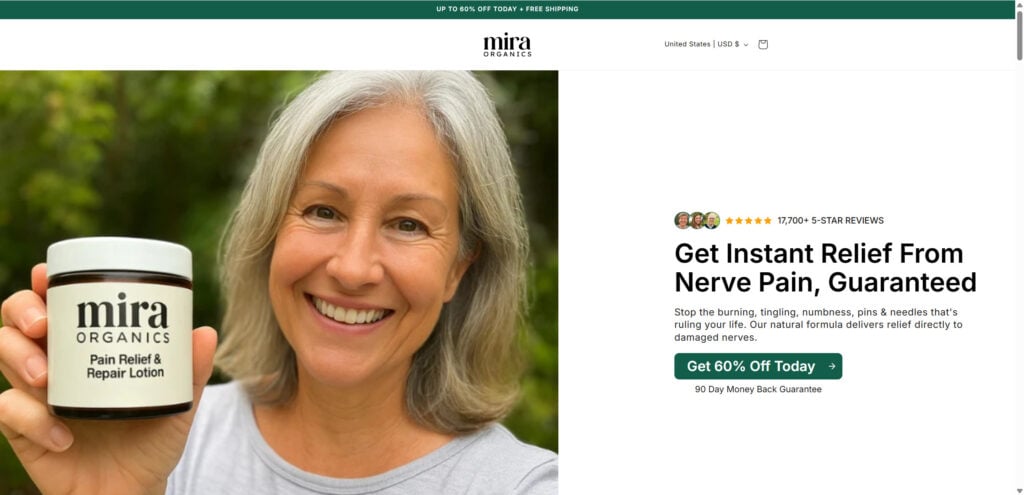
“Mira Organics Pain Relief & Repair Lotion” (often shown in ads as a clean, premium jar with “mira organics” branding) is marketed as a fast-absorbing topical solution for nerve discomfort.
The landing pages and ads tend to hit the same emotional pressure points:
- “Instant relief” or relief in minutes
- “Guaranteed” results
- Dramatic claims about nerve repair
- Big percentage statistics, like 89% feeling relief quickly
- A heavy focus on sleep improvement, like “sleeping better within 2 weeks”
- A “sold out” narrative designed to push urgency
- A strong “buy now” call to action with discounts and bundles
On the surface, it looks like a modern wellness brand.
The design is clean. The photos look professional. The language is confident. The reviews on the page often sound heartfelt and dramatic.
But several patterns commonly show up with products like this, and they matter because they can change what you are actually buying.
1) The marketing claims are much bigger than what a topical cream can prove
A topical cream can sometimes help with comfort.
For example, ingredients that cool the skin, reduce irritation, or soothe inflammation can feel helpful, especially for muscle soreness or localized discomfort.
But “nerve repair” is a very different claim.

Nerves are complex. Neuropathy can be related to diabetes, vitamin deficiencies, injuries, compression, medication side effects, and more.
A cream can’t realistically promise to repair damaged nerves just because it contains botanical extracts or magnesium.
If a website strongly implies it can “fix” nerve damage, “repair nerves,” or “reverse neuropathy,” that’s a major credibility problem.
2) The page uses statistics that are hard to verify
A big red flag is when a sales page uses specific numbers that feel scientific, but gives no study details.
For example:
- “89% feel relief within 15 minutes”
- “95% sleeping better within 2 weeks”
- “88% experience long-term relief”
If there’s no published study, no methodology, no sample size, and no link to the research, those numbers are marketing, not evidence.
And when you’re buying something for a real health concern, marketing numbers can be dangerously persuasive.
3) The product presentation can be AI-generated or heavily edited
Another pattern seen in many dropship-style operations is “perfect” product imagery.
The jar, label, and lifestyle photos can look like a premium brand campaign, but the product that arrives can be generic, cheaply packaged, or noticeably different.
When product images look computer-generated, overly smooth, or inconsistent across the page, it can signal that the branding was created to sell quickly rather than built as a real long-term company.
4) The ingredients list looks familiar because it often is
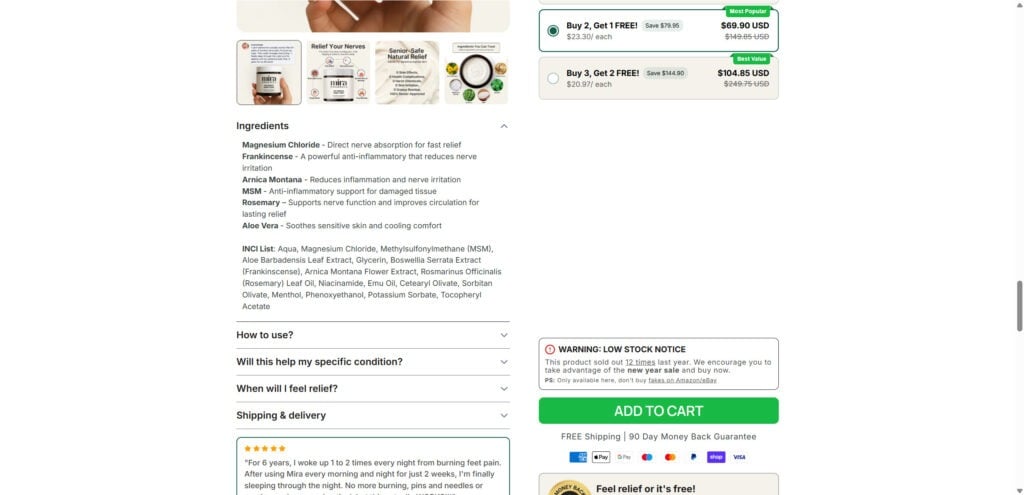
From the screenshot, the highlighted ingredients include:
- Magnesium Chloride
- Frankincense
- Arnica Montana
- MSM
- Rosemary
- Aloe Vera
Then an INCI-style list appears, including water (Aqua), magnesium chloride, MSM (methylsulfonylmethane), aloe extract, glycerin, Boswellia serrata extract (frankincense), arnica flower extract, rosemary leaf oil, niacinamide, “emu oil,” and a few common cosmetic preservatives and stabilizers.
This looks like a topical cosmetic formula.
It may feel soothing for some people.
But it does not automatically justify claims like “repair damaged nerves” or “guaranteed instant relief,” especially at the level implied by the marketing.
5) The selling style looks like a funnel, not a pharmacy-grade product
Pages like this often include:
- Countdown timers
- “Low stock” notices
- “Sold out 12 times last year” messages
- “Only available here” warnings
- Big bundle discounts and “most popular” preselected options
None of that proves a product is bad.
But it does show what the priority is: pushing you to buy fast, before you have time to think, research, or compare.
That matters because trustworthy health brands usually focus on transparency, not pressure.
6) The biggest risk is not just the product, it’s the purchase experience
Even if a cream is harmless, the way it’s sold can still create real problems:
- Confusing subscription or autoship enrollment
- Customer service that goes silent after purchase
- Refund policies that require expensive international returns
- Return addresses that route back to China
- Delivery delays that make chargebacks harder
That’s why many people don’t describe these products as simply “it didn’t work.”
They describe them as a buying trap.
How the Operation Works
This section explains the common step-by-step playbook behind products like “Mira Organics Pain Relief & Repair Lotion,” especially when promoted heavily through social media ads.
These operations are not always identical, but the structure is often very similar.
Step 1: A high-emotion ad targets a real pain point
The first step is almost always an ad on Facebook, Instagram, TikTok, or YouTube.
The ad usually focuses on one of these:
- Burning feet pain
- Tingling, numbness, pins and needles
- “Nerve pain” that keeps you awake
- Older adults who are desperate for better sleep
- People who have tried “everything else”
The goal is emotional urgency.
When you’re exhausted and hurting, “instant relief” doesn’t sound like hype.
It sounds like hope.
Step 2: Big promises, simple solution
The ad typically implies:
- A simple cream can solve a complex condition
- You can get results without changing anything else
- It’s “natural,” so it must be safe
- It works for nearly everyone
This is the “miracle product” framing.
And it is especially effective when the product is positioned as an alternative to doctors, prescriptions, or complicated treatment plans.
Step 3: A landing page that looks like a brand, but behaves like a sales machine
Once you click, you’re taken to a focused sales page.
This page is designed to do three things:
- Build trust fast
- Increase your fear of missing out
- Make checkout feel like the obvious next step
You’ll often see:
- Review counts that look huge
- Before-and-after style stories
- A “90 day money back guarantee” badge
- “No side effects” language
- “Clinically proven” style phrasing without links
- A large discount, often 50% to 60% off
- Preselected bundles to boost the order size
If a brand is truly established, it can usually sell without pressure tactics.
When the page is packed with urgency triggers, it often means conversion is the priority, not long-term customer satisfaction.
Step 4: The ingredient story is written like a medical explanation
This is a subtle but important trick.
Instead of saying “this is a soothing cream,” the copy often says things like:
- “Direct nerve absorption”
- “Targets damaged nerves”
- “Repairs nerve pathways”
- “Stops burning and tingling at the source”
But topical products typically sit on or near the skin’s surface.
Some ingredients can create sensations (cooling, warming) or reduce inflammation.
That can feel like relief.
But it is not the same thing as repairing nerve damage, and it’s not the same as a drug that has been tested for neuropathy.
Step 5: The “proof” is mostly internal
A common pattern is that all “proof” lives on the same website.
- Reviews are hosted only on the product page
- Testimonials look polished and consistent
- Photos look like stock images
- There are few (or no) independent reviews elsewhere
- There’s limited information about the company behind it
When you can’t verify claims outside the site that profits from them, you should assume the sales page is not neutral.
Step 6: Checkout funnels you into bigger purchases
The pricing section is usually designed to increase the cart size:
- Buy 1
- Buy 2, get 1 free
- Buy 3, get 2 free
The “best value” option is highlighted to steer you.
This is classic direct-response marketing.
Again, not automatically evil, but it’s a sign you’re dealing with a sales funnel operation.
Step 7: Fulfillment is often not from a local warehouse
With dropship-style offers, the product can ship from overseas, frequently from China-based logistics channels.
This is where many customer frustrations begin:
- Delivery takes longer than expected
- Tracking updates are vague
- The item that arrives looks cheaper than the marketing
- Packaging may be generic or unfamiliar
- The “brand” feels like it disappears after purchase
And when refunds are requested, the buyer is often told they must return the item internationally.
Step 8: Returns become the wall you cannot climb
The return policy is where the experience can become truly painful.
Some buyers report that:
- They are asked to return to an overseas address
- The cost of return shipping is high
- The package must be tracked and delivered, or refund is denied
- Customer support delays responses until the refund window shrinks
Even when a “money back guarantee” is advertised, it can be difficult to use in practice.
Step 9: Some buyers discover subscription issues
Another common complaint with aggressive online funnels is unexpected recurring charges.
Sometimes it’s a true subscription.
Sometimes it’s an “autoship” toggle during checkout.
Sometimes it’s hidden in fine print.
If you see language like “auto-replenish” or “monthly refills,” treat that as a serious warning to read everything before paying.
Red Flags to Watch Out For
Here are the most important warning signs, written plainly.
If you see several of these together, it’s usually smarter to skip.
- “Guaranteed” instant relief for nerve pain without clinical proof
- Claims about nerve “repair” or reversing neuropathy
- Big user percentages with no study details
- “No side effects” claims, especially for people with sensitive skin
- Reviews that exist only on the seller’s page
- Aggressive urgency: countdown timers, “low stock,” “sold out” stories
- Little transparency about the company, address, or ownership
- Return policies that require international shipping
- Heavy ad-driven presence with limited independent reputation
What To Do If You Already Bought It
If you already ordered and now you’re uneasy, you’re not powerless.
Here’s a calm, practical checklist.
- Take screenshots of everything
Save the product page, the claims, the guarantee, the pricing, and the checkout page.
Screenshot the order confirmation and any subscription language. - Check your bank or card statement for the exact merchant name
The charge name may not match “Mira Organics.”
Write down the merchant descriptor and transaction ID. - Look for subscription or autoship language immediately
Search your confirmation email for words like: “subscription,” “autoship,” “monthly,” “replenish,” “recurring,” “membership.” - Email support and keep it short and firm
Ask to cancel any autoship.
Ask for a refund process in writing.
Save every reply. - If it hasn’t shipped, request cancellation right away
Many sellers will say “we cannot cancel once processed,” but you should still request it immediately and keep the proof. - If it arrives and it’s not what you expected, document it
Take photos of the packaging, label, and contents.
Keep the shipping envelope and any inserts. - If customer support stalls, escalate to your payment provider
If you paid by credit card, contact the issuer and ask about a dispute or chargeback.
If you used PayPal, open a dispute through PayPal.
Deadlines matter, so do not wait too long. - Do not stop medical care because of a topical product
If you have nerve pain symptoms, keep working with a qualified clinician.
A cream may provide comfort, but it should not replace diagnosis and treatment. - If you experience irritation, stop using it
Even “natural” ingredients can trigger reactions.
Wash the area, discontinue use, and seek medical advice if symptoms persist or worsen.
The Bottom Line
Mira Organics Pain Relief & Repair Lotion is marketed like a breakthrough solution, but the sales tactics and claims are where the risk lives.
A topical cream may feel soothing for some people.
But the way this product is commonly promoted, with dramatic “instant relief” messaging, unverified statistics, heavy urgency pressure, and difficult refund pathways, is exactly the pattern many buyers regret.
If you want to try a topical product for comfort, you’re usually safer choosing something with transparent sourcing, clear labeling, and an easy local return process.
If you’re considering Mira Organics specifically, the smarter move for most people is to skip it.
FAQ
Does Mira Organics Pain Relief Cream really “repair nerves”?
There’s no reliable public evidence that a topical cosmetic cream can repair damaged nerves. Relief sensations are not the same as nerve healing.
Why do the ads claim “instant relief”?
Some ingredients can create cooling or soothing sensations quickly. Marketing often stretches that feeling into bigger medical-style promises.
Is it safe to use?
Topicals can irritate sensitive skin, even when labeled “natural.” If you have allergies, sensitive skin, or a medical condition, check with a clinician and stop use if irritation occurs.
Why are refunds so difficult with products like this?
Many ad-driven sellers use return policies that require shipping the product internationally, which can be expensive and discouraging.
What should I do if I was charged again unexpectedly?
Check for autoship or subscription terms, email the seller to cancel, and contact your bank or card issuer quickly if the charges continue.

Reviews & discussion
2 commentsShare a firsthand experience, or ask a question.
Community reviews
Mira Organics Pain Relief Cream
Moderated reader experiences, not an editorial verdict.
I have peripheral neuropathy of my feet and I’m searching for the best treatment to ease the pain. I take a lot of different medication so need to be careful. I am new to this complaint so am ripe for scams and mis information. I do not want to take anymore oral medication and I happened across articles on transdermal magnesium. but I am a complete novice. It sounds great to this novice but I’m ripe to be misled. Is it possible for you to point me in the right direction. I need genuine help and your article seemed to speak my language.
In reply to John
I’m sorry you’re dealing with this — peripheral neuropathy pain is genuinely wearing, and it’s understandable to want something topical rather than more tablets. I have to be honest that I can’t give medical guidance, and this matters especially in your case because you’re on several medications and interactions are a real consideration. The most reliable next step is to raise transdermal magnesium specifically with your GP or pharmacist, who can check it against everything you’re taking. What this article can help with is the other half of your worry — spotting which of these creams are overselling themselves — so you can walk into that conversation already able to tell a credible product from a scam. Please do get a professional’s view before starting anything.