

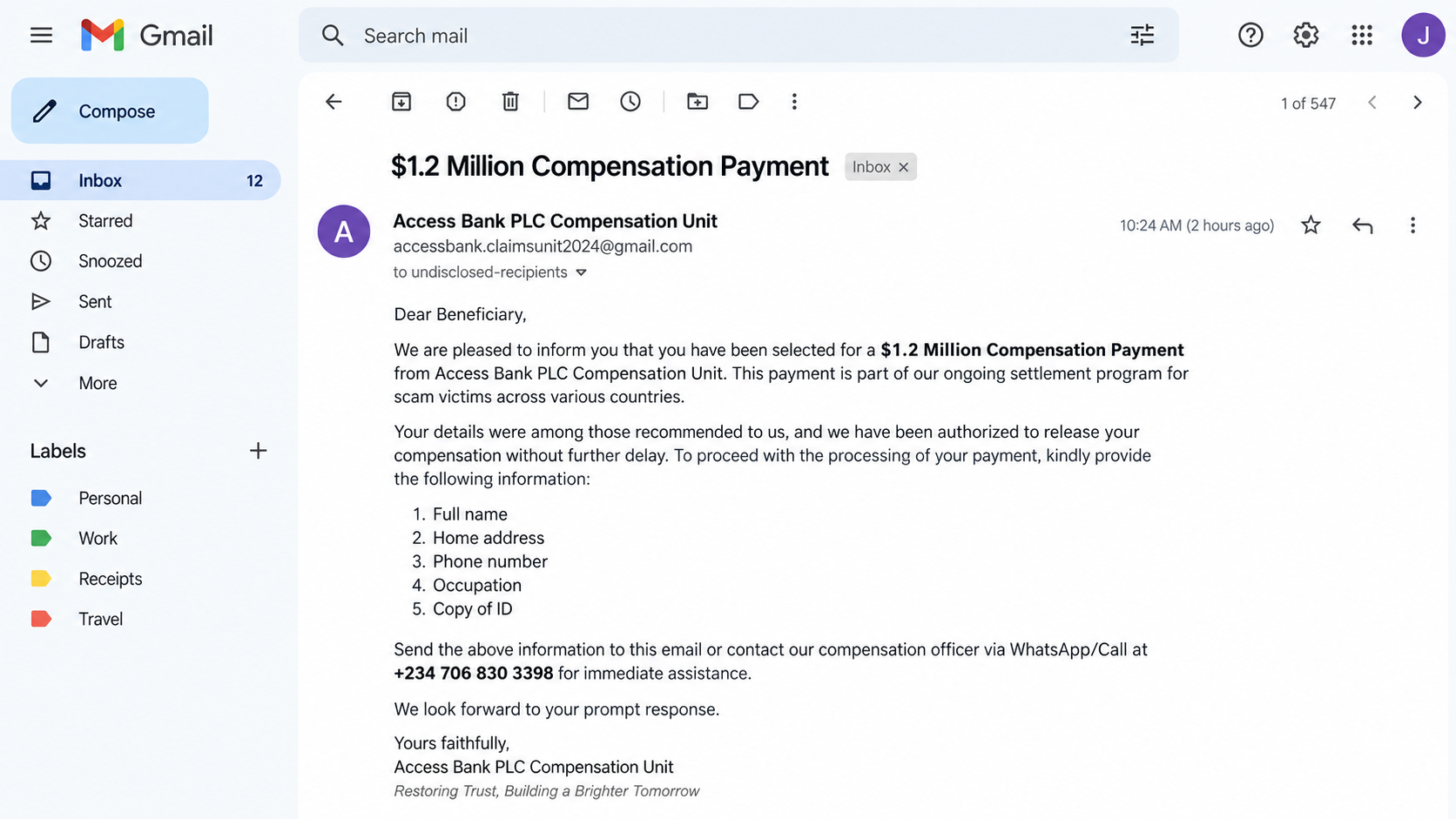
A message from an “Access Bank PLC Compensation Unit” says your name was chosen for a $1.2 million payment to victims of fraud. You did not apply, file a claim, or speak with the bank, yet the sender says the money is already approved.
All that supposedly remains is to provide your identity and contact a compensation officer. The fortune is fictional, but the information requested can create very real losses.
Overview
The email impersonates a real financial institution
Access Bank PLC is a genuine licensed bank. Scammers misuse its name to give an advance-fee and identity-theft scheme the appearance of international banking authority.
The bank is not responsible for a message sent from a free Gmail address or an unknown WhatsApp number. A real company name in the signature does not authenticate the sender.
The $1.2 million award has no credible origin
The recipient is told that a committee, government program, or settlement selected them for compensation. The email rarely identifies a court case, claim number, administrator, eligibility rule, or documented loss connected to the payment.
An unexplained windfall is used to make small requests seem reasonable. Someone expecting $1.2 million may overlook the danger of sending an ID copy or paying a few hundred in fees.
Information comes first and fees follow
The opening request may seek a full name, address, phone number, occupation, bank details, and government identification. After the victim responds, the supposed officer introduces processing, tax, transfer, insurance, or anti-money-laundering charges.
Access Bank’s published fraud guidance says never to share passwords, BVN, or PIN information and never to respond to unsolicited messages asking for personal or financial details.
- An unexpected email announces a $1.2 million compensation payment.
- The sender claims to represent Access Bank PLC or an international committee.
- A free email account and +234 contact number handle the claim.
- Personal details and a copy of identification are requested.
- Fees appear after the victim engages with the supposed officer.
- No payment arrives, and new charges continue until the victim stops.
Why a Compensation Story Targets Previous Scam Victims
People who have already lost money want closure and restitution. A message promising official compensation can feel like long-awaited recognition rather than another unsolicited offer.
Fraud groups may trade what are sometimes called victim or sucker lists. A new operator can contact the same person while pretending to be a bank, regulator, recovery agent, or law firm.
The email may reference earlier fraud in broad terms without naming a case. That vagueness lets recipients supply the missing details themselves when they reply.
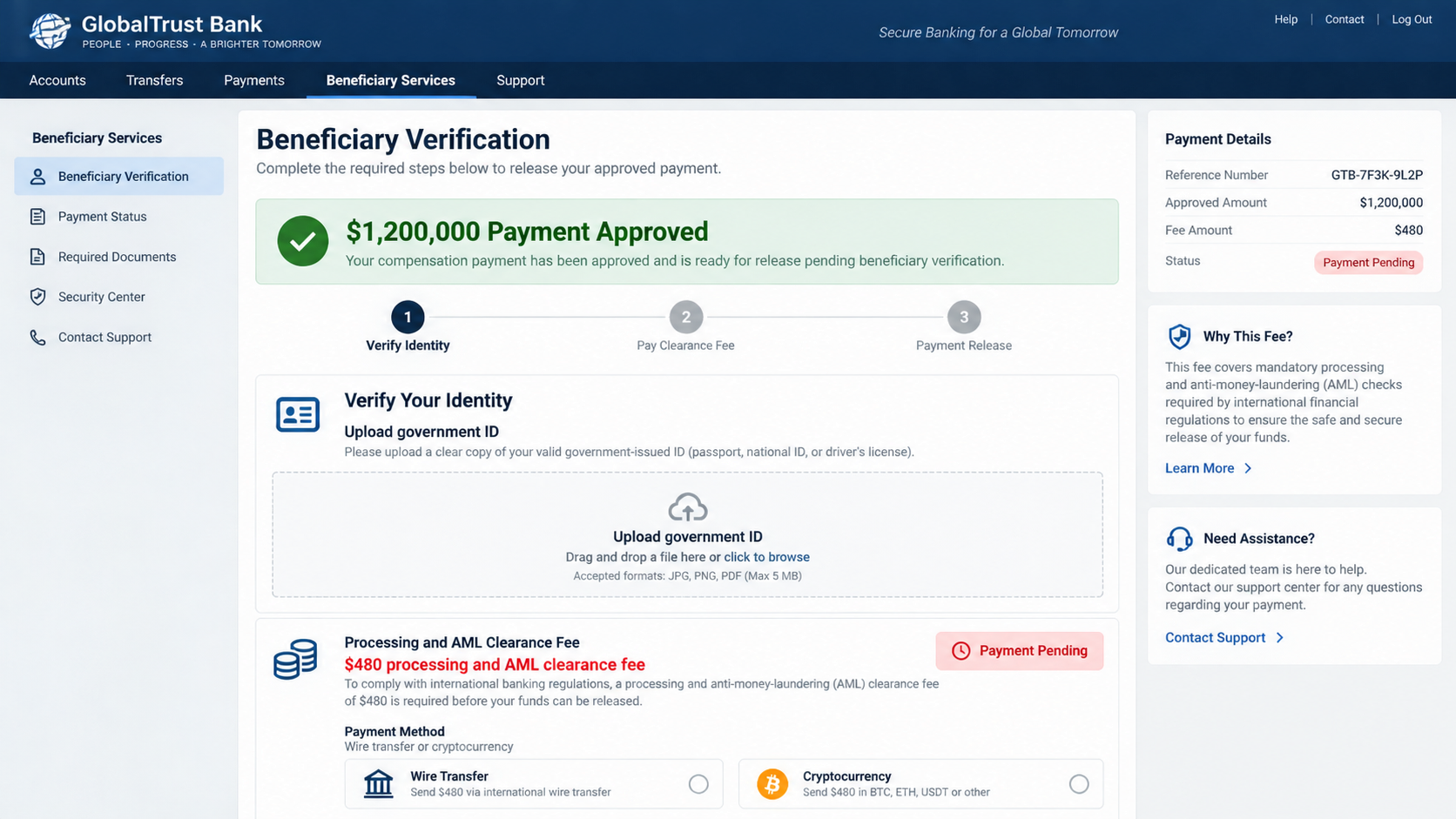
A very large award changes the victim’s sense of proportion. A $480 clearance fee can appear trivial next to $1.2 million, even though the promised balance exists only on a fake letter or portal.
The FTC warns that refund and recovery scammers contact people who already lost money, ask for upfront fees, or request financial information to deliver a supposed reimbursement.
Legitimate compensation programs publish eligibility rules and use traceable administrators. They do not select random email recipients and route claims through a personal mailbox or chat number.
How the Access Bank PLC Scam Email Works
Step 1: A victim list or random mailing is used
The scam begins with email addresses obtained from breaches, purchased lists, public posts, or earlier fraud. A recipient may be targeted because scammers believe they previously responded to an online offer.
The message uses a generic greeting such as “Dear Beneficiary” because the sender often lacks verified identity details. The form request is designed to fill those gaps.
Step 2: A bank-backed compensation award is announced
The writer claims that Access Bank PLC, a government body, or an international panel approved $1.2 million. Words such as settlement, beneficiary, allocation, and anti-fraud program create an official tone.
No prior claim is required. The lack of history is explained by saying that the recipient was recommended, selected from a database, or identified during an investigation.
Step 3: Identity information is collected
The victim is asked to send a full name, home address, phone number, occupation, age, and copy of identification. Bank details may be requested later under the pretext of arranging the transfer.
These details can support identity theft, account-recovery attacks, SIM-swap attempts, fake applications, and more convincing follow-up messages.
Step 4: A fake officer builds a relationship
After the reply, a person using a bank title moves the conversation to WhatsApp, phone, or another mailbox. They may send a certificate, payment advice, staff card, or transfer screenshot.
Those documents are inexpensive to fabricate. Their purpose is to keep the victim focused on the promised payout rather than verifying the program independently.
Step 5: An advance fee blocks the transfer
A processing fee, tax, currency conversion, insurance bond, or anti-money-laundering clearance suddenly becomes necessary. The victim is told the fee cannot be deducted from the award because of banking rules.
Payment may be requested by wire, cryptocurrency, gift card, or money-transfer service. These methods are favored because recovery is difficult once funds are collected.
Step 6: New obstacles generate new demands
Paying the first charge does not unlock $1.2 million. The scammer invents a second certificate, release code, legal stamp, or overdue storage cost.
When the victim stops, another person may offer recovery for an upfront retainer. That second contact can be part of the same operation using the information gathered during the first scam.
Documents and Claims Used to Support the Lie
A compensation certificate may display seals, signatures, reference numbers, and formal language. None of those elements proves that the issuing body exists or that the document appears in an official record.
Fake bank statements can show the $1.2 million as pending. A picture of a balance is not a transferable asset and can be created in an image editor or imitation portal.
The supposed officer may send an employee badge or passport. Stolen photographs and copied identity documents are frequently used to give anonymous scammers a human face.
A tax or anti-money-laundering letter can claim that payment is legally mandatory. Legitimate compliance checks do not require an unknown beneficiary to send cryptocurrency to a private wallet.
Transfer receipts may show a payment stopped one step before completion. This manufactured near-success makes the next fee look like the only barrier between the victim and the award.
The sender may name the Central Bank of Nigeria, the United Nations, the World Bank, or another respected institution. Independently check the named organization’s public warnings and contact details.
Spelling mistakes can reveal a crude campaign, but correct grammar does not establish legitimacy. Templates can be copied from real financial correspondence and refined easily.
A +234 phone number indicates the Nigerian country code, not fraud by itself. The warning comes from the unsolicited award, unverifiable department, free mailbox, identity request, and fee structure together.
How to Verify a Compensation or Bank Email
Ask what exact program created the award, where its rules are published, and which prior claim made you eligible. Then research those facts without using links or numbers in the message.
Visit accessbankplc.com by typing the address yourself. Access Bank publishes fraud-prevention guidance and official contact routes for suspicious communications.
Compare the sender’s domain with the bank’s official domain. A Gmail address that contains “accessbank” remains a Gmail account controlled by whoever registered that username.
Do not upload identification to learn whether the payment is real. Once a passport or license copy leaves your control, the scammer can reuse it in other schemes.
Reject any upfront payment. A random compensation award that requires wire, crypto, gift card, or transfer-service fees is an advance-fee scam pattern.
Speak with a trusted person before responding. The promise of a life-changing sum can distort judgment, while an uninvolved reader will often notice contradictions immediately.
Check the Reply-To field as well as the visible From address. A message can display a formal bank identity while directing every response to a disposable personal mailbox.
Search distinctive sentences from the email in quotation marks. Reused beneficiary language appearing in unrelated awards shows that the message is a template, not a confidential banking notice.
Do not call merely to test the officer’s knowledge. A conversation reveals your accent, location, concerns, and willingness to engage, all of which can help the scammer customize the next request.
Real financial compliance does not depend on keeping relatives, bankers, or police uninformed. A secrecy instruction protects the fraud from scrutiny, not the beneficiary from delay.
If the sender claims that diplomatic couriers will deliver cash, ask why a modern bank cannot document an ordinary regulated transfer. Elaborate delivery stories usually explain away the absence of a normal payment trail.
Be suspicious when the amount changes between documents. Small differences in the award, fee, beneficiary name, or reference number reveal that templates were assembled without a genuine account record.
Company, Address, and Fulfillment Checks
Confirm the institution through its official website
Access Bank lists official contact information and a dedicated fraud-awareness page. Use those channels rather than the email address or WhatsApp number supplied by the sender.
The genuine bank warns customers not to respond to unsolicited requests for personal or financial details and not to share passwords, BVN, PIN, card information, or one-time codes.
Verify the compensation program and administrator
A real settlement or restitution fund should have a named legal basis, published eligibility criteria, deadlines, and a traceable administrator. Search court or regulator records independently.
A vague international “compensation unit” with no public documentation cannot support a $1.2 million obligation.
Check every address and contact point
Compare the claimed office with the organization’s own directory. A copied bank address does not validate a free mailbox, private mobile number, or unrelated payment recipient.
Look up the destination account name before paying. Funds sent to an individual or unrelated business contradict the claim of an official bank program.
Demand a legitimate, fee-free delivery path
Never pay upfront to receive an unexpected refund or compensation. Legitimate organizations do not require gift cards, cryptocurrency, or secret wire transfers to release an award.
Do not accept the claim that fees cannot be deducted from the payout. That explanation exists to make the victim contribute real money before discovering there is no fund.
What to Do if You Have Fallen Victim to This Scam
- End all contact. Block the email, phone, and messaging accounts. Do not pay a final fee or threaten the scammer with information about your report.
- Contact the payment provider. Report the transfer as fraud immediately and ask whether a wire, card charge, money transfer, gift card, or cryptocurrency withdrawal can be stopped.
- Notify your financial institutions. Replace exposed cards, secure online banking, review beneficiaries, and monitor for unauthorized transfers or new accounts.
- Protect identity documents. If an ID or Social Security number was sent, place fraud alerts or credit freezes and watch for identity-verification messages you did not initiate.
- Secure accounts and devices. Change reused passwords and run a reputable scan such as Malwarebytes if you opened an attachment or installed software.
- Reduce malicious-page exposure. AdGuard can block many known phishing destinations and deceptive ads, but it cannot retrieve identity files already submitted.
- Preserve the complete record. Save emails with headers, chat exports, phone numbers, wallet addresses, bank instructions, receipts, fake certificates, and promised payment dates.
- Report the impersonation. Send details to Access Bank through an official contact, then report to the FTC, IC3, and the relevant local financial-crime authority.
- Refuse recovery solicitations. Anyone who unexpectedly promises guaranteed recovery for a retainer, tax, or processing payment may be targeting you again.
If the scammer has enough information to impersonate you, alert close contacts that unexpected requests using your identity should be verified through another channel.
Frequently Asked Questions
Is Access Bank PLC a real bank?
Yes. The institution is real, but the compensation email is an impersonation. A genuine company can have its name and address copied by criminals.
Does Access Bank send $1.2 million to scam victims?
An unsolicited email offers no credible basis for that claim. Verify any real restitution program through official bank, court, or regulator records.
Why does the scammer want a copy of my ID?
Identity documents can support account takeovers, fraudulent applications, SIM swaps, and future impersonation schemes. Do not send one to an unverified contact.
Is a +234 phone number automatically fraudulent?
No. +234 is Nigeria’s country code. The scam is identified by the unexpected award, unverifiable sender, sensitive-data request, and upfront fees.
Can a compensation fee be deducted from the award?
The question assumes the award exists. In this scam it does not, and claims about fee handling are excuses to obtain money before the victim discovers that fact.
Can I recover money sent to the compensation officer?
Recovery is uncertain. Contact every involved bank or payment provider immediately, preserve transaction details, and report the fraud to authorities.
The Bottom Line
The Access Bank PLC scam email uses a real bank’s reputation to support a fictional $1.2 million payment. The first goal is identity information; the next is a chain of fees that never releases any compensation.
Do not reply, upload ID, or pay. Verify the institution and program through contact details you found independently, and report the message before the promise of a windfall becomes a second financial loss.








