

A message about student loan relief lands just as you are trying to understand your next payment. It says a new window is open, but only briefly.
The offer sounds personal and timely. Before you sign in or pay anyone, there are a few questions that can change the entire picture.
Overview
The promise in the message
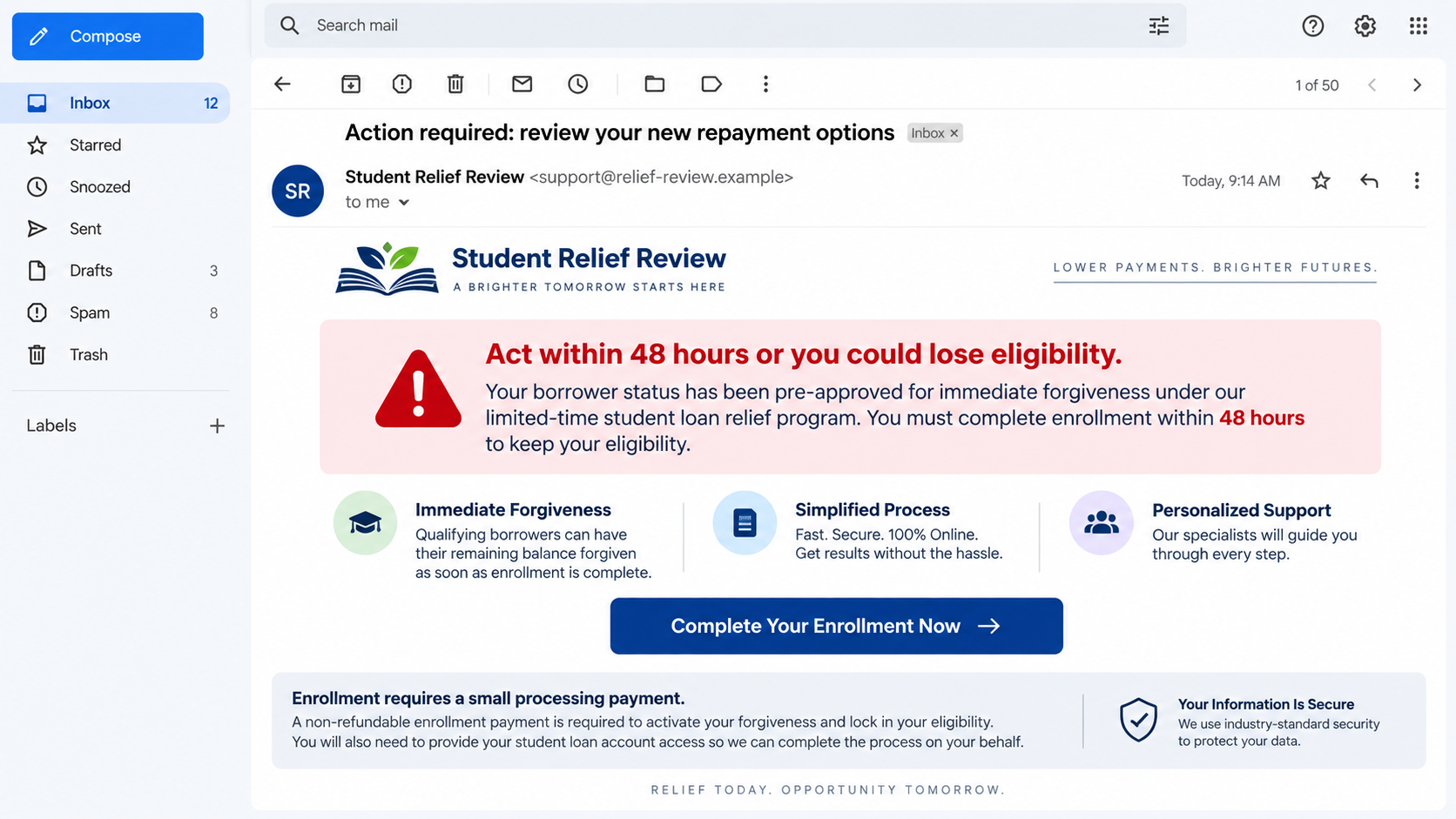
A student loan relief scam claims a borrower can quickly cut payments, erase debt, or secure a place in a limited forgiveness program.
The approach may be an email, text, call, or sponsored search result. It often arrives when repayment rules are in the news and borrowers are unsure what applies.
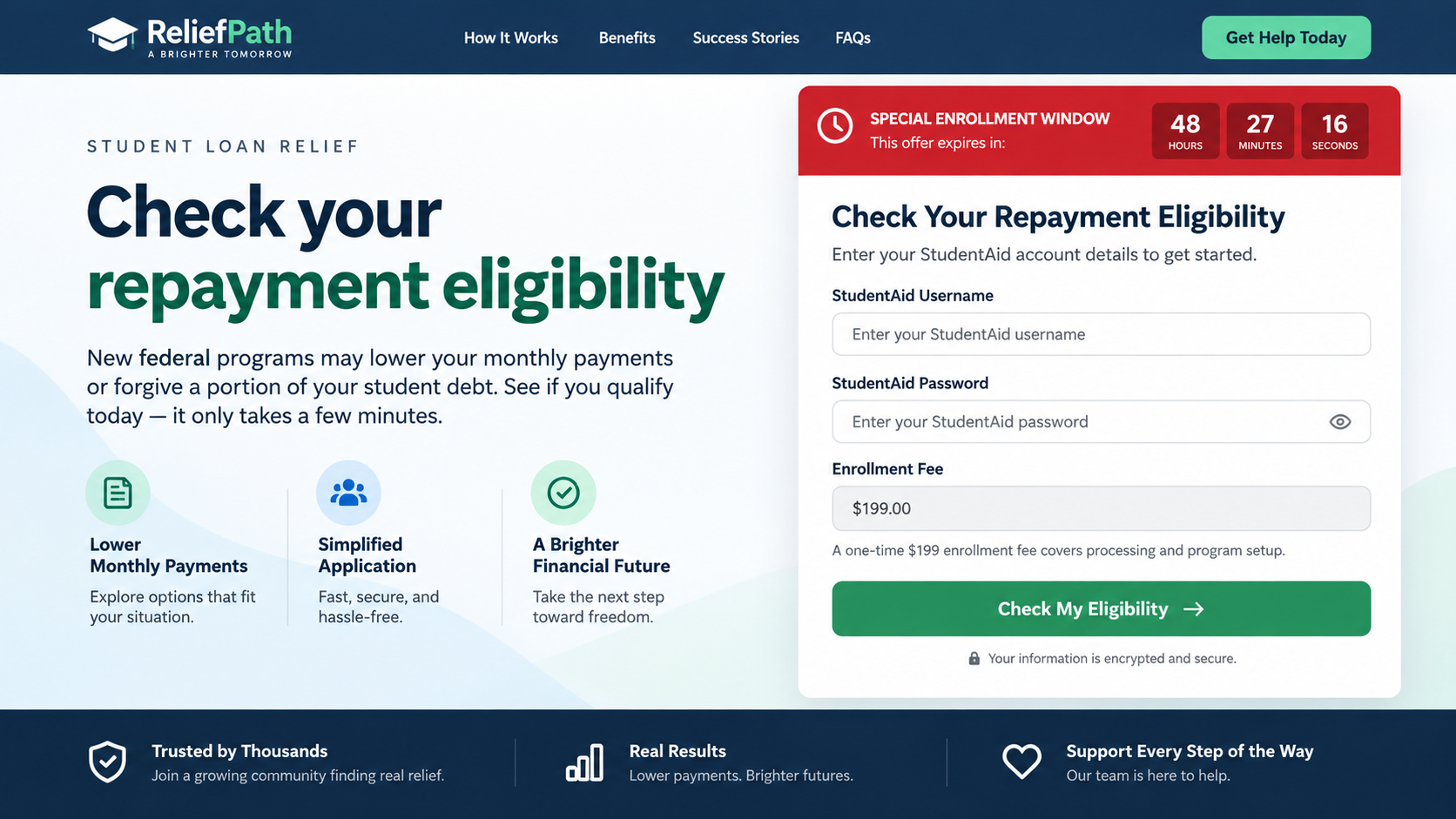
One version asks for an “enrollment” fee. Another wants the borrower’s StudentAid.gov login so a representative can supposedly handle the paperwork.
Why the timing matters
New York’s attorney general warned in September 2026 that changes to federal repayment programs had created confusion that scammers were exploiting.
That warning is about a real vulnerability, not a prediction that every borrower qualifies for a new plan. Eligibility depends on the loan and current official rules.
Federal Student Aid separately warns about fast-forgiveness pitches, unauthorized fees, and requests for account credentials.
What makes the offer suspect
Watch for a combination of promises and pressure, especially when the sender cannot identify the exact federal program and your loan servicer.
- Guaranteed or immediate cancellation regardless of employment, payment history, or loan type.
- A deadline invented by the marketer rather than published by a government agency.
- An upfront fee for help with a free federal loan process.
- A request for your StudentAid.gov password, one-time code, or power of attorney.
The person selling the service may call it “processing,” “document preparation,” or “enrollment.” A new label does not change what the payment buys.
What Legitimate Help Looks Like
Federal loan programs have rules, application steps, and official account records. They are not unlocked by a stranger’s private code or a payment made during a call.
Federal Student Aid says legitimate options include consolidation, repayment plans, and qualifying forgiveness programs. Your loan servicer can explain available actions without handing over your password.
That does not mean every private adviser is fraudulent. The danger lies in false government affiliation, guaranteed outcomes, credentials requests, and fees that violate applicable law.
In New York, the attorney general says charging upfront fees for student-loan-related services is unlawful. Borrowers elsewhere should check their own state rules and the service agreement.
Many real forgiveness programs require years of qualifying payments or work. A pitch promising a wiped balance “today” should trigger a direct check with StudentAid.gov.
The correct plan can also change as laws and litigation evolve. A screenshot of an old program page is not a substitute for your current loan record.
If you are not sure who services your loan, sign in to StudentAid.gov through a bookmark or typed address. Do not use the marketer’s link to find out.
Once you know the servicer, contact it using details from the official account. Ask what action the message claims is necessary and whether that action exists.
How the Student Loan Relief Scam Works
Step 1: A timely message finds a worried borrower
The sender watches the news cycle. When plans, payment amounts, or court rulings change, uncertainty gives a generic solicitation a plausible reason to arrive.
The message may know your name but not your actual loan. Marketing lists and data breaches can provide enough detail for a personal-sounding opening.
Some ads imitate official search results. Others use a reassuring name like “federal support desk” without saying which federal office supposedly runs it.
Step 2: Urgency replaces eligibility rules
A countdown or “last chance” warning tells you that delay will cost you forgiveness. It rarely explains the legal deadline or links a real government notice.
The pressure is useful to the sender because eligibility takes time to verify. A borrower who checks their record may discover that the offer is generic.
New York’s attorney general specifically warns against companies claiming that borrowers must act within a very short period to obtain relief.
Step 3: The representative borrows official language
The caller may refer to consolidation, income-based repayment, or public service. These terms are real, but their use in a sales script does not confer authorization.
A badge, seal, or government-sounding job title is easy to imitate. Ask for the exact program and compare its published criteria to your situation.
Beware the phrase “pre-approved” when the sender has not checked your loan type, servicer, qualifying payments, and other required information.
Step 4: The borrower is asked to pay or surrender access
A fee may be described as necessary to secure a place or submit papers. Yet borrowers can access federal student-loan programs without paying a private company.
Some operators ask for a StudentAid.gov username and password. Federal Student Aid says it and its partners will never ask borrowers for those credentials.
A power of attorney can be equally consequential. It may let a company act on your account, while you lose visibility into what was changed.
Step 5: A private dashboard creates the appearance of progress
After payment, the customer may receive a confirmation page, a scheduled call, or a document checklist. These can look like activity without changing the actual loan.
Some fee-charging services simply submit forms a borrower could submit free. Others may not submit anything at all. The outcome must be checked in your official account.
A pause in communication can be especially costly if the borrower assumes a real payment obligation has disappeared. Continue monitoring your servicer notices.
Step 6: The fee or account access may persist
A recurring “maintenance” charge can follow an initial fee if the agreement includes a subscription. Do not assume every company uses one; inspect your receipt and statement.
If credentials were shared, the account itself may be changed. Contact details can be altered, or a third party may gain ongoing access to loan information.
The scam can end with another sales pitch, such as a paid upgrade to “finish” forgiveness. The original guarantee should never be treated as evidence of approval.
Who Is Offering Help? Four Checks Before You Pay
A government-like name is not a federal affiliation
Identify the legal entity on the site’s terms, invoice, card descriptor, and customer service response. A trading name containing “federal” can still belong to a private marketer.
Federal Student Aid’s own site lists official communications and servicers. Compare the sender’s exact domain and phone number to those records.
If the company claims a special partnership, ask for a public government page confirming it. A badge on the company’s own landing page is not confirmation.
A mailing address may be only a processing point
Search the address independently. A mailbox or registered agent can receive letters without processing student loans or proving any government relationship.
If no legal address is available before payment, that absence makes it harder to enforce promises or send a written cancellation notice.
Keep a copy of every version of the page you saw. Addresses, names, and guarantee language can change after a campaign ends.
A support number is not your loan servicer
Call your servicer using StudentAid.gov, not the solicitation. Ask whether it recognizes the offered program, fee, and supposed deadline.
Before paying any private provider, test whether its support team can answer questions about cancellations and refunds in writing.
If it refuses to identify your actual servicer, it has not shown that it can evaluate your specific loan.
The agreement must show the real service and cost
Read the full price, billing interval, work promised, cancellation method, refund rules, and any authorization to access your federal account.
Beware a checkout that asks for a password instead of explaining a limited, documented authorization. Your login is not a form field for private sales agents.
Save the terms as they appeared when you paid. A later policy update may not reflect what you were shown at checkout.
Why the “Fast Forgiveness” Claim Fails a Reality Check
A legitimate forgiveness determination depends on program requirements. Some borrowers may qualify, but no outside company can guarantee that result to everyone who sees an ad.
Ask which loans are eligible, how many qualifying payments are required, and whether your employment history matters. The answer should match an official source.
If a representative cannot explain the difference between lowering a monthly payment and canceling the principal, their promise is too vague to trust.
Lower payments may change total interest or repayment length. A useful adviser should discuss tradeoffs instead of offering a magical “erase” button.
Someone who is behind on payments may need prompt help, but urgency should point them toward their servicer, not a stranger with a credit-card form.
A Five-Minute Check Before Sharing Anything
Open a new browser tab and type StudentAid.gov yourself. Do not let the ad’s button decide which site is “official” for you.
Look at your loan list, servicer, and current status. A seller who cannot describe the difference between those records and its offer has not earned your trust.
Search the exact program name on the official site. If you only find the name on marketing pages, ask what statute or federal rule creates it.
Compare the deadline in the message with the deadline published by the program. A countdown timer on a landing page is not a federal notice.
Read the email address one character at a time. A familiar agency name before the @ sign means little if the actual domain belongs to a private marketer.
Call the servicer from your account and ask whether an application must be submitted now. Note the date and the representative’s explanation.
If a private company says it has already enrolled you, request the official confirmation number and verify it in your account, not on the company’s dashboard.
Check whether the quoted price is a one-time fee or a recurring charge. If the seller avoids a written answer, do not test the promise with your card.
Ask how to cancel and whether work begins immediately. A sales team that can take payment quickly should also explain its refund process clearly.
Do not sign a broad authorization to access your loan without understanding what actions it allows. A form’s title can sound routine while its permissions are extensive.
Finally, ask a trusted person to read the offer. Another set of eyes often spots a contradiction that is hard to see under a ticking deadline.
What to Do if You Have Fallen Victim to This Scam
- Stop paying the private provider. Send a written cancellation through its stated channel and keep proof. Do not rely on a verbal promise that billing ended.
- Call your card issuer or bank. Explain the offer and any charges. Ask about disputes, recurring-payment blocks, and replacement payment details where appropriate.
- Secure your StudentAid.gov account. Change the password directly, review contact details, and enable available account protections if you disclosed credentials.
- Contact your actual loan servicer. Ask whether forms were submitted, authorizations added, payment settings changed, or a new plan requested without your consent.
- Revoke unwanted authority. If you signed a power of attorney or account-access document, seek help from your servicer or a qualified adviser to revoke it properly.
- Preserve the sales trail. Save the ad, landing page, contract, emails, receipts, card statement, and the exact words used about forgiveness.
- Check for device risk. If you downloaded a file from the promotion, scan with Malwarebytes. AdGuard can reduce exposure to known malicious ads and links.
- Report the conduct. Use ReportFraud.ftc.gov and the Federal Student Aid feedback center. New Yorkers can also contact the state attorney general.
Keep making any legitimate payments your servicer says are due. A private company’s promise does not pause a federal loan.
If you feel overwhelmed, a reputable nonprofit counselor or the New York Education Debt Consumer Assistance Program can help explain options without a pressure sale.
Frequently Asked Questions
Is every student loan relief company a scam?
No. Private advisers exist, but guaranteed outcomes, false government claims, credential requests, and unlawful upfront fees are serious warning signs.
Do I have to pay to apply for a federal repayment plan?
No. Federal Student Aid and loan servicers provide access to federal programs without an outside enrollment fee.
Can a company guarantee immediate loan forgiveness?
No outside company can guarantee a federal determination before checking the applicable program rules and a borrower’s verified record.
What if I gave a representative my StudentAid.gov password?
Change it directly on StudentAid.gov, review your account details, contact your servicer, and report the exposure to Federal Student Aid.
Does a pending application mean I can stop paying?
No. Follow the status and instructions in your official account or from your servicer. Do not rely on a marketer’s dashboard.
Where can a New York borrower get independent help?
The New York attorney general points borrowers to its student lending guide and the Education Debt Consumer Assistance Program for vetted help.
The Bottom Line
A student loan relief scam turns a real repayment worry into a demand for money or account access. The fastest promised cure is often the weakest evidence.
Check your loan through StudentAid.gov and your actual servicer before paying anyone. Real options have published rules and do not require surrendering your password.








