

Olive and Jet wraps an everyday purchase in a polished New Zealand story, bold bundle savings, and promises about alpaca comfort in changing weather.
The socks may look straightforward, yet the important questions sit inside the fibre percentages, review displays, guarantee wording, manufacturing origin, and checkout quantity.
Overview
A registered New Zealand retailer sits behind the brand
Olive and Jet is not presented through a completely anonymous storefront. Its footer lists a New Zealand Business Number, address, phone number, and several support emails.
That number belongs to Pacos Limited, a registered New Zealand company whose recorded trading name is Olive and Jet.
The registered office and service address match the Christchurch address printed on the website, providing a traceable domestic entity.
Official registration is useful accountability evidence, but it does not independently verify each comfort claim, review total, or buying promise.
This review therefore examines measurable commercial risks instead of labeling the entire business fraudulent.
The product is a blend rather than a pure alpaca sock
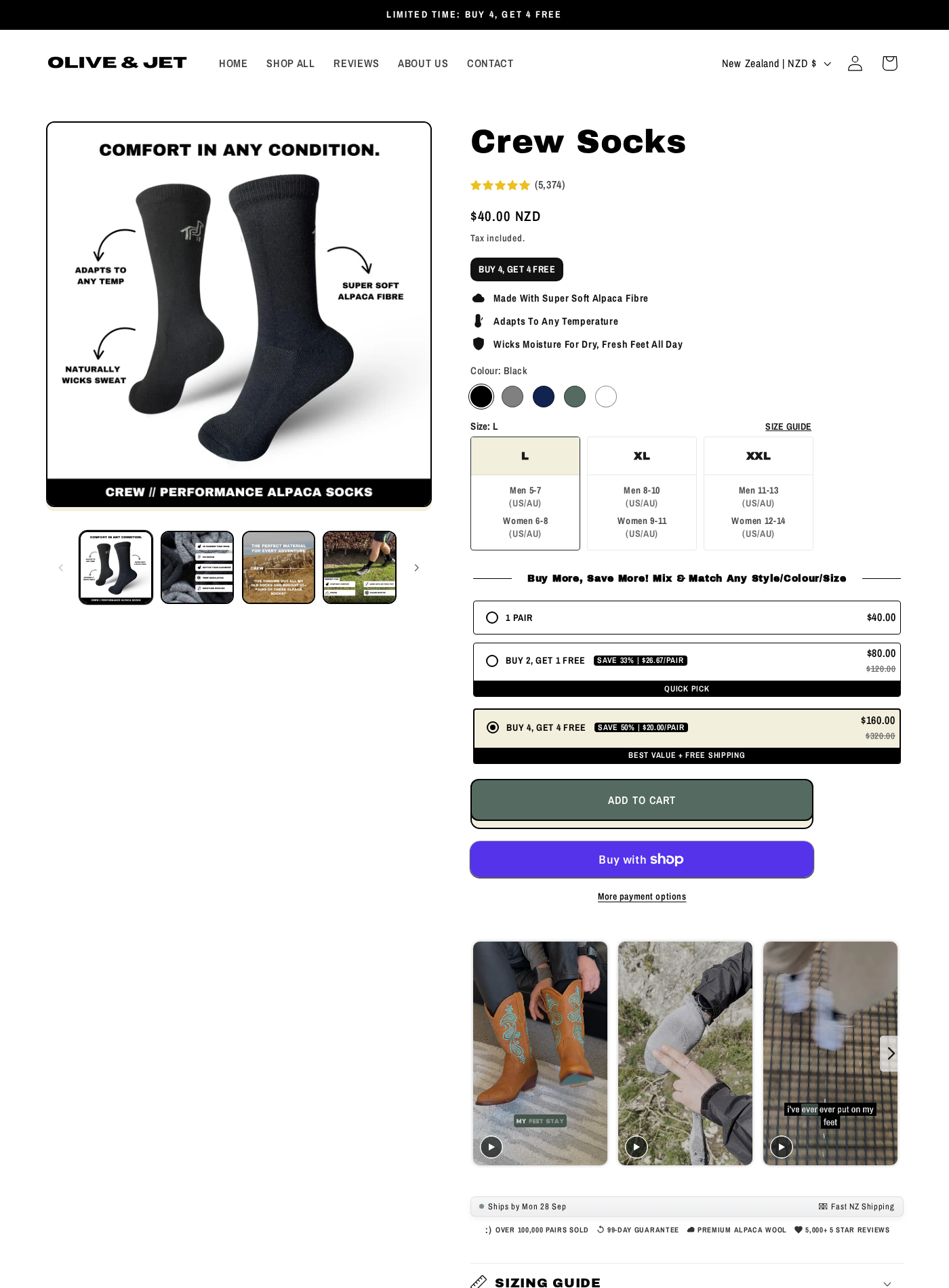
The standard crew sock is described as 45% alpaca fibre, 45% nylon, and 10% spandex.
Other designs use different recipes. The toe sock, for example, lists alpaca alongside nylon, acrylic, spandex, and elastic.
Those blends can be practical because socks need stretch and abrasion resistance, but shoppers should understand exactly what the advertised material description means.
The brand says its alpaca fibre comes from South America while textile specialists in China manufacture the finished products.
New Zealand ownership therefore does not mean the socks are made in New Zealand, and the site currently explains that distinction.
The biggest uncertainties concern promotion scale and expectations
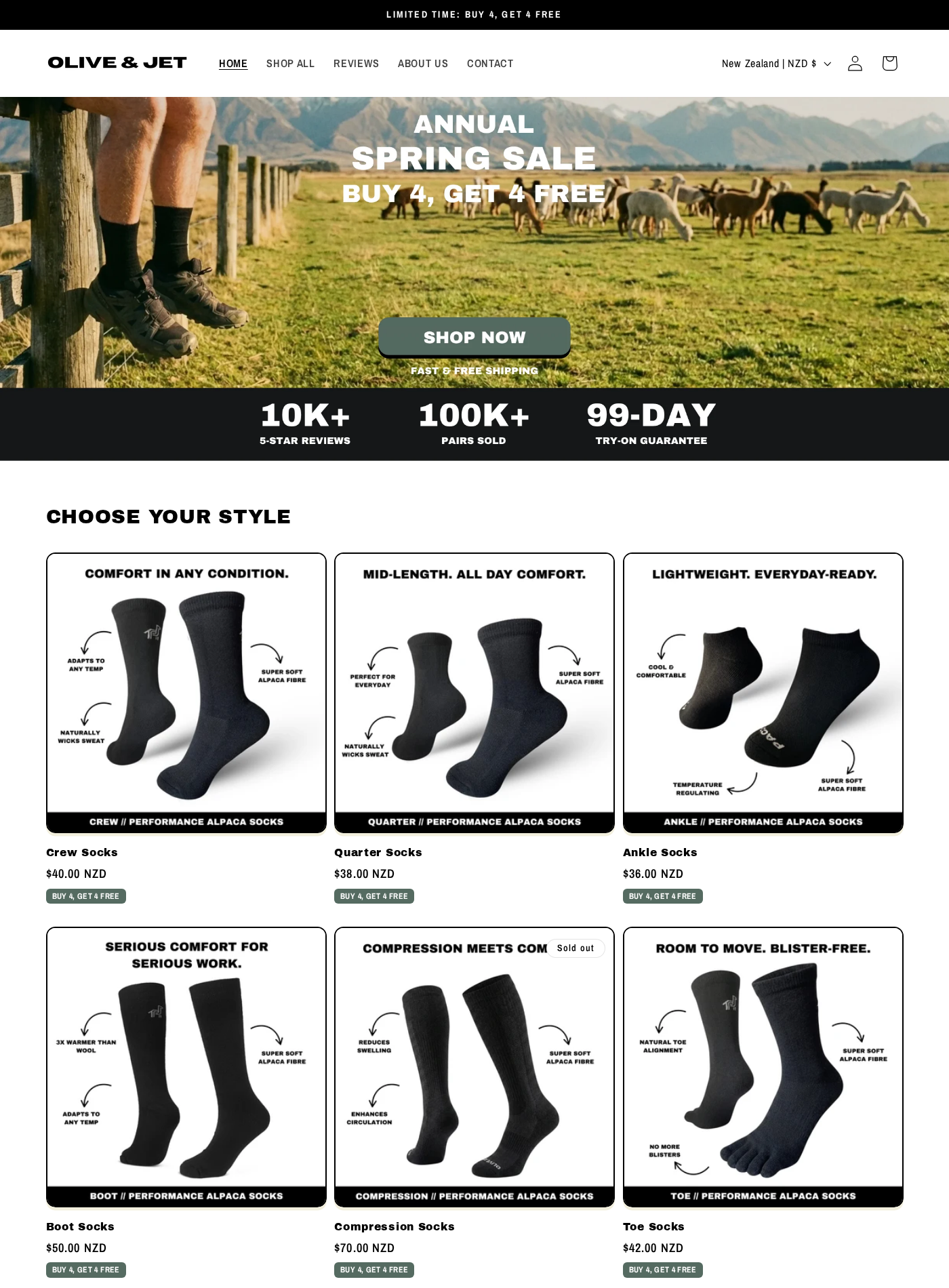
The homepage showed a buy four, get four free campaign, more than 10,000 five-star reviews, over 100,000 pairs sold, and a 99-day guarantee.
The crew-sock page displayed a separate count exceeding 5,000 reviews and preselected the largest eight-pair bundle during our check.
Large seller-controlled totals are not automatically false, but their collection, verification, duplicate handling, and moderation cannot be fully judged from the display alone.
Independent feedback is mixed. Many buyers praise comfort, while others question fibre expectations, durability, sizing, value, or delivery.
The safest decision comes from checking composition, quantity, fit, and return costs rather than relying on a headline score.
- Pacos Limited is the registered New Zealand company connected to the Olive and Jet trading name.
- The oliveandjet.com domain was registered on September 26, 2025.
- The crew sock lists 45% alpaca fibre, 45% nylon, and 10% spandex.
- The website says South American fibre is made into socks with textile partners in China.
- A large eight-pair bundle was preselected on the crew-sock page during our review.
- The storefront promotes a 99-day try-on guarantee with original-condition limits.
- Several different email addresses appear across contact, footer, and policy pages.
- Independent reviews include both satisfied customers and recurring concerns about expectations.
How the Olive and Jet Sales Journey Can Create Buyer Problems
Step 1: A lifestyle promise arrives before the fibre breakdown
The first impression is pastoral imagery, alpacas, outdoor comfort, and language comparing the material favorably with cashmere, merino, cotton, and wool.
That presentation can make a shopper remember alpaca while overlooking that more than half of the crew sock consists of nylon and spandex.
A blended sock is not inherently poor quality, and synthetic fibres can improve fit, recovery, and durability.
The issue is expectation. Someone picturing a nearly pure natural-fibre garment may evaluate the price differently after reading the percentages.
Open the Product Details panel for the exact style because compositions vary between crew, toe, diabetic, and compression designs.
Step 2: Bundle framing makes eight pairs feel like the sensible choice
The homepage repeats limited-time language around a buy four, get four free offer, while the product page compares one, three, and eight-pair choices.
During our check, the eight-pair option was already selected and labeled as the best value with free shipping.
The saving is real only if the buyer wanted that quantity and accepts the per-pair price, fit risk, and return conditions.
A large first order magnifies any sizing mistake, texture disappointment, or durability concern across several identical products.
Select the intended bundle manually, then verify pair count, colors, sizes, discount, taxes, and shipping before payment.
Step 3: Large review numbers supply social proof inside the store
The homepage and product pages present thousands of positive ratings beside claims that more than 100,000 pairs have been sold.
High numbers can reduce hesitation because they suggest the product has already been tested at enormous scale.
The store does not give outside visitors complete access to its review-verification rules, rejected submissions, or customer matching process.
Treat on-site reviews as one information source, then compare detailed independent accounts discussing months of wear, washing, pilling, sizing, and support.
Specific photographs and timelines reveal more than a star average or a brief statement about softness.
Step 4: Performance language stretches beyond simple warmth
The website describes temperature regulation, moisture management, odor resistance, strength, reduced blistering, circulation support, and comfort for sensitive feet.
Some statements concern fibre characteristics, while others imply a practical outcome that depends on shoe fit, activity, construction, washing, and individual health.
Compression and diabetic labels deserve special care because shoppers may read them as medical reassurance rather than product categories.
A sock should never replace professional assessment for diabetes, neuropathy, circulation problems, wounds, swelling, or persistent foot pain.
Ask the seller for compression specifications and substantiation when a claim affects a health-related purchase decision.
Step 5: The guarantee sounds broader than an unrestricted trial
Olive and Jet advertises a 99-day try-on guarantee, encouraging buyers to believe they have generous time to decide.
The site also says returned socks must remain in original condition and excludes pairs subjected to extended, multi-day wear.
That is not the same as using every pair normally for three months and returning them after repeated washing.
Hygiene-sensitive garments often carry conditions, so request written clarification before opening, wearing, or laundering a large bundle.
Keep at least part of the order sealed until one pair has been checked for sizing and initial comfort.
Step 6: Different contact addresses can complicate a time-sensitive request
The reviewed pages displayed angus@oliveandjet.com, sam@oliveandjet.com, support@oliveandjet.com, and angus@pacos.co in different contexts.
Multiple monitored inboxes may reflect a small growing business, but they can also leave a buyer unsure which route governs returns.
Start through the address named in the current return instructions and copy the general support address shown on the order confirmation.
Request an authorization, destination, deadline, and expected refund before posting any parcel.
Save the entire thread because a verbal or informal promise is harder to prove later.
What the Alpaca Claims Actually Tell You
Composition matters more than the largest word on the page
Crew socks contain 45% alpaca, so the natural fibre is a substantial component but not a majority of the finished fabric.
Nylon supplies strength, while spandex provides stretch, according to the seller. That explanation is technically plausible for everyday hosiery.
Toe socks use a different blend, and compression models include polyester and acrylic alongside alpaca, nylon, and spandex.
Do not assume one percentage applies across the catalog merely because every listing emphasizes alpaca.
Print or save the precise composition attached to the size and style you selected.
Warmth and moisture performance depend on construction
Fibre type influences insulation and moisture behavior, but yarn thickness, knit density, shoe ventilation, activity, and weather also shape the result.
A thin blended ankle sock and a tall boot sock cannot be expected to perform identically in the same conditions.
Claims such as three times warmer need a defined comparison product, test method, weight, and environmental setting to become meaningful.
Ask whether the stated comparison refers to equal weight, equal thickness, laboratory fibre data, or a finished-sock trial.
Without that context, treat dramatic multipliers as marketing summaries rather than personal performance guarantees.
Made in China is disclosed, not hidden
The brand explains that South American alpaca is processed with specialist partners in China, while ownership and registration remain in New Zealand.
Manufacturing origin alone does not determine quality, safety, labor standards, or whether a product offers fair value.
It does matter when a buyer assumes local production from national branding, farm imagery, or a domestic company address.
Look for country-of-origin labeling on the delivered package and compare it with the current site statement.
A responsible evaluation should examine the actual item, not rely on stereotypes about an entire manufacturing country.
How to Evaluate Olive and Jet Reviews and Guarantees
Read review detail instead of counting stars
Useful sock reviews mention exact style, foot size, shoe type, washing method, months worn, climate, seam comfort, odor, shrinkage, and visible wear.
A sentence written immediately after delivery can describe softness but cannot establish long-term durability.
Likewise, one damaged pair does not prove that every product will fail, although repeated matching complaints deserve attention.
Compare the date and wording of independent feedback with the present composition because product designs may change.
Give greatest weight to accounts that show receipts, photographs, and a documented support outcome.
Clarify what the 99-day window permits
The guarantee allows trying socks at home while requiring original condition and rejecting extended multi-day wear.
Those phrases leave judgment around acceptable use, washing, odor, packaging, tags, and the number of opened pairs.
Email a concrete question describing your intended trial and ask whether the resulting condition remains returnable.
If ordering eight pairs, ask whether unopened pairs can be returned when one tested pair does not fit.
Keep the reply, because it is more useful than relying on a general badge after a disagreement develops.
Calculate the real bundle commitment
A 50% bundle presentation may still require paying for four pairs at once, which is a meaningful trial cost for socks.
Compare the final amount with equivalent alpaca-blend, merino-blend, and synthetic performance socks sold through retailers offering local returns.
Include postage, taxes, currency conversion, and any cost of sending unwanted goods back to New Zealand.
Check whether the promotion permits mixed sizes and styles, especially when buying for several people.
Value depends on usable pairs received, not the size of the crossed-out total.
Company, Address, and Manufacturing Checks
The registration points to Pacos Limited
New Zealand business records connect NZBN 9429051054786 with Pacos Limited and list Olive and Jet as a trading name.
The company was registered in January 2023, before the current domain registration recorded in September 2025.
Its recorded activity covers clothing retail, and the listed director information gives the business a traceable local identity.
That is stronger transparency than a shop offering only a generic email with no entity.
Registration confirms an organization exists; it does not certify product performance or approve advertising statements.
The Christchurch address matches public business information
The site lists 34 Ivey Road, Christchurch 7676, and public company data shows the same location for registered office and service.
A matching address supports identity consistency, although a registered office may also be residential or administrative rather than a retail store.
Do not arrive unannounced or assume it accepts customer parcels without prior authorization.
A return can require a different facility, department, reference number, or customs declaration.
Use only the destination supplied for your order in writing.
Contact details are real enough to test before purchase
The site publishes a New Zealand phone number and several branded or company-related email addresses.
Call or email with a specific question about fibre percentage, opened-pair returns, and mixed-size bundles before buying.
A useful answer should address the question directly and identify the current return process.
Save the response alongside screenshots of the offer, because promotional pages and staff instructions can change.
If replies conflict, ask which written policy controls the order.
The supply chain spans three regions
The stated fibre source is South America, the manufacturing partner is in China, and the owning retailer is registered in New Zealand.
That arrangement is common in apparel, but buyers should not confuse ownership, raw-material source, factory location, shipping origin, and return destination.
Inspect the delivered label for fibre percentages, care instructions, country of origin, importer information, and size.
Stop wearing socks that cause constriction, skin irritation, unusual swelling, wounds, or persistent discomfort.
Health concerns involving diabetic or compression products should be discussed with an appropriate clinician.
What to Do If You Ordered Olive and Jet Socks and Have a Problem
- Preserve the offer you accepted. Save the product page, fibre percentages, selected bundle, guarantee wording, price, shipping estimate, and checkout total.
- Check every unopened item first. Compare labels, colors, sizes, pair count, composition, and country of origin before removing tags or packaging.
- Test only one pair initially. Confirm fit and immediate comfort without laundering or extended wear while the remaining pairs stay returnable.
- Document any defect clearly. Photograph seams, holes, pilling, size labels, packaging, and the comparison between ordered and received products.
- Request instructions in writing. Contact the return address named in the current policy and ask for authorization, destination, deadline, and refundable amount.
- Explain the precise mismatch. Quote the saved listing rather than using broad dissatisfaction language, especially when composition, quantity, or sizing differs.
- Keep postage evidence. Use tracked shipping only after approval, photograph the packed return, and retain its weight, receipt, customs form, and delivery confirmation.
- Escalate within payment deadlines. Ask the card issuer or payment provider about buyer protection when a material problem remains unresolved after documented contact.
- Seek medical advice for injury. Stop using the socks and photograph the condition if compression, rubbing, irritation, or circulation symptoms appear.
A Lower-Risk Way to Try Premium Socks Online
Start with the smallest useful order
A single pair costs more per unit but limits exposure while you learn the fit, feel, washing behavior, shipping speed, and support quality.
The larger promotion makes sense only after the product works for the intended user.
If the store limits free shipping, compare that expense with the cost of an unwanted eight-pair bundle.
Use a credit card or established payment service offering dispute rights rather than an irreversible method.
A controlled test purchase provides better evidence than a dramatic discount badge.
Treat health-oriented descriptions cautiously
Non-binding cuffs and soft fibres may feel helpful, but a product name does not establish clinical suitability for every person.
People with diabetes can have reduced sensation and may not notice pressure, rubbing, moisture, or early skin damage.
Compression strength should be expressed using recognized measurements and selected for the user’s medical circumstances.
Inspect feet regularly and stop using any garment that leaves concerning marks or worsens symptoms.
Professional advice matters more than a testimonial when circulation or wound risk is involved.
Compare the same type of garment
Do not compare a light ankle blend with a thick hiking sock merely because both mention alpaca or wool.
Match height, weight, cushioning, material percentages, seam design, care requirements, warranty, and return costs.
Consider how many pairs survive repeated washing before calculating value per wear.
Independent durability evidence develops slowly, so recent five-star delivery reviews answer only part of the question.
A fair comparison turns an emotional bundle decision into a practical clothing purchase.
Frequently Asked Questions
Is Olive and Jet a scam?
Current evidence supports a real registered retailer with identifiable New Zealand company details.
The appropriate concern is whether the socks, promotions, and return conditions meet each buyer’s expectations.
Are Olive and Jet socks 100% alpaca?
No. The crew sock reviewed lists 45% alpaca fibre, 45% nylon, and 10% spandex.
Other styles use different blends, so read the individual composition.
Where are Olive and Jet socks made?
The brand says South American alpaca fibre is used by textile specialists in China.
The business itself is owned and registered in New Zealand.
What does the 99-day guarantee cover?
The site allows an at-home trial but requires original condition and excludes extended multi-day wear.
Ask how opened, worn, or washed pairs affect your specific bundle.
Who owns Olive and Jet?
Public registration connects the trading name with Pacos Limited, NZBN 9429051054786.
The website and company records show matching Christchurch details.
Should I buy the eight-pair bundle first?
Only if you already understand the sizing, texture, blend, and return rules.
A smaller order reduces the consequences of a poor fit or unmet expectation.
The Bottom Line
Olive and Jet appears to be an identifiable New Zealand retailer selling genuine alpaca-blend socks manufactured with partners in China.
The main risks concern how shoppers interpret blended materials, dramatic performance language, large on-site review totals, bundle pressure, and the practical limits of the guarantee.
Read the exact composition, begin cautiously, preserve the offer, and confirm opened-pair return rules before committing to the largest quantity.








