

A message apparently from AOK says money is waiting for you. Your past contributions have been reviewed, a refund has been prepared, and all that remains is your authorization.
The AOK refund email scam puts a precise figure on the offer: €478.90. Before you claim it, there is something important to check.
Overview
A refund that supposedly needs your permission
The email borrows the identity of AOK, the German health insurance organization. It presents a contribution review as completed business and makes the payment seem one small step away.
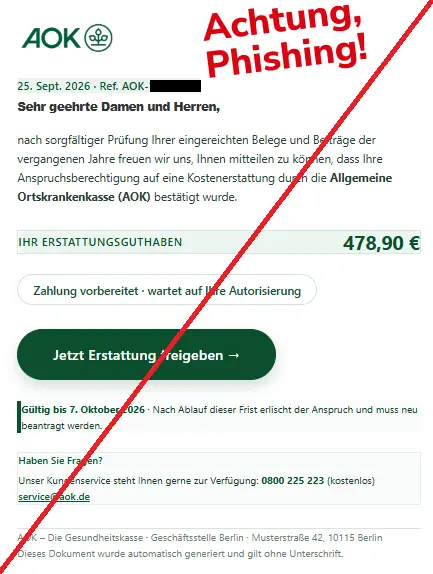
The September 25, 2026 Phishing Radar warning documents a €478.90 offer with an October 7 deadline.
The captured email above shows the authorization button and the claim that the entitlement will expire.
That is an offer made by an impersonator, not proof that AOK owes you this amount. Do not enter information to see whether you qualify.
The promise is the reason to investigate safely, not a reason to trust the form.
AOK has already warned about this kind of impersonation
On its official secure-communication page, AOK describes fraudulent refund emails and mass phishing attempts.
Its warning makes clear that convincing contact details at the bottom of an email do not make the refund request genuine.
This is therefore not an article about an unhappy policyholder or a disagreement with a legitimate insurer.
The scam is the false message and the attempt to collect information under AOK’s name.
There is no verified recipient count for this particular screenshot.
The evidence establishes a documented phishing lure within a broader impersonation problem, not a precise total of people who received it or lost money.
What should make you stop
The bait combines a financial reward with a small administrative chore. Each part is designed to seem unremarkable when you read it quickly. Taken together, these features deserve caution:
- An unexpected contribution refund presented as already approved.
- A specific amount with no independently verified calculation.
- A button asking you to authorize or release the money.
- A deadline that discourages you from checking with your insurer.
- Contact details and reference numbers offered as apparent reassurance.
The amount and cutoff date are not permanent identifiers. A later email could use a different figure or pretend the refund concerns medication instead.
The important question is whether your own AOK confirms the claim through a trusted channel.
Why €478.90 Looks More Believable Than a Prize
A refund does not feel like winning a lottery you never entered. It can sound like money that was yours all along.
That makes the request easier to rationalize, especially if you have recently submitted receipts or dealt with contribution paperwork.
The precise cents add to the effect. They suggest a calculation somewhere behind the message, even though the recipient is not shown a reliable breakdown.
Precision is not evidence; a scammer can type an exact amount as easily as a round one.
The wording also puts you close to the finish line. If the payment is supposedly prepared, why delay it over a simple confirmation?
That is the assumption the sender wants you to make before checking where the button leads.
You can step out of that pressure without forfeiting a genuine claim. Ask your insurer about the underlying refund using its normal contact route.
Do not let an unverified email define either your entitlement or the deadline for proving it.
How the AOK Refund Email Scam Works
Step 1: A familiar insurer becomes the apparent sender
The email uses AOK branding and a formal layout to introduce itself as an administrative message.
A reference number and a date can make it look like a record generated by an internal system.
Those features are easy to reproduce. They do not show that the sender has access to your insurance records, knows your contribution history, or represents your regional AOK.
Even if you really are an AOK member, that coincidence is not enough. The sender still needs to be verified independently before you supply personal or financial information.
Step 2: An approved payment becomes an expiring opportunity
The message offers a refund, then attaches a deadline.
In the captured example, the recipient is told to act before the stated cutoff or face losing the immediate claim and having to apply again.
This creates two reasons to hurry: receiving the money and avoiding more paperwork. Neither reason establishes that there is a real refund behind the email.
Notice what you are not being given: an independently checked explanation linking the amount to your own account. The email supplies confidence and urgency in place of that verification.
Step 3: The button takes over the verification process
Once you follow the button, the website decides what “authorization” means.
A fraudulent page can ask for identity information, account details, or further sign-in steps while continuing to repeat the refund story.
The available campaign evidence does not establish one fixed form for every recipient.
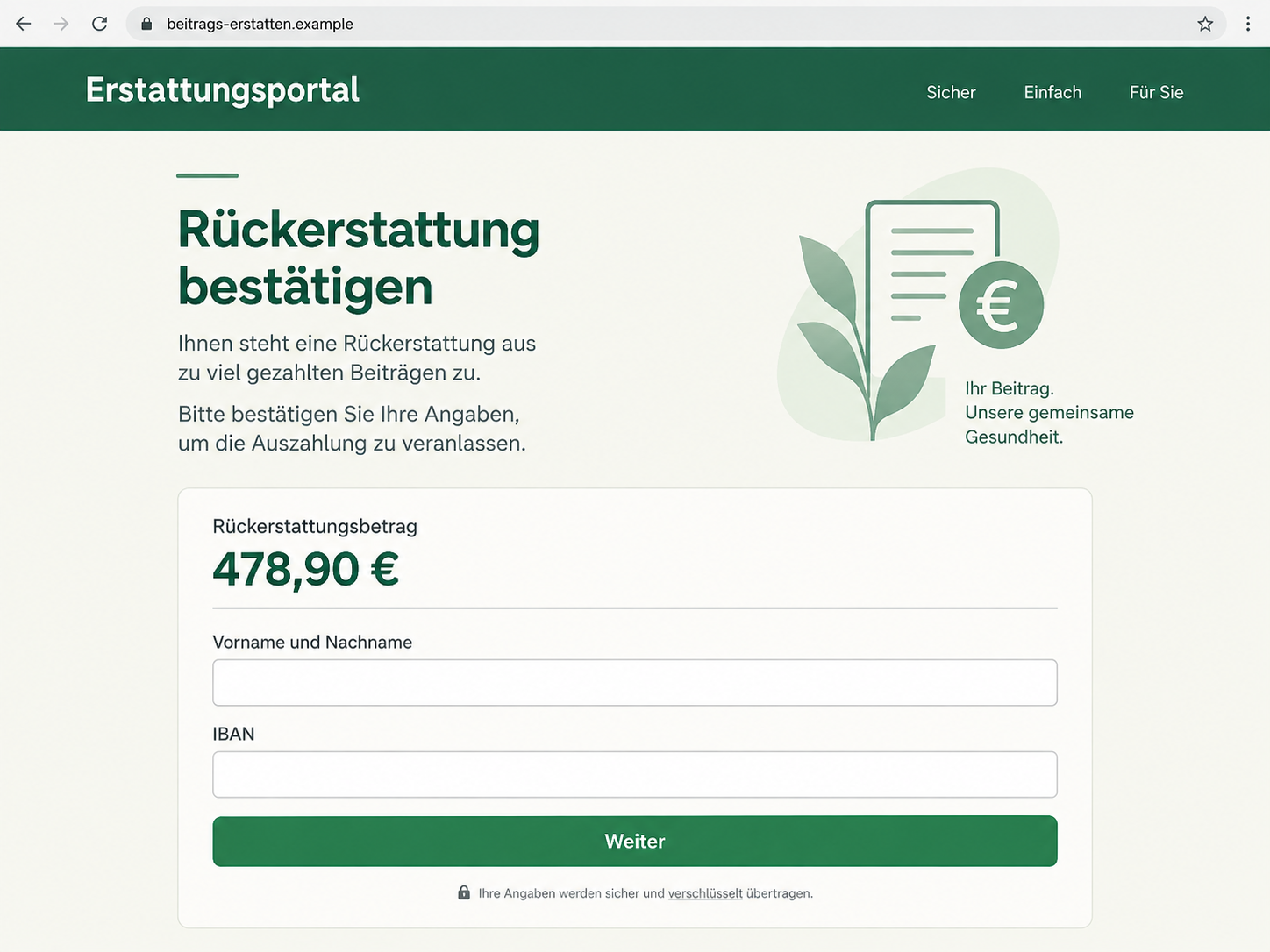
The reconstruction below illustrates a possible data-collection page using a fictional address; it is not an authentic capture of the destination.
The safe rule does not depend on the exact fields. Do not supply information to a refund site merely because an unsolicited email led you there.
Confirm the claim with your insurer first.
Step 4: The request may move beyond a refund
If a page starts asking for online-banking credentials or a payment approval, the risk has changed. You are no longer simply giving someone an account number to receive money.
AOK specifically warns that it does not use your online-banking login to verify your identity.
That warning is particularly useful if a refund form introduces a supposed bank check partway through the process.
Do not continue because you already entered your name. You can stop at any stage.
Any codes, passwords, or approvals requested afterward should be assessed as separate sensitive actions, not harmless additions to the original form.
Step 5: A missing refund leaves the information behind
A confirmation screen cannot prove that money is coming. Neither can a message saying that the payment is pending or that your details must be submitted again.
Once information has been entered on an untrusted site, respond according to what was exposed.
Do not wait for the promised payment date, and do not pay a processing charge to release it.
Further calls or messages may be unrelated, but be cautious if someone suddenly knows details from the form.
Familiar information is not proof that a caller works for AOK or your bank.
Who Sent the Email, and Where Does the Link Go?
The insurer’s name does not identify the operator
AOK is the organization being impersonated. Nothing in this email establishes that the person operating its link is an employee or an authorized service provider.
Do not transfer suspicion to a legitimate business simply because its name was copied. The relevant evidence concerns the message, its demand, and the destination collecting information.
The footer cannot authenticate the page
The captured email includes a street address, a phone number, and an email contact.
A real contact detail can be copied, while an invented one can be made to look ordinary. Neither possibility makes the button safe.
Check your regional AOK’s details independently. Do not call a number from a suspicious message to ask whether that same message is genuine.
Your regional AOK is the right support contact
Use the official AOK website, your established member portal, or contact information on documents you already trust. Ask whether there is an actual contribution adjustment or refund for your account.
If you receive a callback, do not volunteer login secrets. You can end the call and contact the insurer again yourself when the caller’s identity is uncertain.
A payment claim should connect to your real records
You do not need to perform a test transaction or submit extra documents to an unknown form to establish a refund’s legitimacy.
The insurer should be able to discuss the underlying account issue through its normal channels.
Keep the suspicious reference number as evidence, but do not let it override what your verified contact tells you.
A number printed in an email is not a claim you must complete.
What Sharing an IBAN Does, and Does Not, Mean
Giving an IBAN to a phishing site is worth reporting, but it is not the same as giving someone your banking password and approving a transfer.
Avoid advice that treats every type of exposure as identical.
Tell your bank exactly which information left your control.
If the form also requested your date of birth, address, phone number, or insurance information, include that in the account of what happened.
Review transactions for unfamiliar activity and keep records of anything suspicious. Your bank can explain which monitoring or blocking options fit the situation.
Do not assume an empty transaction list immediately afterward means the information cannot be misused later.
A request for a TAN, app approval, or card security code deserves particular attention. Read what any genuine banking prompt actually authorizes.
An action labeled as a refund on a separate website may not match what your bank is asking you to approve.
You are not being difficult by refusing to continue. A legitimate question about health insurance can wait while you establish who is asking it.
A stranger’s countdown is not a reason to hand over control of another account.
What to Do if You Have Fallen Victim to This Scam
Start with the information you actually submitted. There is no benefit in staying on the page, answering its follow-up questions, or trying to claim the money a second time.
-
Stop the conversation and preserve the message. Save the original email and note the destination address if it is already visible.
Record which fields you completed and whether you pressed a confirmation button.
Do not reopen the site just to collect a better screenshot. Existing browser history, the email, and your recollection can still help explain the incident.
-
Ask your real AOK to check the situation. Contact your regional insurer through an established route.
Explain that an impersonation email offered a refund and specify any insurance or identity information you disclosed.
Ask whether your member account needs protective action. Do not send further copies of identity documents unless the genuine insurer requests them through an appropriate secure process.
-
Contact your bank promptly if banking data was involved. Distinguish an IBAN disclosure from a card disclosure, password submission, or approved transaction.
Give the bank the time of the incident and any payment details you can see.
If money has moved, ask about the available recall or dispute process immediately. Recovery depends on the circumstances; nobody contacting you out of the blue can guarantee it.
-
Replace exposed passwords through the real services. If you used a member-portal password on the fake form, change it using the genuine portal.
Change it anywhere else you reused it, particularly your email account.
Check recovery information and unfamiliar sessions where those options exist. A password change at one service does not update the same password at other services.
-
Investigate downloads separately. Entering information into a webpage does not by itself prove malware was installed.
If the site persuaded you to install an app, extension, or file, however, treat that as an additional incident.
Run a Malwarebytes scan to look for malicious software.
If remote access was granted, stop using the affected device for sensitive accounts until it has been checked by someone you trust.
-
Report suspected misuse. Use your email provider’s phishing-report option and notify AOK through its official contact route.
Contact the police if you suspect identity misuse or financial loss, and retain the report reference.
When warning family members, share the pattern rather than your personal data.
Our coverage of fake Revolut identity-check texts shows another way impersonators turn a supposed verification task into a dangerous request.
-
Protect yourself from the next approach. Be wary of a caller offering to retrieve the refund or reverse a payment in exchange for a fee, a code, or remote access.
Contact the relevant institution yourself instead.
AdGuard’s relevant filtering protections can help reduce exposure to known malicious pages and deceptive ads. They cannot authenticate a refund, catch every new domain, or undo information already sent.
Frequently Asked Questions
Is the €478.90 AOK refund email genuine?
The email shown here is a documented phishing message. Do not authorize anything through its button. Check any genuine refund directly with your regional AOK using contact details obtained independently.
Does this mean AOK refunds are scams?
No. The warning concerns criminals impersonating AOK, not legitimate insurance administration. Whether you are entitled to a real refund is a separate question for your insurer.
What if the amount or deadline in my email is different?
A different amount does not make the request safe. Look at the underlying demand: an unsolicited refund tied to a link and a request for information.
Verify it without using the email’s route.
Can AOK ask me to log into my bank to verify my identity?
AOK’s official warning says it does not verify your identity through your online banking. Stop if a supposed insurance refund introduces that requirement, and contact the insurer independently.
Do I need to close my bank account after sharing an IBAN?
Do not assume account closure is necessary. Tell your bank exactly what you shared and follow its advice about monitoring or protective measures.
Passwords, card details, and approvals can require more urgent action than an IBAN alone.
What if I only opened the email?
Report it and remove it without clicking its links. Opening the message alone does not prove account takeover.
If you followed a link, consider whether you submitted data, downloaded anything, or granted permissions before choosing your next steps.
The Bottom Line
The AOK refund email scam makes an invented payment feel like money you only need to collect.
The exact amount, formal reference, and deadline do not establish that the offer comes from your insurer. Check with your regional AOK outside the email.
If you already shared information, tell the insurer and bank what happened, protect the affected accounts, and refuse any further request to “release” the refund.

Join the discussion
0 commentsShare your experience or ask a question about this article.
Discussion
Start the conversation
Have a question or something useful to share? Add the first comment.