

Vivian and Pearl Newport does not begin by selling a jacket. It begins with a mother, a daughter, a coastal boutique, and twenty years of customer trust.
That personal story deserves the same careful inspection as the garments, discounts, company records, fulfillment route, return destination, and promises surrounding the checkout.
Overview
The storefront tells a long local-boutique story from a new domain
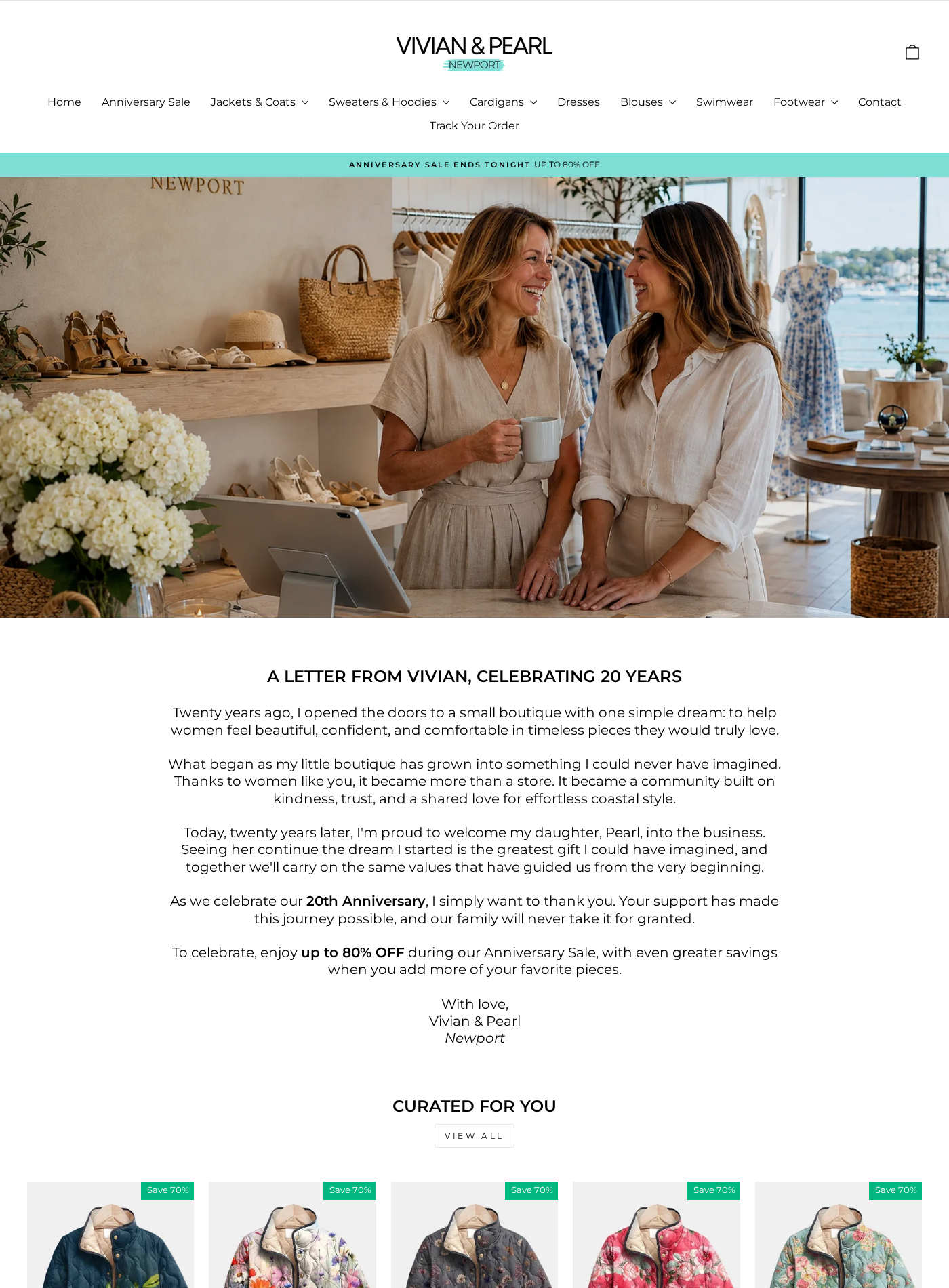
The homepage says Vivian opened a small boutique twenty years ago and now welcomes her daughter Pearl into the business.
Newport imagery, personal letters, family language, and anniversary messaging create the impression of an established coastal retailer with deep community roots.
Registry data shows vivianandpearl.com was registered on July 26, 2026, only months before this review.
A business can predate its domain, but the website provides limited independently verifiable history supporting two decades of operation under this exact identity.
The gap does not prove fabrication, yet it makes the emotional origin story a claim requiring corroboration.
The logistics are Chinese even though the branding centers on Newport
Terms say products ship from China through third-party logistics providers and approved returns must go to a fulfillment partner there.
The business information names Chafo Commerce LLC at a Denver address while another clause says the company is registered in the Netherlands.
Those statements sit beside a Newport identity that can easily lead shoppers to expect a local American boutique and domestic return route.
International sourcing is common and can deliver acceptable goods, but it should be transparent before the customer pays a premium-looking price.
Here, the operational truth becomes clearest deep inside policy pages rather than through the central family narrative.
The return pages contradict each other in important ways
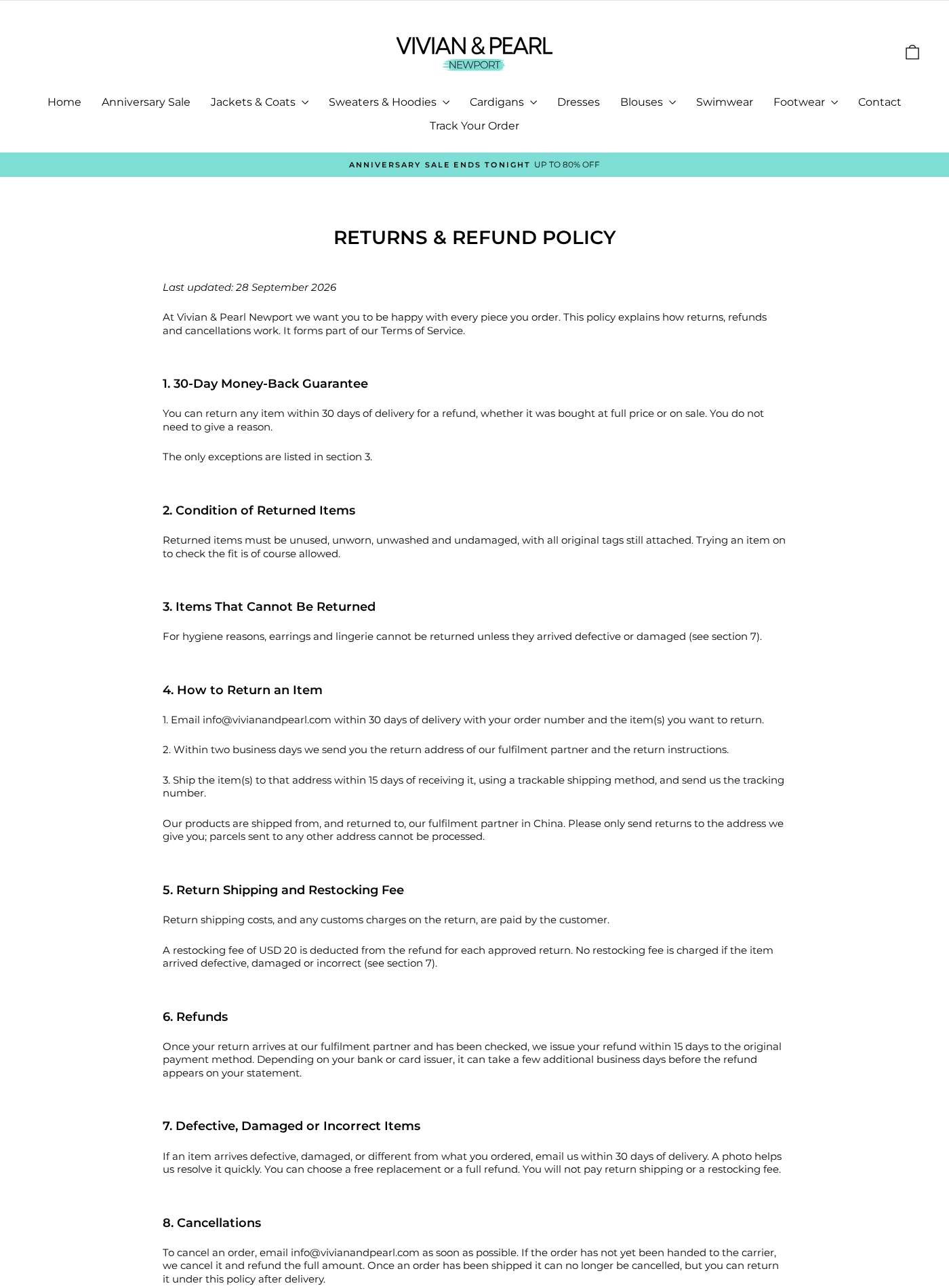
The homepage promises a 30-day money-back guarantee and easy returns, while current return text sends parcels to China at the buyer’s expense.
That page deducts a $20 restocking fee from approved ordinary returns and requires trackable international shipping.
The Terms separately say goods discounted by 40% or more are final sale and cannot be returned, refunded, or exchanged.
The current return page, however, says sale items can return and lists only hygiene exclusions, producing a direct internal conflict.
Because many products show reductions between roughly 50% and 80%, the disagreement affects much of the catalog.
- The vivianandpearl.com domain was registered on July 26, 2026.
- The site claims a family boutique history beginning around 2006.
- Terms name Chafo Commerce LLC and a Denver registered address.
- Another Terms clause says the operating company is registered in the Netherlands.
- Orders are shipped from China through third-party logistics providers.
- Approved returns go to a Chinese fulfillment partner at the customer’s expense.
- The return page deducts a $20 restocking fee from ordinary approved refunds.
- Sale-item eligibility conflicts between the return page and Terms and Conditions.
How the Vivian and Pearl Boutique Funnel Can Create Buyer Problems
Step 1: A social advertisement sells a closing or anniversary story
Boutique-network campaigns commonly begin on Facebook, Instagram, or another feed with a deeply discounted jacket, dress, shoe, or cardigan.
The advertisement may describe retirement, a closing sale, a family milestone, final inventory, or a heartfelt thank-you to loyal customers.
Vivian and Pearl currently uses a twentieth-anniversary event ending tonight, with savings shown up to 80%.
The story makes the discount feel exceptional and personal rather than part of an ordinary direct-response sales system.
Save the advertisement and revisit it later to see whether the same deadline and narrative continue.
Step 2: The landing page builds a relationship with invented intimacy
Visitors meet Vivian and Pearl through photographs, first-person letters, handwritten-card references, Newport scenery, and language about generations working together.
This emotional detail encourages trust before the shopper studies legal identity, manufacturing origin, or shipping terms.
A genuine family merchant could use the same techniques, so the storytelling alone is not proof of deception.
The risk appears when the biography lacks independent history while operational details point to a remote network model.
Verify the claimed physical boutique, earlier business records, local coverage, and archived presence rather than accepting the page as evidence of itself.
Step 3: Premium reference prices make generic clothing seem exceptional
Products display dramatic reductions, sometimes placing a $60 or $80 selling price beside a reference value several times higher.
The supposed former price helps ordinary imported apparel feel like boutique inventory being sacrificed during a rare event.
Search by image, unusual product phrase, fabric description, and design details across marketplaces and other boutique-branded sites.
When identical photographs appear widely, compare materials, sizing, shipping, and return options instead of paying for the invented provenance.
Judge the present price against the likely product, not the crossed-out number.
Step 4: The order enters a China-based fulfillment chain
The Terms disclose that third-party logistics partners in China ship the products and receive approved returns.
That arrangement resembles a broader boutique-store network where a branded storefront markets products while overseas partners hold and dispatch inventory.
Customers may receive a real garment, yet its materials, fit, color, finishing, or perceived quality can differ from the premium emotional presentation.
Delivery takes longer and support has less direct control than a local boutique shipping its own stock.
Preserve tracking and packaging because they reveal the carrier route and fulfillment source.
Step 5: Easy-return language becomes expensive after delivery
A global banner and product pages describe a 30-day guarantee, full refund, and easy returns without emphasizing international postage or the $20 deduction.
The detailed policy requires buyers to request an address, ship to China, pay freight and customs, use tracking, and wait for inspection.
For a moderately priced garment, tracked international postage plus the restocking fee can consume much of the recovery.
The conflicting final-sale clauses create another obstacle when nearly every attractive listing is heavily discounted.
Ask for the exact destination and net refundable amount before placing the order, not after discovering poor fit.
Step 6: Brand names and websites can change while the funnel survives
The underlying model does not depend on Vivian, Pearl, Newport, or any single domain remaining online for years.
A network can replace the boutique name, founders, city, sale occasion, and product selection while reusing logistics, policy language, images, and advertising tactics.
The shipping page even contained a hidden mail link referencing sanibel-boutique.us behind visible Vivian and Pearl text during our research.
That residue is consistent with template reuse, although it does not establish who controlled the other domain.
Evaluate the current legal seller and fulfillment structure instead of trusting a memorable storefront story.
The Fake Boutique Network Pattern Explained
The story changes, but the emotional structure stays familiar
One store may feature a retiring couple, another a mother and daughter, and another a designer closing after decades of sacrifice.
Locations often evoke trust and affluence, such as Newport, London, Melbourne, Amsterdam, or a picturesque coastal town.
The narrative supplies heritage that the young domain and sparse outside record cannot independently demonstrate.
Photographs may be stock, generated, edited, or simply unrelated to a real local retail operation.
A buyer should verify the people, storefront, address, and historical timeline separately.
Social advertising turns a generic catalog into a premium event
Networks can test numerous products and stories rapidly through targeted feeds, keeping advertisements that produce the best response.
A garment with inexpensive overseas sourcing receives a new name, elevated reference price, boutique description, and emotionally urgent discount.
The advertisement is not selling only fabric and stitching; it sells exclusivity, sympathy, local identity, and fear of missing the final opportunity.
That does not prove every image or sentence is false, but unsupported claims should never determine the purchase.
Reverse-search the product and compare the price against visually identical marketplace listings.
Fulfillment centers separate the storefront from the merchandise
Orders can pass directly to a Chinese supplier or logistics partner that packages and ships goods without operating the customer-facing brand.
The website owner therefore avoids maintaining a Newport shop, domestic warehouse, large local staff, or conventional retail inventory.
This model can reduce costs, but it also weakens quality inspection, delivery control, and simple domestic returns.
A return warehouse processes parcels; it does not prove the boutique story, designers, or product origin presented in advertisements.
Ask where inventory physically sits before purchase and whether a domestic return option exists.
Claims and Contradictions Found on Vivian and Pearl
The twenty-year story conflicts with the available digital timeline
The homepage and letters describe a boutique opened around 2006, yet the current domain appeared in July 2026.
No independently verified archived website, local storefront address, earlier trading name, or longstanding public review profile is prominent in the pages reviewed.
A legacy offline boutique could launch online recently, but the merchant should be able to document that history clearly.
Search business filings, local directories, archived newspapers, maps, and historical social accounts for the exact claimed Newport operation.
Until corroborated, treat the biography as advertising, not established fact.
The seller’s jurisdiction is internally unclear
Article 2 of the Terms names Chafo Commerce LLC at 1500 N Grant Street, Suite 5192, Denver, Colorado.
Article 14 then says Vivian and Pearl is operated by a company registered in the Netherlands and applies Dutch law.
A United States LLC can have international ownership or operations, but the wording does not explain that relationship.
Buyers need to know which entity contracts with them, appears on the card statement, issues invoices, and receives legal notices.
Ask support to reconcile both clauses in writing before a high-value order.
The returns page and Terms disagree about discounted goods
The current return page says any item may return within 30 days, whether purchased at full price or on sale, except listed hygiene products.
The Terms say anything reduced by 40% or more is final sale and excluded from returns, refunds, and exchanges.
Most featured products show discounts large enough to trigger that exclusion if the Terms control.
The rule most favorable to the consumer is mentioned elsewhere, yet shoppers should not have to resolve contradictory legal pages after purchase.
Save both policies and request confirmation tied to the exact SKU.
Company, Address, and Fulfillment Checks
Chafo Commerce LLC is the named operating entity
The Terms identify Chafo Commerce LLC and publish a Denver address as the registered contact for Vivian and Pearl Newport.
They say registration information is available on request rather than supplying a state filing number directly.
Ask for the jurisdiction, entity number, registered status, and invoice name before relying on the boutique identity.
The payment descriptor should clearly connect with Chafo Commerce LLC or an explained processor relationship.
Unexpected descriptors should be reported promptly to the merchant and card issuer.
The Denver location is not presented as a Newport shop
The listed address is 1500 N Grant Street, Suite 5192, Denver, Colorado, while branding repeatedly centers on Newport.
No public walk-in boutique address appears in the pages reviewed, despite the story describing physical doors opened twenty years ago.
A registered business address can lawfully differ from a retail location, but the actual store should still be verifiable.
Do not travel to or ship returns toward the Denver address without explicit authorization.
The published logistics route sends approved customer returns elsewhere.
China handles both outbound fulfillment and approved returns
Terms disclose that products ship from third-party logistics providers in China and must return to a Chinese fulfillment partner.
The customer pays international postage, customs charges, and other return expenses for ordinary dissatisfaction.
Current return text also deducts $20 after an approved parcel arrives and passes inspection.
This makes the purchase structurally different from buying at a Newport boutique with a local counter.
Calculate the worst-case recovery before ordering multiple sizes or several discounted items.
Template residue links the site to broader operational reuse
The shipping page displayed Vivian and Pearl contact text while the underlying email link referenced info@sanibel-boutique.us during our inspection.
Such residue can arise when store templates, operators, agencies, or policy components are reused across several brands.
It does not by itself prove common ownership of every referenced website.
Combined with a young domain, imported fulfillment, generic catalog, and emotional heritage story, it strengthens the need for independent verification.
Save these inconsistencies because they may disappear after pages are corrected.
What to Do If You Ordered From Vivian and Pearl and Have a Problem
- Capture every promise now. Save the product page, anniversary message, discount, return banner, Terms, refund page, size chart, materials, and order total.
- Record the parcel before opening. Film labels, customs information, seals, packaging, all garments, tags, colors, sizes, and visible defects in one sequence.
- Keep disputed clothing pristine. Do not wash, alter, perfume, remove tags, or wear the item beyond a careful indoor fit check.
- Quote the favorable sale-return language. If support invokes final sale, provide the current policy saying sale purchases can return and preserve both conflicting pages.
- Request the full Chinese destination. Obtain recipient, address, authorization, customs wording, tracking requirement, deadline, and expected refund before shipping.
- Calculate the net amount first. Subtract tracked international postage, customs, the $20 restocking fee, and non-refundable charges from the expected refund.
- Reject unauthorized substitutes clearly. Compare fabric, design, color, sizing, and quality with saved listing claims and identify each material difference.
- Open a payment dispute on time. Provide advertisements, receipts, tracking, policy conflicts, photographs, emails, and promised resolution before protection deadlines expire.
- Report misleading local claims appropriately. Send documented concerns to consumer-protection or advertising authorities covering your location and the stated seller jurisdiction.
How to Recognize Another Boutique-Network Store
Look for a history that exists only on the website
Search the founder names, claimed shop address, exact boutique name, opening year, local press, maps, archived pages, and social-account history.
A long-running local shop normally leaves traces independent of its current advertisement.
Be cautious when a dramatic retirement or anniversary story appears immediately after a domain was registered.
Generated-looking founder images are another reason to verify, although visual suspicion alone cannot prove image origin.
The decisive issue is whether the claimed people and history can be corroborated.
Search one product photograph across the web
Generic imported goods often appear under many invented boutique names using the same model pose and background.
A reverse-image result can expose large price differences, different material descriptions, and marketplace listings predating the boutique story.
Do not assume the cheapest listing is accurate either; compare specifications and seller protections carefully.
Repeated photographs show non-exclusivity, not necessarily identical inventory from every seller.
Use the result to question premium reference pricing and alleged in-house design.
Read returns before believing the emotional sale
Check whether goods return overseas, the buyer pays postage, sale items are excluded, restocking fees apply, and authorization is mandatory.
Search policy pages for another store name, email domain, legal entity, or contradictory jurisdiction.
A local-sounding storefront with a distant fulfillment route may still deliver, but returns can become economically pointless.
Pay by credit card, avoid oversized first orders, and never buy several sizes when the policy discourages returns.
The safest defense is understanding the logistics before the story creates urgency.
Frequently Asked Questions
Is Vivian and Pearl Newport a real twenty-year boutique?
The website makes that claim, but the current domain dates only to July 2026.
We did not find enough independent history to verify the full story.
Where do Vivian and Pearl products ship from?
The Terms say orders are fulfilled through third-party logistics providers in China.
That differs from the Newport-centered branding and family-boutique impression.
Where must returns be sent?
Approved returns go to a fulfillment partner in China, not automatically to the Denver address.
Customers must obtain the exact destination from support.
Are discounted items returnable?
The current refund page says sale goods can return, while the Terms exclude reductions of 40% or more.
Save both pages and demand clarification.
Does Vivian and Pearl charge a return fee?
The return page says ordinary approved refunds lose a $20 restocking fee.
The customer also pays international postage and customs expenses.
Who operates Vivian and Pearl?
The Terms name Chafo Commerce LLC at a Denver address.
Another clause refers to a Netherlands-registered operator, creating a jurisdictional inconsistency.
The Bottom Line
Vivian and Pearl follows the modern fake-boutique playbook closely: emotional heritage, local prestige, dramatic discounts, generic imported inventory, and difficult overseas returns.
That pattern does not prove every parcel is nonexistent, but it makes the twenty-year story and premium positioning unsafe foundations for a purchase.
Verify the history, reverse-search the garment, treat the sale as potentially final, and calculate China return costs before allowing the family narrative to decide.








