

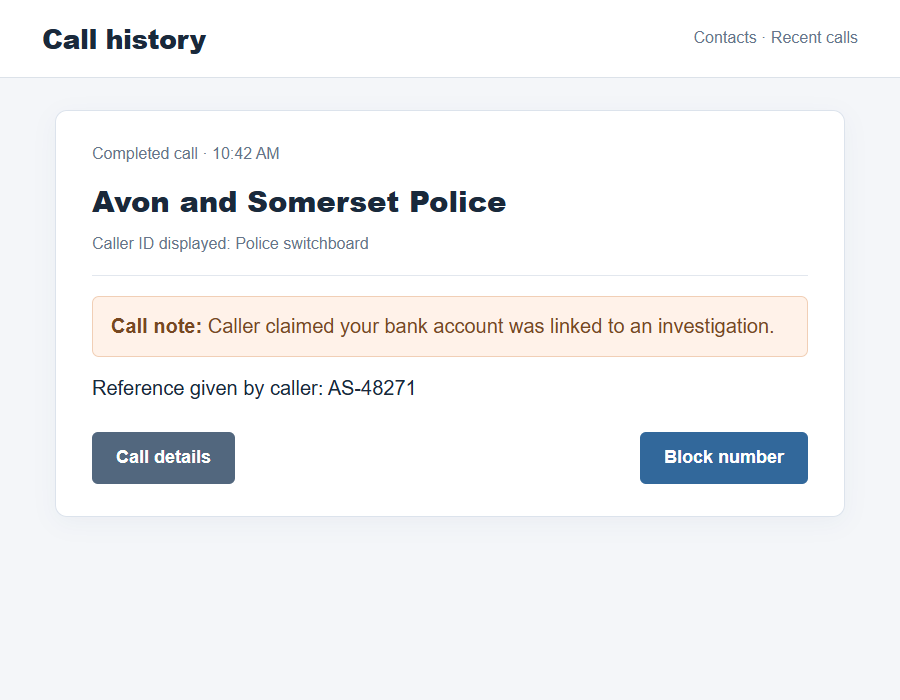
The caller says they are a police officer. They know your name, mention a case number, and insist your bank account needs protecting.
Even the number on the screen seems to belong to the police. That apparent match is where many people stop questioning the call.
Overview
What callers claim is happening
Residents have reported calls from people claiming to represent Avon and Somerset Police. The supposed officer says personal data has been compromised or linked to crime.
Another version says the recipient’s bank account is exposed to fraud. The caller may claim an arrest has already been made and a police investigation is under way.
The caller can add convincing details, including an apparent case reference or information about the person answering. Familiar facts make the story feel more credible.
- The call may appear to come from a real police telephone number.
- The person may claim to know private details or a nickname.
- A case reference can be presented as proof of an investigation.
- The requested action may be a transfer to a supposed safe account.
What Avon and Somerset Police confirmed
The force issued a public warning after receiving multiple reports of impersonation calls. It said reports also came from outside its policing area.
Police described callers who may try to obtain sensitive banking information or instruct victims to move money to an account controlled by fraudsters.
The warning also addressed number spoofing. The displayed number can appear genuine even though the incoming call did not originate from the police.
Some people called that number back and reached the real police control room. That callback showed the number belonged to police, not that the earlier caller was genuine.
The key judgment
An unexpected police call asking you to move money is a scam, however professional the caller sounds. No legitimate investigation requires a transfer to a “safe account.”
Avon and Somerset Police is the organization being impersonated. The force is not asking members of the public to transfer funds or disclose banking security details this way.
The official warning does not identify one fixed caller number or payment account. Do not assume a different number means a different, safer situation.
Why the Number on Your Screen Can Mislead You
Caller ID is useful for ordinary calls, but it is not reliable identity proof. Fraudsters can manipulate the number presented to the receiving device.
This creates a dangerous moment for a careful person. You search the displayed number, find the police website, and conclude the call must be real.
The search only confirms who owns the displayed number. It does not confirm who placed the call that just reached you.
A second trap follows. You press the call-back button and reach the real police switchboard, which seems to validate the earlier conversation.
It does not. The callback is a new call to the genuine number. The first caller could still have been a fraudster using that number as a mask.
To verify a claimed officer, end the call and contact the organization independently. Use a number you found on its official website, not one read aloud by the caller.
In the UK, police guidance points to 101 for a non-emergency police contact and 999 for an emergency. Using a different phone can add separation.
If you must use the same landline, allow time for the previous call to clear before dialing. Do not let the caller control the verification process.
How the Avon and Somerset Police Call Scam Works
Step 1: The fraudster opens with authority
The call arrives without warning. The person introduces themselves as a police officer and may give a rank, name, or apparent collar number.
A steady, professional tone is part of the persuasion. The caller does not have to shout to create pressure; sounding routine can be more effective.
They may mention an investigation, an arrest, or compromised records. These claims position the recipient as someone who needs to cooperate quickly.
The identity details can be invented or borrowed. A real officer’s name found online is not proof that the person speaking is that officer.
Step 2: Personal details make the story feel specific
According to the police warning, some callers appeared to know information about the people they contacted, including details and nicknames not normally public.
This may make the call feel impossible to fake. In reality, knowledge of a detail is not authorization to direct your finances.
Personal information can come from many places, including data shared previously, breached records, and information collected through earlier contact.
The advisory does not establish exactly how these callers obtained it. The safe response does not depend on solving that question during the call.
Step 3: A case reference creates false verification
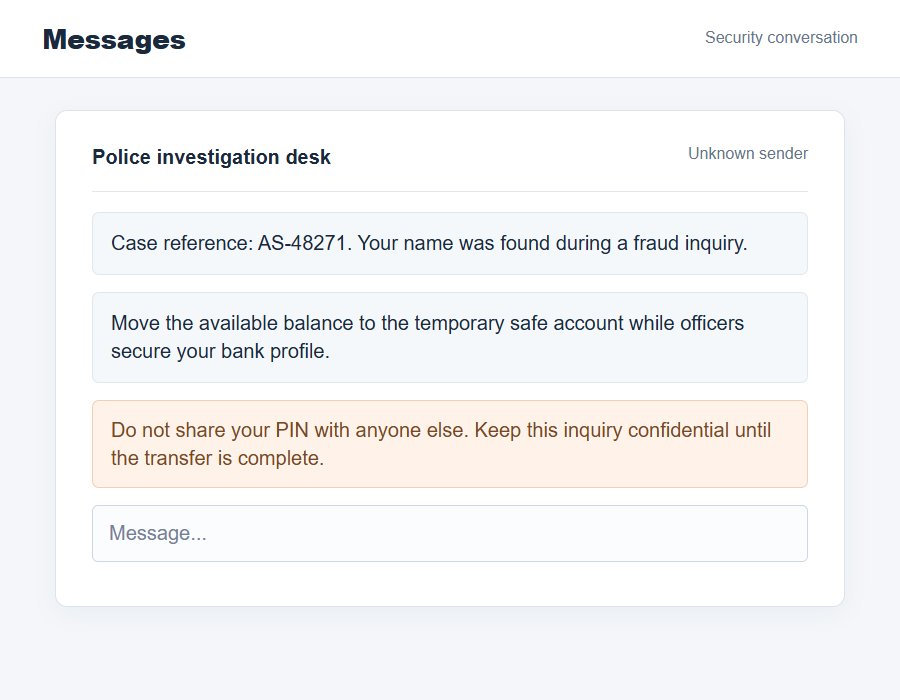
The caller may provide what appears to be a crime or case reference. It sounds like something you can repeat to the police later.
A made-up reference is easy to say. A real reference could also be quoted out of context. Neither proves the person speaking has police authority.
The caller may invite you to “check” the displayed number online. That invitation is not generous; it steers you toward a test that spoofing defeats.
Real verification requires an independent conversation with the force, initiated after you have ended the suspicious call.
Step 4: The supposed investigation becomes a money request
Once trust is established, the caller says your account is at risk and your funds need protection. The proposed fix is to move them elsewhere.
The destination is described as a safe account, evidence account, or temporary holding account. In the official warning, such an account would belong to fraudsters.
Some callers may instead seek bank details, PINs, passwords, or one-time codes. Those details can let them attempt unauthorized access without a transfer from you.
The request may be presented as confidential. Secrecy prevents you from asking a family member or your bank whether it makes sense.
Step 5: Pressure keeps you from checking independently
A fraudster can say the transfer must happen before a suspect moves the money. They may insist that hanging up would interfere with an investigation.
They may ask you to stay on the line while opening your banking app. That gives them another chance to correct doubts and keep the story moving.
A legitimate officer will not object to you ending a call and checking the identity through the force’s official contact route.
The moment a caller resists independent verification, the claim of authority becomes less credible, not more.
The Red Flags That Matter Most
The safest rule is behavioral. Judge what the person asks you to do, not how official the caller ID or case language appears.
- Move money to protect it or help an investigation.
- Withdraw cash, buy gift cards, or hand over bank cards.
- Reveal a PIN, banking password, or one-time passcode.
- Keep the call secret from your bank or family.
- Stay on the line while you make a transfer.
- Use a verification number supplied during the suspicious call.
Avon and Somerset Police says it will not ask people to do those things as part of an investigation. The warning applies even if a caller knows real details.
Do not argue with the person to prove they are lying. Ending the call is safer, faster, and leaves you free to check.
How to Verify a Claimed Police Officer
Write down what was said, but do not treat the caller’s reference as validated. End the conversation before opening your bank or sharing information.
Find the force’s published contact route yourself. Type the official site address or use 101 in the UK, rather than calling a number from the suspicious conversation.
Explain that you received an unexpected call, give the claimed officer’s details, and ask the force to check whether anyone genuinely contacted you.
If a real matter exists, the force can tell you an appropriate next step. You do not need to solve the case while the incoming caller waits.
Contact your bank through the number on your card or its official app if the caller mentioned your account. The bank can check for unusual activity.
Do not assume the real police switchboard confirming its own phone number settles the question. Ask specifically whether the earlier call was made by an officer.
Be careful with web search ads for police or bank contact numbers. An official site or an existing trusted app is a better route than a sponsored result.
If the call reached someone elderly or vulnerable, offer to help with an independent callback. Let them speak for themselves while you support the verification.
What a Real Investigation Would Not Need From You
The caller’s story may change, but the central demand stays similar: give control of your money or account information to someone you have not verified.
Moving your savings does not preserve evidence. It creates a transaction that may be difficult to reverse if the destination belongs to a criminal.
Sharing a passcode does not help police confirm identity. It may allow a criminal to approve a login, payment, or account change.
Handing over a bank card does not assist a fraud inquiry. The person collecting it would gain a direct route to your funds.
The police advisory also mentions requests to buy gift cards or goods. Those requests should be understood as payment demands, even when wrapped in investigative language.
Sometimes the caller says a bank employee is involved in the crime. That claim can discourage you from calling your bank for help.
Do not let a stranger isolate you from the very institutions that can confirm or challenge their story. Contact the bank through your known channel.
If you are asked to withdraw cash, remember that physical collection leaves you with fewer transaction controls. Refuse and call police independently.
Written notes can help later: who claimed to call, what they requested, which account they gave, and when they wanted you to act.
Record those details only if you can do so safely. You do not owe the caller more conversation just to complete a perfect report.
One confident sentence is enough: “I will contact the police directly.” Then hang up and make the separate call yourself.
That pause is not uncooperative. It is the appropriate response to a request that could empty an account within minutes.
If the caller tries again, repeat the same verification route. A new voice, case number, or displayed number does not validate the original demand.
What to Do if You Have Fallen Victim to This Scam
- End contact immediately. Do not answer follow-up calls or messages from the same person, even if they claim to be checking the case.
- Call your bank through an official route. Tell its fraud team exactly what you transferred or disclosed and ask about freezing, recalling, or monitoring the account.
- Secure exposed credentials. Change passwords through the genuine banking service. Tell the bank if you disclosed a PIN or one-time code.
- Preserve the evidence. Save call times, displayed numbers, any voicemail or message, account details supplied, and transaction references.
- Report the impersonation. Contact police independently and report fraud through the UK’s official reporting service. Do not rely on a number supplied by the caller.
- Watch for repeat approaches. A second caller may claim to be a fraud investigator or recovery agent. Verify every new contact from scratch.
- Tell someone you trust. Shame and isolation help fraudsters. A friend or family member can help you document events and stay focused.
If you only answered the call but shared nothing, you have not automatically lost access to your bank. Report it and remain alert for follow-up attempts.
Security software cannot undo a bank transfer or authenticate a caller. Your strongest control against this phone scam is independent verification.
Frequently Asked Questions
Can scammers display a real Avon and Somerset Police number?
Yes. The force warned that callers can spoof numbers so an incoming call appears to come from its genuine telephone lines.
Does reaching the police when I call back prove the earlier call was real?
No. Your callback reaches the number you dialed. It does not authenticate whoever placed the earlier incoming call using that number on the display.
What if the caller knows my nickname or address?
That makes the call more persuasive, but not more authorized. Verify through the force before discussing finances or personal security information.
Will police ask me to move money into a safe account?
No. Avon and Somerset Police explicitly warns that it will not ask you to transfer money to a purported safe account as part of an investigation.
Should I give the caller a one-time banking code to confirm my identity?
No. Do not disclose a one-time code, PIN, or password to someone who called you. Contact the bank independently if your account might be affected.
Who should I contact after sending money?
Contact your bank’s fraud team immediately, then report the incident to police and the UK’s official fraud-reporting service with your saved evidence.
The Bottom Line
The Avon and Somerset Police call scam uses official-sounding detail and a spoofed number to make a dangerous request seem routine.
End the call, verify independently, and never move money or reveal banking security details for someone who claims to be conducting a police investigation.








