

A page promises extra FLR tokens if you vote on a rewards date. It resembles a familiar crypto portal, and the button takes only a moment to press.
Before you connect anything, look at what this particular vote asks you to trust. The answer is more important than the promised bonus.
Overview
The offer borrows a real governance idea
Flare does have a governance process. Token holders can review proposals and cast votes through the official Flare Portal.
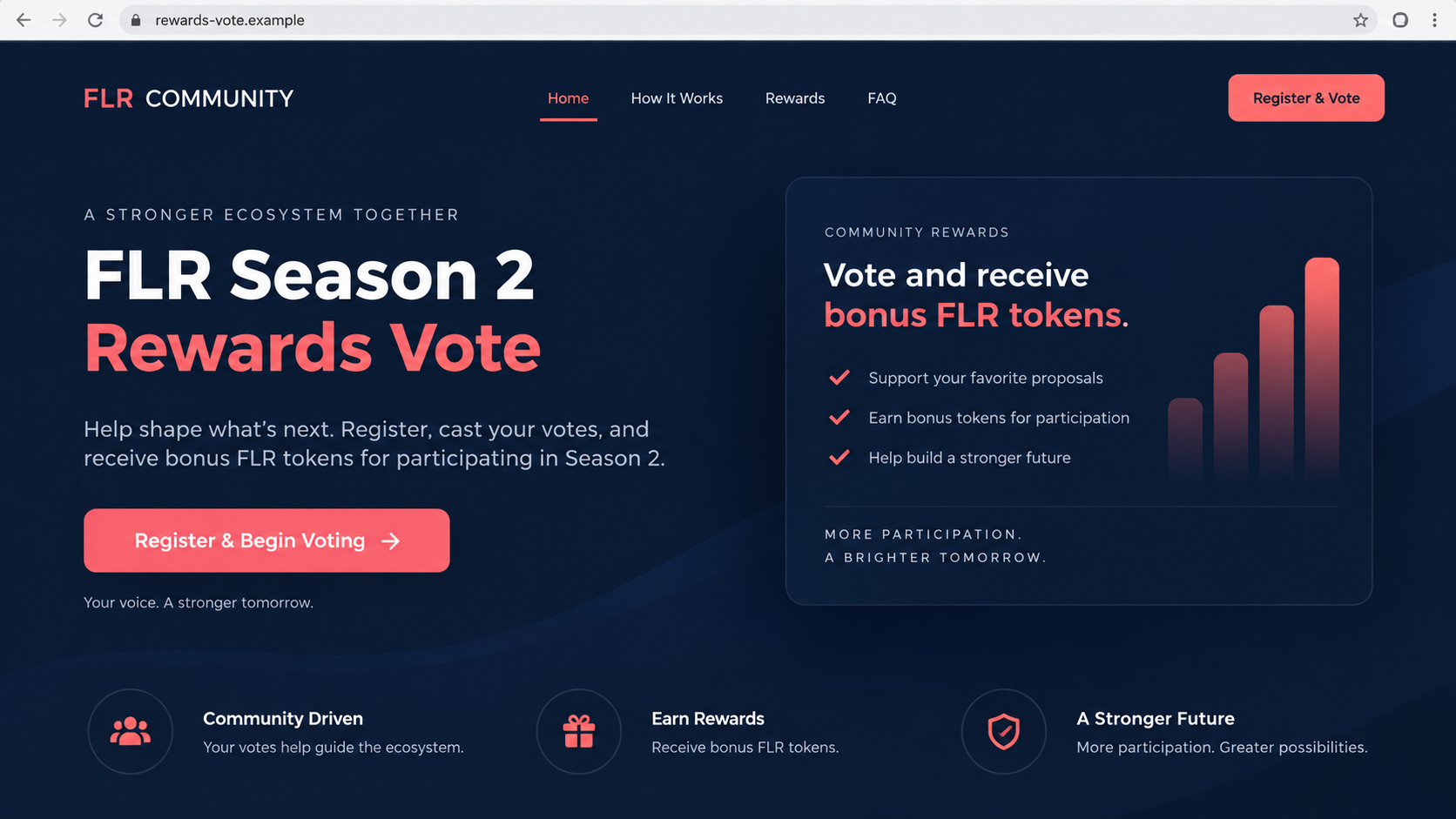
The suspicious offer used that legitimate concept as cover. It described an “FLR Season 2” rewards-date vote and promised bonus tokens for participation.
That distinction matters. A real voting system does not make every voting invitation genuine, especially when the invitation arrives through an unrelated domain.
A documented version used a domain styled to evoke the Flare Foundation, rather than the official Flare voting route. The domain name was part of the impersonation.
The real decision point is the wallet request
The page offered a “Register & Begin Voting” button. From there, visitors were prompted to select and connect a cryptocurrency wallet.
Connecting a wallet is common on legitimate decentralized applications. It is not, by itself, a proof of fraud or an automatic transfer of funds.
Here, the surrounding claim and destination made that request dangerous. The examined page was identified as a wallet-draining lure, not an authorized vote.
The public specimen does not establish a verified count of affected wallets or a total amount stolen. Those numbers should not be invented.
What readers can verify without taking the bait
The safest check happens before any wallet prompt. Open Flare’s official website independently and follow its governance links from there.
Then compare the proposal itself. Official governance items have identifiable proposal pages and voting periods, not a vague bonus for choosing a rewards date.
Use this quick filter when a token-related voting link appears in a post, ad, chat, or search result:
- Check the full destination address, not only the page logo or headline.
- Find the proposal through Flare’s own governance page.
- Treat a surprise token bonus as a separate claim requiring verification.
- Read every wallet permission before approving or signing.
- Leave immediately if the site asks for recovery words.
The illustration above recreates the kind of promise at issue with a fictional address. It is not a live portal or a capture of the malicious site.
Why the Voting Story Sounds Believable
Crypto communities vote on real proposals, and Flare publishes information about governance. That makes “vote” a less suspicious word than “send us your coins.”
The lure turns participation into a prize. It says you are helping set a future rewards date while earning an extra allocation for doing so.
This pairing gives the click two motives. Someone might want to influence the network, or simply avoid missing a token distribution.
Neither motive confirms the event. An unrelated site can copy the language of governance while asking for permissions the official proposal never requires.
On the real Flare network, proposal details are published through official channels. A reader can locate the governance hub without using the promotional link.
A legitimate token reward also has rules, eligibility, and a verifiable source. A broad promise that every participant receives a bonus deserves scrutiny.
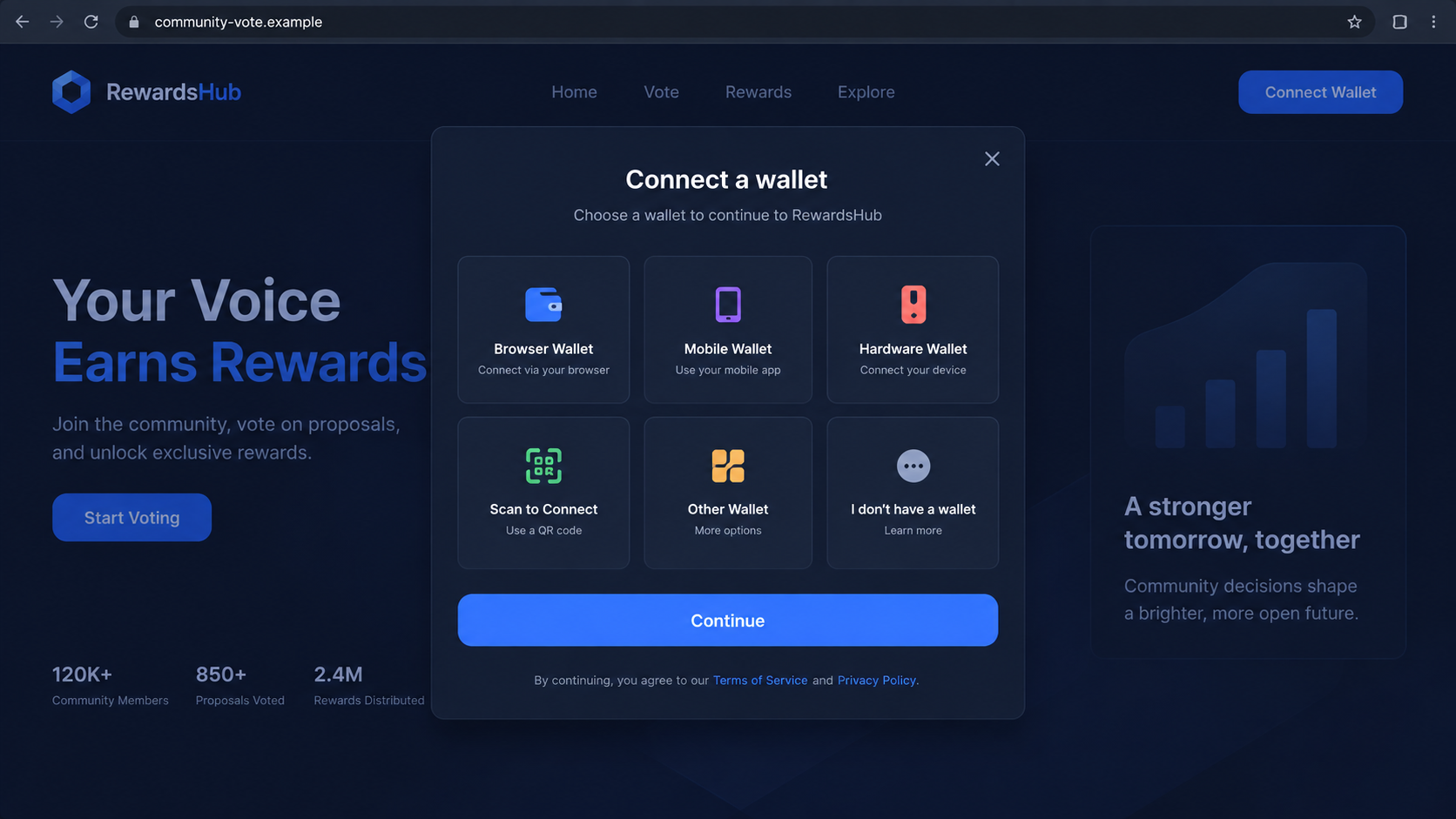
Pages like this frequently use familiar wallet names in a selection grid. Familiar choices make the flow look standard, even when the host is not.
Visual polish is cheap compared with stolen assets. A clean design, working buttons, and HTTPS can coexist with a malicious transaction request.
Our second illustration shows a generic wallet-selection prompt. It demonstrates a possible decision point without reproducing any functional malicious connection.
How the Flare Voting Rewards Scam Works
Step 1: A voter encounters an unofficial rewards invitation
The first contact may be a social post, reply, ad, or search result. The public specimen does not prove one exclusive distribution channel.
What stays consistent is the bait: a vote framed as a limited opportunity to influence FLR rewards and collect additional tokens.
The language sounds community-minded rather than transactional. That helps the invitation blend into normal discussions about governance, staking, and rewards.
People already following Flare news are especially likely to recognize the vocabulary. Familiar terms lower the urge to inspect the address carefully.
Do not rely on a search ranking or a shared link preview. Either can carry a page whose operator has no role in Flare governance.
Step 2: The lookalike page supplies borrowed authority
The observed page imitated the appearance of a Flare-related platform. It used a network-themed domain, navigation, banner, and voting language.
A visitor might read the headline and button before noticing the address. That is the exact gap the impersonation needs.
The official Flare route is discoverable through flare.network and the Flare Portal. The documented lookalike was a separate destination.
A padlock in the browser bar does not settle ownership. It only indicates an encrypted connection to whichever website the address names.
The site may also include ordinary-looking explanations of eligibility. Such details can make a fake event feel established without proving authorization.
Step 3: A bonus turns curiosity into action
The page’s incentive was not merely a chance to vote. It suggested that participation would bring a bonus token allocation.
That promise creates a quiet deadline even without a visible countdown. Readers may worry they will miss a one-time reward.
Before acting, ask where the allocation is documented. Can you find the same event through official governance announcements and proposal records?
If the answer depends entirely on the page making the promise, the evidence is circular. The offer is authentic only because it says so.
There is no need to connect a wallet simply to check whether a proposal exists. Official descriptions can be read first.
Step 4: The site asks for wallet access
The examined lure moved from “Register & Begin Voting” to a wallet connection interface with many familiar wallet options.
Multiple wallet choices make the page accessible to a wide audience. They do not demonstrate that any wallet provider endorses the event.
A connection normally reveals an address and allows a site to request later actions. The dangerous part may arrive as a signature or approval.
Always read the actual wallet prompt. Is it identifying an official proposal, or granting a contract permission to move assets?
Some wallets render technical requests poorly. When the transaction details are unclear, declining is safer than guessing that “verify” means harmless.
Step 5: A harmful approval can move assets
Researchers classified the observed page as a crypto drainer. Such pages seek a permission or signature that can let an operator transfer assets.
The exact wallet prompt can change with the connected wallet, chain, balance, or the page’s current code. Do not assume every visitor sees identical buttons.
A transaction can look like a routine registration step while authorizing token movement. The wallet interface, not the page copy, defines what will happen.
Some losses occur quickly. Others follow later, after a malicious approval remains active and a balance becomes worth taking.
The specimen analysis supports the drainer assessment. It does not prove that every person who merely viewed the page lost funds.
Step 6: The site can vanish while permissions remain
Scam domains are easy to replace. A blocked or dead link does not undo an approval already recorded on a blockchain.
That is why recovery starts with the wallet history, not with arguing over whether the landing page still opens today.
Check the precise token allowances, contract addresses, and transactions on the chain where the wallet interacted. Use a trusted explorer and wallet tool.
If a secret recovery phrase was entered, the problem is deeper than an allowance. A new wallet with a new phrase is needed.
Keep the suspicious domain and screenshots for reporting. Do not revisit it to test whether it will show the same prompt again.
How to Separate Real Flare Voting From a Lookalike
Start at the official Flare site by typing the address yourself. Follow the governance link to the current portal and proposal list.
Read the proposal number, voting period, and eligibility details there. A surprise campaign on another domain should match those records exactly.
Be cautious when a supposed governance event promises tokens for a vote that is not listed anywhere official. That is an independent red flag.
Search results can be manipulated with ads, and social accounts can be compromised. An announcement needs a trusted origin, not just many reposts.
When the site requests a signature, inspect its contract and permissions. A normal vote should not require broad spending rights over unrelated tokens.
Never share a seed phrase, private key, or backup file. No governance vote needs that information, whatever the page says about verification.
Wallets can show a human-readable warning, but the wording varies. If you cannot understand the request, stop and seek the official procedure.
Remember that a site can be malicious without asking for a payment upfront. The valuable target is authority over assets already in the wallet.
What to Do if You Connected a Wallet to the Fake Vote
- Stop interacting with the page. Close it and reject any pending prompts. Do not connect a second wallet to see whether the offer changes.
- Record what happened. Save the domain, approximate time, wallet address, chain, screenshots, and transaction hashes. Keep your seed phrase out of every report.
- Check the wallet’s activity. Open a trusted explorer directly and review recent transfers, approvals, and contract interactions. Look across every chain the wallet uses.
- Revoke suspicious allowances. Use a trusted revocation tool linked from your wallet or chain’s established resources. Revoking an allowance can limit future token transfers, but cannot reverse completed ones.
- Move assets if the secret was exposed. If you typed or shared a recovery phrase or private key, create a new wallet with a fresh secret and transfer remaining assets promptly.
- Protect connected accounts. Change passwords and revoke sessions if the page also collected email or exchange credentials. Do this from a clean device.
- Scan only when software exposure occurred. If you downloaded an extension or installer, run Malwarebytes. AdGuard can reduce malicious ads, but neither tool restores stolen crypto.
- Report the destination. Send details to your wallet provider, the platform hosting the link, and the appropriate cybercrime reporting service. Include transaction hashes, not secrets.
- Ignore recovery brokers. Anyone promising a guaranteed blockchain reversal in exchange for a fee or your new wallet phrase is a second danger.
What the Fake Voting Page Cannot Prove
A displayed token balance can be copied from a public blockchain explorer. Seeing it on a page does not mean that page is authorized to manage your wallet.
A countdown and a reward total can also be programmed without any actual rewards pool. Neither proves that tokens will arrive after a signature.
Do not take a wallet provider’s logo as an endorsement. Scam pages routinely include familiar wallet names because they are the options visitors expect.
The same applies to a contract address shown in small print. Its mere presence is not an audit or proof that it does what the page claims.
If you want to verify a proposal, follow the link from Flare’s own governance pages. Compare the proposal description, timing, and voting interface there.
A message posted in a chat group is not a substitute for that official route. Screenshots can be altered and forwarded long after a campaign ends.
Be especially careful if the site promises a bonus that grows when you act immediately. A legitimate governance decision should be understandable without a rush.
When a wallet dialog appears, read the requested action in the wallet itself. A transaction, token approval, and plain message signature carry different risks.
If the dialog is vague or the contract cannot be verified, reject it. Missing a supposed bonus is less costly than authorizing an unknown spender.
After closing the site, review recent approvals and transactions. That check is useful even when your balance has not changed yet.
Frequently Asked Questions
Is Flare itself running this rewards vote?
The documented bonus-vote page used an unofficial destination. Check Flare’s governance pages and Portal for any authentic proposal before connecting a wallet.
Does connecting a wallet automatically empty it?
Not always. Connection usually precedes additional requests. Review any signature, transaction, or spending approval, and inspect history if you already accepted one.
Can I recover tokens already transferred?
Confirmed blockchain transfers are generally irreversible. Preserve hashes, contact relevant exchanges if funds arrive there, and report the theft without paying recovery scammers.
Why are so many wallet brands shown on the page?
A broad connection menu increases the pool of possible targets. Familiar wallet choices do not mean those providers verified the voting event.
What if I only visited the page?
Close it and do not reconnect. Viewing the page alone is different from signing a transaction or entering secrets, but avoid any downloads.
How can I check a genuine Flare proposal?
Navigate from flare.network to its governance resources and Portal. Compare the proposal number, dates, and wallet action with the official record.
The Bottom Line
The Flare Voting Rewards scam attached a token bonus to a governance-sounding page, then steered visitors toward wallet access on an unofficial domain.
Read the proposal through Flare’s own channels before any connection. If you already approved something, inspect and secure that wallet now.








