

A parent is told their child has a rare chance to appear at a modeling event. The invitation sounds specific, and the next payment sounds manageable.
Then another invoice arrives. The excitement that made the first request believable can make it harder to question the fifth.
Overview
One family’s hopes became a costly advance-fee trap
In September 2026, federal prosecutors announced that Chanise Coyne had been sentenced to five years in prison for a child modeling fee scam.
Coyne admitted taking more than $4.6 million from a local family. She claimed the payments would cover advance fees for their young daughter’s participation in events.
Those events were fictional, according to the Justice Department. The child was not placed in a single modeling event through the claimed arrangement.
The court ordered restitution of $4,669,962.76, a five-year prison term, and three years of supervised release. Coyne had pleaded guilty to wire fraud.
Fabricated documents made the story feel real
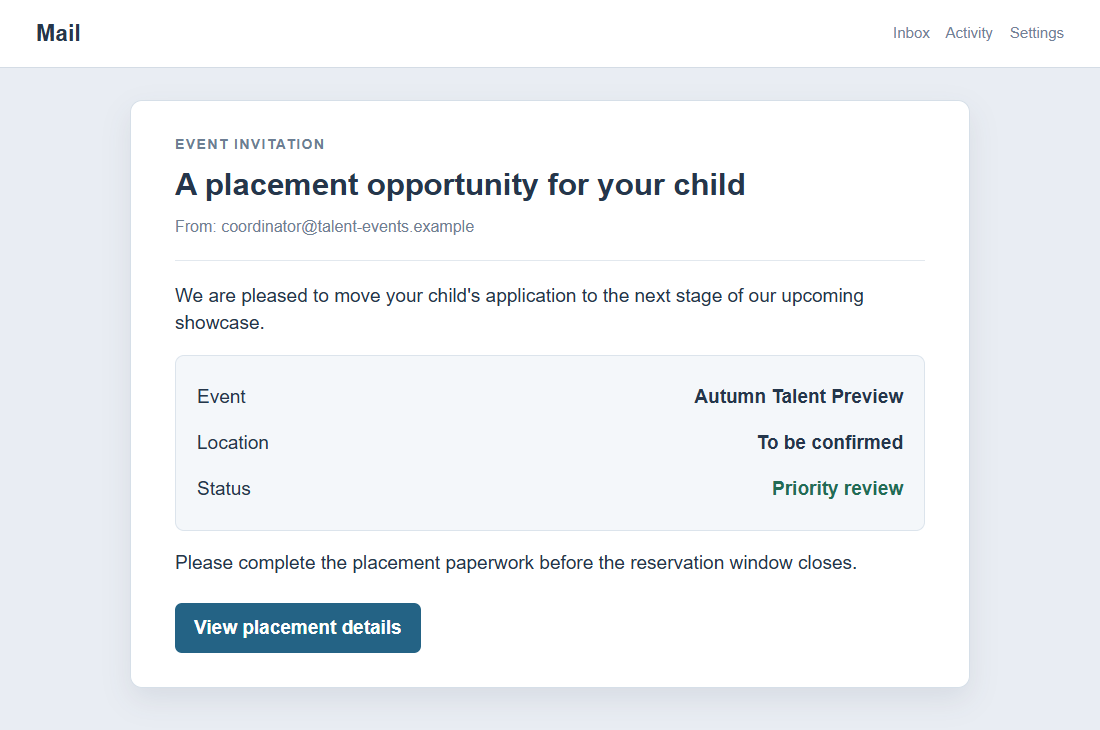
The scheme did not depend on one vague verbal promise. Court records describe fake text messages, emails, and invoices relating to supposed event placements.
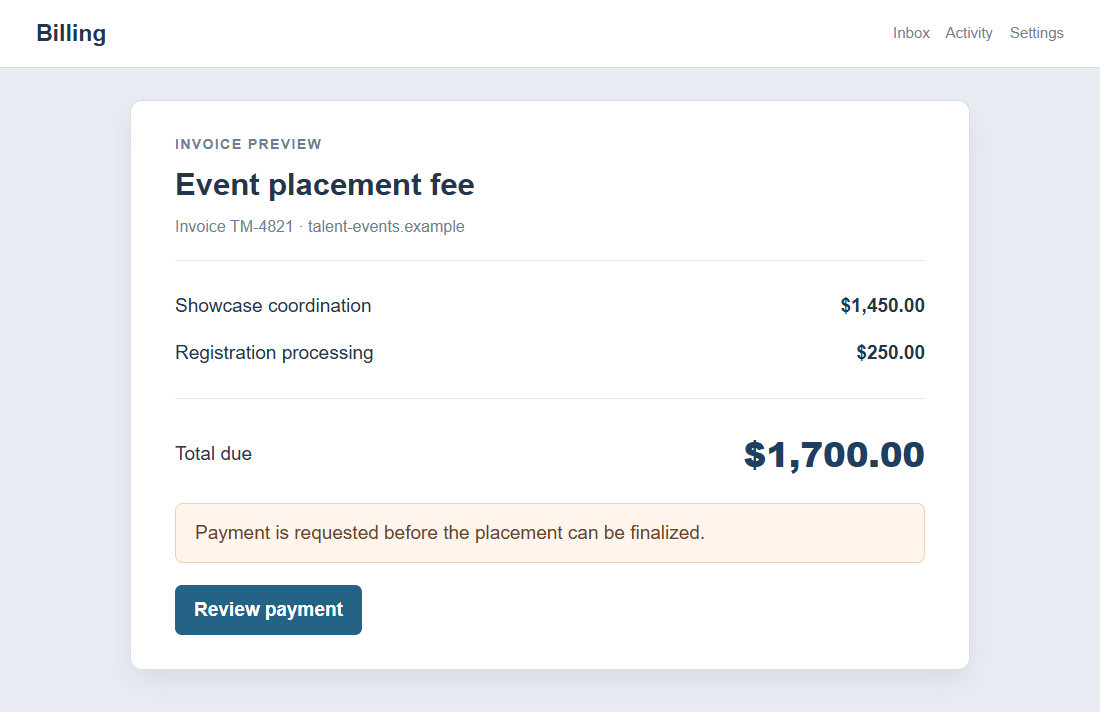
Each document could make the next payment look like an ordinary production expense. A family seeing a detailed invoice might assume an actual event stood behind it.
The DOJ did not release the complete wording or design of those records in its public summary. Our two images are fictionalized, non-functional examples.
They illustrate how a fee request and event confirmation might appear, not the documents that Coyne sent to the family.
- A claimed placement is not verified merely because an invoice names an event.
- Emails and text threads can be created or altered by the person requesting money.
- A genuine venue or event should be independently contactable.
- Repeated advance fees deserve scrutiny before any additional payment.
- A child’s ambition should not become a reason to suspend financial checks.
The case is about deception, not ordinary modeling work
Legitimate child modeling opportunities can involve real contracts and expenses. The problem here was the fraudulent claim that nonexistent placements required large payments.
The DOJ says the money was used for Coyne’s benefit instead. It reported substantial gambling expenditures and more than $200,000 spent on concert tickets.
That detail describes this defendant’s use of proceeds. It does not mean every person requesting a modeling fee has the same motive.
Families should verify the actual opportunity, the contracting party, and the payment destination rather than judging only the glamour of the pitch.
What the Court Records Establish
The fraud targeted one family whose daughter hoped to model. Coyne presented supposed events across the country as opportunities requiring advance payments.
To support the story, she generated fraudulent records, including texts, emails, and invoices. These records related to placements that did not happen.
The amount is striking, but the underlying mechanism is familiar. A promised benefit remains just out of reach unless the target pays another fee.
The family may see each charge as a small piece of a larger career investment. Earlier payments then make it emotionally harder to stop.
Prosecutors did not publicly list every individual charge, event name, or conversation in the short announcement. We should not pretend to know that missing sequence.
What is established is the core: fake placements, fabricated supporting documents, payments exceeding $4.6 million, and no actual modeling event placement.
Coyne pleaded guilty. The sentence and restitution order are court outcomes, not merely accusations circulating online.
At the same time, restitution ordered by a court is not the same thing as money already recovered and returned. Victims should not assume a full repayment is guaranteed.
How the Child Modeling Fee Scam Works
Step 1: A credible opportunity catches a family’s attention
The offer centers on something a parent wants for their child: a role, audition, showcase, or placement that could open doors.
A real child’s aspirations make the approach personal. The family may already have invested time in photographs, auditions, or travel.
The Coyne case involved supposed placements in events across the country. The DOJ does not say that every contact began through an advertisement or website.
For that reason, the safest question is about the specific event and people involved, not merely whether the invitation arrived by email.
Step 2: A fee is linked to the promised placement
The next message introduces an advance cost. It might be framed as registration, travel coordination, production, wardrobe, or another event-related expense.
Those examples are common possibilities, not a list of Coyne’s exact invoice labels. The documented claim was that advance fees would fund placements.
Ask who receives the money and what contract gives them authority to collect it. A bank account in an individual’s name may require an explanation.
Request a written breakdown of services, cancellation rights, and what happens if the event does not occur. Do this before any payment.
Step 3: Fake documents become the apparent proof
In the prosecution, fraudulent emails, texts, and invoices supported the story. A dated message can look like a confirmation even if its sender invented it.
Look beyond the forwarded screenshot. Contact the event organizer, venue, or agency through contact information you found independently.
A scammer may discourage direct contact by saying a placement is confidential or still being finalized. That explanation should increase, not reduce, caution.
Even if a real event exists, it does not follow that the person requesting payment represents its organizers or can secure a role.
Step 4: New costs appear as the family commits
Once a family pays, the promise can expand. Another supposed deadline, confirmation, or administrative problem creates a reason for another transfer.
The public case summary does not disclose the exact payment cadence. The point is that the family paid repeatedly for nonexistent opportunities.
Each earlier payment can become a reason to continue. People hope the next payment will finally turn all previous spending into a real opportunity.
That is the sunk-cost trap. Stopping can feel like abandoning the child’s dream, even when stopping is the best way to protect the family.
Step 5: The promised event never materializes
In Coyne’s case, the money did not produce a single event placement for the child, the DOJ said.
A scammer might offer a postponement, blame an organizer, or promise a refund. None of those explanations should be accepted without independent documentation.
Preserve the original claims alongside the outcome. That comparison helps investigators understand what was promised, what was paid, and what actually happened.
If you discover the event never existed, stop sending money immediately. Do not pay a final processing fee to recover earlier payments.
How to Verify a Modeling Opportunity Before Paying
Start with the event itself. Find the organizer’s official site and contact it through a published address or number, not the details in a forwarded message.
Ask whether the event is scheduled, whether the child has a confirmed role, and whether the organizer recognizes the person requesting money.
Check the contract. It should identify the legal business, services, dates, total cost, refund policy, and who is responsible for the child’s safety.
A one-page invoice without a contract may document a requested payment, but it does not establish a legitimate placement.
Look at the payment recipient carefully. A name that differs from the agency or event can have an innocent explanation, but demand one in writing.
Ask for a second opinion from a trusted adult who is not invested in the offer. Excitement is natural, and a fresh reader may notice contradictions.
Do not send a child’s identification documents, address, school information, or travel plans until the opportunity and recipient have been verified.
Any real production involving a minor should have clear guardian consent, supervision rules, and a transparent schedule. Vague secrecy around a child is unacceptable.
A company registration or polished website is not enough by itself. Confirm the particular event and placement, not just the existence of a business name.
In a high-cost arrangement, seek independent legal advice before committing. The cost of a review is small compared with an open-ended fee sequence.
Red Flags That Matter More Than a Glossy Invitation
- The promised role cannot be confirmed by the event organizer directly.
- Invoices arrive from a person or account unrelated to the stated agency.
- The fee schedule changes after you make an initial payment.
- Only screenshots are offered as evidence of a placement.
- The organizer supposedly forbids you from asking questions.
- A refund depends on sending more money first.
These warning signs do not automatically prove fraud in every dispute. Together, they justify stopping payments until the missing facts are independently verified.
Keep the focus on evidence. A warm relationship with a promoter is not a substitute for a contract and direct confirmation from the event.
Questions a Parent Can Ask Before the Next Invoice
Ask for the event’s exact name, date, location, and organizer. A phrase such as “national showcase” is too vague to check independently.
Request the name and role of the person who approved the placement. Contact that person through the organizer’s published number, not a forwarded introduction.
Ask what the fee buys today. Does it reserve a role, cover travel, purchase a portfolio, or merely pay for an application review?
If the answer changes between calls, record both versions. A shifting explanation may reveal that the charge is being invented as the conversation develops.
Confirm whether other families pay the same amount and whether the organizer receives any of it. A promoter should be able to document the money trail.
Ask for the refund policy before paying, not after an event is postponed. Pay special attention to clauses that make every charge nonrefundable.
Read any release covering your child’s image, name, or likeness. A modeling opportunity should never require broad rights without a clear purpose and guardian review.
Check whether travel and accommodation are genuinely needed. Do not book nonrefundable arrangements based only on a message from the person collecting fees.
For a major opportunity, ask a trusted professional outside the arrangement to review the paperwork. Independent scrutiny can break the spell of a polished pitch.
Do not be embarrassed to pause. An authentic placement should withstand a reasonable verification call and a request for the complete terms in writing.
The Coyne case shows that fabricated documents can survive casual inspection. The stronger test is whether the named organization confirms the underlying event directly.
That distinction protects legitimate opportunities too. Families can say yes with confidence when the documents, organizer, payment recipient, and actual schedule all align.
What to Do if You Have Fallen Victim to This Scam
- Stop the payment sequence. Do not send another advance fee, even if a deadline or promised refund sounds urgent. Tell the other party to communicate in writing.
- Preserve every record. Save original emails, texts, invoices, contracts, bank records, payment confirmations, event names, and any cancellation messages.
- Contact the payment provider. Explain which placements were promised and which never occurred. Ask about reversals or disputes, and follow deadlines for your payment method.
- Verify the event independently. A direct denial or absence of the claimed placement can help establish the mismatch between promise and reality.
- Protect your child’s information. If you shared identification, photos, travel details, or account access, ask relevant institutions how to limit exposure and document any misuse.
- Report the conduct. File a local police report and an IC3 complaint if the communication or payments crossed online channels. Provide copies, not your only originals.
- Be wary of recovery agents. Someone offering to recover the money for a new upfront charge may be exploiting the same loss a second time.
If the person continues to contact you, do not debate each invoice. A short written refusal and preserved messages are more useful than another pressured conversation.
Families can also speak with a lawyer about civil remedies. The criminal restitution order in the Coyne case does not automatically resolve another family’s dispute.
If a child is distressed, explain that adults created the false opportunity. The child did not cause the loss by being hopeful.
A digital safety scan is relevant only if you opened a suspicious attachment, installed software, or entered credentials on an unknown site. An invoice alone does not imply malware.
Frequently Asked Questions
Are all child modeling fees scams?
No. The Coyne case involved fictional placements and fabricated records. Judge a particular offer by its verified event, contract, payment terms, and actual organizer.
Did the child appear in any of Coyne’s claimed events?
The Justice Department says the family’s money was not used to place the young girl in a single modeling event.
Were the emails and invoices real business records?
Court records describe them as false and fraudulent support for supposed placements. A document’s professional appearance does not establish its truth.
Was Coyne convicted or only accused?
She pleaded guilty to wire fraud and was sentenced to five years in prison in September 2026.
Does the restitution order guarantee repayment?
No. An order creates a legal obligation, but actual recovery depends on assets, collection, and the court process.
What should I verify first if I receive a similar offer?
Contact the named event organizer directly through its independently found channel. Ask whether the event, placement, and fee collector are genuinely connected.
The Bottom Line
The child modeling fee scam in the Coyne case used fake records to turn a family’s hope into repeated payments for events that never happened.
Before paying for any promised placement, verify the event and collector yourself. If the proof fails, protect your child and your finances by walking away.








