

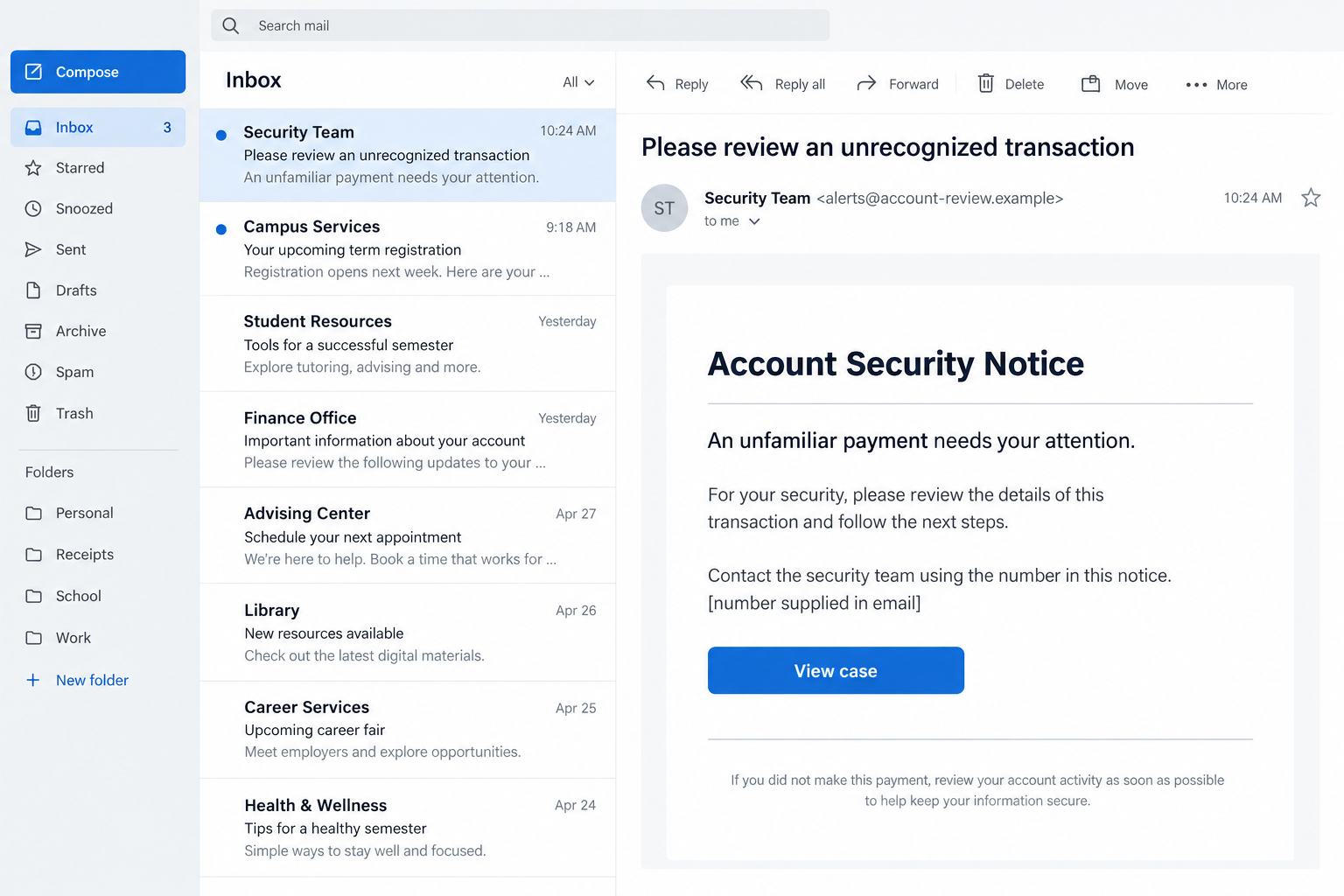
The email mentions a transaction you do not recognize. A helpful security representative is ready to explain what happened and arrange the next step.
Then the conversation turns to your physical bank card. The Macquarie card collection scam is worth understanding before anyone comes to your door.
Overview
An email can be the beginning of an in-person theft
Macquarie’s March 2026 alert describes fraudulent transaction emails that provide a number to call. The people answering impersonate the bank’s security team.
After asking about personal and account details, they may propose a transfer to a supposed safe account or collection of the customer’s card and PIN.
The courier branch asks the customer to prepare an envelope for someone coming to collect it. That is the mechanism examined in this article.
Macquarie’s warning makes clear that the bank does not require customers to return cards through this unsolicited process.
The familiar bank is being impersonated
Macquarie is not the scam operation. Fraudsters borrow its identity to make handing over a card feel like a protective banking procedure.
The warning does not identify a legitimate delivery company as a participant. Someone calling themselves a courier does not establish their employer or authority.
Nor does the alert mean that everyone who receives the email encounters both branches. The transfer demand and collection request are alternative routes described by the bank.
What makes the request dangerous
- The callback number comes from the same unverified message that created the alarm.
- The representative asks for information they should not need you to disclose.
- A physical card is described as evidence, compromised property, or something awaiting replacement.
- The PIN is requested alongside the card.
- A pickup deadline discourages checking with the bank independently.
Scamwatch also warns about card collection fraud, including requests to leave cards or cash for pickup.
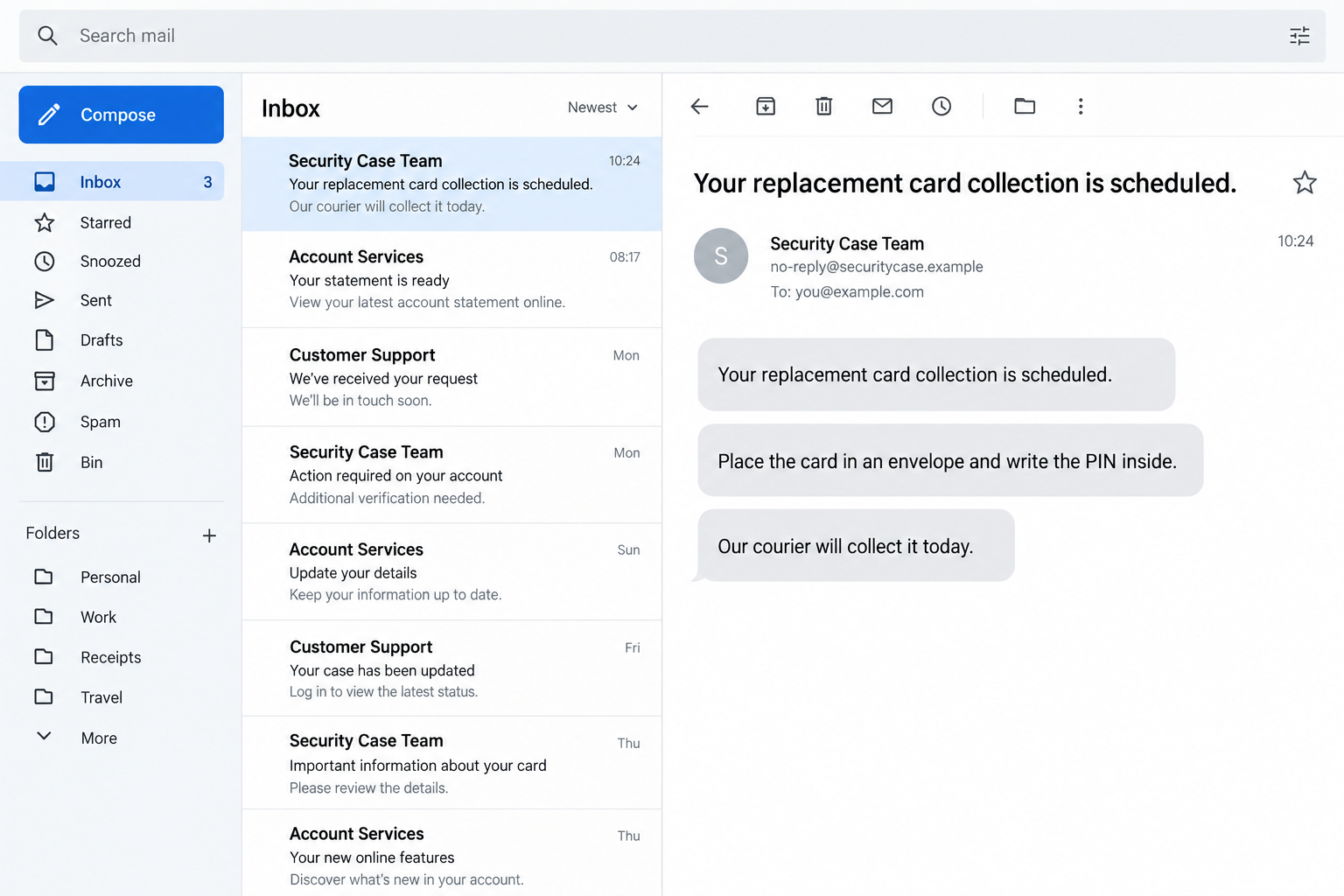
The example email and messages shown here are illustrations. Their fictional details explain the sequence without presenting them as actual correspondence from the bank.
Why a Courier Can Make a Phone Scam Feel More Believable
A person promising to collect something can make an online conversation feel concrete. You may think a criminal would avoid showing up in person.
That assumption is unsafe. A collection scheme can use someone other than the person speaking on the phone.
You do not need to determine how the participants are organized to protect yourself. The requested handover is already the important warning.
Imagine a caller saying the card must be secured before another transaction occurs. The pickup then appears to solve the problem the caller just described.
This is an illustrative explanation of the pressure, not a documented quotation. The emotional shift is from protecting your card to surrendering it for protection.
A reference number, appointment time, or professional greeting can reinforce the impression of a routine service. None independently proves that the bank authorized the collection.
The safest check takes place outside that conversation. Contact the bank through its app, card details, or independently located official contact page.
If a real card problem exists, legitimate support can explain how to block and replace it without relying on the caller’s collection instructions.
How the Macquarie Card Collection Scam Works
Step 1: A transaction warning makes the reader want an immediate answer
The message introduces activity the recipient may not recognize. Its purpose is to make calling the supplied number feel like the responsible thing to do.
You do not have to establish that the claimed transaction occurred before pausing. Open your banking app independently and check the actual account activity.
A message can invent a transaction or describe a concern without providing evidence. Its confidence is not a substitute for your bank’s records.
Do not reply with a screenshot of your balance to prove that something is wrong. That gives an unverified sender additional private information.
Step 2: The supplied number leads back to the impostor
Calling a number yourself can feel safer than answering an unexpected call. It is only safer when you obtained that number independently.
If the email supplied it, the sender still chose who answers. The callback does not create an independent identity check.
On the call, the person can present a department name and ask questions that resemble normal verification. Familiar wording can make the conversation feel established.
Stop before discussing balances, passwords, codes, or a PIN. A polite request for a reference does not require you to continue with that same person.
Step 3: Information gathering strengthens the manufactured emergency
The bank’s warning describes requests for identifying information and details about accounts. Those questions can reveal both the target’s identity and the potential value available.
A caller may repeat details you already supplied as though they independently knew them. Keep track of what originated with you.
Knowing a name or partial card information also does not prove bank employment. Leaked, purchased, or previously disclosed information can make impersonation more convincing.
Resist the urge to correct the caller’s wrong account details. Corrections can supply exactly the information the caller was missing.
Step 4: The card and PIN become part of the proposed solution
Instead of simply helping you block a card through the bank, the impostor requests a physical handover. The instructions may sound organized and time-sensitive.
In the Macquarie warning, the customer is asked to place the card in an envelope and write the PIN on it for collection.
That combines two things which should remain protected. Possession of the card and knowledge of its PIN can enable unauthorized use.
The envelope does not make the arrangement secure. Its appearance as a delivery procedure does not establish that anyone receiving it is entitled to the contents.
If you have already prepared the envelope, stop the handover. Do not wait for the collector to arrive before contacting the bank.
Step 5: The handover creates immediate financial and personal risk
Once the card leaves your control, the response becomes urgent. Blocking it through your bank is more useful than continuing to question the original caller.
Do not assume the caller’s statement that the card is already disabled is true. Confirm its status through the bank’s own system.
If someone is coming to your address, there is also a personal safety issue. Avoid confrontation and do not arrange a meeting to recover the card.
Tell police if a suspicious collection is imminent or has occurred. Use emergency services when there is immediate danger, rather than trying to investigate the collector yourself.
Caller, Number, and Collection Checks
The number displayed is not proof of identity
Caller ID can be manipulated. A familiar bank name or a number resembling a known contact does not settle who is on the line.
End the conversation and initiate a separate contact through the bank’s official channel. Do not use a replacement number dictated by the caller.
If you cannot tell whether a call has ended, use a different trusted device or the bank’s app to reach support.
A card replacement does not require a secret PIN handover
The practical distinction is between a bank helping you control your card and a stranger asking you to surrender the tools needed to use it.
A replacement process may involve delivery of a new card. That does not authorize an unsolicited person to collect your current card with its PIN.
Ask the bank directly how an old card should be handled after cancellation. Follow those verified instructions rather than the impersonator’s procedure.
A uniform, badge, or collection code does not resolve the problem
Physical presentation can be copied just as easily as an email layout. A code only proves that two participants share the same code.
Do not let a collector’s confidence overrule what the bank tells you through a separate contact. You are allowed to refuse the handover.
There is no need to open the door to debate the matter. Your priority is securing the account and getting appropriate help.
The Safe-Account Branch Is a Separate Trap
A useful interruption is to put the physical card somewhere secure and end the call before deciding anything. This separates the caller’s pressure from your next action.
If another household member is expecting the courier, tell them not to hand over the envelope. The person answering the door may not know the earlier conversation.
Do not leave the package outside while you verify the request. Collection could occur before you finish speaking with the legitimate bank.
If a collector appears, avoid confrontation. Keep yourself safe, refuse the handover, and contact police if you feel threatened or the person refuses to leave.
You do not have to prove the visitor’s role before protecting your card. The bank can investigate the report without you attempting to detain anyone.
Macquarie’s alert also describes requests to transfer money for protection. That branch moves funds directly rather than obtaining a physical card.
A new destination supplied by an unexpected caller is not made safe by its label. The destination account’s actual ownership is what matters.
Do not approve a transaction simply because the caller calls it a cancellation, reversal, or verification. Read what the banking app says you are authorizing.
If the app displays a payment, the caller’s explanation does not turn it into something else. Stop and consult the bank independently.
Someone who first tried a card collection might propose another method when you hesitate. Assess each new instruction on its own, without assuming continuity means legitimacy.
What to Do if You Have Fallen Victim to This Scam
- Block the affected card through a trusted route.
Use the bank’s official app or independently obtained contact number. Explain that the card and possibly its PIN were collected by someone impersonating security staff.
Ask whether replacement, account restrictions, or additional monitoring are needed. Do not rely on the scammer’s claim that the card was already cancelled.
- Tell the bank exactly which information was disclosed.
List the PIN, account credentials, one-time codes, personal details, and any app approvals separately. Each may create a different kind of exposure.
Include attempted transfers even if they appear pending or failed. The bank can check its records and advise on the relevant response.
- Report unauthorized transactions promptly.
Identify transactions you did not authorize and explain any payments you made under deception. Keep dates, amounts, recipients, and the bank’s case reference.
Ask about recall or dispute options without assuming a refund is guaranteed. Speed and accurate details may improve the chance of limiting further losses.
- Handle the pickup as a safety matter.
If a collector is expected, do not hand over anything or confront them. Inform police and follow their advice about the situation at your address.
If immediate danger develops, contact emergency services. Retrieving a card yourself is not worth escalating a potentially unsafe encounter.
- Preserve the communication trail.
Keep the original email, callback number, call times, messages, collection instructions, and any description you can safely provide from memory.
Do not contact the collector to obtain more evidence. Save existing material and let the bank or authorities advise on the next steps.
- Check digital exposure when relevant.
If you installed a program during the call, stop banking on that device until it has been checked. Malwarebytes can help identify supported malicious software.
AdGuard may reduce some malicious advertising or website exposure, but neither tool blocks a stolen physical card or substitutes for contacting the bank.
- Warn anyone sharing access or the address.
Tell household members not to release an envelope, card, or cash. Contact joint account holders through a normal channel so they can recognize follow-up requests.
Share the warning without publishing your card details, home address, or private banking screenshots on social media.
- Report and plan for follow-up impersonation.
Report the scam through the bank, police, and Scamwatch. Be wary of anyone later promising recovery while requesting another payment or confidential code.
Keep using the legitimate case reference when contacting support. A new unsolicited caller quoting the incident still needs independent verification.
Frequently Asked Questions
Does Macquarie collect a card and PIN by courier?
The bank’s scam alert rejects this unsolicited card-return request. Verify any card issue directly with Macquarie instead of following collection instructions from an email or caller.
Is it safer because I called the number myself?
Only if you obtained the number independently. Calling the number inside a fraudulent email still connects you to the destination chosen by the sender.
What if the caller knows my address?
Knowledge of an address does not prove authority. Refuse the collection, contact the bank, and involve police if someone is coming or you feel unsafe.
Should I give the collector a cut-up card?
Do not cooperate with an unverified pickup. Block the card and ask your bank how to dispose of it safely through its normal replacement process.
Will a scan stop someone using the collected card?
No. Card misuse must be addressed with the card issuer. Device scanning is relevant only if suspicious software or another digital threat was also involved.
Can a bank guarantee reimbursement after this scam?
Outcomes depend on the circumstances and applicable process. Report promptly, provide accurate evidence, and ask the bank to explain available dispute or recovery options.
The Bottom Line
The Macquarie card collection scam starts with a banking concern and ends by asking you to surrender the card and information needed to use it.
Keep the card, end the unverified conversation, and contact the bank independently. If a handover already happened, block the card and report the collection promptly.








