

You finish reading about a parasite cleanse, and then another problem appears: what happens to your liver afterward? Ellora offers a bottle for that worry.
We examined the Liver Detox page, its recurring-order option, and the formal refund terms. The distance between the headline and the policy matters.
Overview
What the product promises
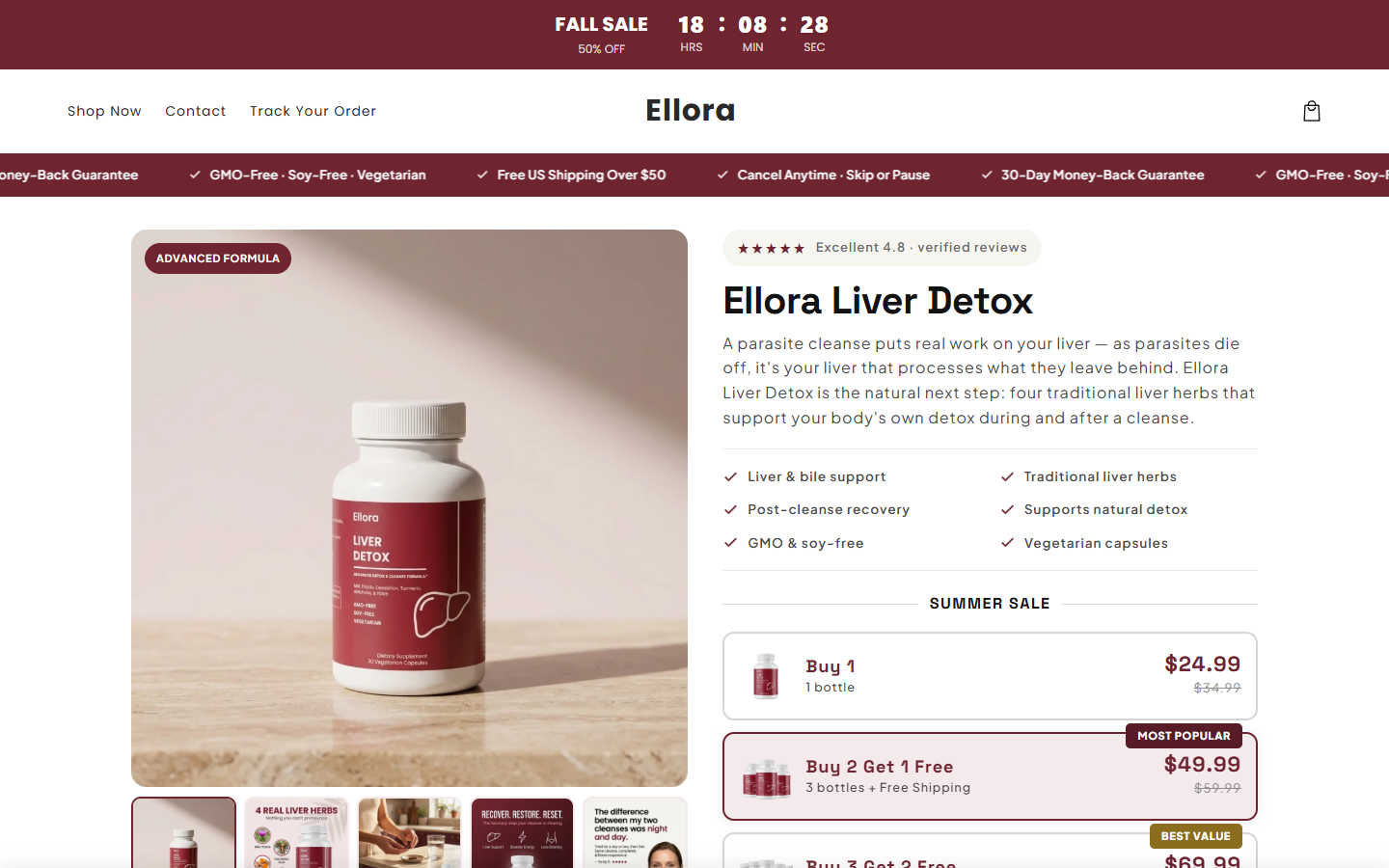
Ellora Liver Detox is a four-herb supplement promoted as a companion to a parasite cleanse. The page features milk thistle, turmeric, dandelion, and artichoke.
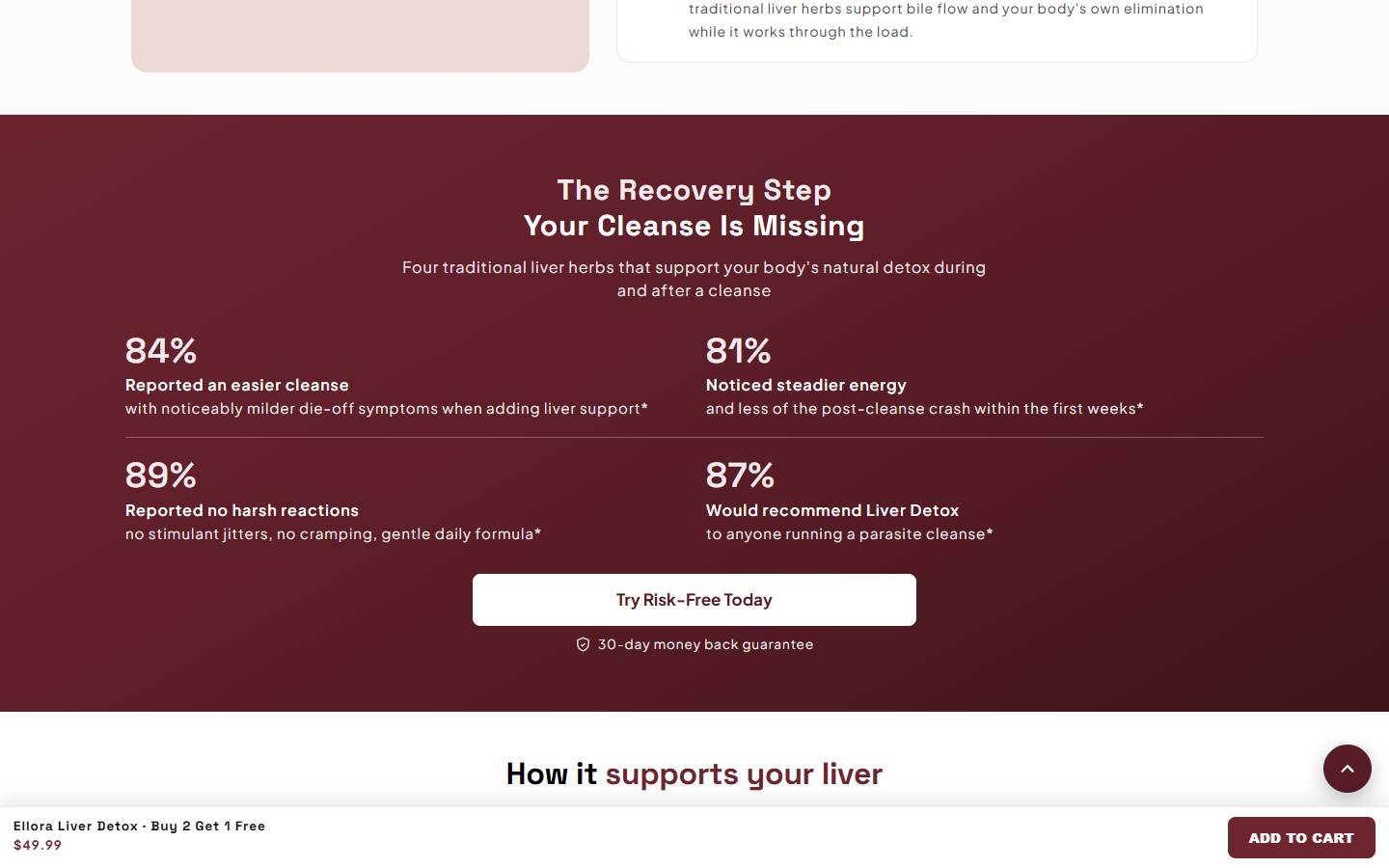
Its pitch says dying parasites release a “toxin flood” that can overwhelm the liver. The product is positioned as support during and after that imagined process.
That explanation arrives before evidence that the shopper has parasites, that the cleanse kills them, or that this product improves a measurable liver outcome.
What a buyer actually selects
The store offers one bottle and larger bundles. In our review, the product page displayed a Subscribe and Save selection with instructions to uncheck it for a one-time order.
The selected refill runs every 28 days on the product page. A separate subscription policy speaks of a 30-day supply arriving every 30 days.
Those two intervals are close, but not identical. More importantly, a buyer choosing a multi-bottle package needs to know precisely what quantity repeats.
The page also shows both a “fall sale” countdown and a “summer sale” label. Such leftover seasonal copy weakens confidence in the displayed urgency.
Why we would pause before ordering
Ellora names a company, publishes support details, and provides a subscription policy. That makes it different from an untraceable checkout.
The concern is the combined effect of a fear-based medical narrative, a preselected renewal, and a refund policy narrower than the large guarantee suggests.
- The page connects ordinary post-cleanse symptoms to a “toxin flood.”
- The advertised mechanism is not established for this finished formula.
- Subscribe and Save appeared selected in our review.
- The page said to uncheck it for a one-time purchase.
- The page used a 28-day refill interval, while policy text used 30 days.
- First-time purchases and recurring shipments have different refund rules.
- The formal policy deducts a $4 restocking fee from approved refunds.
We found commercial and medical-claim risks, not proof that Ellora fails to ship products. The article focuses on choices shoppers can verify.
How the Ellora Liver Detox Funnel Works
Step 1: A first purchase creates a second health worry
Ellora’s story assumes someone is already undertaking a parasite cleanse. It tells that person the cleanse can place an extra burden on the liver.
The pitch makes a second bottle feel like responsible aftercare. If the first product stirred up toxins, refusing liver support may feel risky.
That dependency is the core sales move. It does not follow that every person taking a cleanse is experiencing parasite die-off or liver injury.
A headache, nausea, or rash during a supplement regimen can have many explanations. Calling it “die-off” without a diagnosis may miss a product reaction.
There is a business consequence, too. Once discomfort is framed as necessary progress, the customer may keep using products instead of seeking a return.
Step 2: A simple four-herb formula makes the story plausible
Milk thistle, turmeric, dandelion, and artichoke are familiar plants in wellness marketing. Ellora assigns each a role in liver protection or bile flow.
Traditional use can be worth studying. It does not show that the combination removes toxins released by dying parasites in a specific customer.
The page also suggests the herbs help “flush the wreckage out.” That vivid phrase gives no measurable definition of the supposed wreckage.
Ask which ingredients, amounts, and clinical endpoints support the finished product’s claim. A promotional diagram is not a test result.
A useful study would also separate the liver product from the cleanse itself. Otherwise, improvement could be due to stopping an irritating regimen.
Step 3: Bundles turn a recovery add-on into months of stock
The pricing area promotes a single bottle at $24.99, a three-bottle bundle at $49.99, and a five-bottle bundle at $69.99 during our review.
Bundle discounts can be legitimate. They also increase the initial spend before a buyer knows whether the formula suits them.
Ellora recommends use during a cleanse and for weeks afterward. That suggested timeline gives the larger bundle an emotional reason to exist.
Calculate the amount due today, the supply duration at the recommended serving, and the policy covering opened bottles before choosing the biggest offer.
For example, three bottles do not automatically mean a three-month subscription. The renewal schedule must match the actual selected plan, not an assumption.
Step 4: The discount carries an automatic delivery
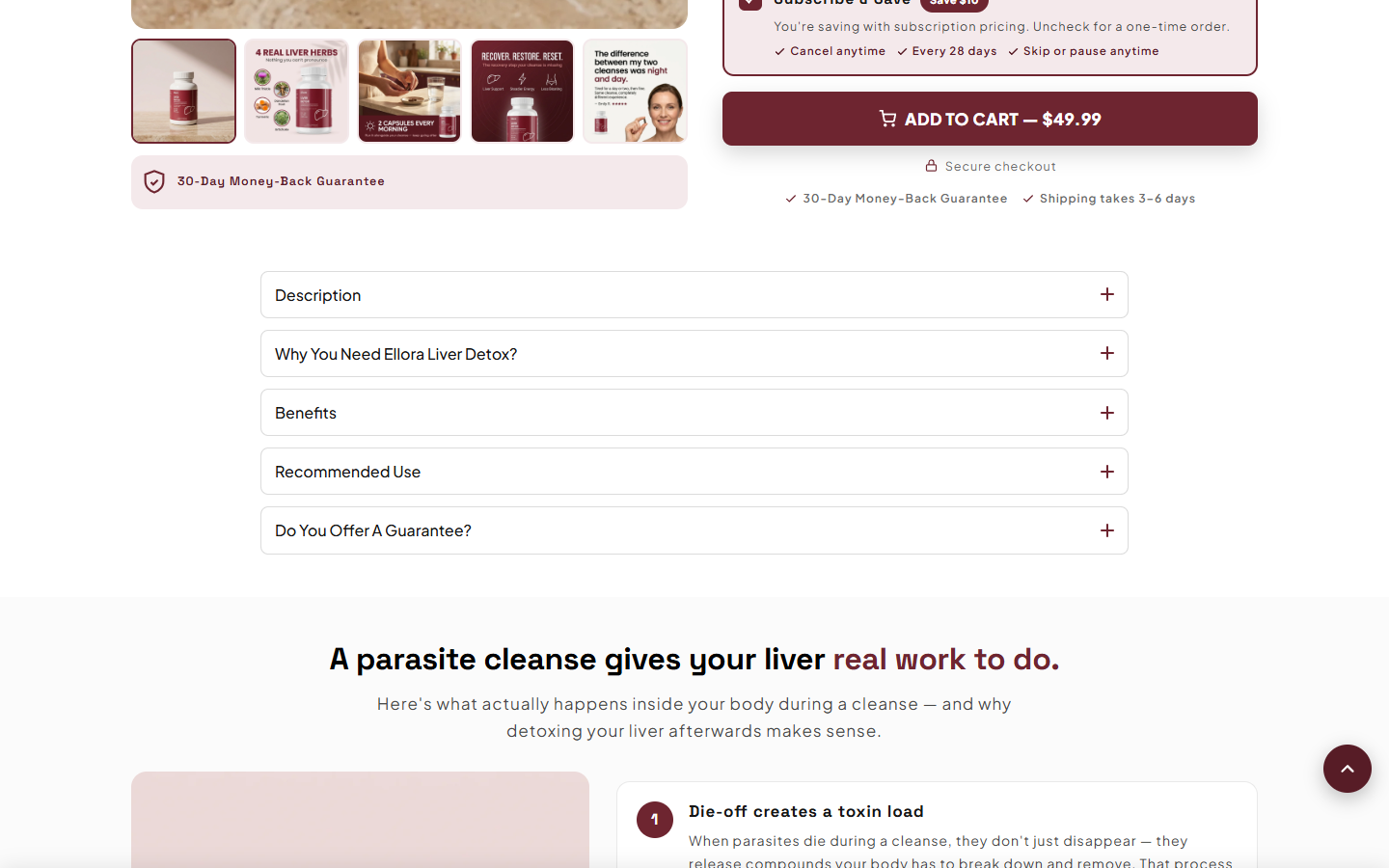
Our product-page view said, “You’re saving with subscription pricing. Uncheck for a one-time order.” That is a clear instruction, but it asks the buyer to notice and act.
The same area described a repeat shipment every 28 days. The subscription policy describes automatic billing for a 30-day supply every 30 days.
A seven-day difference would be material; this two-day difference is smaller. Still, no policy ambiguity should exist over the date a card is charged.
The more consequential question is bundle renewal. Does a three-bottle initial order produce three more bottles, or just one? Confirm that in writing.
A customer may be comfortable with either arrangement once it is clear. Uncertainty becomes costly when another package is charged before the first is finished.
Step 5: The guarantee changes depending on the order
The product page promises a 30-day money-back guarantee in warm, simple language. One FAQ says an unhappy customer can ask for a full refund.
Ellora’s formal policy limits that satisfaction promise to a customer’s first purchase of a product. It says automatic subscription orders are excluded.
For recurring shipments, the policy requires items to remain unopened and unused. The customer pays return postage, and a $4 restocking fee applies.
That is not “no fine print” in any practical sense. A buyer should read the formal policy before relying on the more generous product-page wording.
The policy also says its first-purchase guarantee can be used once per product type. Exchanging the item removes that guarantee, another detail absent from the short pitch.
Shipping, handling, and optional shipping-protection fees are nonrefundable. A “full refund” headline can therefore describe less than the entire card charge.
Step 6: Processing deadlines narrow the exit
Ellora says cancellation changes apply to future billing when made before the next date. Already processed or shipped orders cannot simply be stopped.
The refund policy gives an order-cancellation window of six hours after placement. That is much shorter than the advertised 30-day satisfaction period.
These deadlines govern different actions. Canceling an order, canceling a subscription, returning a bottle, and seeking a satisfaction refund are separate requests.
Put each request in writing, with the exact order number and desired outcome. A short message saying “please cancel” may leave the wrong item active.
The policy permits a $4 cancellation-related fee in some circumstances. Ask the seller whether it applies before accepting a partial credit.
The “Die-Off” Story Needs Better Evidence
An assumed parasite is not a diagnosis
Ellora is not selling an antiparasitic medicine. Yet its page treats parasite death as a starting premise for the liver product.
For someone who began a cleanse because of online advertising, that premise may be entirely untested. The CDC advises that diagnosis uses appropriate medical tests.
Different organisms require different tests, and some require a clinician to review more than one sample. A general detox routine cannot replace that process.
Worsening symptoms should not be celebrated
The page describes fatigue, headaches, brain fog, nausea, and breakouts as a possible “die-off” crash. It then frames liver support as the answer.
Those same symptoms may signal a reaction to a cleanse product, dehydration, infection, medication interaction, or an unrelated problem.
Do not keep taking two supplements just to push through a problem the marketing calls normal. Seek advice if symptoms are concerning or persistent.
Keep both labels, because clinicians need the full ingredient lists and doses. The phrase “liver detox” alone tells them almost nothing useful.
A liver claim needs a measurable outcome
What would show this bottle worked? A feeling of lightness is subjective. Even a single improved blood test could reflect many changes.
Strong evidence would specify the complete formula, dose, group studied, comparison, duration, and meaningful liver outcomes. Ellora’s storytelling does not provide that.
The FDA’s approval explainer makes an important distinction: supplements do not receive the premarket drug review buyers may imagine. Customers should not equate “natural” with proven.
Know when to stop the experiment
People with known liver disease should not self-treat through a detox offer. They need an individualized medical plan and review of everything swallowed.
Turmeric and other botanical products can be unsuitable with some conditions or medicines. Check the actual label with a clinician or pharmacist.
If you develop jaundice, dark urine, severe abdominal pain, or significant vomiting, seek urgent medical assessment rather than waiting for an online guarantee.
Company, Address, and Fulfillment Checks
The terms name Ellora Brand LLC
Ellora’s terms identify Ellora Brand LLC as the company behind the website. The refund page lists a Wyoming business address.
That is a meaningful piece of identity information. It does not prove that a particular health claim works, nor does it prove a manufacturing location.
A California return center has a different role
The terms direct approved returns to a Santa Ana, California address. A return facility is expected to handle parcels, not necessarily manufacture capsules.
It would be incorrect to call the address fake simply because it differs from the Wyoming business address. The two can serve different functions.
Ask which entity will appear on your payment statement and which location will receive a product return.
Support is part of the financial test
The refund policy gives an email contact. The site also links a support desk and a subscription-management page.
Before ordering, send a simple question: if you select the three-bottle subscription, what quantity and charge will recur, and on which date?
A precise written reply is more valuable than a generic “cancel anytime” badge. We have not tested whether every customer receives a timely answer.
Manufacture and safety need separate documentation
Neither a business mailing address nor a returns warehouse establishes where the herbs were grown, capsules filled, or batches tested.
Ask for a full Supplement Facts panel, lot code, manufacturing country, and available quality documents. Do not infer a Chinese origin without evidence.
The important issue is traceability. If a bottle arrives with a different label or formula, you need a responsible company that can explain the difference.
Likewise, a package tracking number proves only movement. It says nothing about purity, dose accuracy, or whether an advertised outcome was studied.
What to Do If You Ordered Ellora Liver Detox
- Read the confirmation before anything else. Identify the selected bundle, payment amount, subscription state, and next expected billing date.
- Save the screen you actually saw. Keep copies of the product promise, uncheck instruction, refund policy, and final order summary.
- Cancel future shipments if unwanted. Use the account portal, then email support for written confirmation. Ask whether a pending order has already processed.
- Use the right refund category. First-time dissatisfaction and recurring-order returns follow different rules. State which order you mean and ask what is refundable.
- Act inside the shortest applicable deadline. The site gives six hours for order cancellation. Refund and return windows are longer but govern different remedies.
- Do not send a parcel without authorization. Ask for the correct return address and whether an opened bottle qualifies before paying postage.
- Check your statement for another charge. If billing continues after confirmed cancellation, present the written record to your card issuer promptly.
- Take symptoms seriously. If a cleanse left you unwell, stop assuming “die-off” and consult a healthcare professional with both product labels.
The FTC’s subscription guidance recommends checking preselected options and disputing unauthorized charges when a merchant will not resolve them.
Frequently Asked Questions
Is Ellora Liver Detox a confirmed scam?
No such conclusion follows from our review. The store identifies a company and policies. We found concerning health claims and billing terms requiring scrutiny.
Does the site preselect a subscription?
Our product-page review showed subscription pricing and instructed customers to uncheck it for a one-time order. Verify your own cart before paying.
Will a three-bottle bundle repeat every month?
The public subscription policy describes a 30-day supply, while the page also offers bundles. Ask the merchant to confirm your exact renewal quantity.
Is the advertised refund genuinely no-questions-asked?
The formal policy adds important limits. First-time orders have a different path from recurring shipments, and approved refunds may lose a $4 fee.
Does a parasite cleanse create a toxin flood?
That is Ellora’s marketing story, not a diagnosis of your condition. Symptoms during a cleanse should be evaluated rather than automatically attributed to parasites.
Is the Wyoming address proof of a fake company?
No. The site names Ellora Brand LLC, and a separate California address handles approved returns. Different business and fulfillment addresses are common.
The Bottom Line
Ellora sells a liver supplement by turning the supposed aftermath of a parasite cleanse into another purchase. The health mechanism needs stronger proof than the page supplies.
Its recurring-order selection and narrower formal refund policy deserve equal attention. If you cannot identify the next charge and your true exit route, do not rush checkout.








