

You are locked out, your plans are unraveling, and the first search result promises a quick visit for a surprisingly small fee.
A locksmith scam often becomes difficult to recognize precisely when you most need help. The details worth checking start before anyone reaches your door.
Overview
The problem is a misleading price or identity, not the trade
Legitimate locksmiths provide an essential service. This article concerns deceptive advertising, impersonation, and pressure that can turn an emergency call into an unexpected bill.
The Better Business Bureau describes schemes involving very low initial quotes followed by substantial price increases on arrival.
It also warns that dishonest operators may imitate reputable businesses. A recognizable listing can therefore require checking just as much as an unfamiliar one.
A high charge alone does not prove a scam. The key issues are what was represented, what work was necessary, and what you actually authorized.
The emergency makes comparison harder
When you are stranded, a low advertised number feels like an answer. Waiting to ask questions can seem less important than getting somebody dispatched.
That is exactly why the difference between a service-call fee and a complete job price matters. They may describe very different things.
- Does the quoted amount cover attendance only or the actual opening work?
- Are labor, replacement parts, travel, and after-hours charges included?
- Who is the legal business taking responsibility for the job?
- What changes require your approval before work proceeds?
- What fee applies if you decline the on-site estimate?
Clear answers do not guarantee perfect service, but they give you a basis for comparison and an evidence trail if the terms change.
Not every complication is dishonest
Locks, doors, vehicles, damage, and access conditions differ. A genuine professional may need additional information or an inspection before giving a final price.
Drilling can sometimes be necessary. An unmarked vehicle or a higher-than-expected estimate is not, by itself, proof that a technician is fraudulent.
The concern is unexplained escalation, misleading promises, unauthorized work, or pressure that prevents informed agreement. Judge the conduct and documentation, not appearances alone.
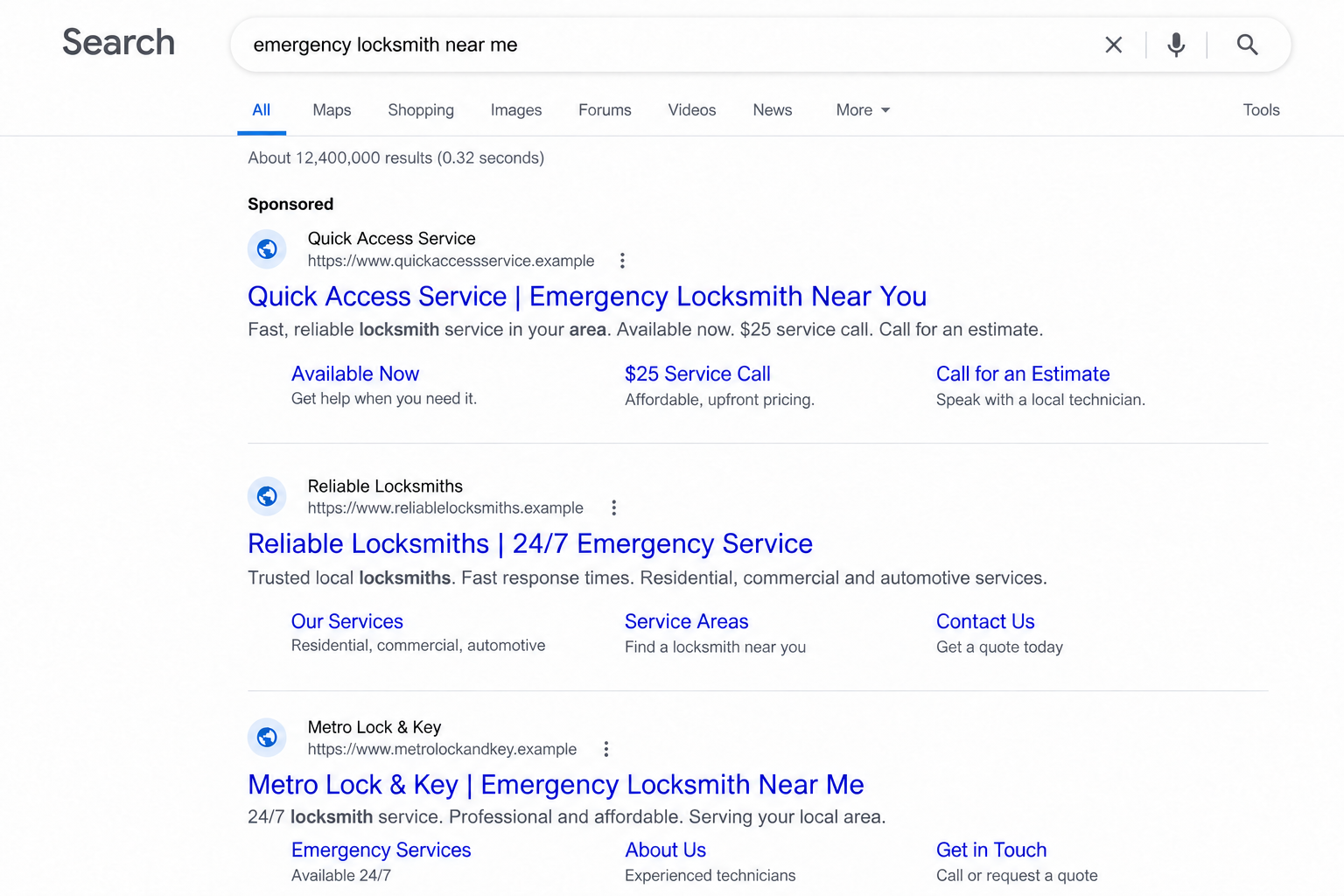
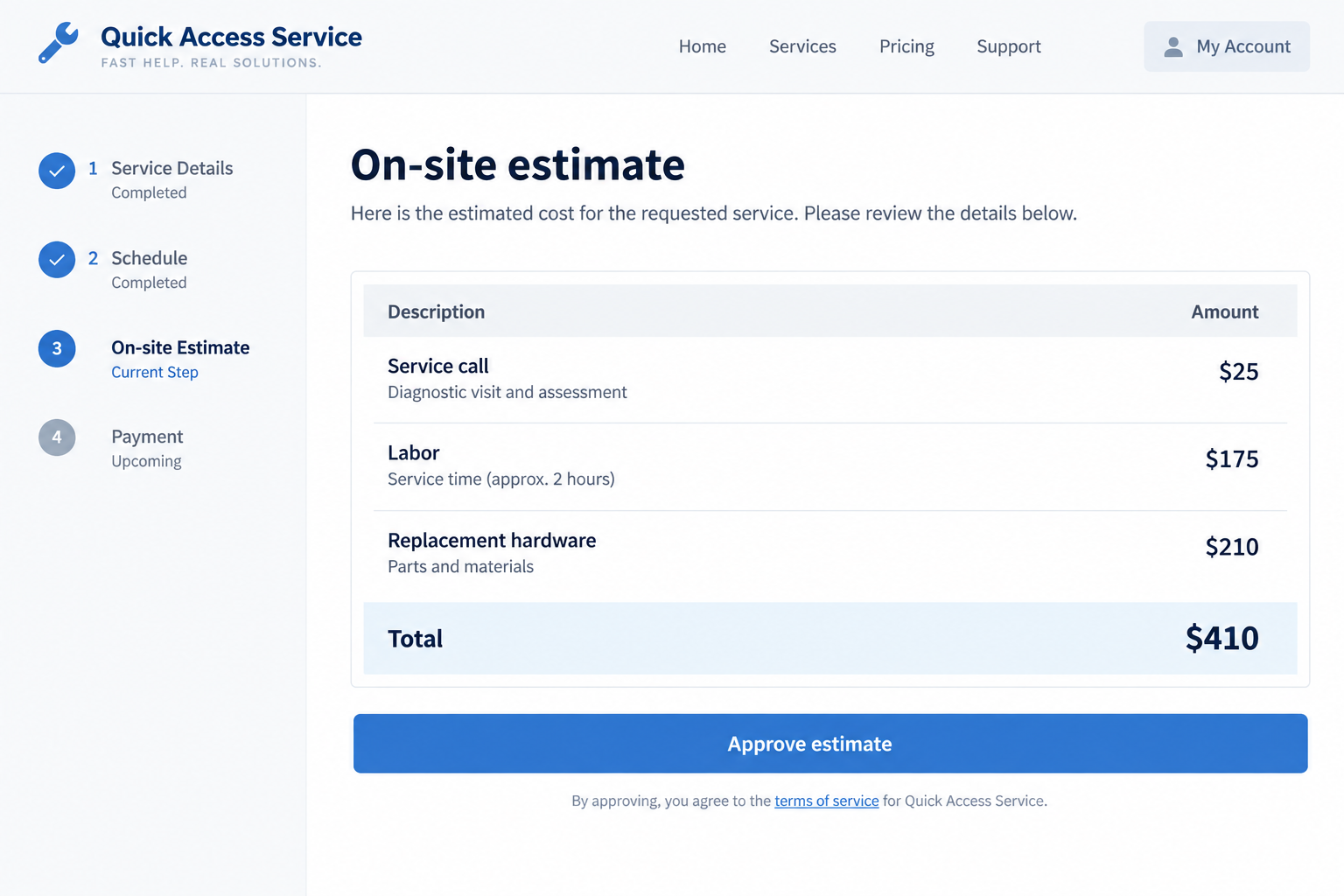
Our example screens use a fictional business and invented prices. They illustrate how an initial fee can differ from a later total, not standard market rates.
How the Locksmith Scam Works
Step 1: A search result offers a reassuringly small starting price
You search for nearby emergency help and see an advertisement emphasizing speed and a low number. The business appears to cover your neighborhood.
Read the wording around that price. A starting fee, attendance charge, and all-inclusive opening price are not interchangeable, even when the advertisement makes one number prominent.
Do not assume a sponsored position means the provider has been recommended for your specific job. Advertising placement and professional suitability are separate questions.
Save a screenshot before calling. Include the business name, advertised terms, date, and web address so the original offer is not lost.
A familiar logo should also be checked against the business’s independently located contact details. An impersonating advertisement may route calls somewhere else.
Step 2: The call gets a technician dispatched before terms are clear
The person answering may concentrate on your location and estimated arrival time. You can end the call without understanding who will attend or what you owe.
A call center is not automatically suspicious. Many legitimate services use dispatchers, contractors, or centralized booking systems.
What matters is whether the dispatcher identifies the responsible business and explains the quote. Ask whether the technician works for that business or another provider.
Request the estimate and conditions in writing, preferably before agreeing to dispatch. Include any cancellation or attendance charge if you later decline the work.
If nobody can explain the pricing basis, consider another provider while you are still free to compare. Do not treat urgency as a substitute for agreement.
Step 3: The on-site explanation changes the expected cost
After arrival, the quoted figure may become only a call-out charge. Labor, additional tools, replacement hardware, or other items are then introduced.
A revised estimate can be legitimate when a real complication is discovered. Ask what changed and which additional work is actually proposed.
Get a complete total, or a clearly explained pricing basis, before tools are used. Confirm what happens if the first approach does not work.
Do not approve a vague phrase such as whatever it takes if you need a cost limit. State the limit and request approval before exceeding it.
If the explanation contradicts the booking promise, preserve both versions. You may choose to decline, subject to any properly agreed attendance terms and local rules.
Step 4: Destructive work can increase the pressure
A proposal to drill or replace a lock deserves an explanation. Ask why nondestructive options are unsuitable for this particular situation.
You are not expected to diagnose the mechanism yourself. You are entitled to understand the proposed work well enough to decide whether to authorize it.
Replacement can create additional expenses and security decisions. Ask what hardware will be installed, what it costs, and what warranty or documentation accompanies it.
When safe and practical, a second opinion can help if the explanation seems inconsistent. Do not physically interfere with a technician or escalate a confrontation.
Being locked out creates pressure, but damage already started should not be used to justify unexplained charges or further work you never approved.
Step 5: The final payment becomes the immediate priority
By the time access is restored, you may simply want the encounter over. That can make it harder to question the invoice carefully.
Compare each item with the agreed estimate. Check whether quantities, parts, call-out charges, and labor correspond to what was discussed and performed.
Ask for the business name, contact details, and an itemized receipt. A payment terminal receipt alone may not explain the work or the contracting business.
Cash is not proof of dishonesty, but a pressure-driven demand can leave less useful documentation. Consider a payment method offering records and applicable dispute options.
If you feel threatened, prioritize personal safety. Move away when possible and seek emergency assistance if there is immediate danger.
How to Check the Company Behind the Locksmith Booking
Match the advertisement to the responsible business
Write down the legal or trading name given during booking. Compare it with the estimate, receipt, payment descriptor, and technician’s identification.
Names can differ legitimately, especially with subcontracting. Ask the business to explain the relationship rather than assuming every mismatch proves deception.
The practical question is who will handle a complaint or defective installation afterward. A recognizable advertising label is not enough if responsibility remains unclear.
Check what the address actually represents
A website may describe broad local coverage without maintaining a storefront on every street it mentions. Mobile service alone is not a warning verdict.
However, an address presented as a staffed local shop should be verifiable as such. Look for consistent business details through independent directories or official records.
Do not assume a map pin guarantees a physical office. Ask where written complaints should go and retain the answer with your booking records.
Know how post-service support works
Ask who handles callbacks if the new lock fails or the door stops operating correctly. Obtain the business’s normal support route rather than only a technician’s number.
A warranty should explain what is covered and by whom. An oral promise is harder to rely upon when the parties later disagree.
Keep your complaint factual if support is poor. Record attempted contacts and responses without turning an unanswered call into an unsupported accusation of criminal conduct.
Make the technician and replacement parts traceable
Check identification and any locally required license through the appropriate authority. Licensing rules vary, so do not apply another jurisdiction’s requirements to your location.
For replaced hardware, request the make, model, itemized price, and warranty details. Ask for the removed parts when practical and safe.
Those details help another professional assess the installation. They also make a later dispute more concrete than a general claim that the work seemed expensive.
Questions Worth Asking Before You Agree
The best questions are specific enough to produce a useful answer. You are trying to understand the transaction, not challenge someone’s technical knowledge.
- What is the complete expected price for the situation I described?
- Which circumstances could change that price, and how will you obtain approval?
- Will you provide an on-site estimate before opening or replacing anything?
- What will I owe if I decline that estimate?
- Who issues the invoice and handles any warranty claim?
- Can I pay using a method that provides a clear transaction record?
Describe the problem accurately without publishing your address or access details in a public discussion. Photos may help a verified provider, but consider what they reveal.
When discussing a vehicle, be ready to establish ownership through the provider’s legitimate process. A professional checking authorization is not necessarily creating an unreasonable obstacle.
For rented property, contact the landlord or building manager when feasible. There may be an approved provider or restrictions on replacing shared-access hardware.
What to Do if You Have Fallen Victim to This Scam
- Make sure you and the property are safe.
If there were threats or immediate danger, contact local emergency services. Do not remain in an unsafe confrontation to obtain a better receipt.
If the installation seems insecure, ask an independently chosen reputable locksmith to assess it. Do not assume every disputed job requires wholesale replacement.
- Build a clear before-and-after record.
Preserve the advertisement, booking messages, quoted price, final invoice, payment record, and photographs of relevant work or damage.
Write a chronological account while the details are fresh. Separate what you were told from what you observed and what another professional later concluded.
- Request an explanation and remedy in writing.
Identify the specific difference between the agreed terms and the bill. Ask for an itemized explanation, corrected invoice, or appropriate remedy.
Keep copies of the request and any response. Avoid unsupported public allegations while you are still establishing the facts.
- Ask the payment provider about available disputes.
If you paid by card or a supported payment service, contact it promptly. Explain the misrepresentation or unauthorized additions accurately.
Do not describe an authorized payment as card theft simply because you dispute the service. The correct process depends on the facts and applicable rules.
- Report deceptive listings and business conduct.
Use the advertising or mapping platform’s reporting process for misleading identity or pricing claims. Include the listing address and evidence of the discrepancy.
U.S. readers can contact their state consumer-protection office and use ReportFraud.ftc.gov. BBB complaints and Scam Tracker may also document the experience.
- Escalate workmanship concerns to the right professional or authority.
If licensing applies locally, check the regulator’s complaint process. An independent assessment may help distinguish necessary work from avoidable damage.
Seek qualified advice for substantial losses or a legal dispute. This guide cannot determine your contractual rights or guarantee reimbursement.
Prepare One Reliable Contact Before the Next Lockout
Save the contact somewhere you can access if your usual device is unavailable. A household member or building manager may also hold the verified details.
For commercial premises, establish who can authorize replacement hardware and spending. An emergency should not leave a junior employee guessing about approval limits.
After legitimate work, test the lock while the technician is present if it is safe. Ask how to report a problem and retain the itemized documentation.
A few minutes of research while you are not stranded can make the next emergency less stressful. Save a verified local provider’s details.
Check service areas and after-hours arrangements, not just reviews. A good provider outside your area may not be useful when you need immediate help.
Discuss spare-key or access arrangements with household members, landlords, or building management as appropriate. Avoid insecure hiding places and public disclosure of access information.
There is no antivirus remedy for a misleading service quote. The useful protections here are verification, documented consent, safe payment records, and accountable workmanship.
Frequently Asked Questions
Does a high locksmith bill prove I was scammed?
No. Evaluate the agreed terms, actual work, local conditions, and explanation for changes. A misleading quote or unauthorized work is more significant than price alone.
Is a low call-out fee the total price?
Not necessarily. It may cover attendance only. Ask explicitly whether opening work, labor, parts, travel, and applicable additional charges are included.
Does drilling always mean the locksmith is dishonest?
No. Some situations require destructive entry. Ask why it is necessary and obtain approval terms before work begins.
Can I trust a sponsored locksmith advertisement?
Advertising placement does not replace checking the provider. Verify identity, pricing, and the responsible business independently before authorizing the job.
Should every legitimate locksmith have a marked vehicle?
A vehicle’s appearance alone is not decisive. Identification, required credentials, a clear estimate, and an accountable business relationship are more useful checks.
Can I get an inflated charge refunded?
You can request a remedy and ask your payment provider about disputes. Outcomes depend on evidence, payment method, local law, and the actual transaction.
The Bottom Line
A locksmith scam exploits urgency and unclear terms. Establish who is coming, what the quote includes, and how changes will be approved.
Good emergency service should restore access without leaving you guessing about responsibility or the bill. Keep that standard even when you need help quickly.








