

A caller says your details were used to book a flight. You have never heard of it. The fake airline booking scam starts with that mismatch.
Before you can work out whether anything happened, a routine booking question begins to sound like something much more serious.
Overview
The flight is a reason to keep you talking
This is not a complaint about an airline selling a bad ticket. It is an impersonation scheme built around a booking the recipient does not recognize.
The caller claims your identity was used without permission. Instead of helping you verify that claim independently, they steer you toward another supposed authority.
In documented versions, the conversation escalates into a fabricated police case and demands involving money. The airline name lends credibility to the opening, not the demand.
Police have documented the airline-to-official handoff
The Singapore Police Force’s 2025 scam report describes callers impersonating airline staff and alleging that personal details were used fraudulently.
The documented route can lead to purported foreign officials and requests for transfers connected to investigation, bail, or safeguarding money.
That establishes the broader mechanism. It does not prove every recent anonymous report reached the same payment stage or involved the same criminal group.
The impersonator is the problem, not the real airline
- An unsolicited contact claims there is a reservation or identity problem.
- The caller supplies the evidence, the urgency, and the proposed solution.
- A transfer to another supposed official prevents independent checking.
- Criminal allegations increase pressure after the recipient denies booking.
- Secrecy or financial demands replace ordinary travel support.
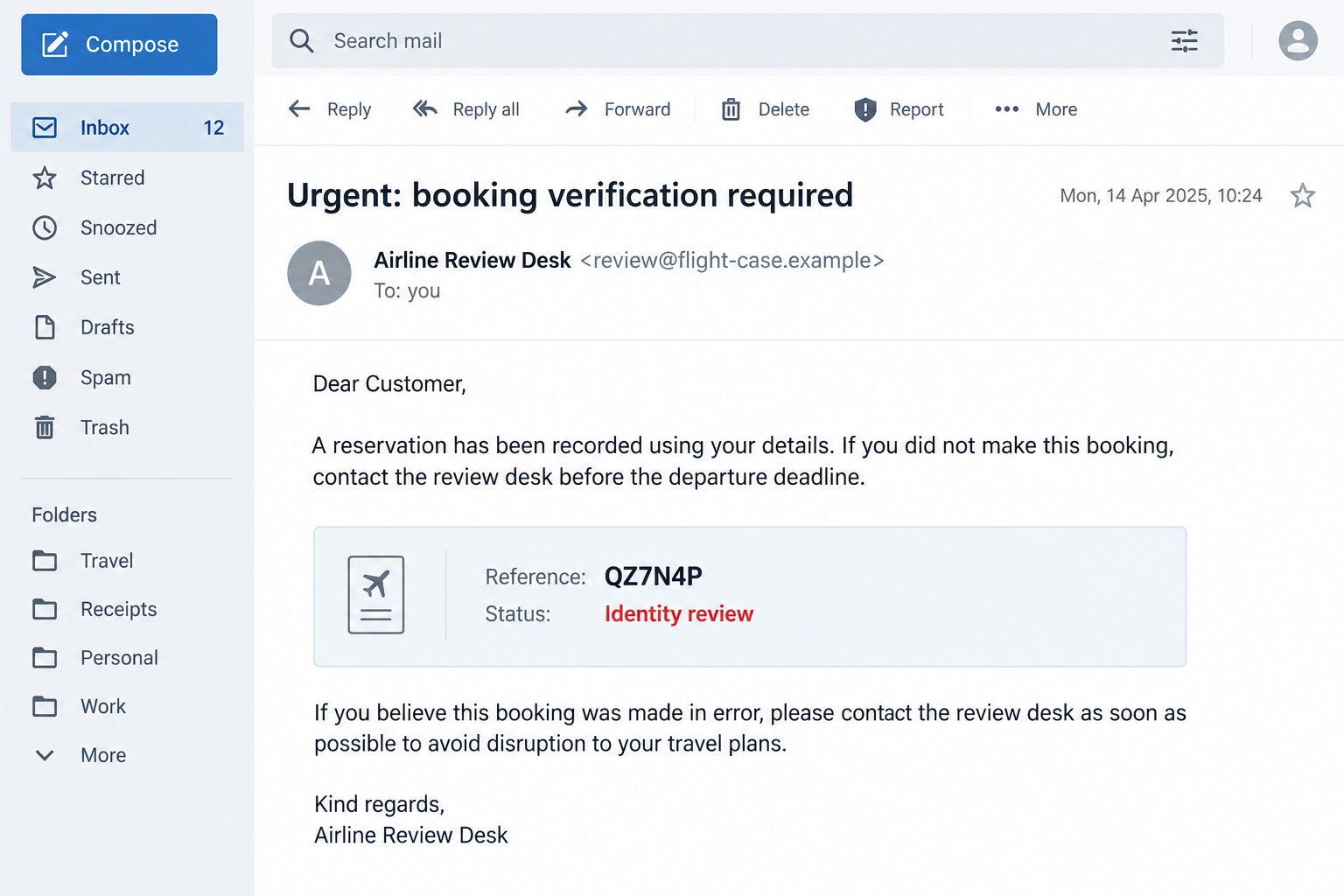
The screens in this article are fictional reconstructions. Their names, addresses, references, and wording illustrate the approach rather than reproduce an authenticated airline notice.
Why a Flight You Never Booked Gets Your Attention
An unfamiliar booking raises reasonable questions. Was a card used? Has somebody accessed your account? Could a passport number be involved?
The scammer does not need to answer those questions convincingly at first. They only need you to stay on the line long enough to introduce another concern.
Denial then becomes part of the script. When you say you did not book, the caller can portray that answer as evidence of identity misuse.
The conversation shifts from checking a reservation to defending your innocence. You may begin explaining yourself to someone whose identity you have never established.
A legitimate airline can contact customers about travel. The existence of an unexpected call is not, by itself, proof of a scam.
What matters is whether you can verify the underlying issue through the real airline and whether the requested action belongs in an ordinary booking inquiry.
Airline support does not become a reliable police connection simply because a caller offers to transfer you. That handoff needs its own independent verification.
Taking a few minutes to check separately is not an admission of guilt. You do not have to accept an invented deadline to demonstrate cooperation.
How the Fake Airline Booking Scam Works
Step 1: The caller introduces a reservation you cannot recognize
The opening identifies an airline, a fraud desk, or a booking review team. A reference number and departure deadline may make the story feel concrete.
Do not confirm sensitive details to discover whether the caller already has them. Asking you to supply missing information can be part of the deception.
Write down the claim without treating it as established fact. A reservation number spoken by a stranger is something to check, not proof.
If you have no trip planned, that is a reason to contact the airline independently, not a reason to follow an unfamiliar verification process.
Step 2: Your denial becomes an identity-fraud allegation
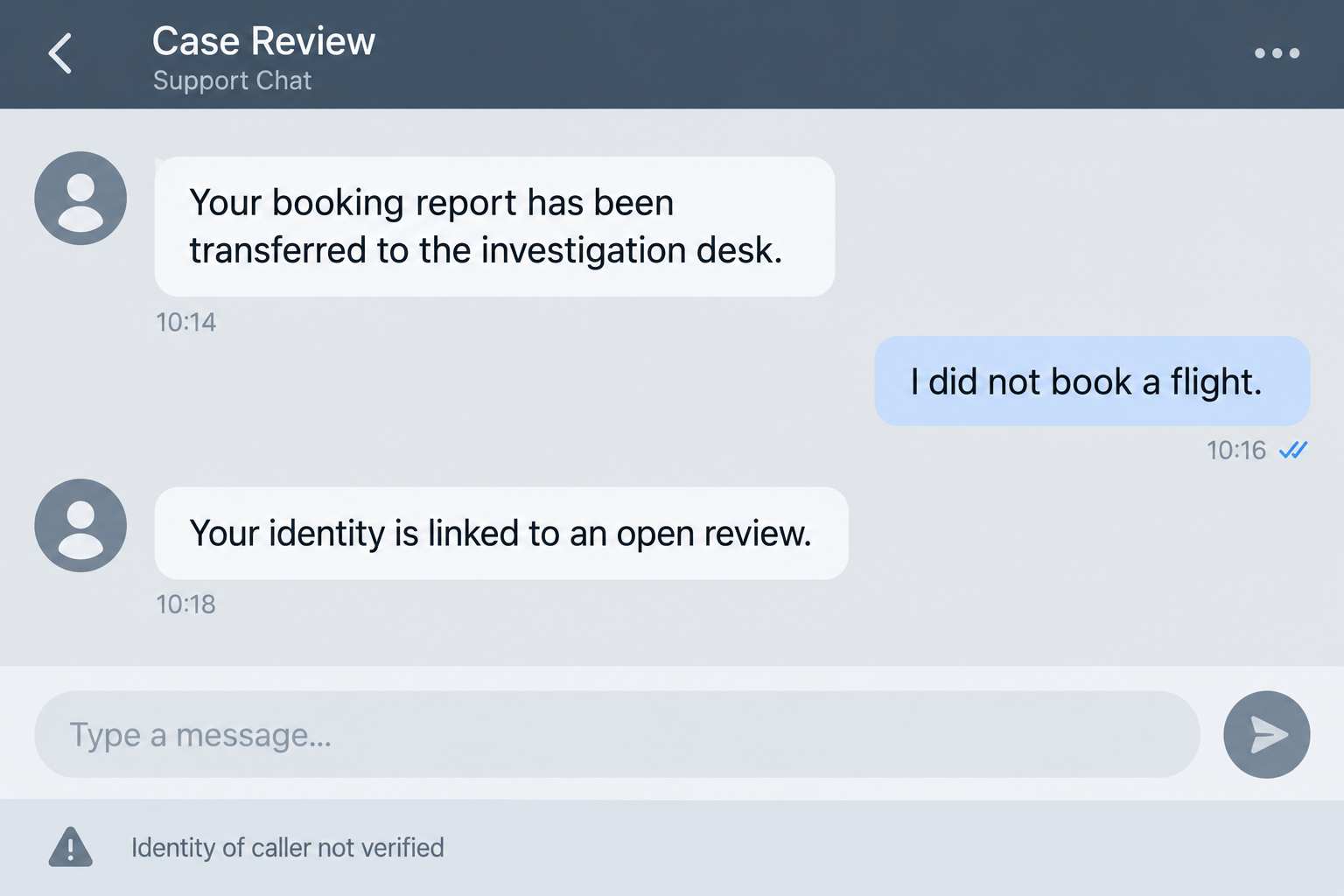
After you deny making the booking, the supposed representative suggests that someone used your identity. The story now feels larger than a travel mix-up.
You may be asked to describe your whereabouts, confirm identification, or explain why your details appear in the alleged record.
Those questions can make the call feel investigative. They do not establish that there is a real record or that the caller is authorized to investigate.
Stop giving information. If genuine identity misuse is a concern, you can investigate it through your accounts, providers, and appropriate official reporting channels.
Step 3: The airline supposedly transfers you to an investigator
The next voice may claim to represent police, immigration, or another government body. The change of speaker makes the story seem independently confirmed.
But a connection controlled by the first caller cannot verify the second. Two people agreeing on a story may simply be participating in it.
The police material documents this escalation in cross-border impersonation cases. It should not be read as evidence that every airline-themed call uses identical agencies.
Do not remain on the line for authentication. End the call and locate the claimed institution through a source outside the conversation.
Step 4: A booking problem becomes a threat to your freedom or finances
The supposed investigator alleges criminal involvement or misuse of your identity. Serious language makes ordinary verification feel too slow.
In the documented scam category, demands can involve money for an investigation, bail, or a supposed safe account. These are fraudulent pretexts.
A caller may also insist the case is confidential. That prevents a family member, bank employee, or real official from challenging the story.
You are not required to move funds to prove that you did not book a flight. Stop before authorizing any financial action.
Step 5: The impersonator keeps control of the next contact
A message thread, scheduled callback, or purported case portal can prolong the relationship. New instructions may arrive after the original travel claim fades into the background.
The longer this continues, the harder it can feel to walk away. Time spent cooperating is not evidence that the inquiry is legitimate.
Return to the first unresolved question: did the real airline confirm the booking through a channel you chose independently?
If not, the rest of the story is still resting on an unverified opening. You can stop now, even after several conversations.
How to Check the Booking Without Following the Caller
Use the airline’s own app or a separately located website
Open an app you already use or type the airline’s known address. Avoid links, phone numbers, and search advertisements supplied during the suspicious exchange.
If you have an account, review it there. An unfamiliar reservation may need support review, but the caller should not control how you obtain that support.
Explain that an unknown person claimed to represent the airline. Ask what information the real support team needs to assess the claim safely.
Verify payment separately from the reservation
Check your card or bank account through its official channel. A caller’s assertion that you were charged is not the same as a posted transaction.
If there is an unfamiliar charge, contact the issuer. Do not let the suspicious caller handle the dispute or refund.
A genuine billing problem can coexist with a scam attempt. Finding one real detail does not authenticate all later instructions.
Keep passport and account information out of the call
Do not send identity-document photographs to an unverified caller or messenger account. Such material can create additional problems beyond the invented booking.
Never provide a one-time security code because someone says it will clear your name. Read the actual purpose of any code notification you receive.
If a code concerns a login or payment you did not initiate, stop and contact that service directly.
What Real Airline Warnings Actually Say
Singapore Airlines warns about impersonation and phishing, including telephone approaches and spoofed numbers. Its advice supports checking contact through genuine channels.
American Airlines also publishes communication-security guidance. Use the actual airline’s guidance rather than treating a caller’s display name as authentication.
These warnings do not mean every message carrying those brands is fraudulent. Nor do they show that either airline caused the impersonation.
The accusation belongs to the false representative and the deceptive request. Keeping that distinction clear helps readers report the right problem.
The police advisory on official impersonation provides additional context for the later escalation into threats and money demands.
Official warnings are more useful than speculation about how a particular caller obtained your number. You can interrupt the mechanism without solving that mystery first.
Do Not Let a Foreign-Authority Claim Rush You
Cross-border allegations can be especially intimidating. You may not know the relevant procedures, language, or where to verify a supposed official.
The caller benefits from that uncertainty. A transfer offered inside the suspicious call feels easier than locating a legitimate contact yourself.
Do not accept the convenient option simply because the unfamiliar one takes longer. Ask local police, a trusted adviser, or an appropriate official channel for guidance.
If you are in Singapore, ScamShield provides official scam-checking resources. Elsewhere, use your local reporting and assistance services.
A demand to remain alone, keep a camera running, or avoid contacting family should increase concern. You do not need to follow such instructions while verifying.
If you feel physically threatened, seek urgent local assistance. Do not travel to an unfamiliar meeting location or confront someone claiming to be connected to the case.
Keep a Real Travel Problem Separate From the Threat
Sometimes you really are traveling when a suspicious call arrives. That coincidence can make its claims feel harder to dismiss.
Check your itinerary through the booking channel you originally used. Confirm any cancellation, schedule change, or payment problem there before responding to the unexpected contact.
If an actual trip needs attention, resolve that issue with genuine support. Do not allow it to justify a separate demand from a supposed investigator.
For example, a real reservation number does not establish that your identity is involved in a criminal case. Those are separate claims requiring separate verification.
Save both sets of records without merging them. Your confirmed itinerary belongs in one category; the unsolicited caller’s allegations belong in another.
This approach avoids an unhelpful choice between ignoring everything and trusting everything. You can protect your travel plans while refusing an unverified escalation.
What to Do if You Have Fallen Victim to This Scam
- Disconnect the invented support chain.
End calls and stop responding to the case thread. Do not use the supposed investigator to confirm whether the airline representative was genuine.
Tell someone you trust about the conversation, especially if you were instructed to keep it secret. An outside perspective helps break the pressure.
- Contact the real airline and any affected financial provider.
Ask the airline to check the claimed booking through its official support. If money moved, notify the bank or payment service immediately.
Give transaction details and explain the impersonation. Ask what interruption, recall, or dispute options exist without assuming a refund is guaranteed.
- Secure whatever information you actually exposed.
For leaked passwords, change them through the genuine service and review sessions. For disclosed payment details, ask the issuer about appropriate protection.
If you sent an identity document, consult its issuing authority about the relevant response. Do not pay the caller to delete the copy.
- Preserve the route from booking claim to demand.
Keep call times, displayed numbers, messages, case references, destination accounts, and receipts. Record which statements were claims rather than independently verified facts.
Report the incident to local authorities and the impersonated organization. Existing records are enough to begin; you do not need another conversation with the scammer.
- Check devices if links or software were involved.
A phone conversation alone does not require a malware-removal routine. If you installed a requested app or file, arrange a device-security review.
Malwarebytes can assist with malicious-software checks. AdGuard can reduce exposure to deceptive pages and advertising, but neither establishes an investigator’s identity.
- Treat follow-up recovery offers as a new verification task.
Someone who knows about the incident is not automatically your rescuer. Do not pay a release fee or share another code to recover earlier funds.
Continue through the providers and agencies you contacted yourself. Keep their genuine case references separate from numbers invented during the fraudulent call.
Frequently Asked Questions
Does an unexpected airline call always mean fraud?
No. Airlines can contact customers. The safest response to an unfamiliar booking claim is independent verification, particularly before sharing sensitive information or accepting a transfer.
Can a real-looking reservation code prove the story?
No. Ask the genuine airline to check it. A reference supplied by the caller is not independent evidence of either a booking or criminal involvement.
Why does the caller transfer me to supposed police?
The handoff can create false confirmation and greater pressure. A second voice on a connection controlled by the first caller does not authenticate the allegation.
Should I pay a temporary deposit to clear my name?
Do not transfer funds on that basis. Independently verify the institution and seek appropriate local advice instead of accepting financial instructions from the unsolicited contact.
What if they know my full name and passport details?
Knowledge of personal data does not establish authority. Stop disclosing more, contact the relevant providers, and ask the document issuer about protection if details were exposed.
Does this warning accuse the named airline of fraud?
No. The scam is impersonation of airline staff and officials. Legitimate airlines are separate from criminals borrowing their names to make false demands.
The Bottom Line
The fake airline booking scam turns a simple denial into a reason for escalating pressure. A flight you never booked should not become a secret money transfer.
Check the reservation with the real airline, outside the suspicious conversation. You can investigate a genuine concern without accepting the caller’s invented chain of authority.








