

One pair of glasses for a book, a laptop, and a bright afternoon sounds wonderfully convenient. BlueLume’s sales story makes that possibility feel close.
Before choosing a lens, however, there is a more basic question worth asking: who is making the promises you are reading?
Overview
The verdict is about the pitch, not a laboratory-tested pair of glasses
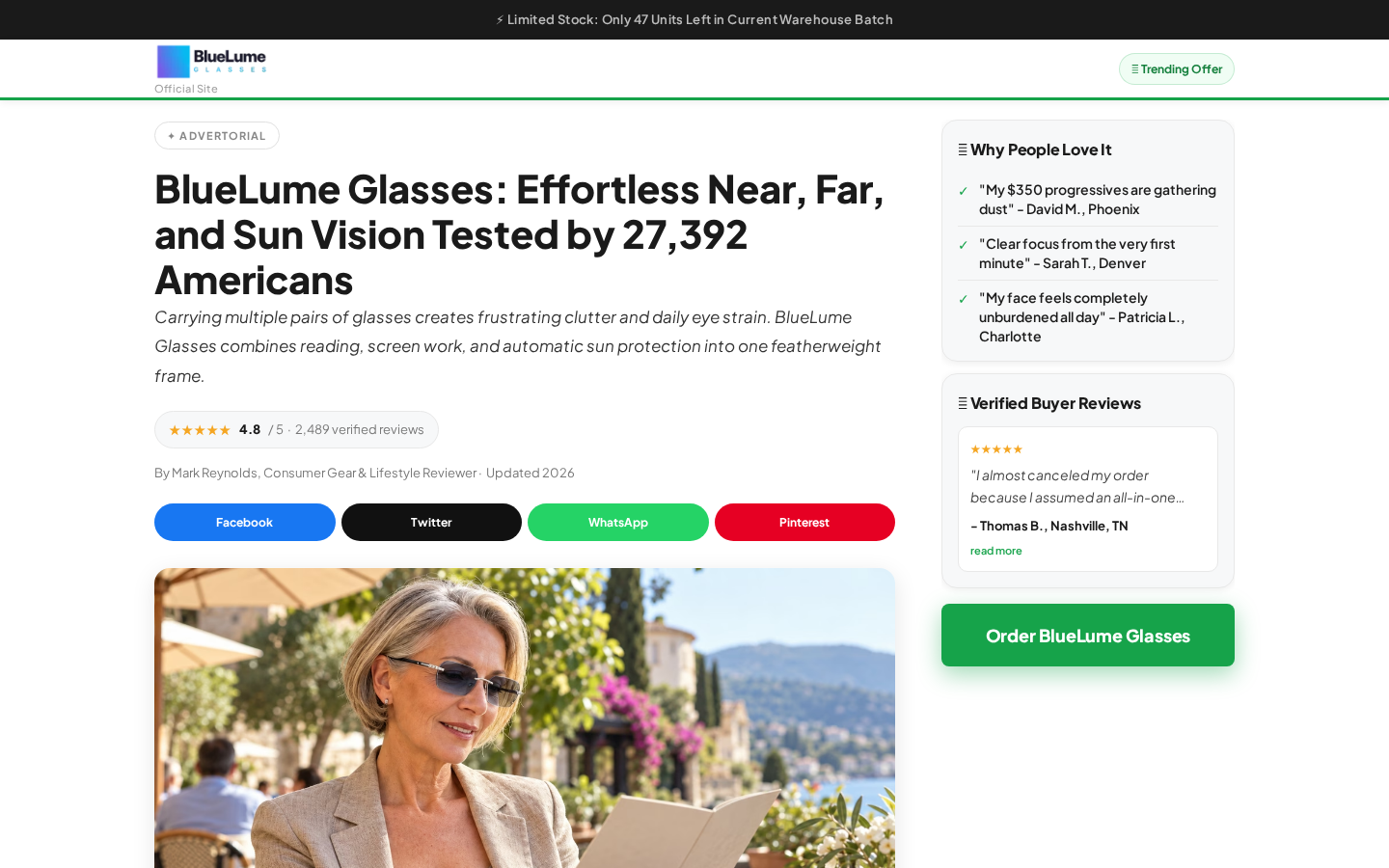
The BlueLume promotion deserves a firm warning. Its polished review-style page advertises dramatic vision benefits while functioning as a paid sales funnel.
The page calls itself an advertorial. Its footer says it is an advertisement, not independent news or a consumer-protection report.
We found no published optical test supporting its precise buyer counts, review totals, or sweeping claim that one ready-made pair replaces several different prescriptions.
That does not prove every shipped pair is counterfeit. It means the marketing offers much more certainty than the accessible evidence supports.
The advertised trial is less simple in the seller’s policy
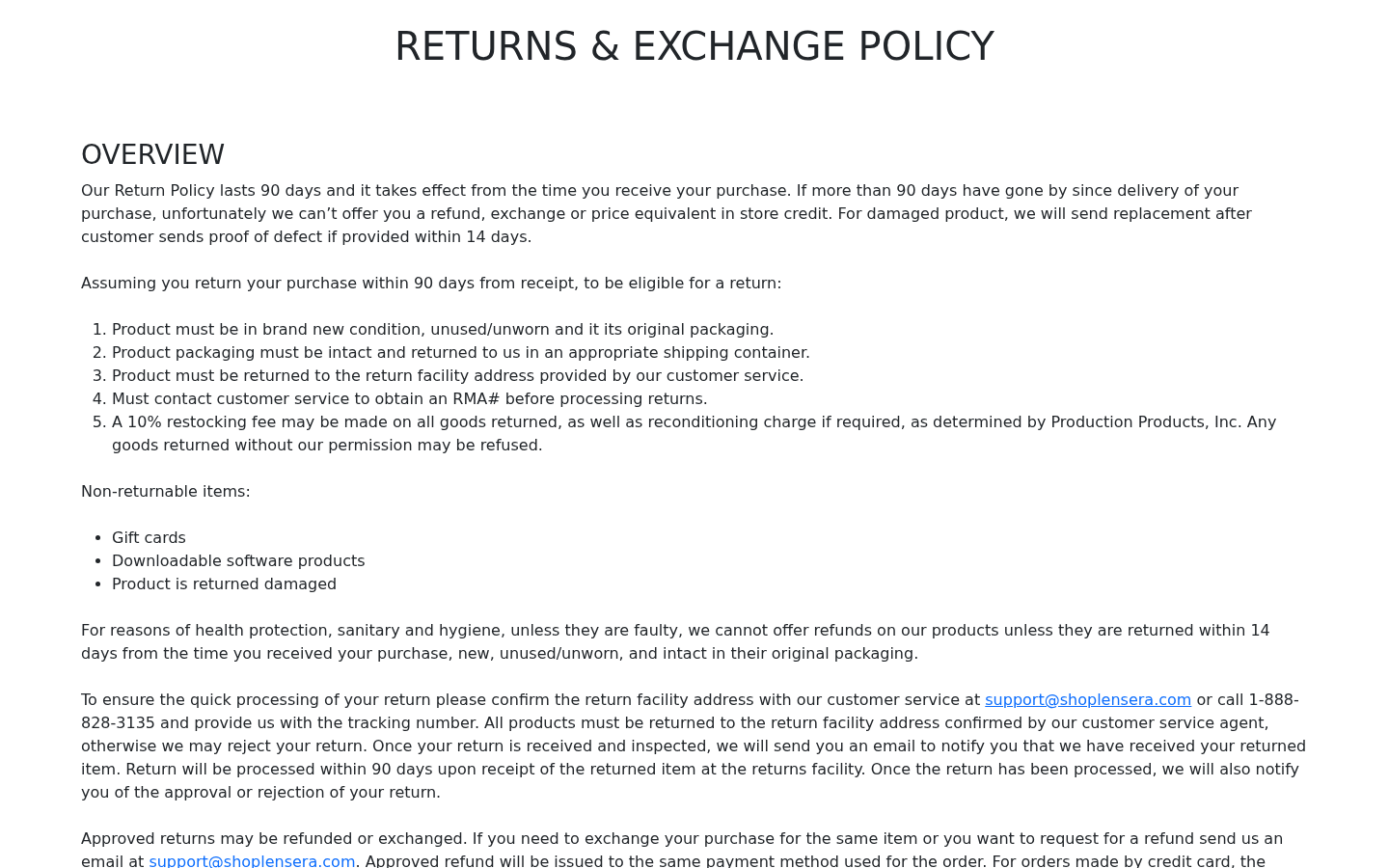
The sales page repeatedly offers a 90-day money-back guarantee. The linked seller return policy begins with 90 days, then imposes narrower conditions.
It requires unused, unworn glasses in intact packaging, advance authorization, and a return address supplied by support. It allows a possible 10% restocking fee.
A later hygiene paragraph says refunds are unavailable unless goods return within 14 days, new and unused. Buyers should not have to reconcile those conditions after payment.
Two websites divide the sale and the responsibility
The advertorial sends shoppers toward a different provider. Its own return page says the advertorial operator does not sell, ship, or refund products.
That division matters when the advertisement makes specific promises about domestic dispatch, optical performance, and a lengthy trial.
Our practical conclusion is simple: do not buy on the strength of this advertorial. First verify the actual seller, lens specification, written return terms, and payment page.
Here are the decisive checks:
- The supposed review is openly labeled an advertisement.
- The buyer and review numbers are not independently documented on the page.
- The affiliate disclaims responsibility for product orders and refunds.
- The seller’s 90-day headline is narrowed by unused-product and 14-day hygiene language.
- Possible restocking and return-processing delays can change the real value of a refund.
- The seller’s policy contains unrelated wearable-fitness-tracker copy, a serious quality-control warning.
What the Glasses Advertisement Wants You to Believe
The BlueLume page starts with a relatable annoyance: switching between reading glasses, screen glasses, and sunglasses throughout the day.
That problem is real. Many people would gladly carry one reliable pair instead of three cases.
The promotion then leaps from a common inconvenience to a highly ambitious solution. It describes continuous near-to-far optics, automatic darkening, and blue-light filtering.
It also promises immediate relief from eye fatigue, quick domestic dispatch, and a product that works straight from the box without individual fitting.
Those are different claims. A photochromic tint, a progressive optical design, a suitable prescription, and relief from symptoms each require different evidence.
The page does not show a controlled test, prescription range, independent lens measurements, or a clear explanation of who can safely use the glasses.
A stock photograph of someone reading outdoors cannot demonstrate distance acuity. A testimonial cannot tell another buyer whether the lens suits their eyes.
Even the phrase “tested by 27,392 Americans” is doing more work than the page proves. It does not identify a study, sampling method, results, or examiner.
The large review count is similarly presented inside the advertiser’s own environment. We cannot verify those purported buyers from the advertorial alone.
Blue-light filtering deserves separate caution. It is often sold as a remedy for screen discomfort, but eye strain has several possible causes.
Dryness, an incorrect prescription, reduced blinking, lighting, and prolonged near work can all matter. A filter should not be marketed as a universal fix.
Someone who needs prescription correction should not treat a generic sales claim as a substitute for an examination or a properly specified lens.
That is especially important for driving. An advertisement promising clear highway signs is not proof that a given pair meets a buyer’s distance-vision requirements.
Before ordering, ask for the exact optical power, lens type, UV performance, relevant standards, and whether the product is prescription or nonprescription.
If the seller cannot answer those questions, the convenient story has not become a trustworthy eyewear purchase.
How the BlueLume Sales Funnel Works
Step 1: A review-looking page captures a familiar frustration
The landing page is structured like a personal consumer review, complete with a named reviewer, rating display, testimonials, and a “tested” headline.
That layout encourages a reader to process the article as independent advice before noticing the small advertorial label.
There is nothing inherently wrong with advertising. The problem arises when an advertisement borrows the authority of a review without showing review-grade evidence.
The footer’s disclosure is decisive. It says the page is not an actual news article and that the operator may earn money from clicks or sales.
It also says bylines may be pen names. That makes the named reviewer less useful as a person a buyer can independently question.
Step 2: Impressive numbers make uncertainty feel settled
The headline cites 27,392 Americans. The rating block claims 2,489 verified reviews. A top strip says only 47 units remain.
Numbers feel precise, which makes them persuasive. Yet precision is not verification when the source is the company benefiting from the purchase.
The page provides no accessible method showing how the buyer total was counted, how reviews were verified, or when inventory was last measured.
A shopper should treat those numbers as advertising claims until independent records support them.
The stock warning and discount also change the pace. They encourage a decision before the buyer compares optics, competitors, and refund conditions.
Step 3: Testimonials answer objections before facts do
The quoted customers describe reading menus, seeing distant signs, reducing headaches, and abandoning expensive progressives.
Each testimonial resolves a different hesitation. Together, they create an impression that the product will fit almost everyone.
But eyewear is personal. The difference between a useful convenience item and an unsuitable lens can depend on prescription, astigmatism, pupil distance, and adaptation.
A review page could explain those limitations. This sales page mostly uses praise to move readers toward the order button.
Do not mistake a cluster of vivid personal stories for a measured result or a promise that your own visual needs will be met.
Step 4: The order link transfers the buyer to another party
Repeated buttons send visitors away from the advertorial. The affiliate’s policy states it does not process orders or handle the guarantee.
The actual seller’s identity, billing descriptor, return facility, and terms therefore matter more than the logo above the “review.”
At checkout, save the URL and all terms. Compare the merchant name with the receipt and the card statement.
If an optional bundle or extra unit appears, remove it before paying. We did not verify that such an upsell exists in this specific checkout.
Never assume an affiliate’s 90-day language controls a purchase simply because it was the first promise you saw.
Step 5: The refund path narrows after the purchase
The provider’s policy starts with a 90-day period, but requires the glasses to be brand new, unworn, and in original intact packaging.
That creates an obvious question: how can a customer meaningfully test vision and comfort while keeping the product unworn?
Another paragraph refers to a 14-day hygiene deadline. The text does not clearly explain which rule controls an ordinary opened eyewear return.
The policy also says approval can depend on an RMA and that a 10% restocking fee may apply.
It gives customer service control over the return address. Shipping anything back without that authorization may cause the return to be refused.
Those conditions make the guarantee materially less reassuring than the front-page phrase “risk-free” suggests.
Step 6: Confusing policy language weakens accountability
The seller’s return page names an unrelated “Production Products, Inc.” in the restocking clause and uses a support address at shoplensera.com.
Its About section describes wearable fitness trackers, not glasses. That reads like leftover template copy on an eyewear return page.
Template residue does not establish criminal intent. It does show insufficient care in the document customers must rely on when money is disputed.
A buyer should ask which entity takes payment, which company wrote the guarantee, and who actually has authority to issue a refund.
If support cannot identify one accountable business, the attractive article has led into a weak consumer-protection position.
The Return Promise Has Real Financial Consequences
The difference between a 90-day window and a 14-day unused-item rule is not a technicality. It changes whether a normal trial can end in a refund.
Imagine someone wears the glasses for a week and discovers distorted distance vision or discomfort. The advertorial suggests a generous trial.
The seller could point to the unused condition or hygiene wording. We have not tested how the company applies the clauses in practice.
That uncertainty alone should stop an impulse purchase. A guarantee is only useful when its conditions are clear enough to predict.
A possible restocking deduction compounds the issue. A refund may be lower than the advertised price even if the return is approved.
Shipping costs are another unknown. The affiliate expressly says the provider decides who pays return postage and whether additional charges apply.
The provider’s policy also allows substantial processing time after the returned goods reach the facility.
That timeline can run against payment-card dispute periods. If the seller delays, the buyer should not wait indefinitely for a promised response.
Ask support, before purchase, whether opened and tried-on glasses can be returned after 14 days, whether the 10% fee applies, and who pays postage.
Keep the answer in writing. A chat promise is more valuable when it contains the order link, product name, and exact terms.
If the answer conflicts with the published policy, do not treat the informal reassurance as a repair. Ask for the policy to be corrected.
Company, Address, and Fulfillment Checks
The advertorial is not the seller
The review-looking website calls itself a marketplace and disclaims shipping, support, returns, exchanges, and refunds.
It may earn compensation from the transaction while leaving the product provider responsible for any problem.
That separation should be impossible to miss, yet the promotional headlines sit much closer to the top than the responsibility disclaimer.
The seller’s identity needs written clarification
The product return page names BlueLume Glasses, then refers to Production Products, Inc. and a different support domain.
Those names may reflect a processing arrangement, an old template, or separate companies. The page does not explain the relationship.
Ask for the legal entity on the card charge and compare it with the checkout terms, receipt, and return authorization.
A return address is not proof of headquarters
The policy lists a San Leandro, California return address and says support may supply the facility address for a specific return.
A receiving address can belong to a warehouse, mail service, or logistics partner. It does not, by itself, establish where the glasses were manufactured.
Do not ship to a printed address without the required RMA. Get the destination and tracking instructions from the seller first.
Product claims require more than marketing copy
The accessible sales page does not substitute for lens specifications, prescription suitability, UV measurements, manufacturing details, and a traceable warranty operator.
Its copy about fitness trackers in the eyewear policy is a warning that even basic product-specific proofreading failed.
We cannot determine manufacturing origin from that mistake. We can demand that the seller identify the actual glasses and support their claims.
What to Do if You Already Ordered BlueLume Glasses
- Preserve the transaction record. Save the advertorial, checkout, receipt, card descriptor, terms, and any order confirmation. Include the date and full URL of each page.
- Check the quantity and charge immediately. Compare the authorization with what you intended to buy. If an extra item appears, request cancellation in writing before dispatch.
- Ask for the real return terms. Request a written answer about the 90-day promise, 14-day hygiene wording, unused condition, 10% fee, return postage, and RMA.
- Do not rely on the affiliate for a refund. The advertorial says the product provider handles orders. Contact the merchant named on the receipt and copy the support address in its policy.
- Document any mismatch before using the item further. Photograph the packaging, lenses, instructions, and any defect. Explain the exact difference between the product and its advertised specification.
- Escalate a failed refund promptly. If the seller refuses to honor clear written terms, ask your card issuer or payment platform about its dispute process and deadlines. Present facts, not assumptions.
- Protect your vision. If the glasses blur distance vision, cause discomfort, or do not match your prescription, stop using them for driving and consult an optometrist.
Frequently Asked Questions
Is the BlueLume “review” independent?
No. The page labels itself an advertorial and says it may earn commissions from sales or clicks.
Are BlueLume Glasses proven to replace prescription progressives?
We found no published test or individualized prescription specification demonstrating that the ready-made pair can replace a buyer’s prescribed lenses.
Does the 90-day guarantee cover tried-on glasses?
The provider’s written policy is unclear. It requires unused, unworn goods and also contains 14-day hygiene wording. Ask the seller before paying.
Who handles a BlueLume refund?
The advertorial says it does not. The product provider listed in the transaction and its return policy should be contacted.
Does the California address prove the glasses ship from the United States?
No. A return address does not establish manufacturing origin or outbound fulfillment. Request a verifiable shipping commitment from the seller.
Is every BlueLume order a scam?
We cannot establish that. The documented problem is a deceptive-looking advertorial and a return promise diluted by conflicting restrictions.
The Bottom Line
BlueLume’s strongest evidence is its own warning sign: a paid “review” making precise, sweeping claims while disclaiming responsibility for the order.
The seller’s policy then turns a simple 90-day pitch into an unused-item return with a possible fee and contradictory 14-day language.
Skip this offer unless the real seller resolves those contradictions in writing and provides credible lens specifications for your needs.








