

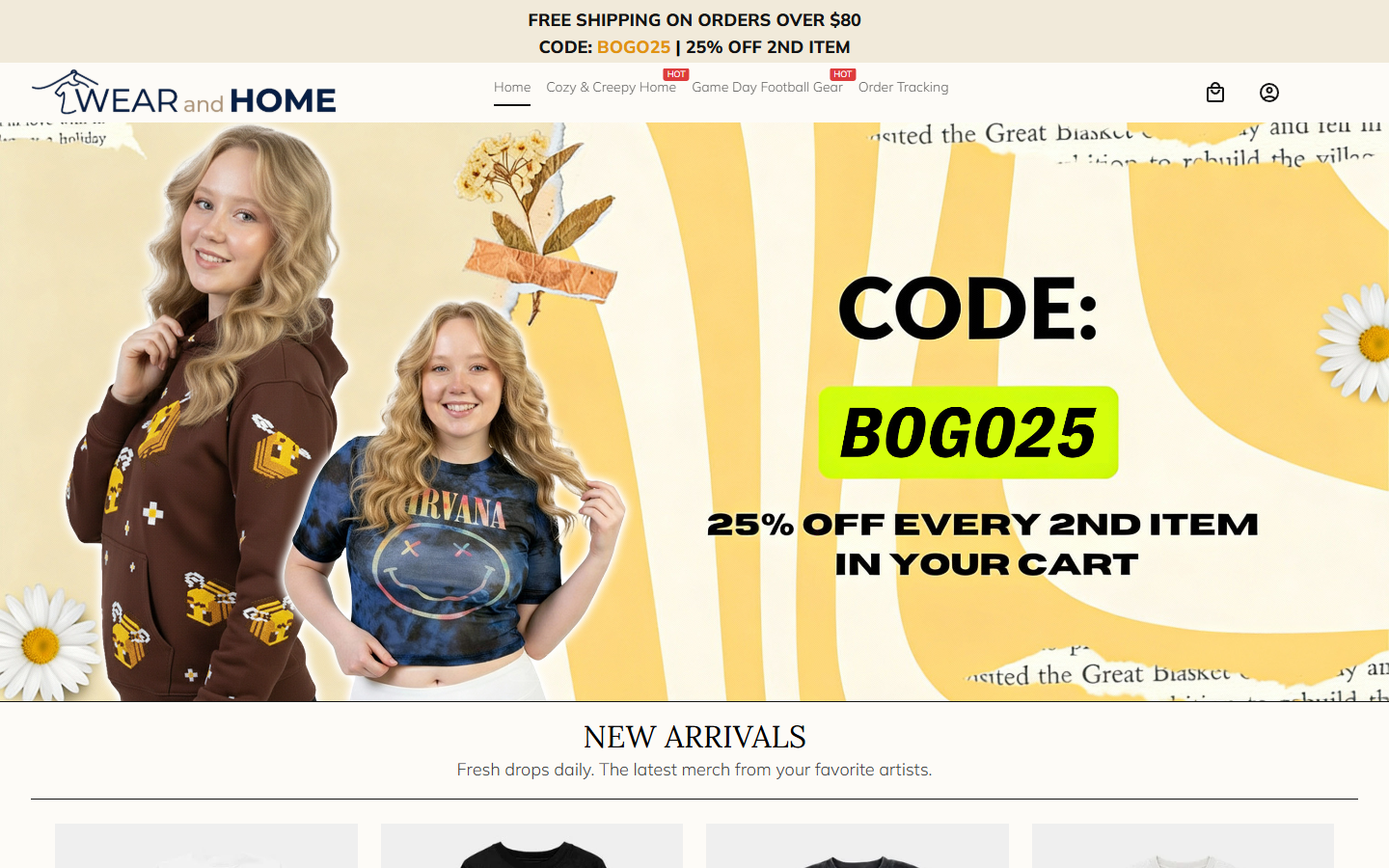
The WearAndHome homepage looks built for fans who spot a favorite team, artist, or television reference and want it on a shirt.
The catalog is enormous. That makes the question of who made each item, and what happens after checkout, unusually important.
Overview
The verdict: a real storefront with serious buyer-risk signals
WearAndHome is an operating online store with a vast assortment of printed apparel, fan-themed goods, and personalized products.
It would be inaccurate to call the entire business a proven scam. It would also be careless to treat its polished pages as enough reassurance.
The store’s own presentation and outside customer feedback tell sharply different stories about quality, support, and what arrives.
Our recommendation is to avoid an impulse buy, especially for unofficial-looking fan merchandise or a gift needed by a fixed date.
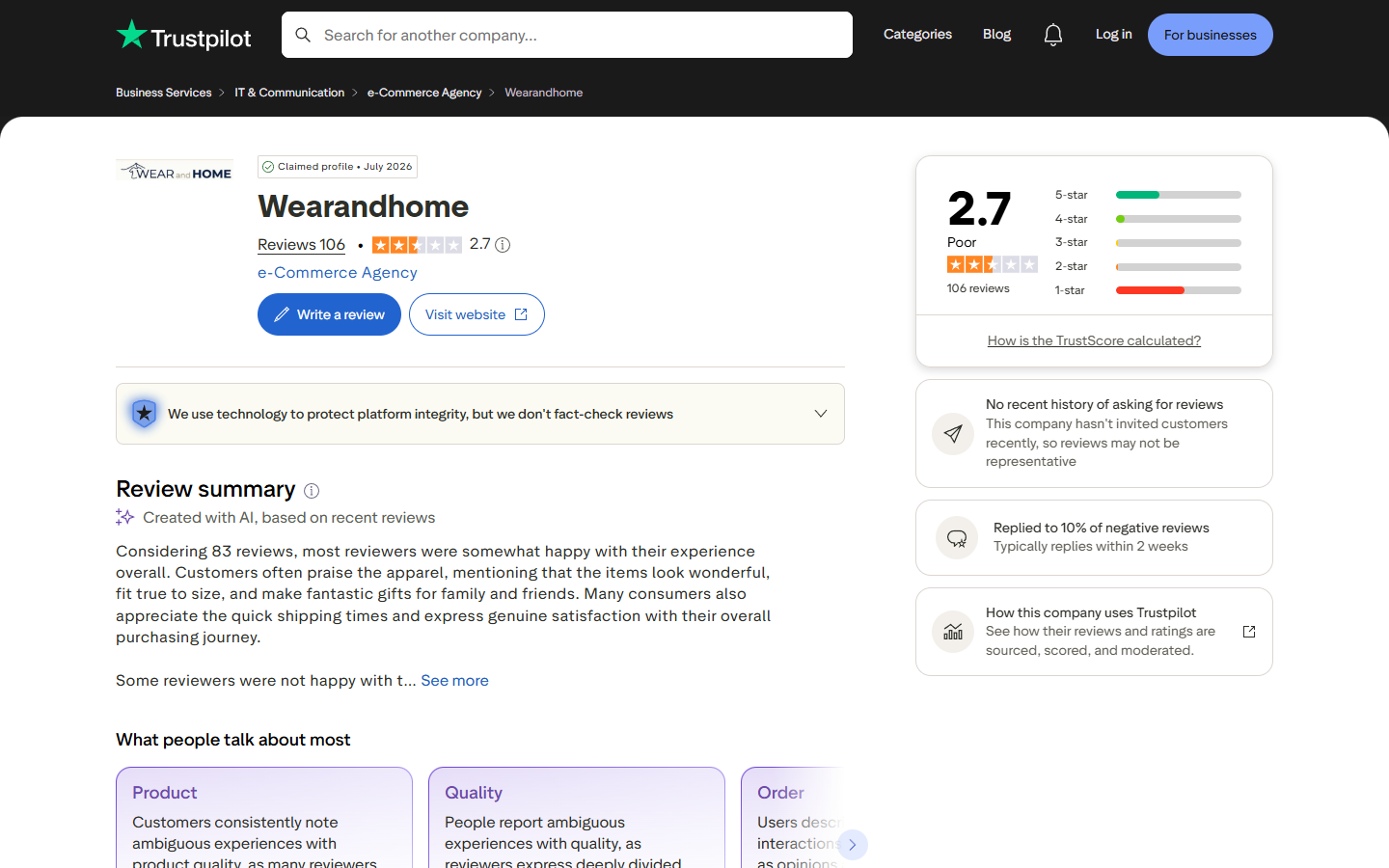
Store ratings and outside reviews do not agree
WearAndHome displayed an in-store 4.9 rating with more than 1,600 customer ratings during our review.
Its Trustpilot profile showed 2.7/5 from 106 reviews in a separate check. Recent posts included praise and serious complaints.
The contrast does not prove one source is fabricated. Review populations differ, and public platforms do not individually verify every claim.
It does mean that a buyer should not rely on a single favorable number controlled by the shop’s own page.
The payment terms introduce another party
WearAndHome’s payment policy says an accepted order may involve a contracting party other than WearAndHome.com.
It also says the card may be debited on authorization, before the goods are dispatched.
Those provisions do not prove that a third party handles every purchase. They create a practical question: who owes the customer a refund?
Before paying, check the following:
- Is the item officially licensed or merely fan-inspired?
- What exact fabric and printing method will be used?
- Is the image a photograph of the finished item or a digital mock-up?
- Who is the legal seller named on the final checkout and receipt?
- When will a made-to-order item be produced and delivered?
- What remedies apply if the item differs materially from the picture?
What WearAndHome Actually Sells
The homepage says “fresh drops daily” and highlights merchandise tied to musicians, sports teams, festivals, films, and internet personalities.
Its catalog displayed thousands of products. That breadth is part of the appeal: a shopper can find a design for almost any fandom.
It is also a reason to slow down. A huge print-on-demand catalog cannot be evaluated as one uniform product line.
A simple shirt and a personalized sneaker have different materials, manufacturing paths, fit risks, and return consequences.
Some WearAndHome listings say items are made to order and printed in the United States. That is the store’s product-specific claim.
We did not inspect a factory or prove the origin of every item. The buyer should save the claim attached to the exact listing.
Likewise, a product title that begins with “Official” should not be accepted as licensing proof by itself.
A licensed item normally has identifiable rights-holder information, authorized-retailer status, a manufacturer, or packaging that can be checked independently.
We did not determine that WearAndHome’s entire catalog is unlicensed. We found that many products invoke recognizable entertainment and sports identities.
For a fan buying a gift, the distinction matters. A custom fan shirt may be acceptable; an expected official jersey is a different purchase.
Read the product description literally. Does it promise embroidery, textured patches, or merely an image printed to resemble them?
One recent public review alleged a textured-looking shirt arrived as a flat print. That is an unverified customer account, not our own product test.
The allegation illustrates the question buyers should ask before checkout: what is physical detail, and what is artwork?
Digital mock-ups can make print placement and fabric look more polished than the delivered garment. The store itself warns some customized items may differ from mock-ups.
If the design relies on dimensional stitching, metallic effects, or a specific team insignia, request a photograph of an actual finished product.
A convincing picture is not the same as a product specification. For clothing, exact composition and measurements matter more than the background scene.
Price deserves the same scrutiny. The homepage offers 25% off a second item and free shipping above $80.
Those incentives make adding one more product seem efficient. They can also increase the amount at risk if the buyer has not verified the first item.
Do not let a shipping threshold turn a cautious test purchase into a cart full of uncertain merchandise.
How a WearAndHome Purchase Can Go Wrong
Step 1: Recognition does the first selling
A famous logo, song, team, or character catches the eye before the shopper has examined the merchant.
The item can feel familiar because the underlying culture is familiar. That emotional shortcut says nothing about the store’s rights, quality, or support.
Pause over the exact listing. Is it described as an official licensed item, a custom print, or something ambiguous between the two?
Search the design on the rights holder’s official shop if authenticity matters. Do not assume a matching title is authorization.
Step 2: A mock-up sets expectations the print may not meet
Online apparel images often show a clean, perfectly lit digital rendering. WearAndHome sells many made-to-order designs where the actual print is created later.
That model is common and can produce satisfactory products. It also shifts risk onto the buyer when texture, scale, or color is uncertain.
Check whether the listing specifies screen print, direct-to-garment print, sublimation, embroidery, or an applied patch.
If the method is missing, a shopper cannot reliably predict whether a pictured effect will be physically raised or simply flat ink.
Public reviewers reported both good results and mismatches. The store’s high internal rating should not erase that variation.
Step 3: Promotions enlarge the order
The second-item discount and free-shipping threshold encourage buyers to add more to the cart before they have tested quality.
This is ordinary retail psychology, not itself a scam. It becomes consequential if the first item arrives below expectations.
For a new seller, buy one lower-risk item first. Compare the delivered result with its listing before committing to personalized gifts.
Review the final cart for sizes and quantity. Personalized or made-to-order products can be harder to modify once production begins.
Step 4: Payment can precede dispatch
The payment policy states the card is debited on authorization and treats the amount as a deposit until dispatch confirmation.
It also allows an accepted order to involve an unnamed third-party contracting party, to be identified in the confirmation email.
That language is unusual enough to warrant a pre-sale question. Ask which company will appear on your receipt and handle product disputes.
Keep the confirmation message. If another entity is named, save its terms too rather than assuming WearAndHome’s marketing controls.
We cannot establish from the policy alone that any individual buyer contracted with a third party.
Step 5: Delivery becomes the moment of truth
Several public reviewers describe satisfactory goods and timely arrival. Others allege delays, sizing problems, lower-quality fabric, or pictures that did not match.
Those claims are individual reports, not a controlled sample. They show a meaningful spread of experiences that the in-store score obscures.
Open the parcel carefully and document it before washing or wearing. Photograph the label, material tag, print, and any discrepancy.
For a gift, allow time to examine the product before the event rather than relying on the advertised delivery impression.
Step 6: A complaint needs a specific comparison
“I don’t like it” may be treated differently from “the listing promised cotton, but the label says polyester.”
Compare what was sold with what was delivered. Quote the exact product description and attach a clear photo.
Ask for a written return or replacement decision. If the store invokes made-to-order exclusions, request the clause that applied at checkout.
Do not mail an item to an address found in a search result without authorization. It may belong to a printer or logistics partner.
If the seller fails to address a material mismatch, keep the evidence for a payment-provider dispute.
How to Read the Conflicting Review Signals
A 4.9 store score and a 2.7 Trustpilot score cannot both describe every customer’s experience. Neither should be read as a universal outcome.
The two groups may differ in who is invited, who chooses to post, whether their order was recent, and what products they bought.
Trustpilot’s own page says it uses technology to protect platform integrity but does not fact-check each review.
That means an angry review should not be repeated as proven misconduct. A positive one should not be accepted as proof the next parcel will match.
The strongest signal is not any one testimonial. It is the repeated theme of image-versus-item uncertainty across several recent complaints.
That theme deserves attention because a visual mismatch can affect a buyer even when the parcel technically arrives on time.
At the same time, the page includes positive reports, including buyers who liked their jerseys or received responsive help.
Those positive experiences prevent a fair article from claiming that everyone is cheated. They do not erase the risk of a disappointing order.
The verified conclusion is narrower and sharper: the seller’s in-store score is not a reliable stand-alone decision tool.
Look for a review of the exact garment, fabric type, and print method you plan to buy.
A general five-star site rating cannot answer whether a specific “official” tour shirt has licensed artwork or whether a pillow looks like its mock-up.
Also examine how the company handles negative reports. A polite public response is useful only if a customer receives a practical remedy.
We cannot audit private support outcomes from public reviews. Ask pre-sale questions and judge the clarity of the reply.
If no one can explain material, licensing, delivery, and returns, the safest choice is to keep your money.
Company, Address, and Fulfillment Checks
Who accepts the order?
The payment policy’s third-party contracting language means a shopper should identify the actual seller after acceptance, not just the website brand.
Compare the order confirmation, payment descriptor, policy, and support signature. A mismatch may be explainable, but it needs explanation.
Where is the item produced?
Some listings say printed or made in the USA. That is a claim for those items, not proof that every product in a vast catalog shares one origin.
Check physical labels and any ship-from details. We cannot conclude from the website alone that goods come from China or a specific factory.
Who owns the artwork?
Recognizable team and artist names can appear in listings without making the store an official retailer.
Ask for rights-holder licensing evidence when authenticity matters. Do not accuse a specific listing of infringement without checking the rights.
Where do returns actually go?
A printer, fulfillment center, or returns warehouse may handle parcels for a separate merchant. None is automatically the entity responsible for billing.
Get the return authorization and destination from the seller named on the transaction. Preserve tracking until the remedy is complete.
What to Do if You Already Bought From WearAndHome
- Collect the original listing. Save product photos, fabric claims, sizing, “official” language, order total, and any delivery promise before pages change.
- Identify the merchant. Check the acceptance email and card statement for the contracting party mentioned in the payment policy.
- Inspect the delivered item promptly. Photograph the packaging, print, labels, sizing, and any difference from the mock-up before use or washing.
- Describe the problem precisely. Send support a side-by-side comparison with the exact listing claim, not only a general expression of disappointment.
- Ask for a defined remedy. Request a replacement, refund, or return instructions in writing. Confirm who pays postage and whether personalization affects eligibility.
- Do not miss dispute deadlines. If a material mismatch remains unresolved, ask your card issuer or payment platform about available protections and submit the documented facts.
Frequently Asked Questions
Is WearAndHome a confirmed scam?
No. The site operates and receives mixed public reviews. The documented concerns are product-expectation risk, review contrast, and unclear contracting language.
Are WearAndHome’s fan products officially licensed?
A title or familiar design does not prove licensing. Check the specific item with the rights holder or ask the seller for documentation.
Why do its review scores differ so much?
The store and Trustpilot use different review populations and methods. Neither score predicts the quality of every item in a vast catalog.
Does WearAndHome print everything in the United States?
Some product pages claim US printing. We did not verify a universal origin for all goods or inspect its production facilities.
When is my card charged?
Its payment policy says the card may be debited when authorization is completed, before dispatch confirmation.
What if my item looks unlike the photo?
Save the original listing and photograph the delivered item. Ask the named seller for a remedy, then consult your payment provider if a material mismatch remains.
The Bottom Line
WearAndHome is not a phantom website, but a huge catalog and attractive in-store score should not override the much more mixed outside record.
Buy only after verifying the exact item, seller, production method, and remedy. For a time-sensitive or authenticity-sensitive gift, the uncertainty is enough to shop elsewhere.

Join the discussion
0 commentsShare your experience or ask a question about this article.
Discussion
Start the conversation
Have a question or something useful to share? Add the first comment.