

A caller offers to cut your DIRECTV bill in half. The pitch sounds like a loyalty promotion, and they seem to know how much you already pay.
Then the caller introduces a special activation payment. That detail changes the conversation from a discount offer into something you need to verify.
Overview
How the half-price offer is presented
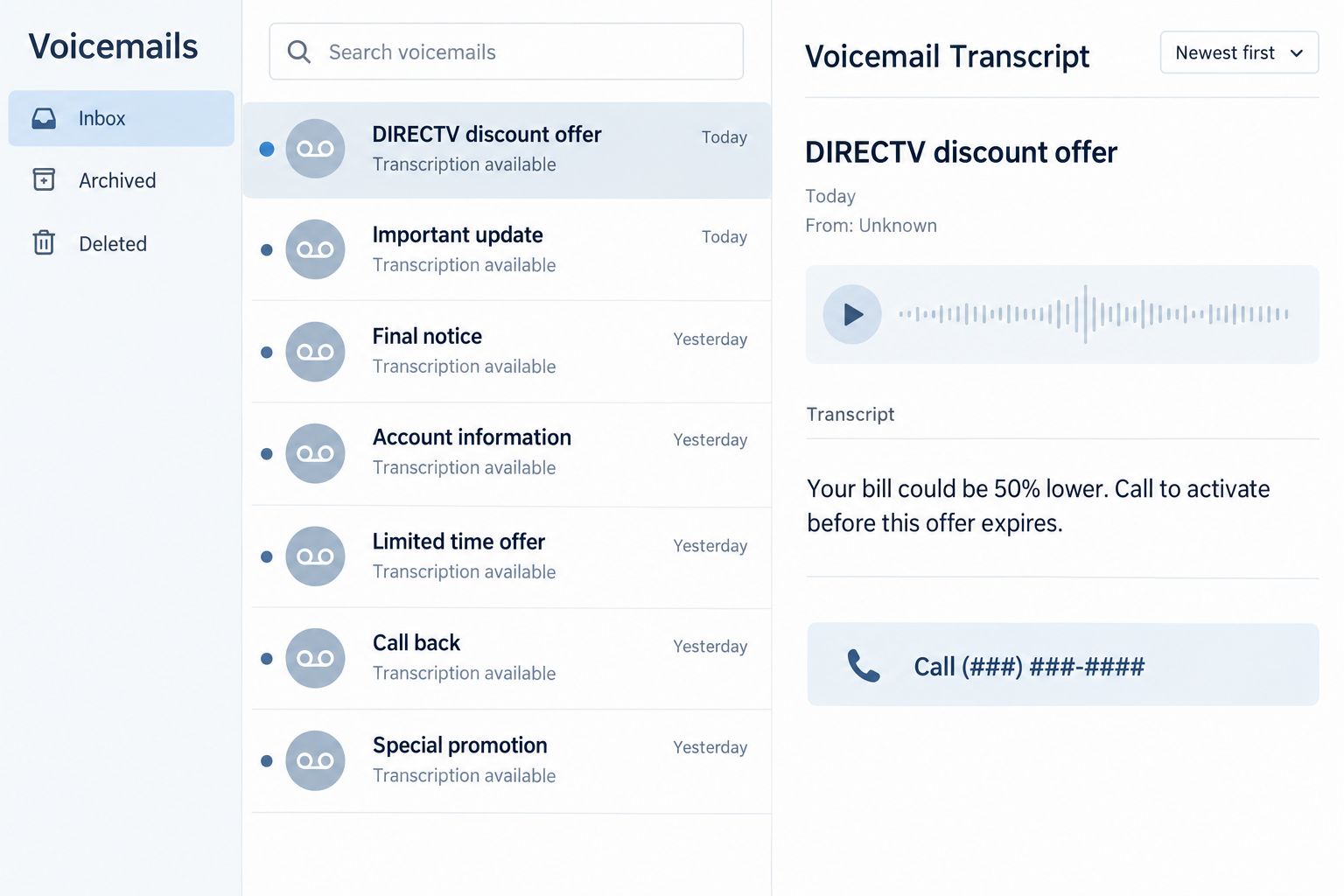
The DIRECTV 50% discount scam usually begins with an unsolicited call or voicemail claiming a limited promotion on satellite or streaming service.
A reported example from OnlineThreatAlerts describes a caller promising a large reduction and steering customers toward a supposed activation process.
The pitch may mention a retail gift card, prepaid card, or several months paid upfront. Those requests are the crucial warning signs.
DIRECTV is a real provider. The scam is the impersonating caller or message, not the company whose name is used in the promotion.
What official guidance confirms
DIRECTV’s fraud guidance warns about offers that require prepaid credit or retail gift cards before a discount begins.
Its consumer warning also describes the 50% off pitch and says it does not accept retail gift cards as bill payment.
The Federal Trade Commission has warned about discounted TV and other service offers demanding gift cards.
Those sources support calling the gift-card offer fraudulent. They do not establish that every discount call, account credit, or legitimate promotion is fake.
The images below are fictional screen reconstructions of a voicemail and an email-style offer. They are not captured DIRECTV communications.
Red flags you can identify quickly
- The offer arrives out of the blue and asks for a fast callback.
- The discount is tied to a retail gift card or prepaid card.
- The caller wants the card number and PIN read aloud.
- They say the unusual payment is a temporary activation requirement.
- The phone number comes from the message rather than your bill or account.
- They discourage you from checking the offer inside your official account.
A legitimate billing question can be settled through the provider’s own account and support channels. The caller does not get to define the only route.
Why the Offer Sounds Like a Real Promotion
It matches a bill people already dislike
Monthly TV bills are a familiar expense. A promise to cut one by 50% is easy to imagine, especially when providers sometimes run retention promotions.
The scammer uses that possibility to make an extreme discount feel less strange. They may say you were selected because of your account age.
Do not assume a caller knows your account simply because they mention a plausible bill range or service type. Those facts can be guessed.
Even if they know your name, confirm any promotion by signing into your account or calling a number you obtained independently.
The caller presents the payment as a temporary exception
A request for gift cards would normally sound wrong. The caller may explain it as a sponsor arrangement, promotional credit, or special activation rule.
Those stories change the label, not the risk. A retail gift card is difficult to recover once its number and PIN are shared.
The caller may also say the discount will appear on future bills, making the upfront payment seem like an investment rather than a loss.
Official DIRECTV guidance rejects this route. A genuine account promotion should be confirmable in the provider’s own billing system.
A familiar caller ID can be misleading
The screen might display a local number or a name that resembles customer service. Caller ID is not reliable proof of an organization’s identity.
Likewise, a prerecorded voicemail can be edited to sound polished. The professional tone does not make the callback number official.
If someone claims to represent DIRECTV, end the call. Contact the company from a bill, app, or official website you opened yourself.
Ask whether the specific promotion exists on your account. Do not repeat payment details from the suspicious caller as if they were valid policy.
How the DIRECTV 50% Discount Scam Works
Step 1: An unsolicited call creates a limited opportunity
The caller offers a dramatic reduction, often framed as a loyalty reward or partnership. The time limit encourages a decision before verification.
Some people receive a voicemail and call back later. That makes the second conversation feel customer-initiated, although the number still came from the scammer.
A script may ask whether you are the account holder. Answering that question can give the caller more information without proving they represent the provider.
Take note of the offer, then use official contact information instead of the callback route.
Step 2: The caller builds a billing story
They may quote a monthly amount, describe a future credit, or claim a sponsor will cover part of the bill for several months.
Those details make the promotion feel administratively plausible. Yet the caller may not actually be looking at your DIRECTV account.
They might ask you to confirm an address, account number, or payment method. Providing it can help the impostor sound more knowledgeable during the call.
Do not give the information merely because they already know some other detail. Verify the person first using a separate official channel.
Step 3: The “activation” payment appears
Once you are interested, the caller says the discount requires an upfront payment. A retail gift card or prepaid card becomes the proposed method.
The payment may be described as covering several months, a promotional deposit, or a sponsor condition. That language hides its unusual destination.
The second illustration shows an email-style version of the same request. It includes an explicit warning rather than any usable card number.
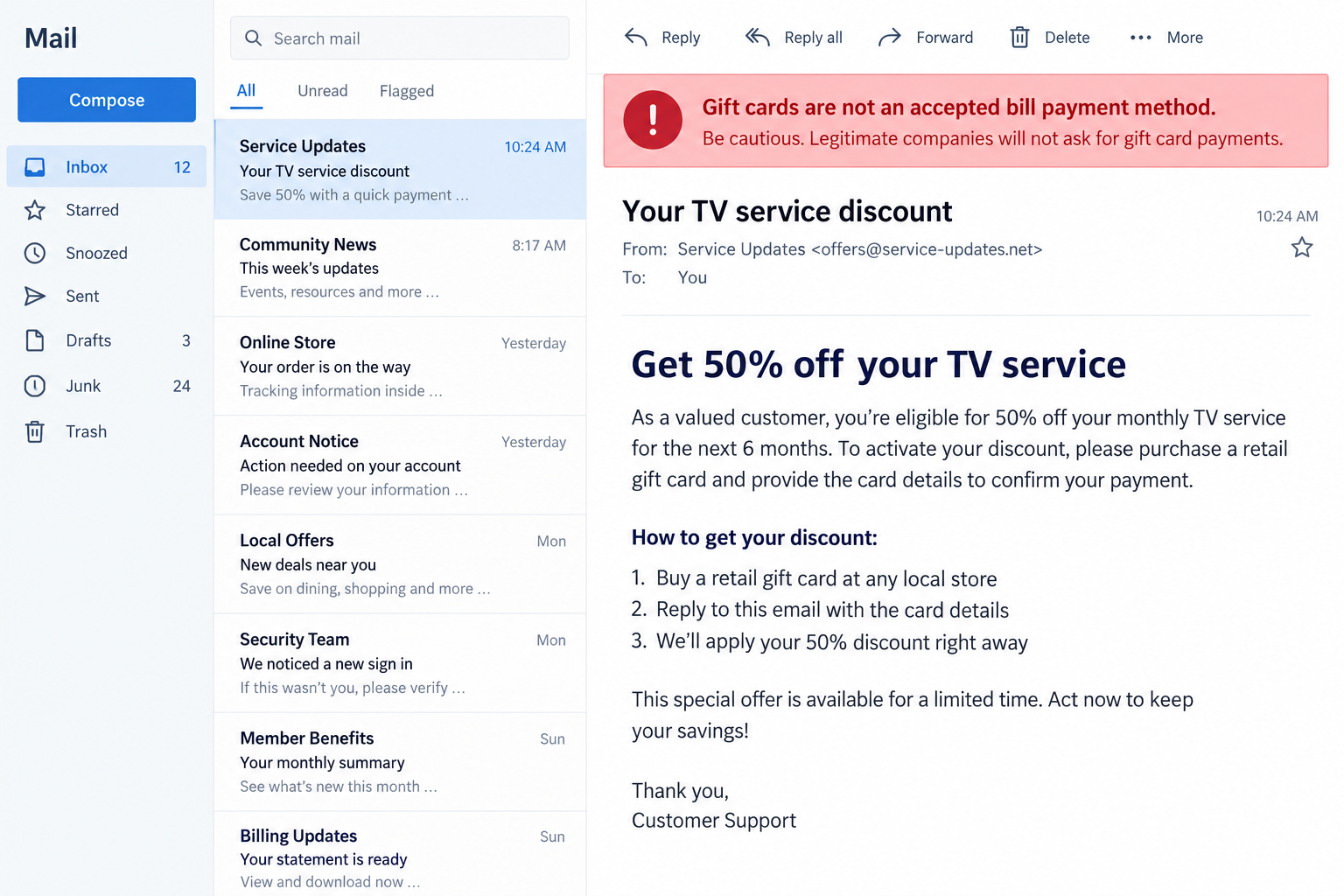
DIRECTV states that retail gift cards are not an accepted bill-payment method. The claim of a special exception should not override that rule.
A real discount does not require you to purchase a third-party card and reveal its redemption code to a caller.
Step 4: The card details are collected
The victim may be told to buy a specific card and read the numbers over the phone or send a photo. The scammer can redeem it quickly.
If the victim hesitates, the caller may promise a receipt or account credit once the card is validated. That reassurance is not a payment guarantee.
Some scammers may ask for another card after claiming the first was declined or the amount was wrong. Repeating the purchase compounds the loss.
Stop at the first request. Contact the card issuer and provider directly if a card number was already shared.
Step 5: The expected discount never appears
The caller may send a fake confirmation or say the lower rate starts next billing cycle. That delay buys time before the customer checks the account.
When the real bill arrives unchanged, the supplied number may no longer work. A follow-up caller might ask for another payment to fix the problem.
The genuine account history is the source of truth. A text or email “receipt” from the caller cannot create a provider credit.
Report the interaction promptly, even if you have not yet seen a second charge or another call.
How to Verify a DIRECTV Promotion
Check the official account and billing terms
Sign into DIRECTV through a saved app or typed website address. Review current plan, promotional credits, and any offer communicated inside the account.
If you cannot find the promised discount, contact official support and ask about that exact promotion. Do not use the number the caller supplied.
Ask when a genuine credit would begin, how long it lasts, and whether an eligible plan change is required.
Write down the support case number. A real representative should not ask you to complete a retail gift-card purchase to verify eligibility.
Do not use caller ID as verification
It is easy to feel reassured by a familiar area code or business-like display name. Those details are separate from the caller’s true authorization.
Hang up and dial an official number from your bill or the company’s site. Starting a new call breaks the path the scammer controls.
Do not transfer to a new number given by the suspicious agent. That still keeps verification inside the same untrusted conversation.
If a genuine offer exists, it will remain explainable through the provider’s own support or account records.
Questions to Ask Before Accepting Any Bill Discount
Where will the credit appear?
A genuine promotional credit should have a clear place in your provider account or billing history. Ask when it begins and what amount changes.
The caller may promise an email after payment. That is not equivalent to an account-level credit visible through official DIRECTV channels.
If the representative cannot explain the offer through the regular account system, pause. Contact official support with the promotion details.
Do not purchase a gift card to “reserve” the rate while you check. That urgency is part of the deception.
Who receives the upfront payment?
A retail gift card is redeemed by whoever receives its code. That is a different payment path from a normal TV-service bill.
Ask why a provider would need a card issued by an unrelated retailer. The answer may sound elaborate, but the destination remains separate.
DIRECTV’s own warning says retail gift cards are not accepted bill payment. A caller’s claim of an exception should fail this check immediately.
Even if you purchased the card yourself with a bank card, giving away its code transfers value to the recipient of the code.
What happens when the offer ends?
Real promotions have dates, eligibility rules, and billing terms. A caller focused solely on today’s payment may avoid those questions.
Ask what the bill becomes after the discount, whether your plan changes, and how the offer can be confirmed in writing from the provider.
A scammer may invent answers. The point is not to debate them, but to compare the claimed terms with your actual account.
If the offer exists, the company can explain it through its official support. If it does not, do not let a voicemail create an obligation.
When the Caller Knows Personal Details
Hearing your name or address can be unsettling. Those details may come from public records, marketing lists, an earlier call, or unrelated exposure.
Do not reveal additional identifiers to test whether the caller knows them. That only helps an impostor fill gaps in their script.
Ask the company through its official number whether anyone accessed or changed your account. Review the account’s recent profile and payment activity.
If you shared a password or verification code, treat it as an account-security issue even if no gift card was purchased.
If you merely confirmed a name, the immediate risk is lower. Still watch for tailored follow-up calls that refer to the earlier conversation.
Keep your response proportional to what you shared. A suspicious voicemail alone is not proof your account has been compromised.
What to Do if You Have Fallen Victim to This Scam
- Stop the call and keep the card receipt. Do not buy a second card. Save the voicemail, message, receipt, card packaging, and any confirmation the caller sent.
- Contact the gift-card issuer immediately. Use its official customer service route. Ask whether the card can be frozen and whether any balance remains.
- Tell DIRECTV through its official support channel. Ask it to review your account for unauthorized changes and confirm whether any real promotion or payment was recorded.
- Protect account access if you shared credentials. Change the DIRECTV password, enable available security protections, and update reused passwords on other services.
- Call your bank if you disclosed card data. Buying a gift card normally differs from sharing your bank card number. Explain exactly which details the caller obtained.
- Record the call details. Note the displayed number, actual callback number, dates, claimed promotion, gift-card type, and the amount requested.
- Report the fraud. File a complaint with the FTC and local authorities as appropriate. Reports can help connect related calls and payment destinations.
- Beware of a second recovery pitch. Someone may promise to retrieve the gift-card value for another fee. Verify any approach independently and do not send more money.
If you spoke to the caller but gave no information and bought no card, there may be no account loss. Block or report the number and verify your bill normally.
If you did share a card code, speed matters. Gift-card funds can be spent quickly, and recovery is not guaranteed even when you report promptly.
Frequently Asked Questions
Is every DIRECTV discount offer a scam?
No. The warning concerns unsolicited offers demanding retail gift cards or similar unusual upfront payments. Confirm any promotion through your official account.
Does DIRECTV take retail gift cards as bill payment?
Its fraud guidance says it does not. A caller claiming a one-time exception for a 50% discount is describing a known scam pattern.
What if the caller knew my monthly bill?
That does not prove authorization. The figure may be guessed, obtained elsewhere, or learned from you earlier in the conversation.
Can caller ID show DIRECTV even when the call is fake?
Yes. A displayed name or number is not enough to authenticate the caller. End the call and contact the company through independent details.
Will a gift-card payment appear on my DIRECTV account?
A card code shared with an impostor generally does not pay the provider. Check the genuine account and ask official support whether any payment posted.
What if I only listened to the voicemail?
You have not paid or exposed credentials by listening. Avoid the callback number, and check any claimed promotion through DIRECTV directly.
The Bottom Line
The DIRECTV 50% discount scam turns a desirable bill reduction into an upfront gift-card demand. The provider’s real name does not validate the caller.
Verify promotions through your own account or official support. If you shared a card code, contact its issuer immediately and report the impersonation.








