

A boutique promises the polished New York look, and the clothes arrive looking nothing like the pictures. That is the story several Ash New York customers describe.
Those accounts deserve attention, but they are not the whole investigation. The questions that matter are who sold the order and what remedy a buyer can actually obtain.
Overview
The verdict: too much return risk for a speculative order
Ash New York presents itself as an online clothing retailer. Its public review profile shows a striking concentration of dissatisfied buyers alleging poor quality and difficult returns.
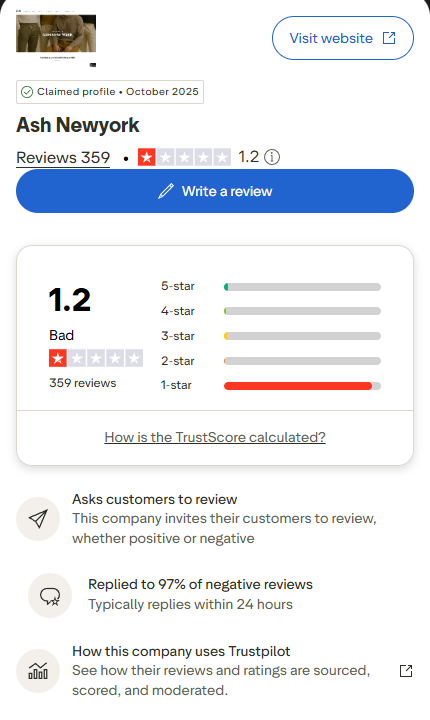
We saw a 1.2 out of 5 Trustpilot score from 359 reviews when checking the profile. That is a warning signal, not proof that every order fails.
Our attempt to load the seller’s website for a current capture failed. A capture failure does not establish that the store has closed or cannot serve other visitors.
The practical conclusion is still firm: avoid a new order until you can inspect the live seller, identify its legal operator, and confirm a usable refund route.
If you already ordered, focus on the exact listing, your payment record, delivery evidence, and the seller’s written response. Those facts matter more than a broad accusation.
What the public complaints actually allege
Many Trustpilot reviewers say delivered garments differed from photographs, fabric felt cheaper than expected, or sizing and construction disappointed them.
Other reviewers describe return instructions involving shipping abroad, expensive postage, or an offer of a partial refund instead of a straightforward return.
These are customer accounts, not items we independently bought and measured. Some positive feedback and company responses also appear on the review platform.
The pattern is important because it points to a possible gap between a premium-looking storefront and the economics of reversing an international clothing order.
The checks that change a buying decision
Before paying any fashion site with this profile, answer the following questions in writing:
- Which legal company appears on the checkout, receipt, and card statement?
- Where must an unwanted item physically be returned?
- Does the buyer pay international postage or a restocking fee?
- Will an approved return produce cash or only store credit?
- Can the seller provide actual garment measurements and material composition?
- Is the advertised shipping date realistic for an event purchase?
If the site or support cannot answer those questions before purchase, do not treat a countdown discount as compensation for the uncertainty.
Why a New York Name Does Not Resolve the Seller Question
A brand name can evoke a city without describing where the company operates, where garments are made, or where unwanted parcels must go.
A shopper seeing “New York” may imagine domestic dispatch and easy local returns. Neither follows from the name alone.
The Better Business Bureau listing for Ash New York identifies a Dover, Delaware address as a registered-agent address rather than an operating location.
A registered agent can receive legal correspondence for a business. That role is not the same as a showroom, warehouse, customer-service office, or returns desk.
The distinction matters most after delivery. A buyer cannot simply send a dress to the first U.S. address associated with the business and expect a refund.
The BBB page also flags a phone number appearing on another retailer’s site. Shared contact details merit a question, but they do not establish common ownership.
We did not verify a complete corporate chain, manufacturing source, or current return warehouse. The absence of that proof is why this is a buyer-risk report.
A registered-agent address does not make the business fake. It also does not answer the practical question of where a buyer sends an unwanted order.
For a clothing purchase, the useful address is the one authorized to receive your specific returned order under the written policy.
Ask for that destination and the refund method before ordering, not after the parcel has crossed a border.
How the Ash New York Buying Journey Can Go Wrong
Step 1: A polished product page sets expectations
Fashion storefronts sell a feeling before they sell a garment. Models, lighting, and carefully chosen angles can make inexpensive fabric look substantial.
That is ordinary advertising until the delivered item’s material, fit, or construction differs materially from the listing.
Save the page for the exact color and size you choose. Record fabric composition, measurements, included accessories, delivery estimate, and the photographs.
Do not rely on a general size chart if the specific item has unusual tailoring. Ask for chest, waist, hip, length, and sleeve measurements where relevant.
An event outfit is especially unforgiving. If it arrives late or fits poorly, a nominal return right may not restore the missed occasion.
Step 2: A sale price makes the return terms seem secondary
A substantial discount can make a buyer think there is little to lose. Return postage, fees, and store-credit rules may change that calculation.
Imagine a $60 dress that costs $30 to ship back internationally. Even a theoretically available refund may leave the buyer with a painful loss.
That example is arithmetic, not a verified Ash New York fee. Check the seller’s current terms and request the actual destination before drawing a cost estimate.
Read the final checkout total too. Taxes, expedited shipping, and exchange options can differ from the enticing first price.
If the return policy is inaccessible or vague, the safe decision is to wait. A sale does not obligate you to buy without knowing the exit route.
Step 3: Delivery reveals the actual item
Some reviewers say the received clothing did not match their expectations. Those claims need to be tested against the exact advertised specifications.
Open the parcel carefully and film the label and contents in one continuous sequence. Photograph tags, seams, fabric texture, and any visible defect.
Compare garment measurements with the saved listing using a tape measure. An objective discrepancy is stronger evidence than “this feels cheap.”
Keep the packaging and avoid altering or wearing the item beyond what a reasonable inspection permits. Return eligibility often depends on condition.
If the seller shipped a different product, identify the mismatch precisely in the first support message. Attach pictures and request the stated remedy.
Step 4: The return route may create a second expense
Trustpilot complaints describe overseas return destinations and expensive postage. We have not confirmed that every order receives the same instructions.
Before buying a label, request written authorization, the complete address, the refund amount, and who bears postage for a defective or misdescribed item.
Never guess the destination from a package label or registered-agent address. The package could be undeliverable or rejected as unauthorized.
Compare the quoted return cost with the amount you could recover. Also check whether your payment provider covers misdescription, not just non-delivery.
Do not miss a dispute deadline while negotiating indefinitely. Calendar the last date to ask your card issuer for help.
Step 5: A partial-refund offer changes the bargain
Several public reviewers say they were offered a small refund if they kept the item. That can be a legitimate compromise, but it is not full relief.
Decide based on the item you received, the seller’s policy, and your available payment remedies. Do not accept merely because return shipping feels intimidating.
Ask whether accepting the payment closes the case or waives a later return. Keep the answer and proposed amount in writing.
If a garment is unusable or materially different, a token discount may be poor value. Explain the specific discrepancy and request the appropriate remedy.
Conversely, a small defect on an otherwise acceptable item may make a partial refund sensible. The buyer, not a review headline, must make that call.
Step 6: Silence or delay can erode options
Customer-service delays are more than an annoyance when return windows and card-dispute periods are running.
Send one concise message with the order number, defect evidence, requested resolution, and a reasonable response deadline.
Use the address on the receipt or verified site. Do not post your payment details publicly or send a card photo to a social-media account.
If support does not provide a workable solution, contact the payment provider before its deadline. Give it the listing, evidence, policy, and correspondence.
That is a dispute about your transaction, not a request for the bank to decide whether the entire retailer is fraudulent.
How to Read the Reviews Without Losing Perspective
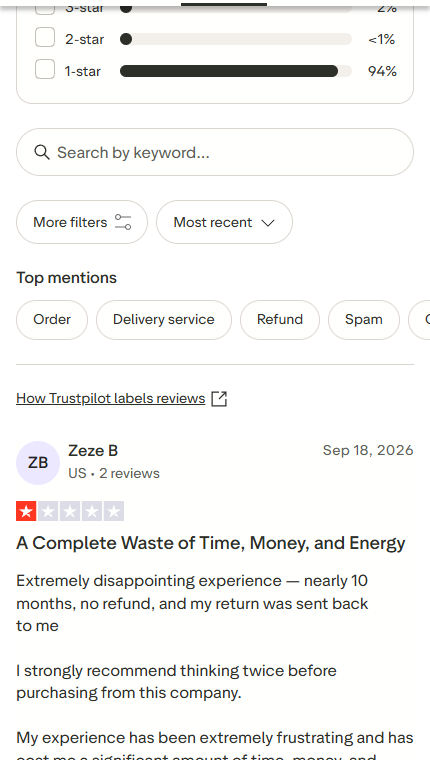
A 1.2 rating is difficult to dismiss. It also cannot tell you, by itself, the exact failure rate across all orders.
Review platforms attract customers with strong experiences, and merchants may actively solicit feedback. Read the substance, dates, and company replies.
Look for repeated, specific details such as fabric type, measurements, return instructions, and offered refund percentages. These are more useful than identical one-line warnings.
Check whether complaints refer to the same domain and period. A renamed storefront or changed policy can make older accounts less directly applicable.
Positive reviews should not be dismissed automatically either. They may describe genuinely satisfactory deliveries, even if other customers encountered problems.
Our finding is narrower than “everyone gets scammed”: public dissatisfaction is unusually strong, and the available business information does not remove key return uncertainties.
For a new buyer, that is enough to justify avoiding a discretionary order. You do not need proof of intentional fraud to choose a more transparent retailer.
For an existing buyer, the reviews provide context but not evidence for your own claim. Your saved listing and delivered garment carry more weight.
Company, Address, and Fulfillment Checks
The registered-agent address is not a return counter
The BBB identifies the listed Delaware address as a registered-agent location, not proof of a retail headquarters or warehouse there.
Ask which entity processed your card and which entity issues refunds. Compare that answer with the receipt, policy, and card descriptor.
Do not mail clothing to the agent. Obtain an authorized return address linked to your order first.
A shared phone number needs an explanation, not a leap
The BBB notes that a phone number also appears on another shopping site. Customer-service outsourcing or shared infrastructure could explain that.
It does not, by itself, prove that both stores share owners, inventory, or a coordinated fraud operation.
Call the number before paying and ask whether the agent can locate Ash New York orders and state the return terms. Record the response.
Overseas returns can consume the refund
Complaints about international destinations raise a concrete financial issue. A low-priced garment may be uneconomical to ship back with tracking.
Request the current country and postal address before purchase. Ask whether a defective item receives a prepaid label rather than ordinary buyer-paid return treatment.
If an agent will not specify the destination, assume the total risk is unknown and do not order for a time-sensitive need.
Garment origin must not be guessed from the branding
A New York-themed name is not a country-of-origin statement. Nor does an overseas return address prove where every garment was manufactured.
Check fiber labels, care tags, customs documentation, and seller disclosures after delivery. Ask for materials and production information before ordering.
The core concern is not that clothing comes from abroad. It is an opaque chain that makes quality expectations and remedies hard to verify.
What to Do If You Ordered from Ash New York
- Preserve the sale. Save the product page, size chart, material description, delivery promise, checkout total, confirmation, and card descriptor. Take screenshots with visible dates where possible.
- Document the item immediately. Film the package opening, photograph labels and stitching, and measure the garment against the advertised dimensions. Keep tags and packaging intact.
- Ask for the remedy in writing. Tell support exactly what differs and request a refund or replacement under its policy. Ask for the authorized return address and postage responsibility.
- Evaluate any compromise carefully. A partial refund may be reasonable for a minor issue, but confirm whether accepting it ends your right to pursue a full remedy.
- Watch deadlines. Note the seller’s return window and your card issuer’s dispute period. Do not let repeated support delays consume both.
- Escalate with transaction evidence. If the seller will not address a material mismatch or missing order, ask your payment provider about a dispute. Submit facts about your purchase, not unverified claims about other buyers.
If the parcel has not arrived, check tracking and the promised date before alleging non-delivery. A delayed shipment and a lost shipment can have different remedies.
If a package is refused or returned by a carrier, preserve tracking history and ask the seller where it wants the item sent next.
Frequently Asked Questions
Is Ash New York a confirmed scam?
We cannot establish that from public complaints alone. The severe review pattern and unresolved business and return details make a new purchase too risky for us to recommend.
Does the Delaware address mean the clothes ship from there?
No. The BBB describes it as a registered-agent address. That does not establish where inventory, customer service, or returns are handled.
Are the negative reviews all verified facts?
No. They are individual reports on a third-party platform. Repeated details are worth examining, but each buyer should document their own order.
Does an overseas return prove the store is fraudulent?
No. Cross-border fulfillment is common. The concern is a costly, unclear return process that may leave a buyer with little practical remedy.
What if support offers only a partial refund?
Ask whether accepting it closes the complaint. Compare the amount with return costs and your payment rights before agreeing.
Should I send the item to the address in a business listing?
No. Only send it to a return destination authorized in writing for your specific order, and keep a tracked shipping record.
The Bottom Line
Ash New York’s public feedback reveals a serious pattern of buyer frustration, while the registered-agent address does not answer the question of where returns go.
Skip a new order until the seller and refund route are clear. If you already paid, document your exact mismatch and act before your remedy deadlines expire.








