

Male-enhancement supplements are sold in a uniquely private moment, when embarrassment and hope can make an anonymous online promise feel easier than asking questions.
Maxorin uses familiar herbs, confident quality language, and large packages to build that promise, but its paperwork tells a less polished story.
Overview
What Maxorin claims to offer
Maxorin is a capsule supplement promoted for male performance, stamina, confidence, circulation, energy, and sexual wellness.
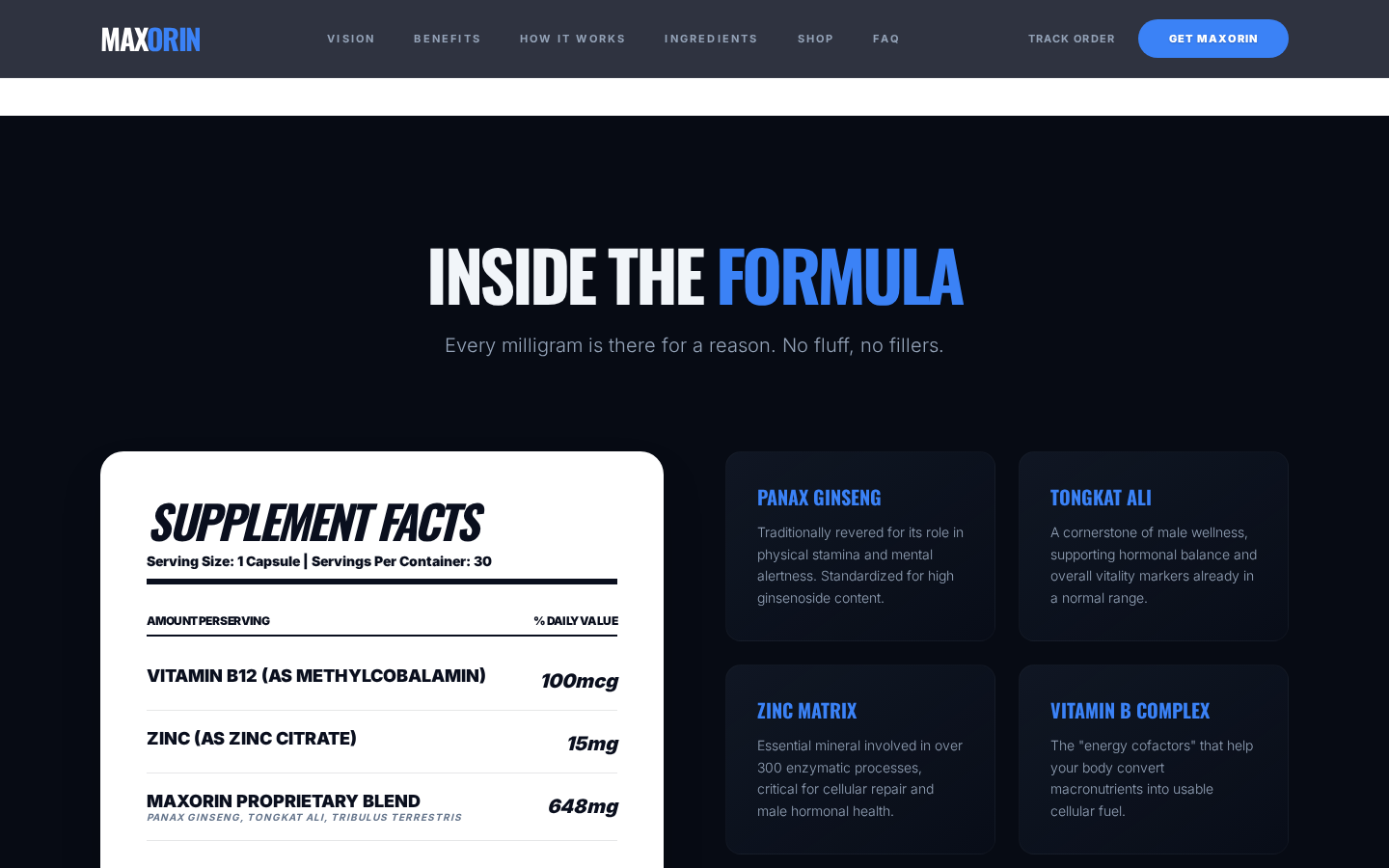
The formula shown on the reviewed page includes vitamin B12, zinc, Panax ginseng, Tongkat Ali, Tribulus terrestris, and additional ingredients.
Most botanicals sit inside a 648 mg proprietary blend, preventing buyers from seeing the individual amount supplied for each named ingredient.
Why the offer deserves scrutiny
The main marketing site used strong phrases about transparency, testing, manufacturing quality, and the absence of synthetic fillers.
However, its footer links for important policies did not open substantive documents during this review, and the separate terms contained another product name.
The sales path also moves buyers toward packages containing several bottles before establishing whether one bottle is effective, tolerated, or refundable.
The investigation in brief
Maxorin should be classified as a high-risk supplement offer. Available evidence does not justify calling every transaction a confirmed subscription scam.
- The proprietary blend conceals each botanical’s individual dosage.
- Quality and testing language is not accompanied by an easily located batch report.
- The principal site’s policy links were nonfunctional during review.
- A separate terms page mistakenly referred to “Vigorus,” weakening document reliability.
- Package pricing encourages two, three, or six bottles at once.
- Returns require all bottles, including empties, and customer-paid postage.
How the Maxorin Sales Funnel Works
Step 1: The promotion enters through a sensitive health concern
Male-performance advertising often targets worries about age, confidence, relationships, energy, or a perceived decline that customers may hesitate to discuss openly.
The privacy of online ordering lowers that emotional barrier, but it also removes the pharmacist or clinician who might challenge unrealistic claims.
Maxorin’s presentation connects several desirable outcomes to one daily capsule without first identifying why a particular user experiences symptoms.
That omission matters because sexual changes can involve medication effects, diabetes, cardiovascular disease, stress, hormones, sleep, or relationship factors.
Step 2: Familiar ingredients create borrowed credibility
Ginseng, Tongkat Ali, Tribulus, zinc, and vitamin B12 are recognizable names repeatedly used across male-wellness marketing.
Recognizing an ingredient is not equivalent to knowing that this combination, dosage, source, and manufacturing batch will produce the advertised outcome.
Studies on one standardized extract cannot automatically validate every supplement using the plant’s common name.
Buyers need extract ratios, individual quantities, purity testing, and relevant human evidence, not merely a list of traditional ingredients.
Step 3: Quality phrases substitute for accessible verification
The site describes the formula with reassuring language such as third-party tested, GMP compliant, made in the United States, and transparent.
Those statements sound precise, but shoppers should ask which laboratory tested which batch, what was measured, and where the certificate can be inspected.
“Made in USA” can describe manufacturing or packaging without proving that every raw ingredient originated domestically.
Similarly, a GMP statement concerns production practices, not proof that the supplement improves erections, testosterone, stamina, or any medical condition.
Step 4: The visitor leaves the marketing site for a package page
The ordering journey redirects away from the main presentation to another store domain and then into a BuyGoods-operated checkout.
Moving between domains can make it harder to recognize which company owns the claims, which retailer collects payment, and who processes refunds.
It also means policies on one page may not match the terms displayed at the moment the customer authorizes payment.
Record each domain and save the offer, because a later support agent may refer to only one part of that chain.
Step 5: Multi-bottle packages make the largest commitment look economical
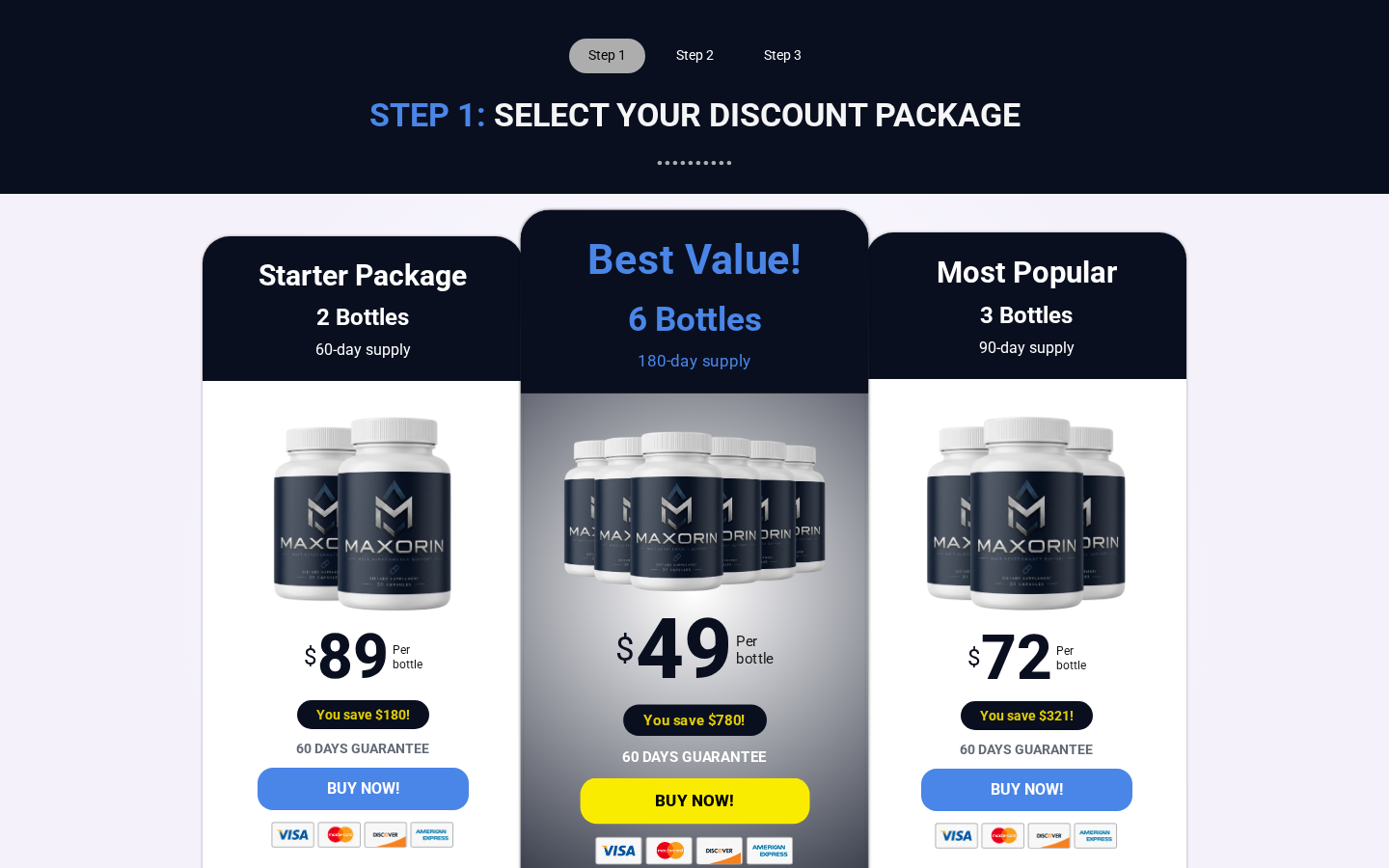
The reviewed package page offered two, three, and six bottles, with the lowest per-bottle figure attached to the largest total purchase.
This pricing directs attention toward apparent unit savings while the customer’s actual charge grows from $178 to $216 or $294.
A six-bottle order is not a free trial. It commits substantial money before the buyer knows about tolerance, effectiveness, or support quality.
Large crossed-out totals can intensify the bargain impression, but they do not prove that the supplement routinely sold at those reference amounts.
Step 6: Checkout presents the transaction as a one-time order
The BuyGoods checkout examined for this article described a one-time purchase rather than an automatic monthly refill arrangement.
That distinction is important. Maxorin has serious transparency problems, but claims of recurring enrollment require transaction-specific evidence.
Customers must still read the final order summary because funnels change, affiliates use different links, and optional offers may appear after the initial purchase.
Save the page showing frequency and total. It is the best evidence if a later charge conflicts with the authorization.
Step 7: The refund process makes packaging and bottle count important
The published return information provides a 60-day period but asks customers to return every bottle, including used or empty containers.
Buyers also pay return postage, and original shipping charges are not necessarily recoverable.
Discarding an empty bottle can therefore weaken eligibility even when the customer is dissatisfied within the advertised period.
Request authorization before shipping, photograph all included bottles, and retain delivery proof until the refund appears on the payment statement.
What the Ingredient Label Does and Does Not Reveal
Vitamin amounts are visible, botanical amounts are not
The reviewed Supplement Facts panel lists 100 mcg of vitamin B12 and 15 mg of zinc per capsule.
It then groups several botanicals inside one 648 mg proprietary blend, leaving individual plant quantities undisclosed.
Without those values, a consumer cannot compare each ingredient with amounts studied in research or calculate exposure alongside other supplements.
The blend total also does not reveal standardization, extract potency, contaminant testing, or whether ingredients vary between production batches.
More ingredients can mean more uncertainty
A broad formula may look comprehensive, yet every added substance introduces another question about dose, interaction, allergy, and quality.
Ginseng and other botanicals can interact with medicines or affect blood pressure, glucose, sleep, bleeding risk, or mood in susceptible users.
Zinc and B12 are nutrients, but taking them does not automatically correct sexual symptoms when no deficiency exists.
People using prescriptions, managing chronic disease, or preparing for surgery should show the complete label to a qualified clinician.
A supplement cannot replace evaluation of persistent symptoms
Erectile difficulties may be an early sign of vascular problems because healthy blood flow is important to sexual function.
Fatigue and low desire can also reflect depression, sleep apnea, endocrine issues, medication effects, or relationship stress.
A marketing page cannot distinguish these causes, and temporary self-treatment may delay care that addresses the actual problem.
Sudden, painful, or persistent changes deserve medical attention rather than repeated purchases of differently branded enhancement capsules.
Problems With the Legal and Policy Pages
Important footer links did not provide working policies
During review, policy labels on the main Maxorin site pointed to placeholder destinations instead of opening complete privacy, terms, shipping, or return documents.
A functioning checkout should not require shoppers to hunt across other domains for rules governing a sensitive supplement purchase.
Policies establish cancellation rights, data use, recurring frequency, refund eligibility, and the entity accepting the order.
When those links fail, customers cannot give informed agreement based on the main storefront alone.
The separate terms mention a different product
A terms page associated with the purchase system referred to “Vigorus” where a careful Maxorin document should identify Maxorin.
This appears consistent with a copied or reused template that was not fully updated before publication.
A naming error does not by itself prove product fraud, but it raises doubts about how carefully warranties, responsibilities, and disclosures were prepared.
Customers should save the erroneous page because it may later help explain reasonable confusion about which terms governed the order.
Company, Address, and Fulfillment Checks
Several businesses participate in one purchase
The Maxorin marketing page, the package store, the BuyGoods checkout, and the fulfillment operation perform different parts of the transaction.
BuyGoods presents itself as the retailer and payment platform, while promotional domains direct customers into its order process.
This layered structure is not unusual in supplement marketing, but it can scatter responsibility across brands, retailers, advertisers, and warehouses.
Write down the legal entity, billing descriptor, support address, order number, and every domain involved before requesting a refund.
The support contacts belong to the sales operation
Published support information includes an email using the getmaxorin.com domain and a United States telephone number.
Call quality alone does not establish manufacturer identity. Ask the representative to name the retailer, product owner, manufacturing facility, and refund administrator.
Confirm important answers through email. A written record prevents later disagreements about cancellation, ingredients, promises, or returned bottles.
If messages bounce or representatives cannot locate the exact product, notify the payment provider before deadlines expire.
The return address is a fulfillment location
The returns page directs parcels to ShipOffers at an address in Aurora, Colorado.
ShipOffers is a fulfillment operation, so that location should not automatically be described as Maxorin’s headquarters, laboratory, or manufacturing plant.
A warehouse can receive inventory and returns without formulating capsules or controlling the advertising claims that generated the order.
Use the address only after support authorizes the return and confirms any required number or labeling instructions.
Manufacturing and testing claims need documents
The reviewed presentation describes United States production, GMP standards, and third-party testing without placing an identifiable laboratory report beside the claims.
Buyers should request a recent certificate of analysis matching the lot number on the bottle they will receive.
A useful report identifies the laboratory, sample, date, methods, ingredient results, microbial testing, heavy metals, and other relevant contaminants.
Generic badges and stock seals cannot substitute for traceable batch documentation.
How to Judge the Offer Before Purchasing
- Discuss persistent performance symptoms and medication interactions with a qualified healthcare professional.
- Ask for each proprietary-blend ingredient’s amount and standardized extract information.
- Request a batch-specific laboratory certificate from an identifiable independent facility.
- Open and save every policy before entering payment information.
- Confirm that the checkout says one-time purchase if that is what you intend.
- Avoid several bottles until one bottle’s safety and value are established.
- Calculate the entire charge rather than focusing on the smallest per-bottle figure.
- Pay through a method that provides a clear process for documented billing disputes.
A legitimate seller should answer dosage, manufacturing, billing, and return questions directly rather than responding with more testimonials or urgency.
If the documentation remains inconsistent, the safest decision is not to provide payment information and health details to that funnel.
What to Do If You Already Ordered Maxorin
- Capture the order terms. Save the product page, package offer, final checkout, confirmation, receipt, billing descriptor, and return policy immediately.
- Confirm whether the charge is one-time. Review the invoice and ask support to state the billing frequency in writing.
- Keep every bottle. Preserve sealed, opened, and empty containers because the refund policy may require the complete package.
- Stop after a concerning reaction. Seek medical advice for significant symptoms and keep the label available for ingredient review.
- Request return authorization promptly. Ask for the eligible amount, deadline, return address, required bottles, and reference number before shipping.
- Use trackable postage. Photograph the bottles and parcel, then retain the carrier receipt and confirmed delivery record.
- Dispute only unresolved, documented problems. Provide the payment company with a clear timeline showing unauthorized billing, misrepresentation, or an unhonored return.
Do not dispose of packaging while waiting for support. A seemingly unimportant bottle or invoice can determine whether the seller accepts the return.
This investigation did not verify an automatic Maxorin refill arrangement. If one appears on your transaction, preserve evidence showing that recurring billing was not authorized.
Frequently Asked Questions
Is Maxorin a confirmed scam?
The evidence supports a strong commercial-risk warning, not a claim that every order is fraudulent. Transparency and documentation problems are substantial.
Is Maxorin sold as an automatic subscription?
The checkout reviewed showed a one-time purchase. Buyers should still confirm frequency because links, affiliates, and future funnels can change.
Why is the 648 mg proprietary blend a concern?
It conceals the amount of each botanical, preventing meaningful comparisons with research doses and complicating interaction or exposure assessment.
Does third-party tested mean Maxorin is proven effective?
No. Laboratory testing may examine identity or contamination, while effectiveness requires reliable human clinical evidence for the finished formula and intended outcome.
Why does the Maxorin terms page mention Vigorus?
The mismatch appears to be an incomplete template reuse. It weakens confidence that the legal documents were carefully tailored and checked.
Can I return opened Maxorin bottles?
The published policy requests all bottles, including used or empty containers. Obtain written authorization and current conditions before sending anything.
The Bottom Line
Maxorin’s herbal label is less transparent than its marketing language suggests, and the sales operation contains broken policies, copied terms, and several corporate layers.
The largest package offers also encourage substantial spending before safety, effectiveness, and support have been established for an individual buyer.
Persistent sexual symptoms deserve proper evaluation. Do not let privacy, urgency, or a per-bottle discount replace medical guidance and verifiable product documentation.








