

5KFunds reviews matter most when a bill is approaching and an online loan offer appears to provide a quick way through a difficult week.
Before entering your details, follow what happens after that first form. The answer can change both your financial decision and the messages you receive afterward.
Overview
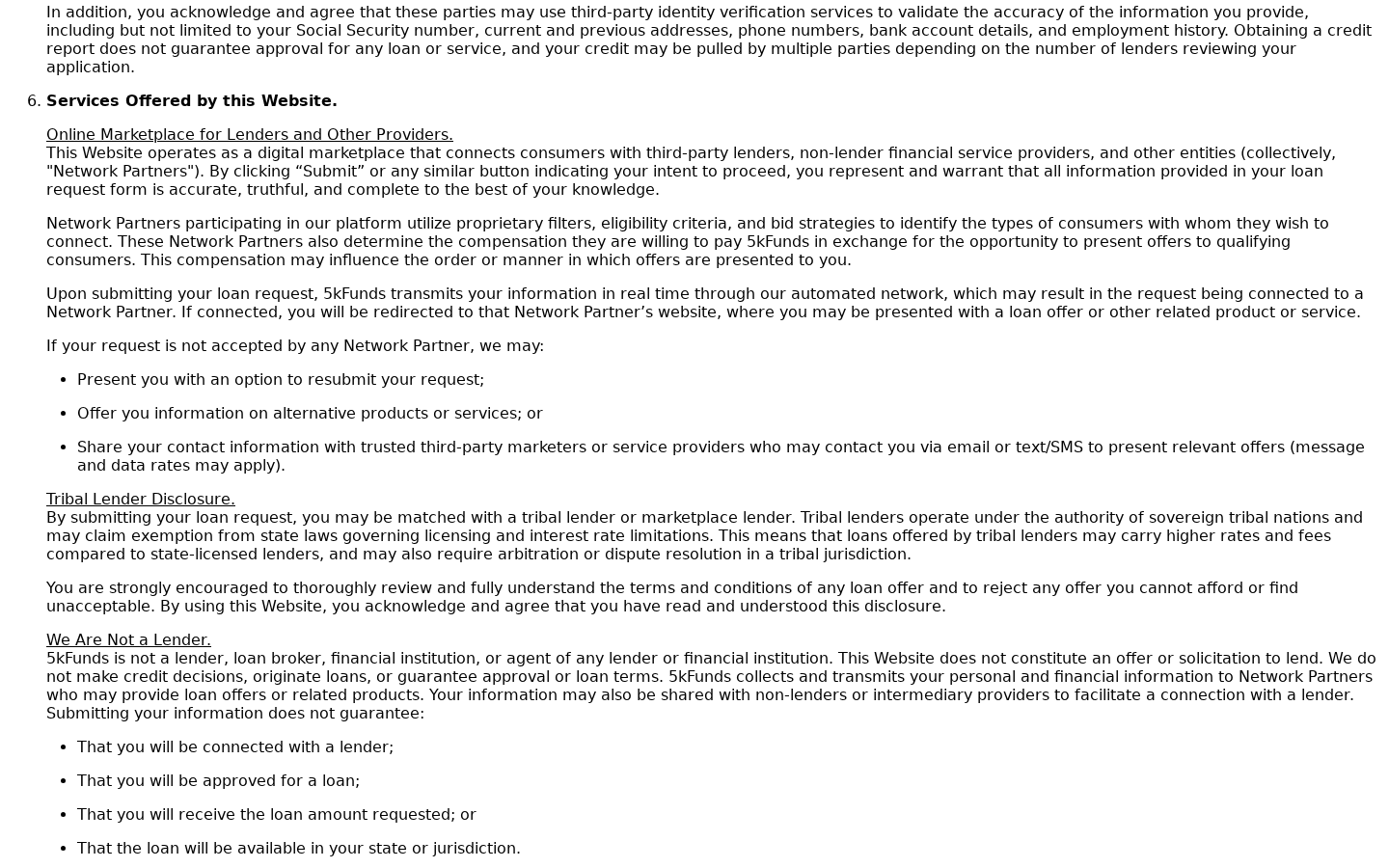
5KFunds connects requests with other providers
The reviewed terms say 5KFunds is not a lender and does not originate loans or make credit decisions. It transmits information to a network of other providers.
Submitting a request therefore does not mean a loan has been approved. The eventual lender, offer, and agreement need their own assessment.
Our recommendation is to understand the sharing arrangement before submitting sensitive details, then independently verify any provider that offers credit.
The main risks concern information and the eventual offer
The terms allow network matching, referral compensation, and possible contact from other service providers. Compensation can influence how offers are presented.
- Personal and financial details may be sent beyond the original website.
- A match does not guarantee approval or the amount requested.
- The lender’s contract determines the actual cost and repayment conditions.
- A lead generator should not be assumed to find the cheapest option.
This is a financial and privacy investigation
Public policies were examined October 8, 2026. We did not submit a loan request, disclose personal information, obtain a credit offer, or test a lender.
The findings do not establish that 5KFunds steals identities or that every partner is fraudulent. Disclosed data sharing is not itself proof of a breach.
The practical concern is whether the process matches what a borrower expects. If you want to deal with one known lender, understand the intermediary before proceeding.
A matching service is not your loan agreement
An online form can make several separate steps feel like one application. Your information goes in, an offer appears, and the service seems to have arranged everything.
In fact, the website collecting the request and the business lending money can have different responsibilities. That distinction matters when you need help later.
A matching-site support team may answer a privacy question without being able to change a lender’s repayment plan. The lender controls the agreement it issues.
Approval, matching, and funding are different events
A match means a provider may review or engage with the request. Approval means that provider accepts an application under stated conditions.
Funding is the actual delivery of money under the agreement. A promising screen or email does not establish that the transfer has happened.
Ask which stage you are in before planning to pay another bill with the expected funds. Timing should come from the actual lender’s confirmation.
You may also receive a different amount or product from the one requested. Evaluate that offer on its own rather than treating it as the original proposal.
A free request can still have consequences
A matching process may not charge the borrower directly while generating referral revenue. The cost to assess includes information sharing and the resulting financial offer.
That business model is not automatically improper. However, it gives you a reason to ask how providers are selected and whether ranking reflects your priorities.
A prominent offer need not be the least expensive. Compare its actual terms with other verified options available to you.
Do not treat a request as casual browsing if it includes sensitive financial identifiers. Read the disclosures at the point where information is transmitted.
How the 5KFunds Loan-Matching Process Works
Step 1: A loan search brings you to the request website
The brand may be encountered while looking for funds online. Before completing anything, identify whether the website lends directly or collects requests for other businesses.
The 5KFunds terms explicitly describe an intermediary marketplace. That explanation should inform your decision before you provide the requested details.
Check the exact address in your browser. A similarly named message or advertisement should not be assumed to have the same operator or terms.
If another business sent you to the form, retain the original offer too. Its representations may differ from the marketplace’s disclosures.
Step 2: The request can involve sensitive information
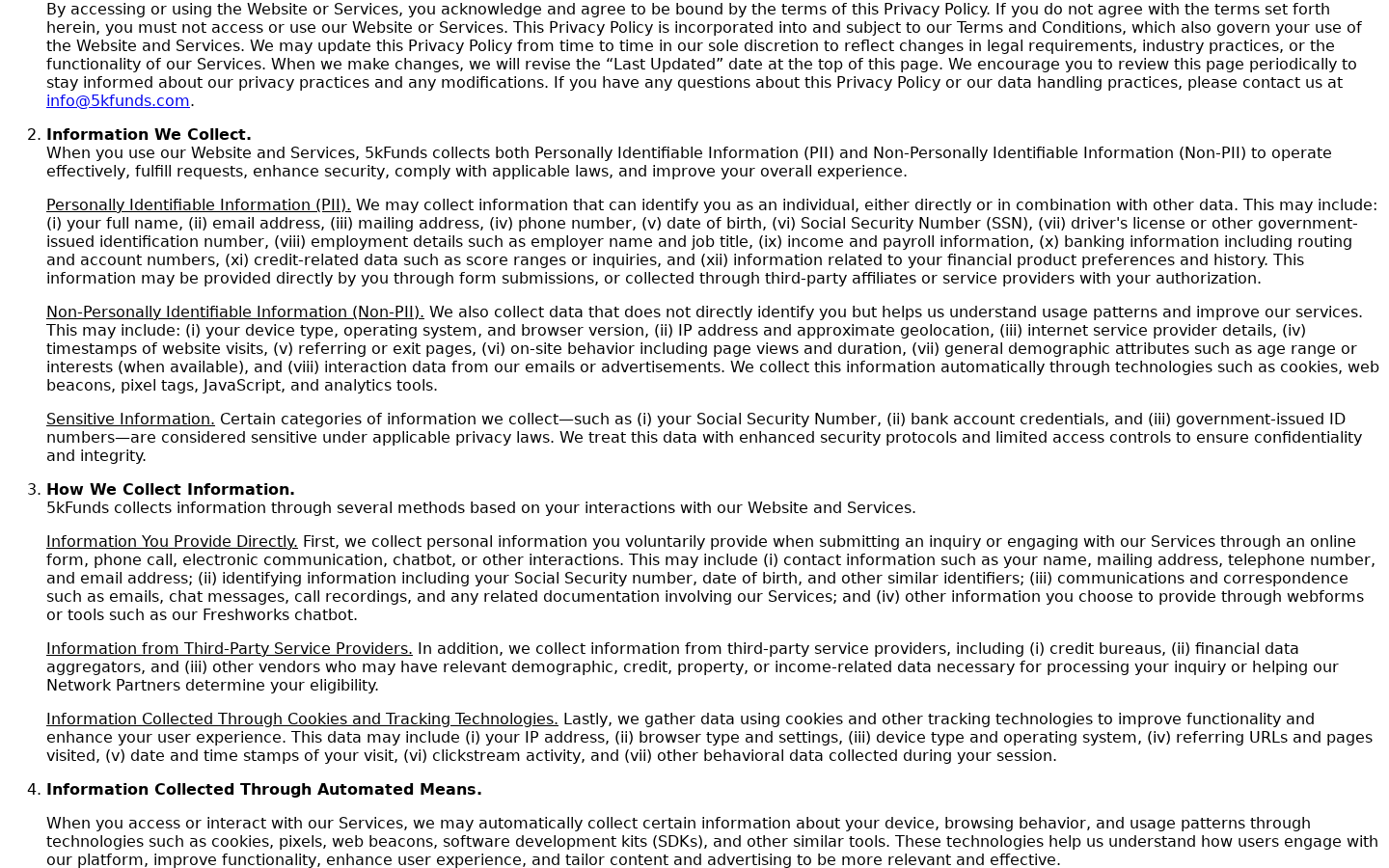
The privacy policy describes categories including contact details, identification information, income, and banking information. These are consequential disclosures, not merely preferences for a quote.
Ask which information is necessary at the current stage and who receives it. Do not provide extra documents to an unexpected caller without independently verifying the request.
Never send a banking password, account verification code, or full credentials through ordinary messages. A person knowing your request amount does not prove their identity.
Read any separate authorization about credit reports. The existence of permission does not establish whether a particular review will be a soft or hard inquiry.
We did not test an inquiry or inspect a personal credit file. Ask the actual provider for a specific explanation before proceeding if that consequence matters.
Step 3: Network providers decide which requests interest them
The terms describe providers using their own criteria and paying for opportunities to present offers. The network’s interests may differ from a borrower’s preferred outcome.
A provider can find your request attractive without supplying the cheapest credit. Consider the total cost and conditions rather than the fact that a match occurred.
If no lender accepts the request, other products or marketing contacts may follow. That possibility deserves consideration before the form is sent.
Keep track of the businesses contacting you. A request sent through one website can become several conversations, each requiring its own verification.
Step 4: A different provider presents the actual proposal
When redirected or contacted, identify the lender’s legal name and official contact details. Confirm the relationship to the request without relying only on the incoming message.
Read the lender’s terms from the beginning. Do not assume the original website’s example rates, amounts, or timeframes bind another provider.
The 5KFunds terms mention possible tribal-lender offers with different claimed legal and pricing arrangements. That disclosure makes careful contract review particularly important.
We have not assessed the legality of a particular partner’s lending terms. Ask your state regulator or qualified adviser about a proposed agreement when necessary.
A request does not oblige you to accept an unsuitable offer. Reject terms you do not understand or cannot realistically repay.
Step 5: The agreement sets the cost and repayment obligations
Identify the amount you receive, total amount you repay, payment dates, fees, and consequences of late payment. Those figures explain the offer better than an attractive headline.
Check whether fees reduce the money delivered upfront. A stated principal amount and the cash available for your bill may differ.
Review any permission for automatic account withdrawals. Ask how to contact the lender or servicer if a payment problem occurs.
Do not plan around repeated extensions or refinancing without understanding the extra cost. An initially manageable payment can become a difficult ongoing obligation.
This review provides general verification steps, not a recommendation to take a particular loan. Your own agreement and circumstances determine the decision.
Step 6: Follow-up contacts need continued scrutiny
After a request, an email or call may arrive with loan or other financial offers. The fact that contact was anticipated does not authenticate every person who approaches you.
Use independently obtained contact information when checking a business. Avoid returning only to the number supplied by the caller whose identity you are assessing.
If you no longer want marketing, use the relevant published opt-out channel. Ask which parties received the request and how to contact them separately.
An unsubscribe request to one company may not address every earlier recipient. Keep a record of the requests and subsequent messages.
Company, Address, and Data-Handling Checks
Identify the operator and each eventual lender
The examined policy copy identifies its operator as 5KFunds. We did not independently establish a current registered entity from those documents.
Ask for the legal business identity responsible for the request. Separately identify the lender and servicer if you accept an offer.
A business name in a policy does not verify every partner’s licensing. Those parties need their own checks appropriate to your location and transaction.
The published mailing address is not a lending branch
The policies list 1223 Wilshire Blvd, #852, Santa Monica, CA 90403-5400 for relevant correspondence. We did not inspect or determine the function of that location.
It should not be described as a bank branch, warehouse, or fake office without verification. The service’s stated role is matching requests rather than originating credit.
Keep separate contact records for the intermediary and lender. Their addresses and responsibilities can differ, and a complaint must reach the appropriate party.
The inquiry channel cannot answer every repayment question
The examined documents list info@5kfunds.com. Use it for a relevant request about the marketplace or information handling, while contacting the lender about its loan.
We did not test response times or send any consumer details. Statements that this channel never answers would exceed the evidence available.
When writing to support, describe the issue clearly and disclose only necessary information. Do not include a complete bank login or password.
Sharing permissions deserve the same scrutiny as rates
The privacy policy describes collection, network relationships, marketing, and retention. Review those sections before transmitting sensitive data.
Encryption protects a transmission differently from limiting who may receive its contents. A secure browser connection cannot answer the latter question.
Ask how to exercise applicable privacy choices and what limits apply after sharing. Do not assume that deleting a browser history entry withdraws previously transmitted information.
What to check before accepting any matched loan
CFPB’s online-borrowing guidance distinguishes lenders from lead generators and explains why borrowers should examine cost, licensing, privacy, and repayment arrangements.
That guidance does not establish that every 5KFunds match is a payday loan. It provides useful checks for evaluating an unfamiliar online borrowing route.
- What amount will reach your account after any upfront deductions?
- What is the complete repayment amount over the agreed term?
- Which company services the loan and answers payment questions?
- How are automatic withdrawals authorized and handled?
- What fees apply if a payment is late or unsuccessful?
- Which regulator can confirm the provider’s status in your state?
Write the answers beside your realistic budget. An offer that fits only if another loan becomes available later deserves particular caution.
If the explanation remains confusing, pause before signing. Pressure to decide immediately should not replace an understandable agreement.
What to Do If You Submitted a 5KFunds Request
- Keep the request and contact record.
Save the exact website, date, disclosures, confirmation, and names of providers that contacted you. Retain relevant offers without circulating your sensitive information publicly.
Identify whether you submitted only a request or also entered a separate loan agreement. Those events have different consequences.
- Verify each proposed lender independently.
Check its legal identity, official contact route, and relevant regulatory status. Compare those details with the agreement and person contacting you.
Do not send additional identification to someone simply because they know your name or requested amount. Establish why the information is necessary.
- Review any agreement before accepting funds.
Confirm the delivered amount, total repayment, due dates, fees, and withdrawal permission. Ask the lender about anything that differs from the original expectation.
Reject an unsuitable offer rather than treating a match as an obligation. Seek appropriate advice if the terms or claimed jurisdiction are unclear.
- Request unwanted marketing to stop.
Use the published opt-out routes and contact the relevant parties. Ask the intermediary about applicable privacy choices and recipients of the request.
Keep dated evidence of each request. Understand that one company’s reply may not settle communications from other businesses previously involved.
- Respond to evidence of unauthorized activity.
If unfamiliar withdrawals, accounts, or credit activity appear, contact the appropriate bank or reporting company promptly. Explain what was authorized and what was not.
Information submission alone does not prove theft. Where misuse is suspected, use official identity-theft resources and preserve the supporting records.
- Escalate through the appropriate institution.
For an unresolved loan issue, contact the lender, servicer, and relevant regulator or CFPB. For an unresolved data issue, identify the party handling that information.
Do not pay an unsolicited caller to remove a supposed debt or guarantee approval. Verify the claimed account through independent contact details first.
Frequently Asked Questions
Is 5KFunds the company that lends the money?
Its reviewed terms say it does not originate loans or make credit decisions. It sends requests to other providers, who require separate evaluation.
Does submitting a request guarantee approval?
No. The terms do not guarantee a match, approval, requested amount, or availability of a loan in your location.
Will the first matched offer be the cheapest?
That was not established. Referral compensation can affect presentation, so compare actual loan agreements rather than assuming an offer’s position reflects lowest cost.
Can submitting information lead to marketing messages?
The policies describe contact and sharing arrangements. Read the applicable disclosure and keep track of the businesses that receive or respond to your request.
Does a secure connection prove my data stays with one company?
No. Transmission security and authorized sharing are different questions. The policy and specific consent explain who may receive information.
Is every lender connected through the service fraudulent?
No such finding was made. Verify the actual lender, costs, licensing, and agreement rather than assigning one conclusion to an entire network.
The Bottom Line
5KFunds reviews should explain the intermediary and the information-sharing decision. A matching request is not an approved loan or a guarantee of favorable terms.
Understand the disclosures before submitting details. Evaluate any eventual agreement independently, and decline an offer whose cost or responsible provider remains unclear.








