

Lily & Lune makes shopping feel like a visit to a small country boutique. A seasonal sweater, a generous markdown, and a friendly story pull you in.
Follow that familiar name today, however, and you arrive at Farm Sisters. Before choosing a size, take a closer look at what comes with the purchase.
Overview
The advertised sale does not come with an ordinary cash-refund promise
Our October 8, 2026 review found Lily & Lune’s website redirecting to Farm Sisters. The destination itself identifies the brand with the Lily & Lune names.
Its homepage promotes clearance savings alongside a 30-day money-back guarantee. The return policy makes an important exception: discounted purchases receive store credit, not an original-payment refund.
That exception matters because the sale is the main attraction. We would not buy clearance clothing here expecting to recover the payment simply because it disappoints.
Approved cancellations also carry a $10 processing charge. These are documented commercial concerns, not proof that every customer receives nothing or that the business is fraudulent.
Lily & Lune and Farm Sisters are connected on the current website
The transition is visible rather than something inferred from a similar logo. The destination describes Farm Sisters using the Lily & Lune names and a countryside-shop story.
Older search results may still describe Lily & Lune Boutique. Those results should not replace the policies actually displayed at the destination where someone orders now.
- Record the website receiving the order, not just the brand name in the advertisement.
- Distinguish store credit from money returned to your payment account.
- Check the cancellation deduction before assuming an unshipped order can be reversed without cost.
- Verify the support address carefully; the published text and email links do not consistently agree.
The sensible decision is to resolve these conditions before paying
A friendly brand introduction cannot settle a refund conflict. Ask whether the exact discounted item qualifies for cash back and what return postage would cost.
If the answer is store credit only, decide whether you would genuinely want another purchase from this shop. Credit is not a useful exit for everyone.
We did not buy a garment, submit a cancellation, or test customer service. The recommendation rests on the current offer and its written restrictions.
What Changed When Lily & Lune Became Farm Sisters?
The destination is more useful than an old search snippet
Entering lilyluneboutique.com led our normal browser to thefarmsisters.com. The page carried Farm Sisters branding, clearance messaging, and a customer-service section using the newer domain.
A redirect can accompany an ordinary rebrand. It does not establish why the change happened, who registered either domain, or whether previous customers received different treatment.
For a purchase decision, though, the practical question is immediate. Which website’s terms will be attached to the order you are about to place?
Save both addresses if an older advertisement sends you through the transition. That helps support recognize the promotion without confusing an earlier page with current conditions.
The clearance story encourages a quick choice
The reviewed homepage advertised savings up to 70%, limited availability, and a clearance event ending that day. Several displayed sweaters shared the same markdown pattern.
For example, Samantha was displayed at $59.95 against $199.95. These were the seller’s listed prices; we did not establish a genuine history of higher-price sales.
The larger number makes the offer look valuable. It does not tell you whether the fabric, construction, sizing, or service justifies the amount actually being charged.
Nor does urgency establish a real closing deadline. We observed the message on one review date, not a documented history proving the event repeatedly resets.
You can leave the basket while checking the terms. A supposed bargain is less attractive when its only ordinary refund route keeps your money inside the store.
How the Farm Sisters Purchase and Return Process Works
Step 1: a familiar boutique name leads to the current storefront
A shopper may begin with Lily & Lune and land at Farm Sisters. The welcome text maintains the personal, countryside theme rather than introducing a clearly identified legal operator.
This is the moment to record the destination. An advertisement, a search listing, and the final order confirmation may use different names during a transition.
Check the actual product page and selected variant. A remembered picture is not enough to document which color, size, or material the merchant agreed to supply.
If the page promises a particular fabric, keep that description. It will be more useful than arguing later that the delivered garment simply feels less luxurious.
Step 2: the sale price and guarantee reduce hesitation
The homepage combines large markdowns with a money-back message. A reader can reasonably interpret that combination as permission to try a purchase without being stuck with it.
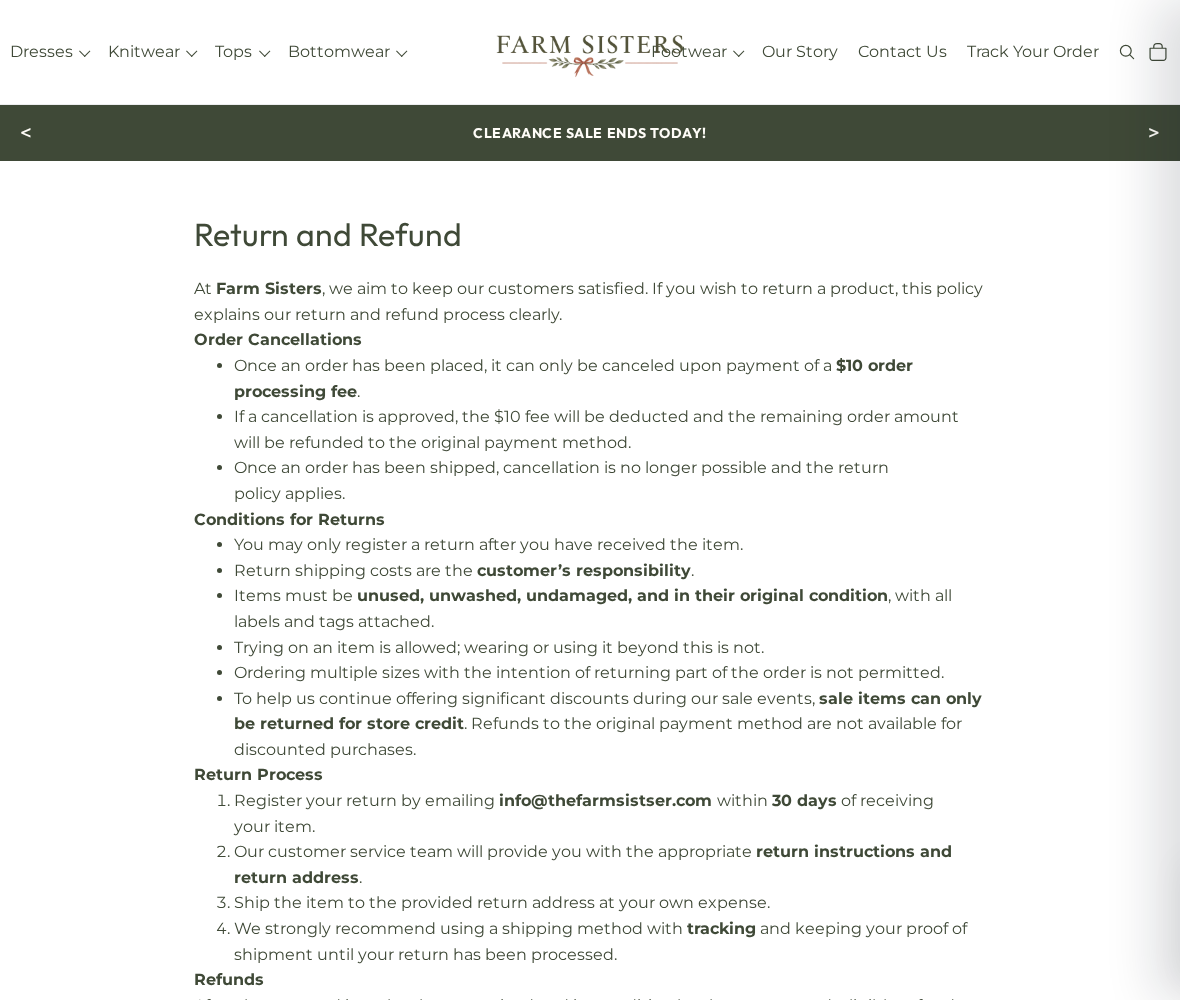
The separate Farm Sisters return policy does not offer that arrangement for ordinary discounted purchases. Its sale exception changes the type of remedy.
Do not assume a broad banner overrides the exception. Ask support to identify the condition applying to the particular clearance item before completing checkout.
Also check whether the order is marked final sale elsewhere. A sale-price badge, a cash-refund exclusion, and a completely nonreturnable item are different restrictions.
Step 3: cancellation is subject to a $10 deduction
The policy says an order can be canceled only with a $10 processing charge, if cancellation is approved. Shipment ends the cancellation opportunity.
That makes an immediate change of mind potentially costly. The wording does not promise every request will be approved simply because a parcel has not arrived.
A $10 deduction from a hypothetical $40 order would leave $30 before any other applicable adjustments. This example illustrates the fee, not a verified transaction.
Ask for confirmation of the remaining refund amount. Do not mistake an acknowledgment of your email for an approved cancellation or a payment already returned.
Step 4: the condition rules limit how clothing can be evaluated
Returns must be unused, unwashed, undamaged, and retain their labels and tags. The policy permits trying something on, but not wearing it beyond that check.
It also rejects ordering multiple sizes with the intention of returning part. That matters if comparing two sizes at home is your usual way to shop.
Measure before ordering and ask how a brief indoor fitting is handled. Washing a garment first could remove a return option you thought remained available.
A genuinely incorrect or defective item is a separate complaint. Describe the actual mismatch rather than disguising an ordinary sizing preference as a manufacturing fault.
Step 5: an approved return may leave you with credit and postage costs
Customers must register a return within 30 days of receipt. Support then supplies the address and instructions, and the customer pays the shipment.
The policy recommends tracking and says eligible refunds are processed after the item is received and approved. Sale purchases remain subject to the store-credit exception.
Return approval therefore does not necessarily mean cash back. You may pay postage to receive spending credit for another item from the same merchant.
Before mailing anything, get the destination, expected remedy, and amount in writing. Sending a parcel without those details can create another problem instead of resolving the first.
Company, Address, and Fulfillment Checks
The brand story does not identify a verified legal operator
The reviewed terms name Farm Sisters and a support email. We did not establish a complete registration record tying a legal entity to this particular storefront.
That is a missing verification, not evidence that no company exists. Ask which entity will appear on the invoice and accept responsibility for the order.
The Lily & Lune names belong to the published presentation. We did not authenticate the people behind that story or label its imagery AI-generated without proof.
A countryside theme is not a verified shop or return address
The inspected terms did not provide a complete business address that we independently matched to a walk-in boutique, warehouse, or factory.
Return instructions are supplied after an email request. A local-looking story should not lead you to assume the return destination will be nearby.
Request the country and recipient before ordering if return cost would affect your choice. A business address, when supplied, is not automatically an authorized parcel destination.
The email spelling needs correction before it becomes your only remedy
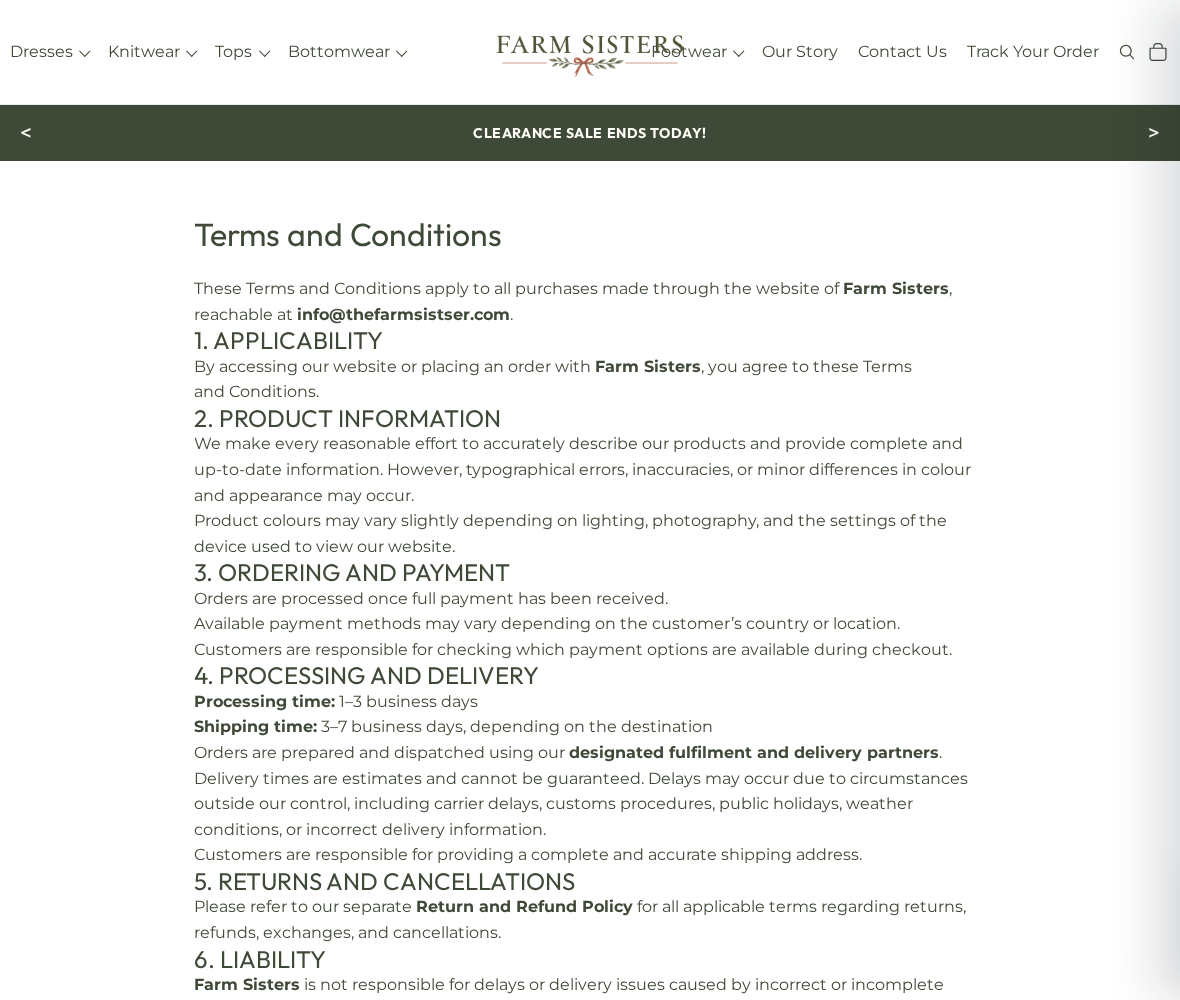
The return policy and terms display info@thefarmsistser.com. Notice the letters in “sistser,” which differ from the storefront’s “sisters” domain.
The footer’s visible email text reads info@thefarmsisters.com, but the inspected email link points to the other spelling. A click can therefore select an unexpected address.
We did not send mail to either address or prove deliberate diversion. Nevertheless, a support-route discrepancy is serious when authorization depends on emailing the seller.
Check the recipient before sending, retain any bounce notice, and use an independently displayed contact form if available. Ask the merchant to confirm its correct support domain.
The fulfillment description does not establish where garments are made
The terms refer to designated fulfillment and delivery partners. They list separate processing and shipping estimates but do not authenticate the manufacturer of the sweater reviewed.
We did not establish a country of manufacture or a connection to a particular overseas factory. A brand redirect cannot supply that missing evidence.
Inspect the delivered care label and material information if you order. Neither a rustic photograph nor an overseas carrier scan proves a garment’s actual production history.
Why Store Credit Changes the Value of This Sale
Consider a shopper ordering a clearance sweater, then discovering the fit is unsuitable. An accepted return may still leave the purchase amount inside the seller’s system.
This is an illustration of the written conditions, not a customer complaint we verified. It explains why “returnable” and “refundable to your card” should not be interchangeable.
Credit can be reasonable when a buyer knowingly accepts it and wants another item. It is much less useful when the original purchase damaged confidence in the shop.
You should also ask whether credit covers shipping on a replacement purchase and whether a later price change affects what it can buy.
The reviewed restriction does not automatically erase any mandatory rights concerning defective or misdescribed goods. The relevant protections depend on the transaction and your location.
For an ordinary preference return, however, do not budget on an original-payment refund that the policy expressly excludes. The distinction should be settled before the sale persuades you.
What to Do If You Ordered From Lily & Lune or Farm Sisters
If an order is already in progress, concentrate on the applicable promise, the correct contact route, and the remedy you need. Keep the process documented.
-
Preserve the route and the order. Save the advertisement, Lily & Lune address, Farm Sisters destination, product details, receipt, and guarantee as they appeared when you paid.
Keep screenshots showing whether the item was discounted. That detail can determine whether support points to store credit or an ordinary refund arrangement.
-
Request cancellation promptly if you do not want shipment. Ask whether the order can still be stopped and whether the published $10 charge will be deducted.
Check the email recipient before sending. Request a definite approval and refund figure, then monitor the original payment account for the actual adjustment.
-
Check the parcel without removing your options. Photograph the packaging, labels, and garment before washing or wearing it beyond an indoor fitting.
Compare the supplied size and material with the saved listing. Report a specific discrepancy instead of relying only on an impression that the product looks different.
-
Clarify the remedy before accepting a return. Ask whether approval produces cash, credit, an exchange, or another arrangement. Identify any postage deduction or fee.
If you relied on the money-back banner, include that capture and ask why the sale exception applies. Preserve the response, including any refusal to explain.
-
Mail only to an authorized destination. Get the full recipient address and confirm it matches your approved request. Use tracking and retain proof of dispatch.
Register the request within the stated period rather than waiting for every question to be resolved. Keep evidence of an attempted message if the address fails.
-
Take an unresolved transaction to your payment provider. Explain the promised remedy, what arrived, and how the seller responded. Ask about available dispute routes and deadlines.
A provider decides eligibility from the circumstances and records. Do not pay an unsolicited recovery service that claims it can guarantee a refund.
Frequently Asked Questions
Why does Lily & Lune lead to Farm Sisters?
That redirect occurred in our browser review, and the destination uses the Lily & Lune names in its own story. We did not verify the business reason.
For a new order, record the current destination and its policies rather than relying exclusively on an older Lily & Lune search result.
Is Farm Sisters a confirmed scam?
We found a cash-refund exception, cancellation fee, and conflicting email spelling. These support a direct buyer warning, not a finding that every transaction is fraudulent.
We would avoid a clearance purchase if you need ordinary cash-back flexibility or cannot establish a reliable support route.
Do discounted items qualify for a money-back refund?
The reviewed policy says discounted purchases receive store credit rather than refunds to the original payment method. That is important beside the homepage’s broader guarantee.
Ask about your exact item and any applicable defect remedy. Do not interpret ordinary sale-return restrictions as a universal statement about all legal rights.
Does canceling an unshipped order cost $10?
The published cancellation condition calls for a $10 processing deduction when cancellation is approved. Once shipped, the policy directs customers to the return process.
We did not test an actual cancellation. Obtain the remaining refund amount and written approval instead of assuming the request has already stopped the order.
Which support email should buyers use?
The visible footer spelling and the policy address differ, and the footer link points to the policy’s “sistser” spelling. Confirm the intended address before relying on it.
We cannot confirm either mailbox’s responsiveness. Save delivery failures and use another verified on-site contact route when necessary.
Can you order two sizes and return one?
The reviewed conditions prohibit ordering multiple sizes with the intention of returning part. Trying an individual garment on is allowed, but ordinary wear is not.
If comparing sizes is essential, choose a merchant whose policy explicitly supports that approach rather than hoping for an exception after delivery.
The Bottom Line
Lily & Lune’s current Farm Sisters destination does not offer straightforward cash-back flexibility on its advertised clearance purchases. Store credit and a $10 cancellation charge change the deal.
Resolve the refund exception and support-address discrepancy before paying. If you need an easy financial exit when clothing disappoints, skip this sale.
Existing buyers should preserve the original promise, submit a timely documented request, and escalate an unresolved transaction through their payment provider.








