

A Moonbirds BIRB airdrop invitation arrives while people are discussing token eligibility. If you have followed the collection, checking your allocation can seem like an ordinary community task.
The familiar name gives you a reason to look. Before choosing a wallet, check which claim process you have reached and what it asks you to authorize.
Overview
The documented copy misuses a genuine token program
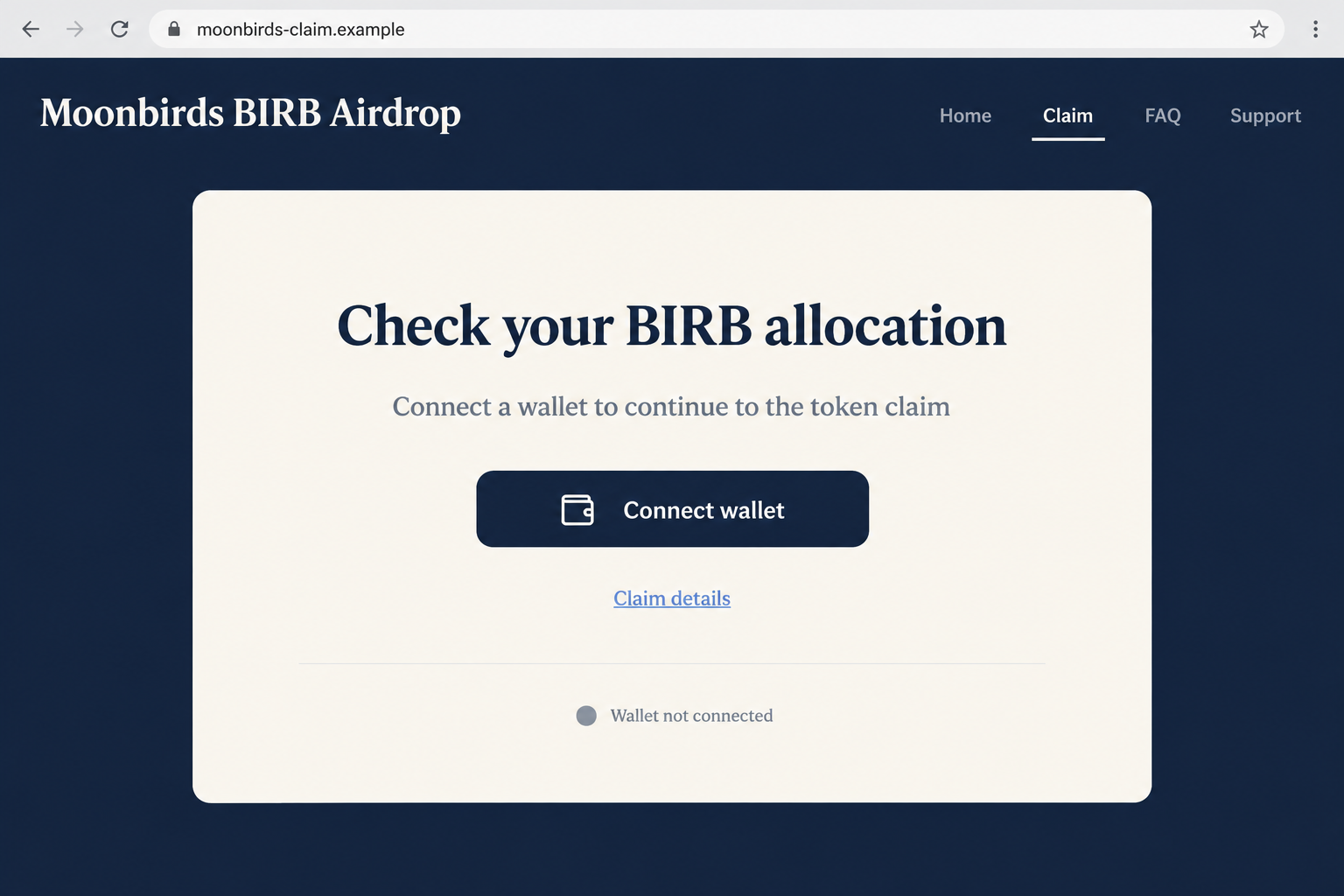
The Moonbirds BIRB airdrop scam is a counterfeit claim page using the identity of a real project. The reported imitation appeared at moonbirds[.]digital.
It presented itself as an official BIRB distribution. A January 2026 investigation identified the page as a wallet-draining scheme rather than an authorized claim.
We did not execute its transactions or examine a particular victim’s account. Its precise spending mechanism should not be presented as independently reproduced here.
The warning concerns that imitation. Moonbirds, its collection, and every legitimate BIRB claim are not being classified as scams.
A real claim route exists, so connection alone is not the verdict
The project’s claim interface includes a Solana receiving-wallet step. Wallet involvement therefore cannot be treated as automatic proof of a fraudulent promotion.
What matters is where the request originates and what the authorization does. A genuine wallet application can display a malicious request supplied by a counterfeit website.
- Establish the claim destination through independently verified Moonbirds information.
- Check eligibility and deadlines against current program terms, not a forwarded announcement.
- Identify the receiving wallet separately from any request affecting existing assets.
- Reject unexplained transfers, broad authority, and requests for controlling secrets.
A website repeating the word BIRB does not establish those facts. Neither does an image showing a supposed allocation awaiting collection.
The record supports a warning, not invented loss details
The example is a previously documented campaign. We are not asserting that its original hostname is active today or that a new October 2026 distribution is fraudulent.
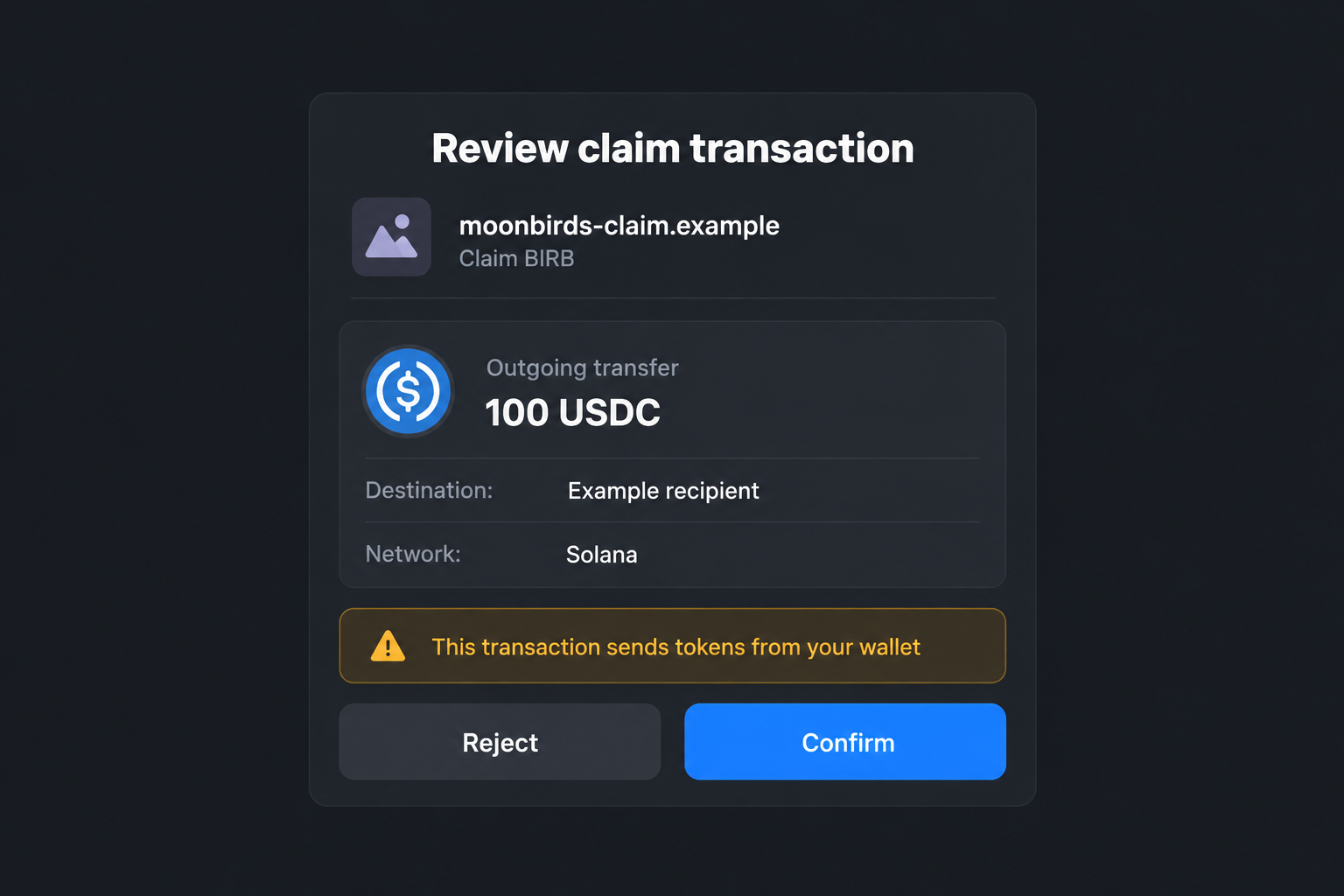
The illustrations use fictional domains. The pictured outgoing USDC transfer is hypothetical, not a verified amount requested by moonbirds[.]digital.
If you interacted, determine whether you only connected, signed something, approved spending, transferred assets, or revealed a phrase. Those actions have different consequences.
An unwanted authorization can require attention even when a page says the claim failed. The wallet’s record is more reliable than the copy’s status message.
Why BIRB Eligibility Is an Effective Impersonation Hook
Collectors already expect project-specific requirements
A token claim connected to a collection can involve ownership history, participation, or program rules. That makes an eligibility page sound plausible to someone familiar with the project.
The impersonator borrows that plausibility. It does not need to invent a completely new reason for a collector to inspect a wallet-related message.
For an illustrative example, imagine receiving a claim link after reading a community discussion. The timing feels relevant even if the person forwarding it never verified the destination.
Interest is not evidence of entitlement. A copied page cannot establish your eligibility merely by displaying the collection’s name and a claim button.
The word “official” is easy to add and difficult to verify by appearance
Anyone operating a webpage can describe a distribution as official. The label has value only when an independently confirmed project route supports that exact claim.
Similar colors, familiar artwork, and a polished layout do not resolve ownership. Even a close visual copy can send requests from a different hostname.
Look at the complete address rather than the page title. Moonbirds followed by a different domain ending is not automatically the same service.
Our image deliberately omits official artwork and logos. It illustrates the identity claim without presenting copied project material as an authentic capture.
An unclaimed allocation can feel like something you must rescue
A reader may fear missing a distribution they expected. That sense of unfinished business can make an unfamiliar page seem worth trying before asking questions.
Yet the website’s assertion that tokens are waiting is still only an assertion. It is not a balance recorded in your receiving wallet.
A real deadline should be checked through the actual program. An urgent message cannot establish one simply by saying that an opportunity is ending.
You can stop an unverified claim without forfeiting an entitlement the page never proved. Do not let uncertainty about eligibility become consent to spend existing assets.
How the Moonbirds BIRB Airdrop Scam Works
Step 1: The claim invitation arrives in a recognizable project context
The visitor encounters a page or link promoting a BIRB allocation. Recognizing the name supplies a reason to continue, particularly during discussions about actual project rewards.
Possible entry routes include social messages, advertisements, or shared links. The recorded case does not establish that every recipient reached the imitation through the same channel.
A trusted community member can also pass along a link mistakenly. Their familiarity with the collection does not authenticate the page they discovered.
Before leaving that conversation, locate the current project information independently. Do not accept the invitation’s own claim to authority as the verification step.
Step 2: A separate claim site presents itself as official
The documented moonbirds[.]digital address adopts the recognizable project name. Its page then states that visitors are participating in the official token distribution.
A domain can sound dedicated to an event without being operated by the project. The spelling should be compared with verified navigation, not accepted because it is memorable.
A copied page may link to genuine public resources to look complete. A real documentation link does not necessarily authenticate the separate site containing it.
Verify the direction of the relationship. Does an independently opened official channel establish the claim destination, or is the unknown site merely pointing toward the real project?
Step 3: Wallet selection is framed as an eligibility check
The visitor is asked to involve a wallet to proceed. That can resemble an ordinary way to identify an account or receive a legitimate token distribution.
Do not stop reviewing at that first request. Connection normally lets an application see account information and propose interactions, rather than giving unrestricted spending authority.
The distinction does not make an impostor trustworthy. It tells you which additional actions to inspect before deciding what exposure occurred.
A wallet connection should never require a website to collect your recovery phrase. A request for that secret is not an ordinary eligibility check.
Step 4: The next request can affect assets already in the wallet
A harmful claim journey can introduce a transfer, spending approval, or consequential signature. The specific authorization used by the historical imitation is not independently confirmed here.
The illustrated example shows $100 in USDC leaving the account while the website calls the operation a BIRB claim. It demonstrates an action mismatch.
A network fee is different from an unexplained token transfer to another recipient. Read the asset, direction, recipient, and permissions rather than trusting the website’s label.
If you cannot explain the request, reject it. Completing an eligibility check does not obligate you to approve the next dialog.
Step 5: A success message can conceal a different account outcome
The page might describe a claim as complete, pending, or unsuccessful. None of those labels proves that your wallet received tokens or remained unchanged.
Check actual transactions. An outgoing asset movement cannot be evaluated from a website’s allocation display alone.
If spending authority was granted, some exposure may remain after closing the tab. If a transfer completed, disconnecting does not reverse that transfer.
Do not repeat the request simply because the promised token balance is absent. Another attempt can add a new authorization without solving the first problem.
Keep the Genuine Claim and the Counterfeit Separate
Current program information can differ from an old announcement
The official eligibility page indicates that Birb Game and Nesting have moved into Collector Profile. This is useful context when evaluating older claim instructions.
A saved screenshot may describe a real previous stage. It does not establish that every newly shared link using the same language is part of today’s process.
Check the latest terms through the project’s verified route. Do not infer that a closed or changed interface requires a stranger’s “replacement” claim page.
This warning is not a recommendation to invest or a judgment about token performance. Authenticity of a claim route and the market value of a token are separate questions.
A receiving wallet and an ownership wallet can serve different purposes
The genuine interface describes a Solana receiving wallet. That should not be confused with a blanket authorization over all assets held in every wallet you use.
When multiple wallets are involved, understand why each one is requested. Ownership checks, message signing, receiving tokens, and transferring assets are not interchangeable operations.
A collection associated with one chain does not automatically determine the chain of every later reward. Follow the verified program’s instructions and the actual wallet request.
Likewise, do not use a recovery tool for the wrong network. Solana token permissions and EVM allowances need their respective supported inspection methods.
A genuine token name does not identify every asset displayed
Names and symbols can be duplicated. A token labeled BIRB in an unknown interface is not authenticated by that label alone.
Obtain any required token identifier from independently confirmed project information. Avoid using an address supplied only by the site that wants your approval.
Unexpected tokens or NFTs may also contain links suggesting rewards. Receiving such an item is different from following its link or authorizing an interaction.
Do not touch unfamiliar assets simply to clean up the display. Consult trusted wallet guidance when an item appears designed to pull you into another claim.
What to Do if You Have Fallen Victim to This Scam
- Pause every request associated with the invitation.
Do not attempt another claim to make an error disappear. Record the destination and whether you connected, signed, approved, transferred, or entered a secret.
Keep the original message and screenshots already available. They can document the solicitation without reopening the suspected site.
- Inspect the relevant wallet records.
Identify each wallet and network you used. Save transaction signatures or hashes, assets involved, and unfamiliar destinations.
If an NFT wallet and a receiving wallet were both involved, inspect each appropriately. Do not assume one unchanged balance proves the entire interaction was harmless.
- End unwanted connections and examine continuing authority.
Disconnect the imitation from the wallet. Then check permissions separately, including asset-specific authority where relevant, using the wallet’s supported process.
Phantom’s scam-response guide explains the difference between disconnection and revocation. Follow the remedy suited to the network and action involved.
- Treat recovery-secret disclosure as a broader incident.
If you typed a phrase or private key into a website, stop relying on that wallet’s secrecy. Create a fresh wallet on a secure device.
Use a new controlling secret, not another account derived from the exposed one. Seek reputable technical help if existing positions complicate securing remaining assets.
- Check any application installed during the claim attempt.
A supposed claiming tool, unexpected wallet extension, or persistent redirect calls for a device review. Use updated Malwarebytes when unwanted software may be present.
AdGuard can help limit some deceptive advertising and harmful destinations. These tools do not recover a sent token or verify your BIRB eligibility.
- Report the counterfeit with precise evidence.
Notify the platform carrying the link and the genuine project through confirmed channels. Share transaction records with appropriate investigators if assets were lost.
For US fraud reports, use ReportFraud.ftc.gov. Avoid public disclosure of recovery phrases, private keys, or unrelated private account information.
- Warn contacts without forwarding an active claim link.
If you shared the invitation, tell recipients not to use it. Describe the mistaken destination rather than sending another clickable copy as proof.
Explain that the real project and the counterfeit are separate. This helps people check safely instead of assuming every genuine claim is fraudulent.
- Decline unsolicited recovery or allocation-unlock offers.
Someone responding to your report may promise a refund or remaining distribution for an extra payment. Independently verify their identity before discussing the case.
Transaction records can support investigation, but not guaranteed reversal. Do not fund a stranger’s recovery process or disclose wallet secrets to complete it.
Frequently Asked Questions
Is every Moonbirds BIRB claim a scam?
No. The genuine project has a claim process. This warning concerns a documented counterfeit that used a separate hostname and presented itself as official.
Does a real claim ever ask to connect a wallet?
Yes. Connection can be part of a legitimate process. Verify the destination and review subsequent financial requests rather than using connection alone as the verdict.
Was the pictured $100 transfer observed in this campaign?
No. It is a hypothetical illustration of a claim label concealing outgoing assets. The historical copy’s exact request was not independently reproduced here.
Should my receiving wallet be evaluated separately from NFT ownership?
Yes. Different wallets and chains can have different roles. Understand each requested action and inspect every account you actually involved.
Is an old eligibility screenshot enough to authenticate a new link?
No. Programs and interfaces change. Confirm current navigation and terms through independently established project information before authorizing a new request.
Does a failed claim mean no information or permission was sent?
Not necessarily. Check the wallet record and any secrets you disclosed. A website’s error message does not establish the outcome of every earlier action.
The Bottom Line
The Moonbirds BIRB airdrop scam borrows a genuine program to make a counterfeit claim feel familiar. Its identity claim is not evidence of authorization.
Verify the route and review each wallet action. If you already interacted, investigate the specific accounts and permissions instead of trusting the page’s claim status.








