

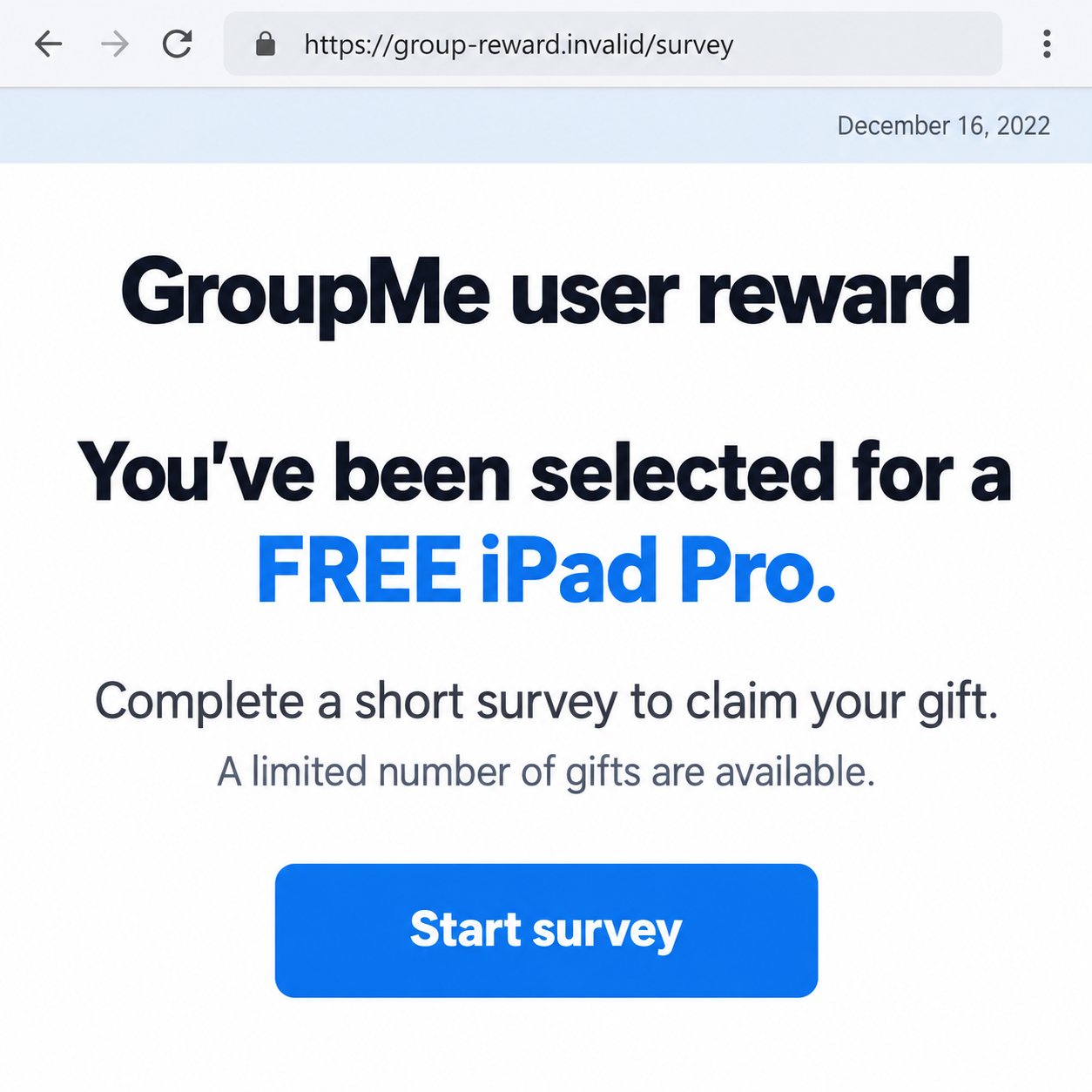
You are supposedly one of a few lucky GroupMe users selected for a free iPad Pro. A short survey is presented as all that stands between you and it.
The GroupMe Love scam makes that invitation feel personal. Look past the prize announcement and pay attention to what the claim process asks you to supply.
Overview
A thank-you reward turns into an information request
The historical GroupMe Love offer used the address groupme.love and claimed selected users could receive a free iPad Pro after answering a survey.
The documented December 2022 funnel then requested personal information and card details. That is not a safe way to claim an unsolicited free prize.
The FTC’s prize-scam guidance identifies demands for payment or financial information as warning signs. A generous headline does not remove that risk.
GroupMe is the legitimate messaging service being impersonated. A website borrowing its name is not proof of a GroupMe promotion or an account breach.
The historical address is not a current-status investigation
This report explains the documented reward funnel. It does not claim that the old domain still operates, that we tested a live checkout, or that a new campaign began.
A later message could use different branding or another address. Judge the actual promise, origin, and information requested rather than looking only for one historical URL.
There is no verified recurring-price term or legal merchant identified here. We will not invent a subscription charge to make the account sound more conclusive.
You also do not need to visit the old address to investigate. The important question is why a surprise gift requires private financial information.
Do not trade a prize promise for card access
- Check a claimed promotion through the genuine service’s own channels.
- Do not treat a survey’s completion as proof that a gift exists.
- Stop before supplying card information to an unverified claim page.
- Keep evidence of the message and any actual charges.
- Report the originating message without forwarding its live claim link.
Both images are original fictional examples of the described stages. Their addresses are nonfunctional, their fields are empty, and they do not depict a reader’s real account.
Why the GroupMe Reward Story Feels Personal
A familiar service name supplies the connection
People use GroupMe for classes, clubs, friends, and other communities. A thank-you message can appear to fit that existing relationship, even when it comes from elsewhere.
The offer may say your telephone number was selected. That claim can feel personalized without showing that the sender has legitimate access to a user-selection process.
Do not assume a message on a platform was written or approved by the platform. Other users can send links, and a trusted contact can share something mistakenly.
A known name is a reason to verify the promotion, not a reason to skip verification. Reach the genuine organization without using the claim site’s directions.
A small winner group makes hesitation feel costly
The historical page described a limited selection of users and urged recipients to act while gifts remained. Scarcity made a short survey seem worth finishing immediately.
That urgency comes from the same party supplying the promise. It does not independently establish inventory, selection, sponsorship, or a real closing time.
You can lose nothing genuine by refusing an unverified financial request. Do not let fear of missing a reward decide who receives your card information.
If someone asks you to share the offer with a group, stop there too. A forwarded invitation can give the false claim credibility it has not earned.
How the GroupMe Love Scam Works
Step 1: A message or page announces that you were selected
The opening frames the device as a thank-you for being a loyal user. It presents winning as something that already happened, not something requiring ordinary consideration.
The recipient is invited to accept the relationship before checking it. A reference to partners or sponsors can suggest endorsement without identifying a verified promoter.
A familiar name inside a web address is not enough. A separate site can borrow it while remaining controlled by an unrelated operator.
Do not assume the offer reveals a platform data breach. Knowing or claiming a number was selected does not establish how it was obtained.
Keep the original message if you received one. Its origin and instructions are more useful than a later guess about which company must have shared your information.
Step 2: A short survey makes the claim feel earned
Questions create a small investment of time. The person may feel closer to receiving the gift after completing several screens, even though no prize was independently confirmed.
The historical offer described its survey as anonymous. That assurance should not be stretched to cover a later page collecting delivery and financial details.
A survey is not automatically malicious, and a question about preferences does not itself prove card theft. The deception is the claimed reward and escalating collection route.
Reassess each new screen. Finishing one stage does not oblige you to agree to the next or to supply information that the original invitation never explained.
Step 3: A claimed delivery need brings in personal information
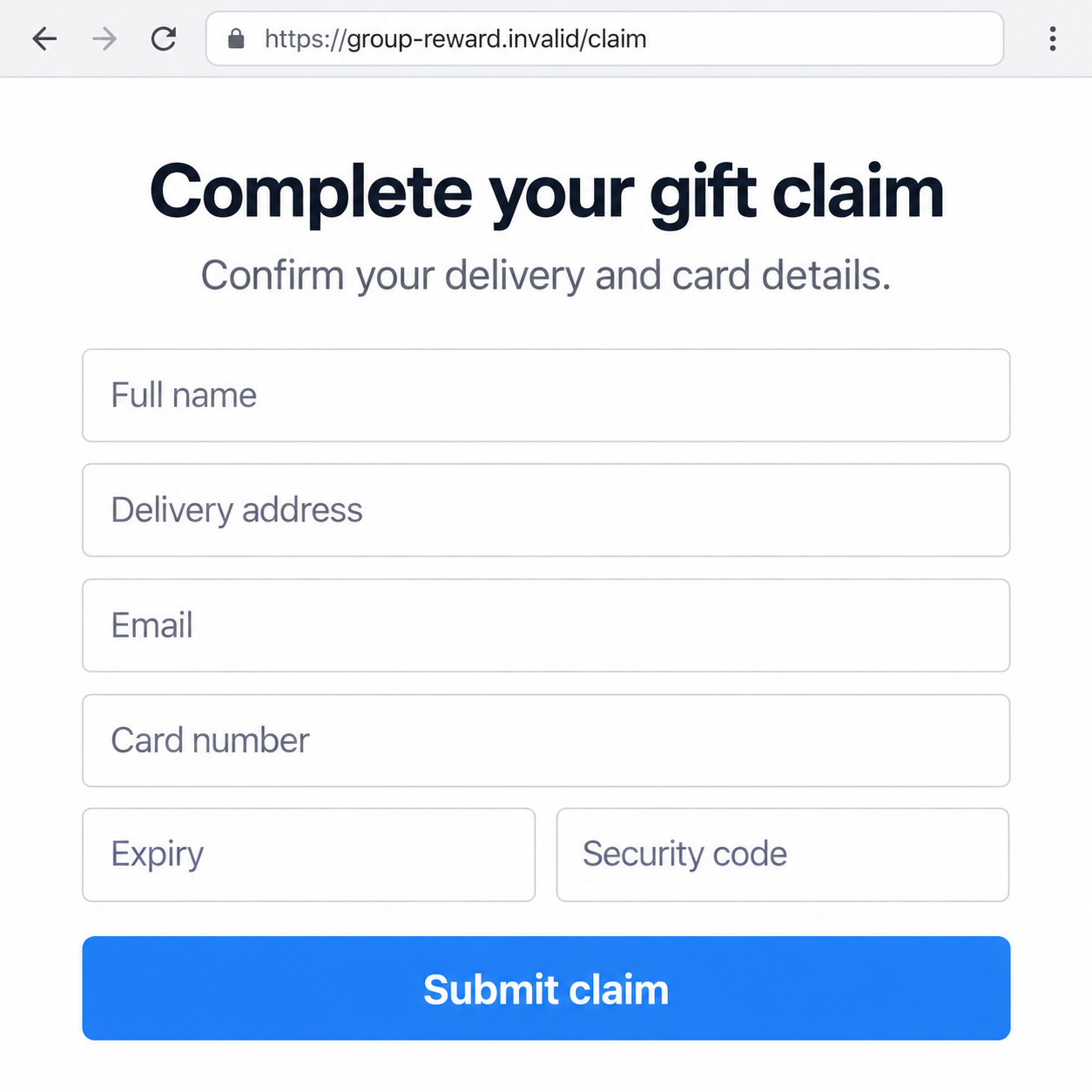
The recorded funnel moved to a form requesting personal details. A name, address, and email can seem reasonable when the reader is imagining a gift being delivered.
But reasonable-looking fields do not prove that any delivery will happen. The promised prize remains unverified, and the operator has not become trustworthy through the survey.
Consider the combination of data being requested. Even without a payment, it may support targeted messages that repeat the same reward or claim something went wrong.
Those are possible uses, not proof of every consequence for every person. If you submitted information, list the actual fields rather than assuming a complete identity takeover.
Step 4: A card form changes the risk of the supposed free gift
The next documented stage asked for credit-card information. That is the central mismatch: a free reward claim has become an unverified financial-data request.
A claim page may use verification, shipping, or processing language to make payment details feel incidental. None of those labels establishes that the promotion is genuine.
Do not approve a charge or submit a card because you already completed the survey. Time spent on the earlier questions does not make this next step safer.
The following invented form illustrates the information request. It deliberately shows no price, subscription term, real merchant, or valid card data that the evidence does not establish.
Step 5: The promised gift can become a reason to keep responding
A confirmation screen would not prove that GroupMe authorized the offer or that a prize was dispatched. The sender can display a success message without fulfilling anything.
If another contact says shipping failed or a refund needs verification, treat that as a new unverified request. Do not provide another code or payment to repair it.
We have not established a particular follow-up charge for this historical funnel. Your own statement and records are the evidence for what happened financially.
Use the card provider and official platform channels to respond. The person promising a gift should not become the person directing your recovery.
How to Check a Promotion Without Using Its Claim Page
Reach the genuine service independently
Open the GroupMe app or its official help channels through the route you already trust. Look for confirmation of the specific campaign and promoter.
A message inside a group can still be user-generated. It should not be treated as an official account notice merely because it appears in a familiar conversation.
If an administrator shared it, ask how they verified it before anyone enters data. The administrator’s confidence may come from the same copied page.
Do not ask the claim site’s own support address to authenticate the claim site. That would let the party seeking information provide its own endorsement.
Separate a real account feature from a prize promotion
GroupMe account settings, ordinary message delivery, and a promised hardware reward are different matters. One genuine service does not establish the other.
A prize page should not receive your account password merely because it uses the platform’s name. If you need account help, start with verified support.
The same applies to a security code received from another provider. Read what action it relates to instead of accepting the prize sender’s explanation.
Do not confuse a polished form with independent evidence
Forms are easy to make convincing. Clear typography, an attractive button, and a believable address field do not show who collects the answers.
A secure connection protects traffic to the selected website. It does not establish that the business behind that site has permission to speak for GroupMe.
If the only evidence of the prize is the page announcing it, there is still no independent verification. Stop before making the claim more costly to you.
What Blocking and Reporting Can Actually Change
Report the message where it originated
Microsoft’s GroupMe reporting guidance describes the Report a Concern option. Select the concern that fits the deceptive content and provide relevant details.
If the invitation came through another messaging service, use that service’s report route instead. You do not need to create a GroupMe account to report unrelated email.
Reporting helps the platform assess the content. It is not a substitute for telling a card issuer about information or payments already exposed.
A blocked person may still post in a shared group
GroupMe’s official blocking instructions explain that a blocked contact can still send messages in a group you both share.
Leaving that shared group prevents those group messages from reaching you. Consider what you need from the legitimate community before deciding how to manage the situation.
An administrator can also review unwanted invitations and deceptive links through the platform’s normal controls. Do not retaliate by exposing another user’s private information.
What to Do if You Have Fallen Victim to This Scam
-
Stop the prize-claim process. Close the page and decline further delivery, refund, or verification requests from the contact that supplied the offer.
Keep the original message and whatever claim records you already have. Do not re-enter information just to obtain a more convincing confirmation or screenshot.
-
Tell the card issuer what you submitted. Use its verified app or the support number on your card, not a contact supplied by the reward page.
Explain whether the full number, expiry, security code, or a payment approval was involved. Ask which safeguards fit the exposure.
If a charge appears, provide its exact description and date. The issuer can assess protection and dispute options without assuming a subscription term the evidence never showed.
-
Check for actual transactions and follow-ups. Review the affected account through your usual trusted route and record anything you do not recognize.
Do not send another payment to test a refund. Ask the provider about pending as well as posted activity and follow its directions for monitoring.
-
Replace credentials only where they were exposed or affected. If you typed a login into the claim flow, secure the genuine service and any reused password.
Review account recovery details and active sessions. Submitting survey answers alone does not prove that your GroupMe or email account was taken over.
-
Keep a private information-exposure list. Note the address, email, telephone number, or documents you shared, while keeping complete identity records off public forums.
If sensitive identity information was involved, consult your location’s appropriate recovery guidance. In the United States, IdentityTheft.gov provides a starting point.
-
Report and manage the originating conversation. Use GroupMe’s official report tools if the invitation came through GroupMe, or the original service’s tools otherwise.
Block the unwanted contact where useful. Remember that shared-group messages can require leaving the group, not just blocking a person.
Warn relevant group members with a safe description or redacted screenshot. Do not circulate the active claim link as a way to demonstrate the problem.
-
Check technical exposure if you installed or enabled anything. Look for unexpected downloads, applications, browser extensions, or notification permissions connected with the offer.
Malwarebytes can help inspect unsafe software, while AdGuard can reduce exposure to harmful advertisements. Neither confirms a prize, refunds a charge, or replaces card protection.
If you only saw the message and supplied nothing, do not conclude that a device infection occurred. Match the response to your actual interaction.
-
Report the fraudulent offer and refuse recovery fees. U.S. recipients can report the conduct at ReportFraud.ftc.gov; other locations have their own fraud channels.
Retain platform and bank references with the original evidence. Be skeptical of unsolicited advisers who promise the gift or your money after another advance payment.
Frequently Asked Questions
Is GroupMe itself responsible for the GroupMe Love offer?
The historical page borrowed the legitimate service’s identity. The reward claim does not establish GroupMe sponsorship or prove that its accounts were breached.
Is groupme.love confirmed to be operating the same scam today?
This article does not make that current-status claim. It explains the documented December 2022 funnel and the warning signs relevant to a similar offer.
Why would an anonymous survey later ask for my address?
The claim can use delivery as the explanation for collecting personal details. That later collection is not authenticated by calling the initial survey anonymous.
Does a free-prize claim need my card security code?
Do not provide financial details to an unverified surprise-prize page. The FTC identifies such demands as prize-scam warning signs, regardless of a friendly delivery explanation.
Will blocking a sender remove messages from a shared GroupMe group?
Not necessarily. Microsoft’s guidance says blocked contacts can still post in shared groups. Leaving that group prevents those messages; reporting addresses the deceptive content separately.
Does this article establish a particular recurring charge?
No. The evidence shows personal and card-information requests, not a verified subscription price. Check your own account for actual charges and tell the provider precisely what appeared.
The Bottom Line
The GroupMe Love scam wrapped a personal and financial-information request in a free iPad Pro reward. Completing a survey did not establish a genuine prize.
Do not submit card details to finish an unverified gift claim. If you already did, contact the issuer, preserve the evidence, and stop following the reward sender’s instructions.








