

The email says a Migros food box has been reserved for you. Answer a short survey, claim your gift, and enjoy groceries without the usual bill.
A familiar orange logo and a small delivery cost make the offer feel easy to accept. The card request comes later.
Overview
The food box is bait for a fraudulent ordering page
The Migros food box scam impersonates the Swiss retailer with a survey reward. Selected customers are supposedly entitled to groceries valued at CHF 49.90.
That amount is the claimed value of the gift, not a verified price or the amount each recipient will be charged.
Zurich cantonal police’s September 16 warning identifies the email, imitation survey, and fraudulent order page. This is a documented phishing campaign.
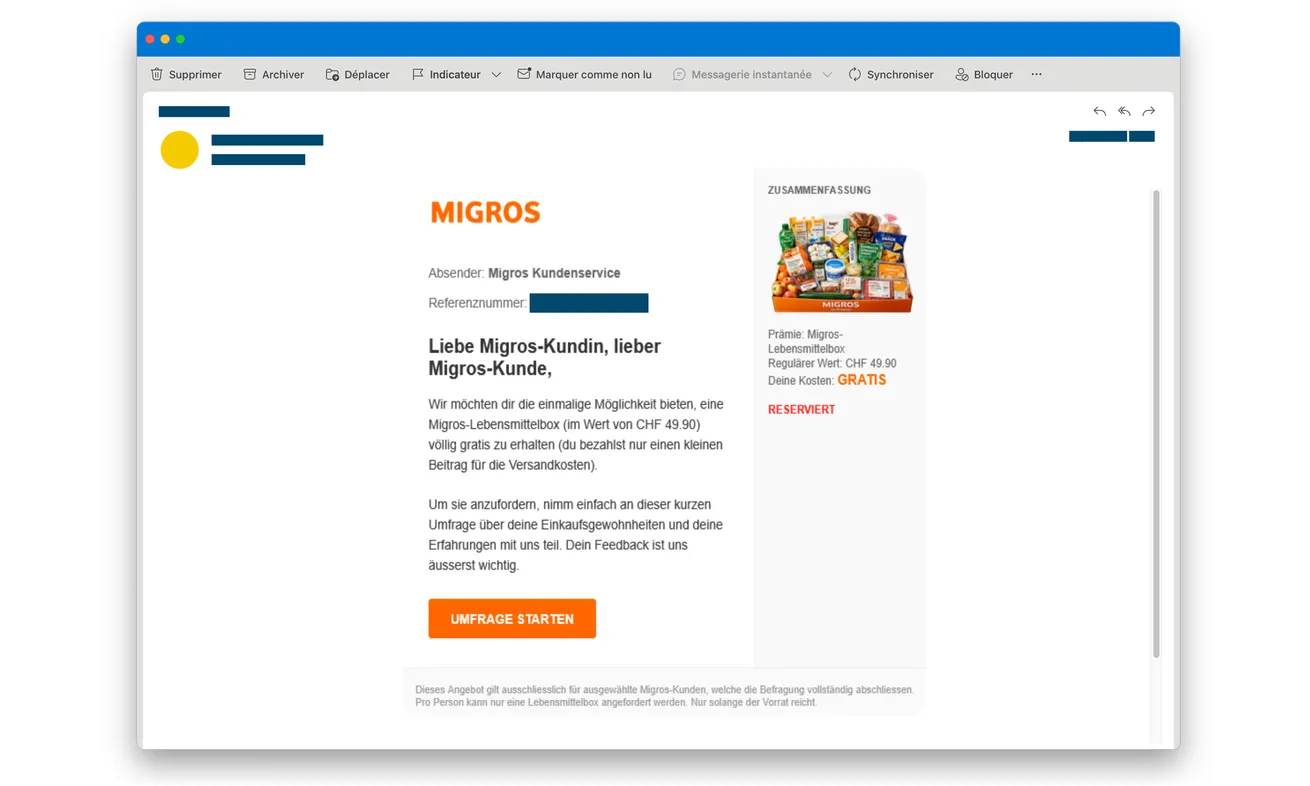
The original email above was published with identifying details masked. The retailer’s branding doesn’t mean Migros organized the offer or operates the destination.
The survey prepares you to accept a small payment
The questions concern shopping habits, Migros products, the Cumulus card, and the app. Completing them makes claiming the box feel like the final step.
The next page asks for contact and delivery details, followed by a small payment. The email itself frames this as a contribution toward shipping.
- An apparently reserved grocery reward creates a reason to open the survey.
- Retailer-specific questions make the form look connected to ordinary customer research.
- Limited stock and supposed other claimants encourage a quick decision.
- A delivery form collects personal contact information.
- The card request exposes payment details despite the offer being presented as free.
The displayed small fee doesn’t limit the risk
Police warn that a larger amount may be charged and the card may be used for further paid services. Don’t treat the visible fee as a loss limit.
The warning doesn’t establish one universal subscription, billing interval, or final charge. Those details shouldn’t be invented to make the story sound worse.
Don’t claim the box through this email. Verify genuine offers through Migros independently, and contact the card issuer if payment details were entered.
Why This Looks Like a Customer Reward Rather Than a Sale
A grocery box is a practical gift. You don’t need to believe you’ve won a fortune to feel that a retailer might reward a few customers.
The reserved label adds a sense that the decision has already been made. You appear to be collecting something assigned to you, not entering a competition.
Then the survey gives you a task that seems to explain the reward. Your feedback is presented as what earns the box.
By the time payment is requested, you’ve already spent time answering questions and supplying details. Abandoning the process can feel like wasting that effort.
But completing a questionnaire doesn’t authenticate the person asking for a card. Your effort is not evidence that a real retailer owes you groceries.
The subject matter helps too. Questions about Cumulus and the Migros app sound informed because they refer to services customers recognize.
Those subjects can be copied into an unauthorized survey. Knowing the retailer’s products isn’t the same as acting on the retailer’s behalf.
The sensible stopping point is before payment information leaves your control. You can pause a supposedly reserved reward without paying to preserve your place.
How the Migros Food Box Scam Works
Step 1: An email offers a reserved grocery box
The sender presents itself as Migros customer service. It promises a box with a claimed value of CHF 49.90 after participation in a short survey.
The original example uses orange branding, a grocery-box image, a reference field, and a prominent survey button. The publisher has obscured identifying details.
The pictured summary labels the box free and reserved. Those words can make the offer feel personalized without proving that Migros selected you.
A reservation label is easy for the page to display. It doesn’t establish that groceries are being held, dispatched, or supplied by the real retailer.
It also mentions a small shipping contribution while describing the reward as free. Read those two statements together rather than remembering only the word gift.
A reference number and product picture don’t identify the operator. They can make the invitation look specific without connecting it to your genuine customer account.
Step 2: The questions make the offer feel retailer-specific
The button opens an imitation Migros page. Recipients answer questions about shopping, products, the Cumulus card, and the app.
These questions create a coherent story: you’re providing useful customer feedback, and the box is your thank-you.
The dangerous leap is assuming that a relevant question proves who asked it. A fraudulent site can discuss a real retailer accurately.
Don’t submit additional account details to prove you qualify. The police warning concerns the reward funnel, not a verified Migros eligibility check.
Step 3: Scarcity pushes the gift toward an immediate order
After the survey, the page says the box can be claimed. Limited availability and apparent interest from other people add time pressure.
That makes checking elsewhere feel like a risk to the reward. In practice, you’re being hurried before the payment destination has been verified.
A countdown or stock statement on a fake page isn’t an independent inventory record. You don’t need to outpace other claimants to protect yourself.
Leave the page and check through the real retailer. If the offer cannot survive independent verification, don’t fund it to avoid missing out.
Step 4: The delivery form collects your contact information
The apparent ordering stage requests a name, address, phone number, and email address. These fields resemble what a real grocery delivery would need.
That practical appearance doesn’t change who receives them. On the fraudulent page, those details are supplied to its operators.
If you stopped after the address form, don’t dismiss the incident because you never paid. The contact information can still support later targeted messages.
Watch for an unexpected confirmation, delivery problem, or invoice that repeats those details. Familiar information doesn’t authenticate the next sender.
Step 5: A small fee opens a larger financial exposure
The supposed gift now requires a small payment. A card form makes that amount look like a minor condition rather than a new purchase decision.
Police warn that entered card details can lead to higher charges or additional paid services. The small amount displayed isn’t a reliable cap.
Don’t infer a specific recurring plan without seeing its actual terms. The established reason to stop is the confirmed fraudulent collection of personal and payment information.
If you already supplied a card, contact the issuer before waiting to see whether a box arrives. Delivery speculation shouldn’t delay payment protection.
What to Check Before Trusting a Survey Reward
Separate the retailer from the sender
Open Migros through the app or website you already use. Ask the genuine retailer about the exact promotion if you can’t verify it there.
Don’t use the survey page’s support link as proof. The person operating the questionable offer can also operate its apparent help desk.
A customer-service label, logo, or reference field isn’t enough. You want confirmation from a route that wasn’t chosen by the email.
Separate a real loyalty program from a copied questionnaire
Cumulus and retailer apps can appear in legitimate customer activity. Their names can also be included in a fake form without permission.
Don’t disclose your real account password or a security code to establish that you’re a customer. That would create another exposure beyond the survey.
Migros provides official account help for genuine login questions. Use that service only where an actual account issue needs attention.
Separate the claimed gift value from the payment
CHF 49.90 describes what the sender says the groceries are worth. It doesn’t tell you the total risk of entering a card.
A tiny shipping fee looks attractive beside CHF 49.90 worth of groceries. That comparison only matters if the retailer actually made the offer.
If an unexpected banking approval appears, read the amount and merchant carefully. Never supply a code merely because the page calls it a delivery confirmation.
If You Gave an Address but Stopped Before the Card
Keep a record of what you submitted and where you stopped. You may need to explain a later message that repeats the same details.
Be alert for unusual orders or invoices in your name. Police specifically warn recipients about this after address information is disclosed.
Don’t pay an unfamiliar invoice simply because it contains the correct address. Verify the claimed order and merchant through independent records.
If you didn’t create a real order, say so when reporting it. A fraudulent page’s confirmation isn’t your evidence that a valid purchase occurred.
For a shared household email or card, tell the other authorized users about the offer. Somebody else may otherwise treat a follow-up as routine delivery administration.
You don’t need to change every unrelated account because an address was entered. Focus on the information actually shared and any suspicious activity that follows.
If you also created a password on the fake page, don’t reuse it anywhere else. Replace it on any genuine account where it was already used.
What to Do if You Have Fallen Victim to This Scam
-
Stop the reward claim. Don’t pay another delivery charge or provide extra data because the box is supposedly about to be released.
Save the email and the available order or payment evidence. Avoid returning to the form to see how far it lets you proceed.
-
Tell the card issuer about the fraudulent form. If you entered card information, ask promptly about blocking or replacing the affected payment method.
Explain whether you approved any banking request and what amount you expected. Don’t wait for groceries before reporting an exposed card.
-
Review actual charges and further billing. Look at genuine statements for the small advertised amount, larger charges, and unfamiliar additional services.
Ask the issuer how to dispute unauthorized entries and prevent further billing. A replacement card alone shouldn’t be assumed to settle every possible payment arrangement.
-
Preserve any terms or receipts already received. If the process claimed a paid service or subscription, keep that wording and the transaction descriptor.
Don’t invent a plan or renewal date when reporting it. Tell the provider what appeared and ask what action applies to the actual charge.
-
Secure credentials only where they were exposed. If you supplied a genuine account password, change it through the real service and address any reuse.
Use official Migros account help if needed. The published food-box mechanism doesn’t establish that every participant disclosed a loyalty-account login.
-
Assess files or software separately. If another step caused an unexpected download or installation, get trusted assistance and consider a Malwarebytes check.
AdGuard can help reduce access to known harmful sites. Neither tool cancels a paid service or recovers information already submitted to the offer.
-
Report the impersonation and any resulting loss. Keep the original email, destination, contact submissions, and actual payment records together.
The police portal explains how to submit a tip. Formal complaints about loss or misuse belong with the competent local police.
When the Promised Box Doesn’t Arrive
Don’t let a supposed delivery delay become a reason to wait through another billing cycle. The confirmed phishing warning is already a reason to protect the card.
A tracking-style email or order number can be part of a follow-up. Verify anything important outside the conversation rather than paying a new release charge.
If a real parcel arrives unexpectedly, don’t treat that as proof that every charge was authorized. Keep the packaging and discuss the actual transaction with the issuer.
Likewise, an empty inbox doesn’t establish that no payment exposure occurred. The important facts are what you submitted and what the real payment records show.
Be cautious about strangers offering to cancel everything for a fee. Use the bank and legitimate providers you’ve independently contacted.
Keep a simple list of reports, case references, and follow-up dates. That makes later statement checks easier without continuing the fraudulent survey.
Frequently Asked Questions
Is Migros actually offering this box?
The documented email and survey are an impersonation campaign. Verify any genuine promotion directly with Migros instead of following this offer.
Is CHF 49.90 the amount I would pay?
No. It is the sender’s claimed value of the groceries. The fraudulent ordering process introduces a separate small fee and exposes the card to further risk.
Does answering questions about Cumulus prove the survey is official?
No. Retailer-specific topics can be copied. Check the sender and promotion through the real retailer before providing account or payment information.
Will every participant be enrolled in the same subscription?
The warning doesn’t establish one universal plan. Police warn about higher charges and further paid services; investigate actual billing rather than assuming identical terms.
What if I only entered my delivery address?
Keep the record and watch for targeted messages or unfamiliar orders in your name. Secure any other information actually disclosed without assuming a card was entered.
Should I wait to see whether the groceries arrive?
No. If card information was supplied to the fraudulent page, contact the issuer now. A delivery promise doesn’t protect the payment method.
The Bottom Line
Don’t pay to claim the Migros food box scam reward. The survey and shipping story lead to a fraudulent collection of personal and payment details.
If you entered a card, contact its issuer and check subsequent billing. Preserve the offer and verify any follow-up through real providers, not the survey’s operators.

Join the discussion
0 commentsShare your experience or ask a question about this article.
Discussion
Start the conversation
Have a question or something useful to share? Add the first comment.