

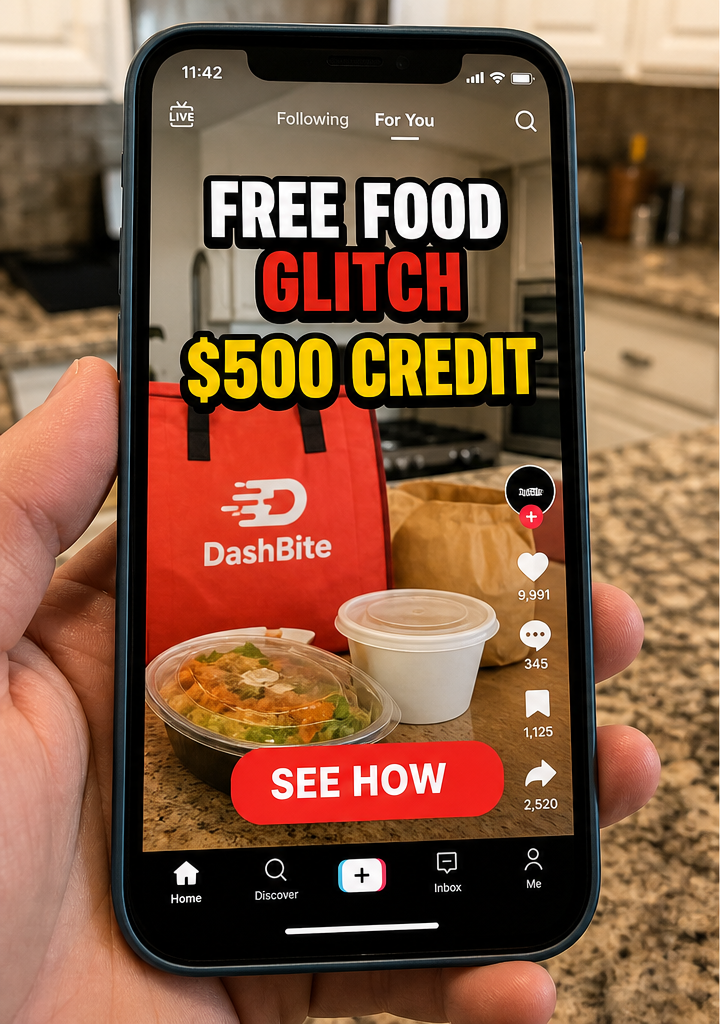
The video looks like someone sharing a loophole before it gets fixed. Tap a hidden link, answer three questions, and a $500 DoorDash credit supposedly appears in time for dinner.
There is no secret food switch waiting behind the button. The DoorDash free food glitch scam uses urgency and hunger to move viewers into a reward system where the valuable result is often a new lead, a paid deal, or a card number.
Overview
The word glitch makes deception feel like a favor
A creator may claim to be a fired employee, a lucky customer, or a person who discovered a billing error. Calling the offer a glitch explains why DoorDash would supposedly provide $500 without advertising it through normal channels.
It also discourages verification. Viewers are told that the loophole could close if too many people share it, so they click immediately instead of checking DoorDash's official promotions, gift card page, or account credits.
The video and the reward page are separate businesses
The post can be created by an affiliate who earns money when a viewer registers. The landing page may then be operated by a reward network, while the deals come from several unrelated app, subscription, and retail companies.
DoorDash branding can appear throughout the first screens without DoorDash operating the campaign. The domain and legal terms determine who actually receives the information, not the bag, color scheme, or gift-card picture.
The promised credit becomes conditions, fees, and tracking
Instead of adding $500 to a DoorDash account, the page can ask for survey responses, contact details, purchases, app downloads, or trial subscriptions. Some variations ask for a small verification or shipping fee before revealing more requirements.
The credit may be presented as attainable only after completing a large set of deals and passing verification. The word free stops being meaningful once the participant must spend money and accept recurring obligations to pursue the advertised value.
- A short video claims a former worker exposed a $500 food glitch.
- A link leaves DoorDash and passes through affiliate trackers.
- Three easy questions make the viewer feel pre-qualified.
- Registration collects contact details and marketing consent.
- Paid deals or trial subscriptions replace the simple credit.
- The same funnel can swap DoorDash for another delivery or retail brand.
Why the Free Food Story Converts So Well
Food delivery is familiar and immediately useful. A $500 credit does not feel like abstract sweepstakes money. A viewer can picture several dinners, groceries, or a week when the household budget becomes easier.
The fake employee story adds insider authority without requiring a celebrity. A uniform, delivery bag, restaurant counter, or app screen can make a stranger seem close enough to the company to know a hidden procedure.
The word glitch also gives the viewer moral cover. The offer is framed as an accidental benefit available to everyone, not as stealing from an individual. That reduces the hesitation someone might feel about an impossibly generous promotion.
Real gift cards have clear purchase and redemption rules. DoorDash says legitimate gift cards are used for eligible orders through its site or app and warns that cards from unauthorized resellers may not be honored.
A social link promising hundreds in value for almost no effort deserves a simple check: open DoorDash independently and look for the credit. If the benefit exists only after leaving the app, the video is selling access to a funnel, not revealing a product feature.
What the Reward Funnel Is Actually Selling
Affiliate-industry listings have advertised DoorDash gift-card leads for a fixed payout to the publisher. That means the social promoter can earn money from a registration even when the viewer never receives the headline credit.
The destination may be part of a broader deal-based reward system. Federal filings concerning RewardZone USA and related companies describe multi-level requirements, paid offers, trial renewals, and consumer consent practices that are far removed from the promise of three questions.
A small verification fee creates another risk. Card details submitted to a reward page can support the initial charge, later renewals, or unrelated offers if the terms allow them. A low first amount does not limit the total exposure.
Some reward participants may complete the formal rules and receive value. That possibility does not authenticate the DoorDash story or make the promotion a glitch. It shows why the precise criticism must focus on impersonation, incomplete disclosure, and the difference between the ad and the contract.
The official offer, if there is one, should be traceable through DoorDash. It should not depend on a creator's bio link, a domain with no DoorDash ownership, or a request to complete offers for companies that have nothing to do with food delivery.
How the DoorDash Free Food Glitch Scam Works
Step 1: A creator reveals a supposed employee secret
The video may show a delivery bag, restaurant kitchen, or app screen while a narrator claims the company accidentally left a $500 reward active. A fired-worker variation suggests the person has nothing left to lose by sharing it.
Large captions promise free food rather than a chance to qualify. Comments saying it worked are positioned where skeptical viewers will see them before opening the link.
Step 2: The profile link hides the change of ownership
The viewer taps a bio link or button that passes through tracking services. The first redirect may use DoorDash-themed words, but the final address belongs to a sweepstakes, survey, or rewards operator.
Watch the address bar at every stage. The fact that a page was opened from a DoorDash-themed post does not make the operator an authorized partner.
Step 3: Easy survey questions manufacture qualification
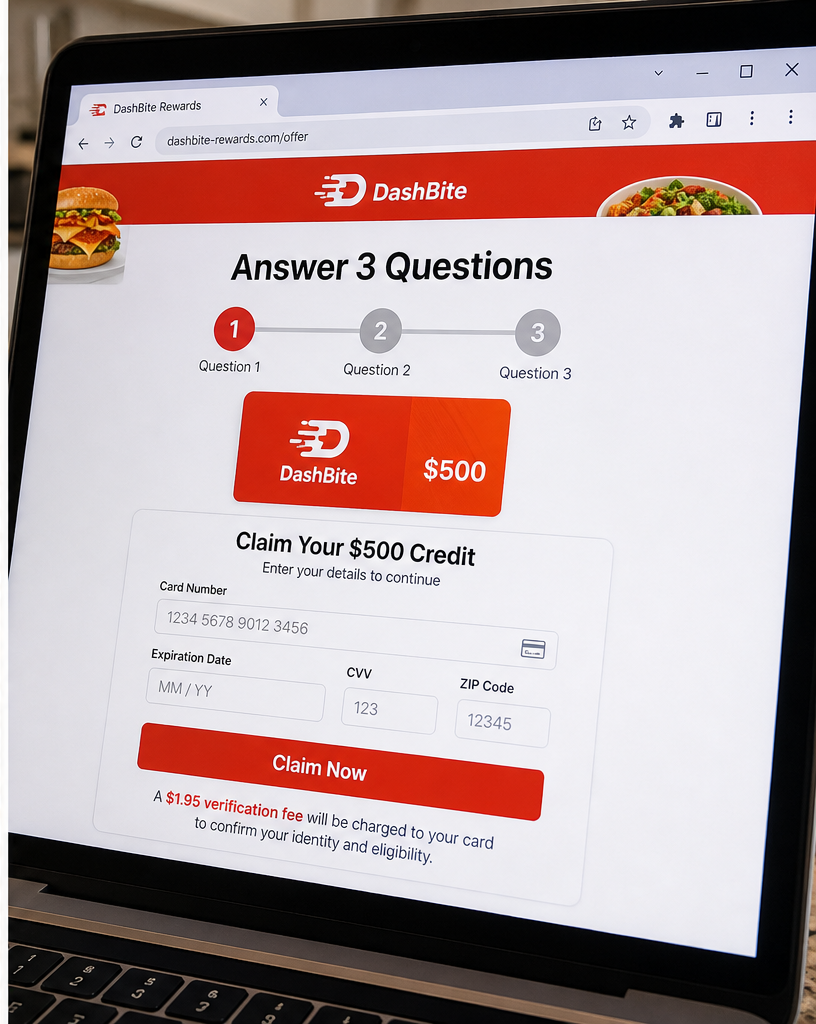
The page asks whether the visitor uses delivery apps, wants a digital gift card, or is old enough to participate. Positive answers lead forward, and a progress bar can say the $500 credit is reserved.
This is a psychological checkpoint, not proof of eligibility. The important rules usually appear later, after the user has invested attention and supplied contact data.
Step 4: The funnel collects a marketable lead
Registration asks for a name, email, phone number, and sometimes an address or birth date. Consent text may authorize calls and messages from many marketing partners.
The affiliate and lead operator can receive value at this point. The visitor is no longer simply answering DoorDash questions, even if the gift-card image stays on every page.
Step 5: Free food becomes a list of paid deals
The page reveals levels that can include apps, subscriptions, purchases, financial products, or services. A large reward may require many completed deals within a fixed period.
Each deal has separate terms. A trial may renew monthly, a deposit may have withdrawal conditions, and an app may not track correctly. Add those costs before treating the reward as a benefit.
Step 6: A small fee can open a larger billing problem
Some versions ask for a low verification, shipping, or activation charge. The amount makes the risk feel limited, but the card form gives an unverified merchant the information needed to bill it.
Read what appears beside the button and in linked terms. If the merchant, renewal amount, and cancellation method are unclear, do not assume the first charge is the last one.
Step 7: The campaign rotates before complaints catch up
When one video or domain receives warnings, the advertiser can change the profile, link, season, or delivery brand. The underlying lead and deal platform may remain unchanged.
A lasting defense is to recognize the pattern: insider story, huge free credit, outside domain, trivial questions, personal data, and paid conditions. That sequence matters more than the logo used this week.
Company, Address, and Fulfillment Red Flags
DoorDash is being used as the bait
The branded ad can be posted by an affiliate and lead to a reward operator with no corporate connection to DoorDash. A real DoorDash promotion should be confirmable in the official app, help center, or verified company channel.
Identify the legal business in the reward terms and the company named beside the final submit button. If neither is DoorDash, the image of a $500 delivery card does not establish sponsorship.
The address can belong to a lead company, not a food service
Reward programs, advertising networks, and their domain privacy services may list offices or mail addresses unrelated to DoorDash's operations. A valid mailing address does not explain who created the deceptive employee story.
Search the address with the legal entity and domain. Distinguish the advertising affiliate, reward operator, deal merchant, and payment processor instead of combining them into one supposed company.
Support can be split into four different conversations
DoorDash can address impersonation and a compromised DoorDash account, but it cannot cancel every unrelated trial selected on a deal wall. The reward operator handles eligibility, while each merchant controls its own billing.
A consumer should obtain written cancellation from every company involved. If a phone line says it only manages rewards, ask for the legal name and support route of the merchant that appears on the card statement.
The fulfillment chain is digital, but still must be traceable
There may be no package or warehouse. The chain consists of a publisher, tracker, lead buyer, reward program, offer provider, and payment processor. Each handoff can create new data use or financial risk.
An accountable offer should disclose those roles before registration. If a visitor cannot tell who issues the $500 credit, who receives card data, or who will renew a trial, the campaign has failed a basic transparency test.
Warning Signs to Check Before You Act
- A fired employee supposedly reveals a benefit worth $500.
- The offer cannot be found in the official DoorDash app.
- The link passes through several unrelated domains.
- Three questions are described as the entire requirement.
- Contact information is collected before full conditions appear.
- The credit becomes apps, purchases, deposits, or trials.
- A small fee is requested to verify a much larger reward.
- Support for the reward and support for the charge are different.
A real in-app credit should appear in the account that can spend it. When a supposed DoorDash glitch instead asks for surveys, paid offers, or a card on an unrelated site, the offer has already contradicted its own story.
What to Do if You Have Fallen Victim to This Scam
- Leave the reward funnel and cancel connected offers. Do not keep paying small fees in the hope of unlocking the advertised food credit. List every survey, app, subscription, and purchase opened after the video, then cancel each one through the provider named on its receipt.
- Call the bank about the card used on the landing page. Use the issuer's official number. Describe the $500 food-credit claim, the amount displayed before payment, and every charge that posted. Ask about disputing unauthorized renewals, blocking the merchants, and replacing the card if its details reached an untrusted form.
- Check DoorDash only through its real app or site. Open your account directly and review orders, credits, saved payment methods, and account details. Do not sign in through the survey link. If the same password was submitted to a lookalike page, change it immediately anywhere it was reused.
- Save evidence before links disappear. Capture the video, account name, fake employee story, redirect addresses, three-question survey, deal wall, fee disclosure, receipts, emails, and statement names. Record the date and time because the ad may point to another brand tomorrow.
- Watch for trial renewals and marketing messages. Search your inbox for words such as trial, membership, renewal, reward, and offer. Mark renewal dates on a calendar, cancel in writing, and review statements for several months. Block repeated calls and texts from lead buyers.
- Clean up downloads and browser permissions. Uninstall apps you downloaded only to satisfy a deal and remove unknown extensions or push-notification permissions. Use Malwarebytes for a complete scan if the device began showing pop-ups, redirects, or unusual behavior.
- Use AdGuard as an extra filtering layer. AdGuard can stop many malicious ad domains, pop-ups, and tracking links before they load. It does not validate a coupon or credit, so confirm real promotions inside DoorDash's official channels rather than through a social video.
- Report the ad and the merchants that charged you. Flag the social post, notify DoorDash about the impersonation, and report the scheme at ReportFraud.ftc.gov. Give the bank and regulator the exact billing descriptor, not only the DoorDash name shown in the ad.
- Do not pay a helper to unlock or recover the credit. There is no special agent who can complete the remaining deals or release a blocked $500 reward. A person demanding a processing payment or verification code is starting a second scam.
Frequently Asked Questions
Is there a DoorDash glitch that gives everyone $500?
No official DoorDash feature matches the viral survey funnel described here. The videos use the language of a glitch to send viewers to unrelated reward and lead-generation pages.
Why do some comments say the offer worked?
Comments can be filtered, planted, copied, or left by people discussing a formal reward program rather than a simple DoorDash credit. They do not prove official sponsorship.
Can I get the credit by answering only three questions?
No. Those questions are usually an entry step. Later pages can require registration, multiple deals, purchases, or trials before a person may claim a reward.
Is a $1.95 verification charge harmless?
No card charge should be treated as harmless on an unverified site. Check the merchant, later billing terms, cancellation route, and whether the card should be replaced.
What if I reused my DoorDash password?
Change it immediately in the official app, change it anywhere else it was reused, review saved payment methods and orders, and secure the linked email account.
Does every reward participant lose money?
No. Outcomes vary, and some formal programs can issue rewards. The scam warning concerns the false glitch story, incomplete disclosure, data collection, and paid obligations hidden behind the ad.
The Bottom Line
The DoorDash free food glitch scam is not a clever app shortcut. It is a marketing funnel that disguises lead collection and paid reward requirements as a secret $500 company credit.
The safest moment to leave is the first redirect away from DoorDash. Once the page asks for registration, outside offers, or a verification payment, the promise has changed from free food into a contract with unfamiliar businesses.
Open the official app, not the creator's link. If the credit is not there, do not spend money or surrender personal data trying to make a social video become true.

Join the discussion
0 commentsShare your experience or ask a question about this article.
Discussion
Start the conversation
Have a question or something useful to share? Add the first comment.