

Gomez Fashion LLC charges can be confusing when the name on your statement does not resemble the shop you remember visiting.
Before following a search result or calling a similarly named retailer, take a moment to connect that payment with the order you actually placed.
Overview
A documented complaint pattern deserves attention
The BBB profile for Gomez Fashion LLC displays a Pattern of Complaints alert. That is more informative than an unexplained accusation in a search result.
The public record connects the name with reports about missing merchandise and payment problems. It does not establish that every transaction using similar wording is fraudulent.
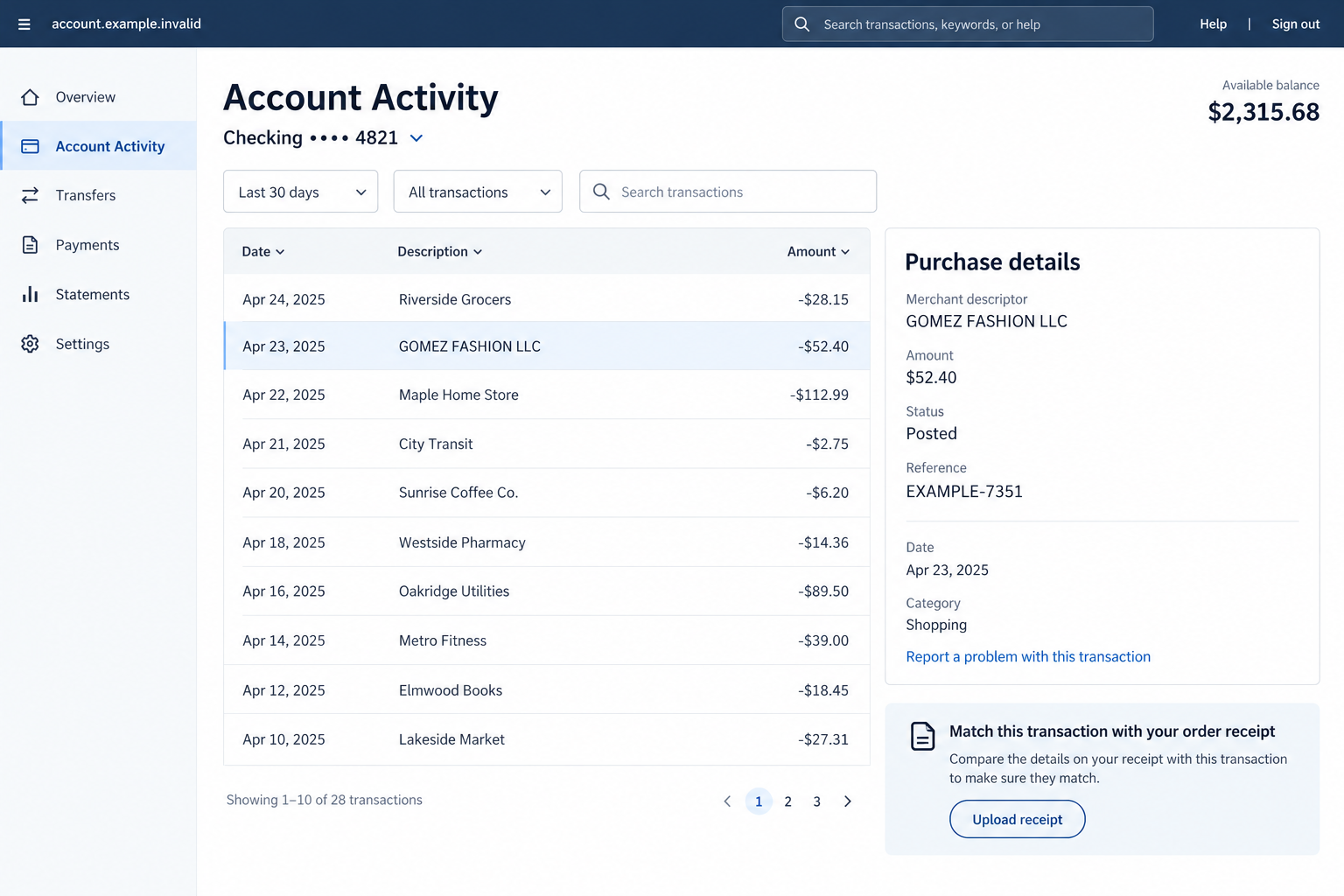
We reviewed those records on October 8, 2026. The article’s screen illustrations use fictional transaction details; they are not customer statements or evidence of particular payments.
The statement name is a starting point, not a complete identity
A January 2025 report names a $68.99 payment described as GOMEZ FASHION LLC / WWW.GOMEFASHIKY. This is a submitted consumer account, not our bank verification.
Other published complaints describe different purchases. The concern extends beyond identifying a single clothing-store page.
- Match the statement amount and date with your receipt.
- Recover the actual storefront address from your own records.
- Check whether the problem is non-delivery, an incorrect item, or an unrecognized payment.
- Ask the issuer for additional merchant details when necessary.
- Do not assume another company with Gomez in its name handled the transaction.
A payment problem needs verification before escalation
Our assessment is a serious merchant-risk warning based on a public complaint pattern. We did not identify the operator behind every reported storefront.
Nor did we authenticate the customers’ payment records or make a test purchase. Those limits matter when determining who should answer an individual dispute.
If your order is missing or the charge is unexplained, investigate promptly through your receipt and payment provider. Do not wait indefinitely for another vague shipping update.
What Gomez Fashion LLC Charges Can Tell You
The text beside a card payment is called a merchant descriptor. It can differ from the brand visible on the storefront.
That difference can have a legitimate explanation, such as another trading name or a payment arrangement. It is not automatically evidence of theft.
But when the name is unfamiliar and the merchandise never arrives, it becomes a useful lead for reconstructing what happened.
Begin with the amount, currency, and transaction date. A pending authorization and a posted charge should not be treated as the same event.
Next, locate the confirmation email or payment-platform receipt. Search your own records rather than accepting whichever similarly named business appears first online.
A descriptor may contain shortened or unusual text. Do not turn it into an assumed official website or type your card details into a speculative address.
The issuer can explain which merchant information it has and how the transaction was processed. That is a better starting point than guessing from a name.
Keep the explanation with the receipt. It helps separate the payment identity, storefront, shipping operator, and any business whose branding may have been used.
How a Reported Gomez Fashion LLC Purchase Dispute Can Unfold
Step 1: A storefront presents an appealing product
Published complaints describe a variety of merchandise rather than one consistent clothing purchase. Some buyers say they believed they were dealing with familiar retail branding.
Those accounts are allegations, and we did not independently verify each website. Do not assume one operator controlled every store mentioned by customers.
The practical lesson is to record the actual checkout address when ordering. An advertisement, search snippet, or recognizable logo cannot identify the payment recipient by itself.
If the price or brand representation raises doubt, verify it before paying. A saved page is useful later, but avoiding an uncertain purchase is better.
Step 2: The payment appears under a different name
The buyer then sees an unfamiliar descriptor. Without a receipt, it can be difficult to tell whether it belongs to the order, another purchase, or unauthorized activity.
Compare records before making that classification. An authorized purchase that was not fulfilled is different from a card payment you never approved.
Tell your provider which situation applies and what remains uncertain. Accurate descriptions help it ask for the right evidence.
Also check whether there were separate delivery or add-on charges. Do not assume a similar amount proves two records describe the same transaction.
Step 3: Tracking gives the impression of progress
Some complaints describe tracking updates despite merchandise not reaching the customer. A tracking page can provide useful information, but it does not settle every delivery dispute.
Check the reference through the carrier’s independently located service. Confirm what that carrier can verify about the shipment and destination.
A status label shown by a store is not necessarily a complete delivery record. Ask for information that connects the parcel to your order.
There can be ordinary explanations for a missing package too. Investigate a delivery error without automatically declaring a tracking system or carrier fraudulent.
Step 4: A request for help becomes a refund conversation
When an order remains unresolved, ask for a specific remedy and completion date. Another statement that support is checking the issue does not return the payment.
One published complaint says a buyer was asked to drop a dispute before a promised refund. We did not independently authenticate that exchange.
If you encounter such a request, consult the payment provider before changing the dispute. Do not assume you can reopen it under identical conditions later.
Keep the original protection in place until the provider explains the correct procedure and any repayment is actually confirmed.
Step 5: The buyer must identify the right party and deadline
BBB classifies the displayed Gomez complaints as Unpursuable, which its page defines as being unable to locate the business.
That status is relevant to difficulty pursuing the matter, but it is not a court finding or an identification of every person behind a transaction.
Your payment provider may still have transaction-specific information that a public profile lacks. Ask what it can do with your receipt and charge.
Act on those procedures promptly. Searching for a perfect company identification should not consume the time available to report a documented payment problem.
A Delivered Label Does Not Resolve a Missing Order
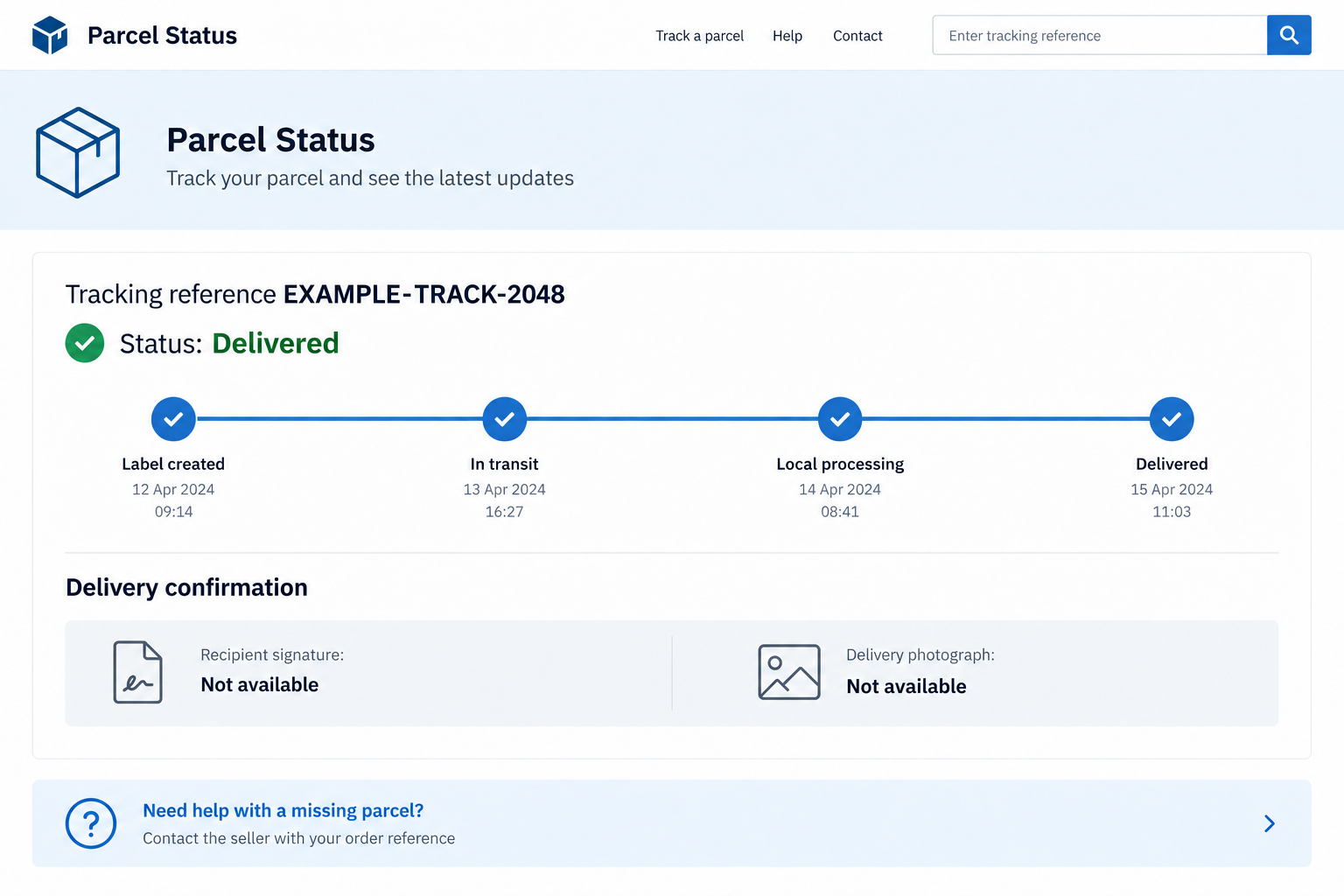
The illustration below shows the kind of status information a buyer might encounter. Its references, dates, and interface are fictional, not a captured courier record.
The real issue is what can be independently established about your own package. A missing photograph or signature is not alone proof of a fraudulent delivery.
Ask whether the reference belongs to the correct shipment and whether any available confirmation connects it with your address.
Give your provider the factual result: the merchandise was not received, the available tracking says a particular status, and these are the verification steps taken.
That description is stronger than simply declaring all tracking fake. It leaves room for the evidence to identify an ordinary delivery error or something more concerning.
Company, Address, and Fulfillment Checks
The billing descriptor does not verify the corporate chain
Gomez Fashion LLC is the name attached to the complaint profile and reported payments. We did not establish its role in every similarly described transaction.
Request the merchant’s legal identity from the provider and compare it with the seller on the receipt. Record any explanation of an intermediary or trading name.
A company name can also be misused. Do not assign responsibility to a particular registrant without connecting it to the actual payment and storefront.
A city listing is not a usable return address
The BBB profile lists Nicholasville, Kentucky 40356. That is not a complete, authorized receiving address for merchandise.
We did not verify a factory, office, warehouse, or return depot for the transactions described. Do not invent one from an unrelated search result.
If a parcel arrives and a return is proposed, obtain the full approved destination and conditions. Ask the provider about the dispute before paying another shipping cost.
Do not send unrelated complaints to the Polish Gomez retailer
The gomez.pl privacy policy identifies GOMEZ S.A. in Poland. That is different published identification from the US LLC name in these reports.
We did not establish a corporate or transaction relationship between them. A similar name is not evidence that the Polish retailer processed your charge.
Use your actual receipt and verified merchant information to choose a contact route. Do not disclose payment records to another company merely because search results mixed the names.
The storefront, dispatch point, and supplier may differ
Some complaints refer to international shipping. Those accounts do not establish the manufacturing country of every item or the location of the payment operator.
Ask who supplied the product, which carrier handled it, and who is responsible for the remedy. Keep those roles separate.
Neither an overseas route nor a domestic-sounding business name proves legitimacy or fraud. The relevant evidence is the transaction, representation, delivery, and response.
What the BBB Alert Means
A pattern alert should be taken seriously, but it is not a blanket verdict about every customer. BBB is not the payment provider or a criminal court.
The profile reviewed listed thirteen complaints. Many displayed accounts concern purchases made in late 2024 and complaints submitted in 2025.
Do not present those dates as a newly verified 2026 surge. The current question is whether the record gives you reasons to verify a purchase or unresolved charge.
Lack of accreditation alone is not proof of wrongdoing. The substance of the complaints and the difficulty locating the business are more material here.
For an individual order, preserve evidence even if it seems to match the public pattern. Your provider evaluates your transaction, not just a review page.
What to Do If You See a Gomez Fashion LLC Charge
- Match the charge against your own purchases.
Record its exact descriptor, amount, currency, date, and posted status. Search confirmation emails and payment-platform records for a corresponding order.
If someone else legitimately uses the account, check with them too. Do not assume every unfamiliar name is unauthorized activity.
- Ask the provider to clarify the merchant.
Use the number or support route independently obtained from your bank or payment service. Request any available seller or transaction details.
Do not call a number supplied by an unverified search result claiming it can resolve the charge. Never provide a password to identify a purchase.
- Preserve the actual storefront and promises.
Save the receipt, website address, advertised item, delivery estimate, and order reference. Keep readable copies of the relevant communications.
If the original page disappears, explain that fact with its saved address. Do not substitute an unrelated retailer with a similar name.
- Verify a tracking claim independently.
Locate the carrier through a trusted route and check the reference. Ask what delivery information is available for your shipment.
Record a mismatch, unavailable confirmation, or possible delivery error accurately. Do not turn an inconclusive tracking result into a definitive accusation.
- Request the remedy and keep your payment rights visible.
For a missing or incorrect order, ask the seller for a clear resolution. Contact the provider promptly if the matter remains unresolved.
The FTC’s order guidance describes seeking help and disputing unresolved non-delivery. Ask which procedures and deadlines apply to your payment method.
- Do not close a dispute for an uncompleted promise.
If a seller requests that step, ask the provider about the consequences first. Confirm an actual credit instead of relying on a future refund estimate.
A partial payment, replacement offer, and full reimbursement are different outcomes. Make sure any agreement reflects the remedy you intended.
- Escalate with a concise factual chronology.
Report suspected deceptive conduct through an appropriate consumer agency. Distinguish the seller’s representation, payment identity, tracking claim, and response.
Avoid paying recovery agents who promise a guaranteed refund. An unresolved purchase should not become another fee paid to an unverified stranger.
Frequently Asked Questions
Is every Gomez Fashion LLC charge automatically fraudulent?
No. Match the payment to your receipt and ask the provider for merchant information. The public complaint pattern supports scrutiny, not an automatic finding about every transaction.
Is this the same business as gomez.pl?
We did not establish that relationship. The Polish retailer publishes GOMEZ S.A. identification. Do not treat a similar name as proof it handled a US LLC descriptor.
What does BBB’s Unpursuable status mean?
The complaints page defines it as BBB being unable to locate the business. It does not establish a refund, a criminal judgment, or the identity of every operator.
Should I close my dispute when a refund is promised?
Ask your payment provider first. A promise is not a completed credit, and changing a dispute can affect available options.
Does tracking marked delivered prove I received the item?
Not by itself. Investigate the actual carrier record and destination, while recognizing that missing parcels can also result from ordinary delivery errors.
What if the order was placed a long time ago?
Contact the provider without assuming standard deadlines remain open. Explain the complete timeline and ask what options, if any, are still available.
The Bottom Line
Gomez Fashion LLC charges deserve careful verification when an order is missing or a statement name is unfamiliar. The BBB complaint pattern is a meaningful warning.
Identify your actual merchant and protect the payment-dispute process. Do not waste time blaming a similarly named company or waiting indefinitely for an uncompleted refund.








