

Ruby & Rose introduces its dresses with a familiar kind of charm. The boutique branding, floral designs, and seasonal offers make browsing feel pleasantly personal.
Perhaps you have already found something for a wedding or a summer trip. Before choosing another color, spend a few minutes understanding the purchase.
Overview
The money-back promise has a major sale exclusion
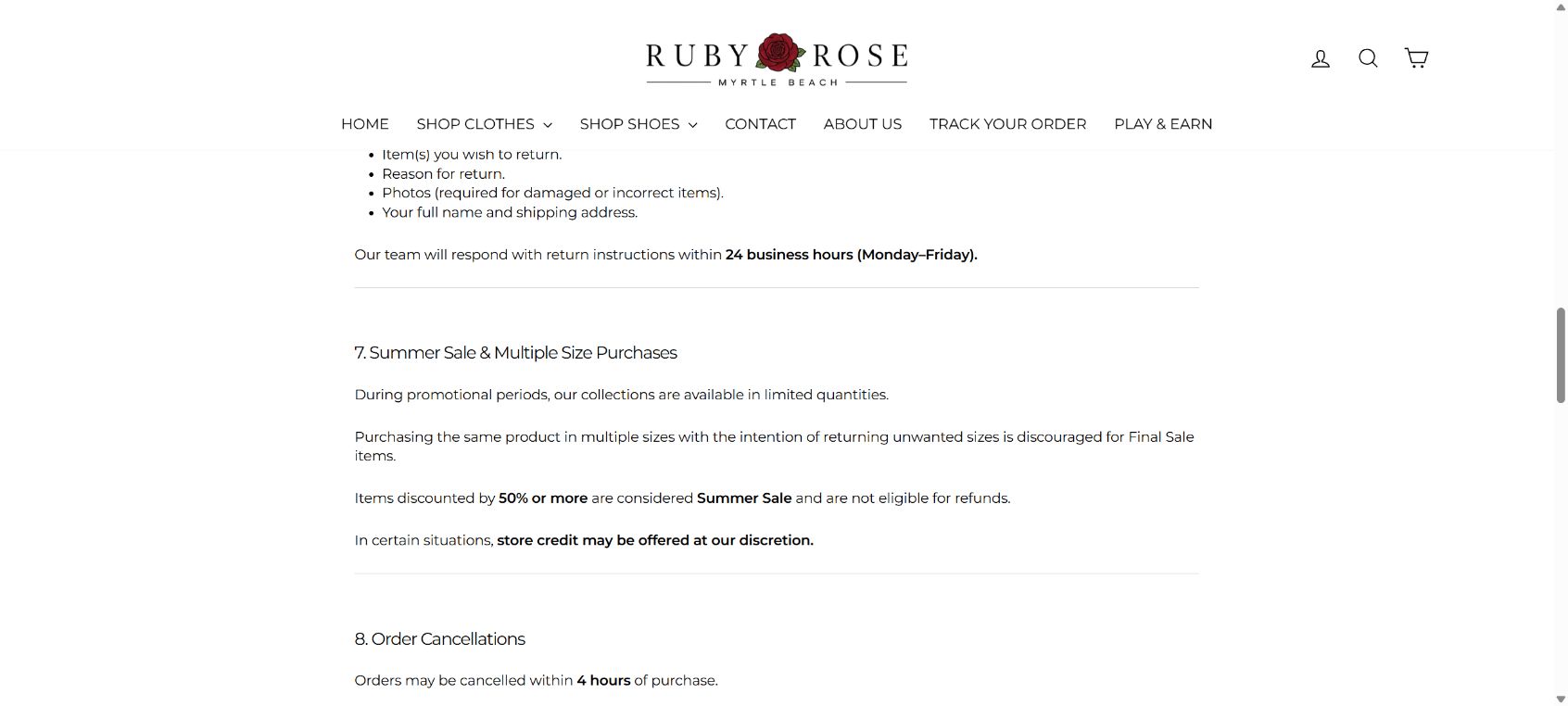
Ruby & Rose’s broad refund reassurance needs a serious qualification. Its published policy excludes cash refunds for items discounted by at least 50%.
The storefront simultaneously promotes a summer sale and labels many dresses with that discount. Shoppers should not assume the advertised guarantee protects those purchases.
Our October 8, 2026 inspection concerns rubyandrose.us, whose branding references Myrtle Beach. It does not concern similarly named boutiques in Texas or England.
We examined the live catalog and linked policies. This investigation identifies documented commercial risks, not proof that every order is fraudulent or never arrives.
The conditions that deserve your attention
- Approved ordinary returns involve international postage and a 15% restocking deduction, subject to the published exceptions.
- Cancellation is limited to four hours, with a separate exclusion for orders above $100.
- The shipping page says parcels are dispatched directly from the supplier.
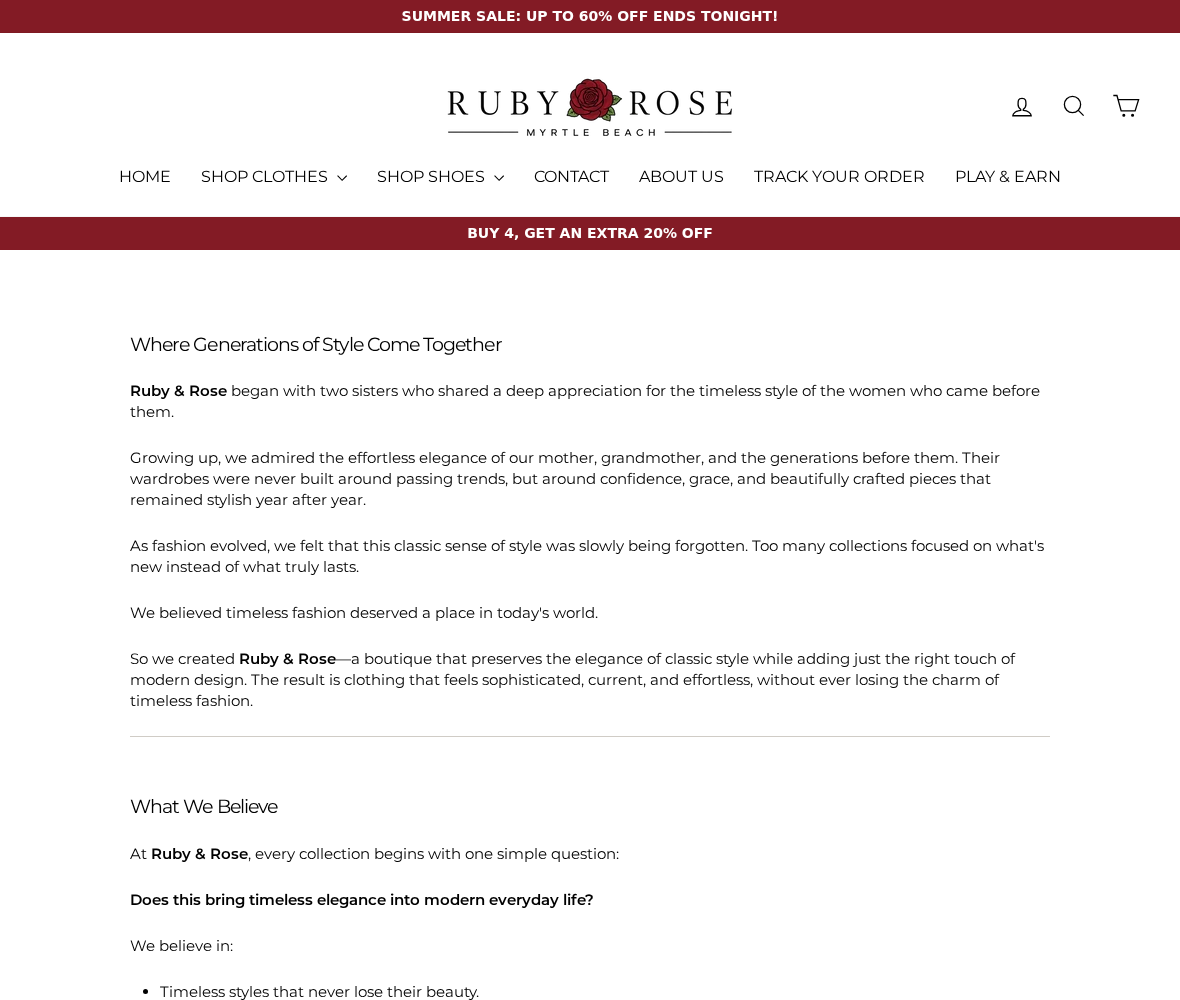
- A page labeled General Terms & Conditions contains a boutique story instead of substantive purchasing terms.
- Support details alternate between .us and .com email addresses.
The difficult question is not whether a dress can be delivered. It is whether you can recover your payment if the dress disappoints.
Our decision: do not order on the guarantee alone
Do not buy a heavily discounted item until the merchant confirms its cash-refund eligibility. If that answer is unclear, leave it out of your cart.
For any eligible purchase, obtain the return country and likely postage cost first. A guarantee with costly conditions is not an inexpensive fitting-room alternative.
We did not establish a refill subscription, test the clothing, or authenticate the founders. Those questions should not be replaced with confident guesses.
Why the Boutique Presentation Changes Expectations
A family-style introduction feels reassuring
The About Us page describes two sisters preserving the elegance of earlier generations. The emphasis is on personal style and carefully chosen collections.
That is an appealing introduction. A shopper may imagine a local team selecting dresses, checking quality, and helping personally when a size does not work.
However, those expectations are different from verified operations. The story does not identify the manufacturer or show how a particular garment reaches your address.
Nor did our review independently confirm the sisters’ identities. Treat the narrative as the shop’s account, not an authenticated history established by this investigation.
The domain matters more than a familiar shop name
Search results contain several Ruby and Rose businesses. Their addresses, products, reviews, and owners must not be combined into one accusation.
Check the exact website in your receipt and browser. A complaint about rubyandroseengland.com does not automatically describe a purchase from rubyandrose.us.
Likewise, a genuine independently operated boutique with a similar name cannot validate this storefront. Shared words are not a business relationship.
This review stays with the .us shop and the pages linked from it. That boundary is important when deciding which support route and policies concern you.
How the Ruby & Rose Sales Funnel Works
Step 1: Seasonal styling makes the offer feel timely
The homepage combines boutique imagery with a summer promotion and an approaching-deadline message. A reader planning an event has an immediate reason to keep browsing.
But an attractive collection is not evidence of local stock. The shipping model described elsewhere must be considered before treating the store like a nearby boutique.
Do not let a sale banner determine your delivery deadline. A dress needed next weekend presents a different risk from one bought without an occasion in mind.
Save the particular advertisement that led you there. We did not verify an active closing-down claim, so that story should not be assumed from the seasonal sale.
Then compare the product’s measurements, material description, and care information with what you actually need. A photograph cannot settle those practical questions.
Step 2: The displayed reduction draws attention away from eligibility
Many reviewed cards were marked 50% off. The store also presented a general money-back guarantee, a combination that can make a discounted purchase feel low-risk.
The problem appears when you read the exception beside that reassurance. The policy distinguishes deeply discounted merchandise from items that remain eligible for repayment.
There is also a rounding question. A displayed example reduced $119 to $59.95, which works out to roughly 49.62%, although its badge said 50%.
That small difference is not evidence that normal sale-price rounding is fraud. It matters because the merchant’s refund threshold uses the same percentage.
Ask whether the badge, exact calculation, or final promotional price determines eligibility. Do not discover the answer only after requesting a return.
Step 3: Buying more can change two important conditions
The shop promotes additional savings for larger baskets. Those offers can encourage someone choosing one dress to add a second style or another size.
Consider a hypothetical basket containing two dresses priced at $59.95 each. If both qualify for 10% off the subtotal, the result is $107.91 before taxes.
That is an illustration, not a checkout we completed. It shows how a seemingly modest second item can move an order past the published cancellation threshold.
Further savings might also affect the sale classification. The policy does not clearly resolve every combination of rounded product discounts and basket-level promotions.
Avoid ordering several sizes solely to return the extras. First determine which items are refundable and whether keeping fewer pieces changes the remaining bundle price.
Step 4: Supplier dispatch replaces the local-shop assumption
The shipping policy describes dispatch from the supplier, followed by a transit estimate. Processing and delivery are separate stages.
Supplier fulfillment can be legitimate. What it does not establish is that a Myrtle Beach shop holds the exact dress, checks it, or ships it domestically.
For a time-sensitive order, obtain the dispatch location and carrier service in writing. A broadly stated delivery range is not an event-date guarantee.
Once a parcel exists, retain its original label and tracking record. Those details can answer questions about the shipment that promotional branding cannot.
We did not prove Chinese manufacture. A supplier-dispatch model and an international-return requirement do not identify the country where every garment was made.
Step 5: A return request becomes a calculation, not just a parcel
An eligible ordinary return can leave the customer paying postage, customs-related expenses, and the stated deduction. Keep those costs separate from the item’s original discount.
For example, a hypothetical $80 eligible item leaves $68 after a 15% deduction. If tracked postage costs $25, the recovery falls to $43.
The example excludes other charges and does not assume that your item qualifies. Its purpose is to price the exit before committing to the purchase.
Refusing delivery is not an automatic escape. The policy applies its deduction to refused or unclaimed packages too, rather than promising an untouched repayment.
A documented damaged or incorrect item needs separate treatment. Explain the actual defect and request the relevant exception instead of accepting a change-of-mind classification automatically.
Company, Address, Support, and Fulfillment Checks
The terms page does not identify the transaction clearly
The General Terms & Conditions page repeats the founders-and-style narrative. It is not a clear explanation of the company contracting with a buyer.
Across the reviewed contact, terms, and privacy pages, we did not establish a named legal operator or independently verified corporate office.
That does not prove no company exists. It means the supplied story and policy pages do not adequately answer who is responsible when a transaction goes wrong.
Ask for the legal seller’s name and compare it with the receipt. If a different payment descriptor appears, request an explanation of that relationship.
Myrtle Beach branding is not a usable returns address
A location printed beneath a logo does not tell you where an authorized parcel must go. This store’s policy places ordinary returns at an international facility.
The exact destination is provided after approval rather than clearly priced in advance. That prevents a shopper from calculating tracked postage while considering the order.
Request the recipient, country, postal code, and customs instructions before paying. If the answer is withheld, assume the cost remains an unresolved part of the purchase.
Do not use a similarly named boutique’s address. Sending a parcel to an unrelated retailer can make recovery harder and inconvenience a business outside this investigation.
The contact details need a single accountable route
The contact page and footer use support@rubyandrose.com. Other policies refer to info@rubyandrose.com or support@rubyandrose.us.
A company can legitimately operate several addresses. The practical concern is whether a customer knows which inbox handles an order and provides enforceable return instructions.
We did not send test messages or establish that any address is unresponsive. Inconsistent publishing should not be inflated into an invented service test.
Keep the response connected to your order number and preserve the email chain. Repeated generic assurances are not a substitute for an address or refund decision.
The supplier model leaves quality questions unanswered
Direct dispatch makes product-specific information especially important. Identify the fabric composition, care instructions, size measurements, and any actual manufacturer shown on the garment label.
Terms such as elegant or premium describe positioning, not measurable construction. A useful seller should explain what the material is rather than simply repeating its appeal.
Neither this review nor the shop’s photographs prove that every item is poor quality. We did not receive a garment for inspection.
The appropriate decision is to buy only when the description and refund route are sufficiently clear. Uncertainty about both puts too much responsibility on the shopper.
The Questions That Should Be Answered Before Checkout
Is a sale item refundable in cash?
Use the exact product link in your question. Ask for a yes-or-no answer tied to its present price, not a general reference to the guarantee.
Then ask which reduction determines its sale status. A product badge and an extra basket discount should not leave the customer guessing which rule applies.
If the only available remedy is discretionary credit, decide whether you would genuinely want another order from this shop. Credit is not equivalent to your money back.
How much money can you recover?
Separate item repayment, deductions, outward shipping, return postage, and potential customs expenses. The useful figure is the money remaining after all applicable costs.
Do not assume every cost applies, but do not assume none applies either. Obtain the destination first, then price a suitable tracked service.
For low-value clothing, that calculation can make returning an unwanted item impractical. The time to learn this is before buying several alternatives for comparison.
Can you change your mind immediately?
The cart total matters as well as the time of the request. Save the amount after promotions and ask how any threshold is calculated.
A rapid fulfillment claim does not itself demonstrate that a specific parcel has left the warehouse. If cancellation is refused, ask what stage your order has reached.
Written merchant rules also do not automatically settle every consumer-rights question. Seek appropriate local guidance if your complaint concerns misdescription or a defective item.
What to Do If You Ordered From Ruby & Rose
- Preserve your version of the offer.
Keep screenshots of the product, discount badge, guarantee, and order total. Save the refund conditions too, including the date and full website address.
This gives you a record of the promise you relied on. A later page change should not leave you reconstructing the transaction from memory.
- Send a clear cancellation request promptly.
Include the order number, purchase time, and the remedy requested. Ask for confirmation that processing has stopped and repayment has been initiated.
If support cites the order threshold or processing stage, retain that explanation. A request sent quickly does not by itself prove the cancellation was accepted.
- Inspect the parcel before altering anything.
Photograph the packaging, labels, seams, material information, and any visible problem. Keep tags attached while assessing fit and condition.
Trying on for size is allowed by the published policy, but wearing or washing the garment can change eligibility. Record a defect before attempting repairs.
- Get a written decision and complete return instructions.
Ask whether your item qualifies for a cash refund and what deduction is proposed. Obtain the international recipient and customs information before mailing it.
For damaged or incorrect goods, ask specifically about the exception. Compare the proposed remedy with the description and assurances associated with your purchase.
- Protect the value of any authorized return.
Choose an appropriate tracked service, retain proof of postage, and photograph the packed item. Check that the parcel is addressed exactly as instructed.
After delivery, ask for inspection and refund confirmation. Do not mistake a tracking update or a promise to review the case for an issued repayment.
- Escalate an unresolved documented problem without endless waiting.
Contact your payment provider about its process and deadlines. Explain the actual issue, such as nondelivery, misdescription, or an agreed refund that was not processed.
Provide the relevant records rather than labeling every transaction fraudulent. Report material misleading claims through the consumer-protection route appropriate to your location.
Frequently Asked Questions
Is Ruby & Rose on rubyandrose.us a confirmed scam?
We found serious refund limitations and unclear business information. That supports a firm buyer warning, not a conclusion that every delivery or transaction is fraudulent.
Does the 30-day guarantee cover every discounted dress?
No universal coverage should be assumed. The policy contains a threshold-based sale exclusion, and the merchant should confirm how a particular item is classified.
Is refusing the package a reliable way to obtain a full refund?
The published rules do not promise that outcome. Refused and unclaimed parcels can still attract the stated deduction, making written cancellation instructions preferable.
Are returns handled at a Myrtle Beach boutique?
The policy describes an international return facility, not a confirmed domestic boutique destination. Request the exact address before assuming postage will be inexpensive.
Did this investigation prove the garments come from China?
No. Supplier dispatch is disclosed, but the inspected pages do not establish each item’s manufacturing country. A parcel label and product documentation provide better evidence.
Can I use another Ruby and Rose shop’s contact details?
Do not assume similarly named shops are connected. Use the domain and merchant details tied to your receipt, and ask this seller to clarify conflicting addresses.
The Bottom Line
Ruby & Rose’s sales presentation makes ordering feel easier than reversing it. The important conditions deserve attention before the dress, not after delivery.
Insist on item-specific refund eligibility and a practical international-return route. If the shop cannot give clear answers, do not pay for the uncertainty.
Already ordered? Preserve the offer, act promptly, and pursue a documented remedy. A reassuring headline should not decide what happens to your money.








