

QC Kinetix reviews can feel personal when joint pain is changing your plans. An offer of relief without surgery may arrive at exactly the right moment.
You want to get back to ordinary things, not spend another evening comparing medical language. Still, a few questions belong before any major commitment.
Overview
A real clinic network requires a more precise review than a scam label
QC Kinetix operates a regenerative-medicine network and advertises treatments including platelet-rich plasma, bone-marrow aspirate concentrate, and other biologic approaches.
The reviewed evidence does not establish that the entire network is fraudulent. It does establish medical and financial questions patients should settle before paying.
Our October 8, 2026 review focuses on the network’s public explanations, FDA terminology, personalized pricing, and financing promotions. No patient examination was performed.
The FDA answer is broader than a patient should rely on
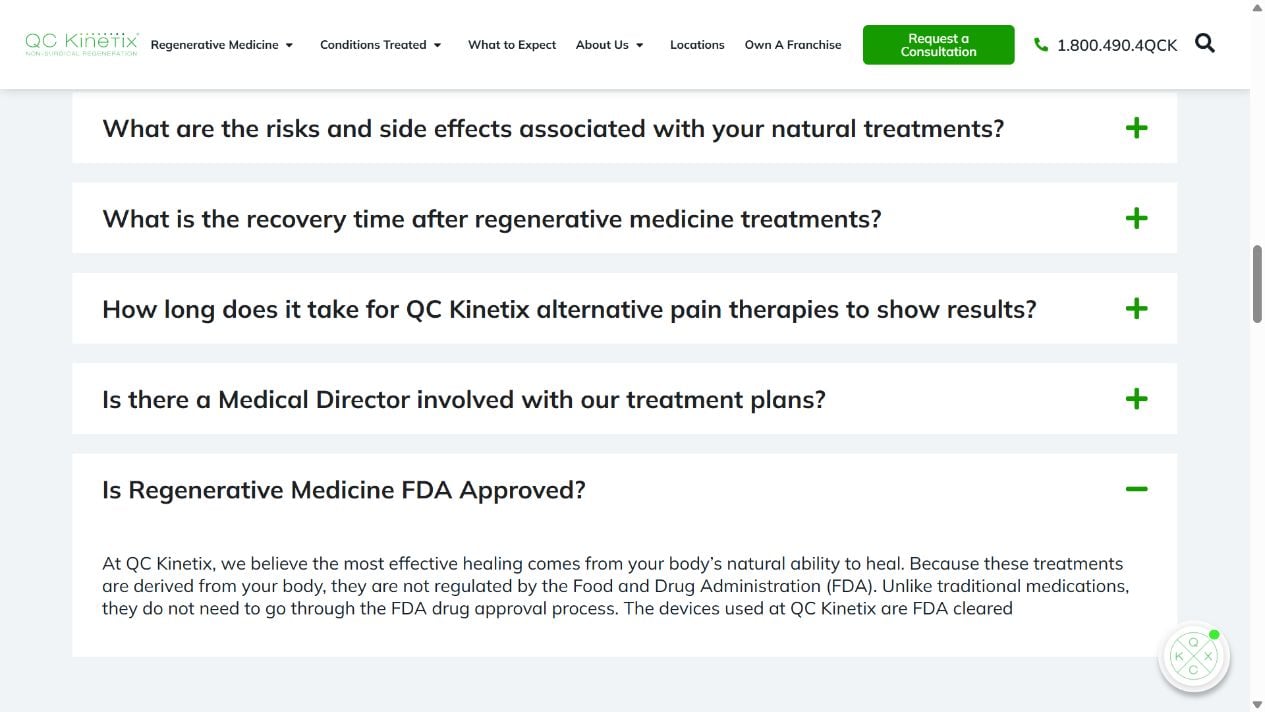
The clinic FAQ says its own-body treatments are not FDA regulated and separately describes the equipment as FDA cleared.
Those statements do not provide a product-specific regulatory explanation. A treatment’s origin, preparation, intended use, and applicable rules all matter.
Patients should ask about the exact proposed procedure. Device clearance is not automatically proof that an entire treatment package achieves the advertised result.
A free consultation is not a free treatment or universal loan offer
The website says an examination leads to an individualized treatment quote. Its payment page promotes third-party financing, including plans starting at 0% APR.
- Identify the diagnosis and exact procedure, not merely the regenerative-medicine label.
- Request evidence relevant to that procedure and your condition.
- Get the full treatment price and cancellation provisions in writing.
- Read a financing agreement separately from the clinic’s promotional wording.
We did not verify every clinic’s license, assess individual treatment outcomes, apply for financing, or establish a current enforcement finding against QC Kinetix.
Why QC Kinetix Reviews Need to Separate Hope From Evidence
Pain narrows the way you make decisions. A promise of easier movement can matter more than a comparison you would normally make carefully.
That does not make the patient gullible. It means the offer should be explained with particular clarity, without letting reassurance replace informed consent.
A success story can be genuine and still tell you little about your likely result. Different diagnoses, preparations, and treatment combinations can produce different experiences.
Ask what improvement means in the specific plan: less pain, better function, a measured change, or a claim about repairing tissue.
Those outcomes should not be blended into one promise. Feeling better does not by itself demonstrate that a damaged joint has been rebuilt.
The website acknowledges individual variation. Keep that qualification beside the attractive headline rather than treating it as an irrelevant footer.
An independent licensed clinician can help you compare the proposed treatment with other appropriate options. This article cannot determine which care is right for you.
The useful question is not whether regenerative medicine sounds impressive. It is whether the exact recommendation is justified for your condition, with clearly explained limitations.
How the QC Kinetix Consultation and Payment Journey Works
Step 1: The promise centers on pain relief without surgery
The public marketing emphasizes nonsurgical care and the body’s own healing processes. That framing can appeal strongly to someone worried about a difficult recovery.
Start by identifying the actual advertised outcome. Is the offer discussing symptom relief, improved movement, tissue repair, or avoiding a different treatment?
Save the page or advertisement that influenced you. A later conversation may use more qualified language than the version you first encountered.
Do not treat nonsurgical as a synonym for risk-free. Medical procedures can require meaningful consent even when they do not involve a conventional operation.
Equally, the presence of promotional language does not establish that every medical recommendation is improper. The recommendation needs individual scrutiny.
Step 2: A consultation assesses candidacy
The FAQ describes evaluating a patient’s condition before proposing treatment. It also lists circumstances in which a person may not be an appropriate candidate.
Bring relevant medical information and ask who will review it. Understand the clinician’s role rather than assuming every staff member is making a medical assessment.
A careful discussion should explain what has been diagnosed and what remains uncertain. You should be able to understand the reasoning without mastering specialist terminology.
If something important is unclear, request the explanation in writing. A clear diagnosis is a better starting point than an attractive package name.
Do not discontinue existing care because a consultation sounds promising. Discuss changes with the clinician responsible for that care.
Step 3: The proposed plan becomes a specific financial commitment
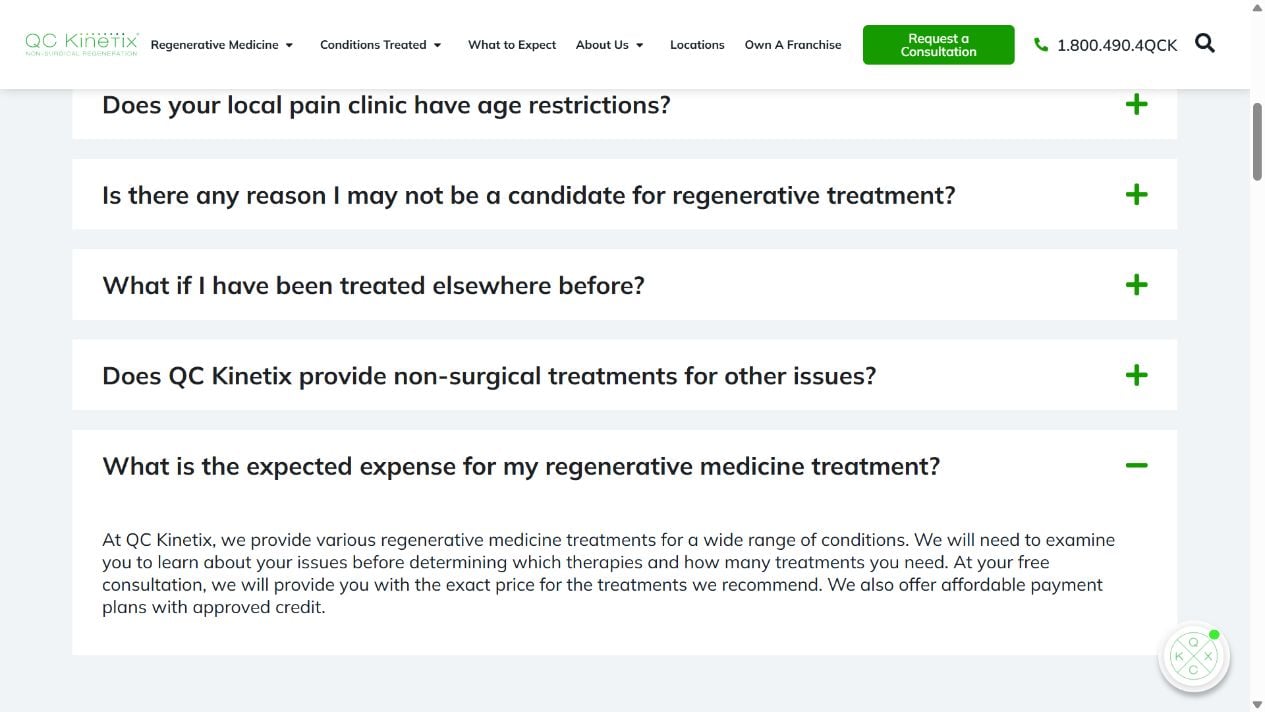
The website does not give one universal treatment price. It says the exact quote depends on the evaluation, recommended therapies, and number of treatments.
The screenshot below shows that explanation. It should prompt a request for a complete, itemized proposal, not an assumption about a typical bill.
Check whether the quotation includes assessment, procedures, follow-up, and any additional charges. Ask what happens if a planned component is not performed.
A smaller monthly payment does not explain the treatment’s full price. Compare the total commitment before deciding how to pay.
This review provides no representative QC Kinetix price. A figure from another patient or location may not describe the plan offered to you.
Step 4: The patient should examine the evidence and regulatory explanation
Ask the provider to name the exact procedure and preparation. Platelet-rich plasma, processed cellular material, and bone-marrow concentrate should not be treated as identical.
Then ask which evidence supports that preparation for the diagnosed condition. A paper discussing a related technique may not support the complete package being sold.
Request an explanation of the regulatory category, any relevant approval or clearance, and the limitations of those references. A badge alone is not enough.
If a response says no oversight applies simply because the material comes from your body, ask for the specific basis for that explanation.
You do not need to resolve complex regulatory questions yourself. If the answer is unclear, seek an independent professional assessment before committing.
Step 5: Financing introduces a separate agreement
The payment page names Cherry among its financing partners and promotes possible approvals up to $50,000. Approval is not a medical endorsement.
The relevant offer is the one presented to you personally. A headline rate beginning at 0% does not prove every applicant receives that rate.
Read the APR, repayment schedule, total amount, and late-payment provisions before agreeing. Ask whether any promotional conditions affect what you will actually owe.
The clinic and lender can have different responsibilities. Understand who must authorize or process a credit if treatment is canceled or refunded.
We did not submit an application or review a private loan contract. No particular patient’s credit terms can be inferred from the public advertisement.
Step 6: Consent and follow-up should preserve the patient’s choices
Before a procedure begins, review the consent form and any cancellation terms alongside the treatment plan. Ask what alternatives and uncertainties were discussed.
Find out how progress will be assessed, who handles complications, and what follow-up is included. A vague promise to monitor improvement is not a complete plan.
If expected improvement does not occur, ask what happens next. More appointments or additional products should not be an automatic substitute for reassessment.
Keep medical concerns separate from the billing dispute. A patient may need appropriate clinical attention while a refund disagreement is still unresolved.
Nothing here should be read as permission to ignore a clinician’s instructions. It is a guide to the questions that deserve answers before a purchase.
What FDA Language Does and Does Not Establish
The FDA regulates categories of regenerative-medicine products. Some materials follow different regulatory pathways or qualify for specific exclusions, depending on their characteristics and use.
The agency’s regenerative-medicine explanation makes clear that the field includes regulated cell, tissue, gene-therapy, and combination products.
That is why “from your own body” is not a complete answer to every regulatory question. It describes origin, not all the facts that determine classification.
Conversely, it would also be inaccurate to claim no regenerative or cell-based treatment has FDA approval. The agency maintains a list of approved products.
Those approvals belong to particular products and indications. They do not automatically transfer to an unrelated clinic protocol using the same broad medical vocabulary.
A device may have been cleared for a particular function. Ask which device, what its clearance covers, and how that relates to the treatment outcome being promoted.
This review does not determine the legal classification of an unidentified patient’s procedure. That would require details the public FAQ does not provide.
The practical finding is that the FAQ’s broad answer should not substitute for a specific explanation. Patients deserve clarity before their own treatment and payment decisions.
Company, Address, and Clinical Provider Checks
The branded network and your contracting clinic may differ
The website also promotes franchise opportunities. A network brand should not be assumed to identify the exact entity responsible for every local agreement.
Read the legal practice name on the proposed contract. It should be clear which business bills you, provides care, and responds to a complaint.
Do not address a dispute to an unrelated location merely because it uses the same branding. Keep the actual contracting entity in your records.
A listed clinic address should match the care location
Confirm the specific address where the assessment and procedures will occur. Compare it with the provider information and the paperwork you receive.
We have not independently inspected every site or verified every local registration. There is no basis here to describe all locations as fake offices.
For a medical purchase, the meaningful check is the exact practice and clinician, not whether another address appears somewhere on a national website.
Clinical credentials and administrative support are different roles
Ask who is responsible for diagnosing your condition, performing the proposed procedure, and managing follow-up. Obtain the person’s professional name and relevant licensing details.
Check credentials through the appropriate official licensing authority. A promotional biography should not be the only source when a medical decision is involved.
Likewise, a billing representative’s reassurance does not resolve a clinical question. Direct medical concerns to the clinician responsible for the recommendation.
The actual preparation and payment provider need identification
Request the treatment’s full description and any materials or devices involved. The word biologic covers more than one product or process.
Also identify the lender if financing is offered. A clinic brand on the application screen does not make the clinic and credit provider the same company.
Keep each party’s contact information and documents separately. That makes it easier to direct a medical, contractual, or payment issue to the appropriate recipient.
How to Read the Price Without Losing the Medical Question
It is natural to focus on affordability once a plan sounds promising. But a manageable payment cannot establish that the proposed care is suitable.
The Consumer Financial Protection Bureau explains that medical financing can introduce costs and repayment risks that deserve separate review.
For a simple hypothetical example, twelve payments of $250 total $3,000 before any additional charges. That is arithmetic, not a QC Kinetix quote or financing offer.
Ask for the cash price and the total amount under the proposed credit arrangement. If they differ, understand why before signing.
Also ask what insurance, if any, would reimburse for your specific care. A statement that a treatment is cheaper than surgery does not establish your personal out-of-pocket comparison.
Take the documents home when time permits. A second opinion and a calm review of the contract can help separate urgency from the actual decision.
No payment plan should be chosen because a sales conversation makes independent review feel inconvenient. You are entitled to ask understandable questions about a major commitment.
What to Do If You Paid for QC Kinetix Treatment
- Collect the specific plan and agreements.
Keep the diagnosis, proposed procedures, consent forms, itemized price, receipts, and financing documents. Identify which local business and clinician are responsible.
These details are necessary for a useful review. A general description of regenerative medicine cannot explain your individual transaction.
- Get medical concerns assessed appropriately.
Contact the treating clinician about symptoms or a suspected complication. Seek urgent medical care when symptoms are severe or rapidly worsening.
If you need an independent assessment, bring the actual treatment records. Do not substitute a video review or an online billing discussion for medical attention.
- Request a clear explanation of the procedure.
Ask what was administered, how it was prepared, and which evidence supports the indication discussed with you. Request copies of relevant records.
If the answer remains vague, consult an independent licensed professional. Do not infer approval or effectiveness from a device name alone.
- Put a cancellation or refund question in writing.
Specify the appointments or procedures involved and the outcome you are seeking. Ask which contractual provision applies and how the amount is calculated.
Keep the response from the responsible local entity. Do not assume another location’s policy or patient experience controls your agreement.
- Speak to the lender about a financed payment.
If financing was used, ask how an approved cancellation or clinic refund would affect the credit account. Get the lender’s instructions directly.
Do not assume the debt disappears after sending a complaint to the clinic. Continue handling account obligations according to qualified advice and the applicable agreement.
- Document unresolved issues factually.
Build a short chronology showing what was promised, what occurred, and what remains disputed. Separate medical outcomes from billing or administrative problems.
Accurate records can help a consumer agency, licensing authority, qualified adviser, or payment provider understand the matter without unsupported accusations.
- Use the appropriate complaint channel.
Clinical conduct, advertising, and financial disputes may belong with different organizations. Ask the relevant official body which information it needs for your specific concern.
For legal advice about a substantial contract dispute, consult a qualified professional. This review does not establish a guaranteed refund or a legal finding.
Frequently Asked Questions
Is QC Kinetix a confirmed scam?
A blanket fraud allegation is not supported by this review. The network is real, but FDA wording, medical evidence, pricing, and financing require patient-specific scrutiny.
Are treatments automatically outside FDA oversight because they use my cells?
No single origin statement answers every regulatory question. The actual material, preparation, intended use, and applicable category must be considered.
Does FDA-cleared equipment prove the treatment will work?
No. Clearance concerns a particular device and purpose. Ask what it covers and what evidence supports the proposed treatment outcome for your condition.
Does the website publish one standard treatment price?
The reviewed FAQ says pricing follows an individual assessment. Obtain your complete written quote rather than relying on another patient’s bill.
Will every financing applicant receive 0% APR?
The promotion describes plans starting at that rate. Your actual eligibility and terms belong to the specific financing offer, which should be reviewed separately.
Does canceling treatment automatically cancel the loan?
Do not assume so. Ask both the clinic and lender how a cancellation or approved refund will be applied to your credit agreement.
The Bottom Line
QC Kinetix reviews should neither dismiss genuine medical care as universally fake nor accept broad promotional claims without detail. The FDA answer needs procedure-specific clarification.
Before committing, obtain an independent clinical assessment, written treatment evidence, the full price, and any credit terms. A hopeful headline is not enough for those decisions.








