

UTOGRU whitening toothpaste looks designed to catch your eye before you read the label. Its colorful tube appears across shops promising a brighter, fresher smile.
But the same product name can lead to very different sellers and claims. Understanding those differences takes more than looking at the before-and-after pictures.
Overview
The product exists, but the advertising varies
UTOGRU is sold as a nicotinamide or niacinamide whitening toothpaste. These are two names for the same form of vitamin B3.
Listings reviewed for this investigation describe different flavors, ingredients, and benefits. Some emphasize ordinary cleaning; others add fluoride-free cavity protection or substantial enamel-restoration claims.
A physical toothpaste can clean teeth without delivering every benefit attached to its name online. The exact formulation and the exact claim both matter.
Our October 9, 2026 checks found reasons to question the marketing and product traceability. We did not establish that every UTOGRU seller is fraudulent.
The clearest concern is mismatched evidence
One active seller page mixed dental testimonials with comments about facial serums, skin texture, and dry patches. Those comments cannot substantiate toothpaste performance.
The same page presented a large review total covering multiple stores and channels. That is not equivalent to verified purchases of this particular tube.
Elsewhere, marketplace copy promoted fluoride-free cavity protection. The presence of that wording does not demonstrate a tested anticavity formulation.
- Product-specific reviews should describe the toothpaste actually being sold.
- Surface-stain removal and cavity prevention are different benefits.
- A brand name does not identify every marketplace seller or manufacturer.
- Prices and package sizes vary between storefronts.
- We did not verify an automatic refill arrangement for the reviewed offer.
What buyers should conclude
Our advice is to pause if the seller cannot provide a readable ingredient label, responsible manufacturer, and evidence for the specific dental benefit being promised.
Do not replace an established cavity-prevention routine simply because a listing describes its formula as natural, gentle, or fluoride-free.
This is an investigation of claims and buying risks. It is not a laboratory test, and it does not establish the composition of every UTOGRU-branded tube.
What We Found on an Active UTOGRU Sales Page
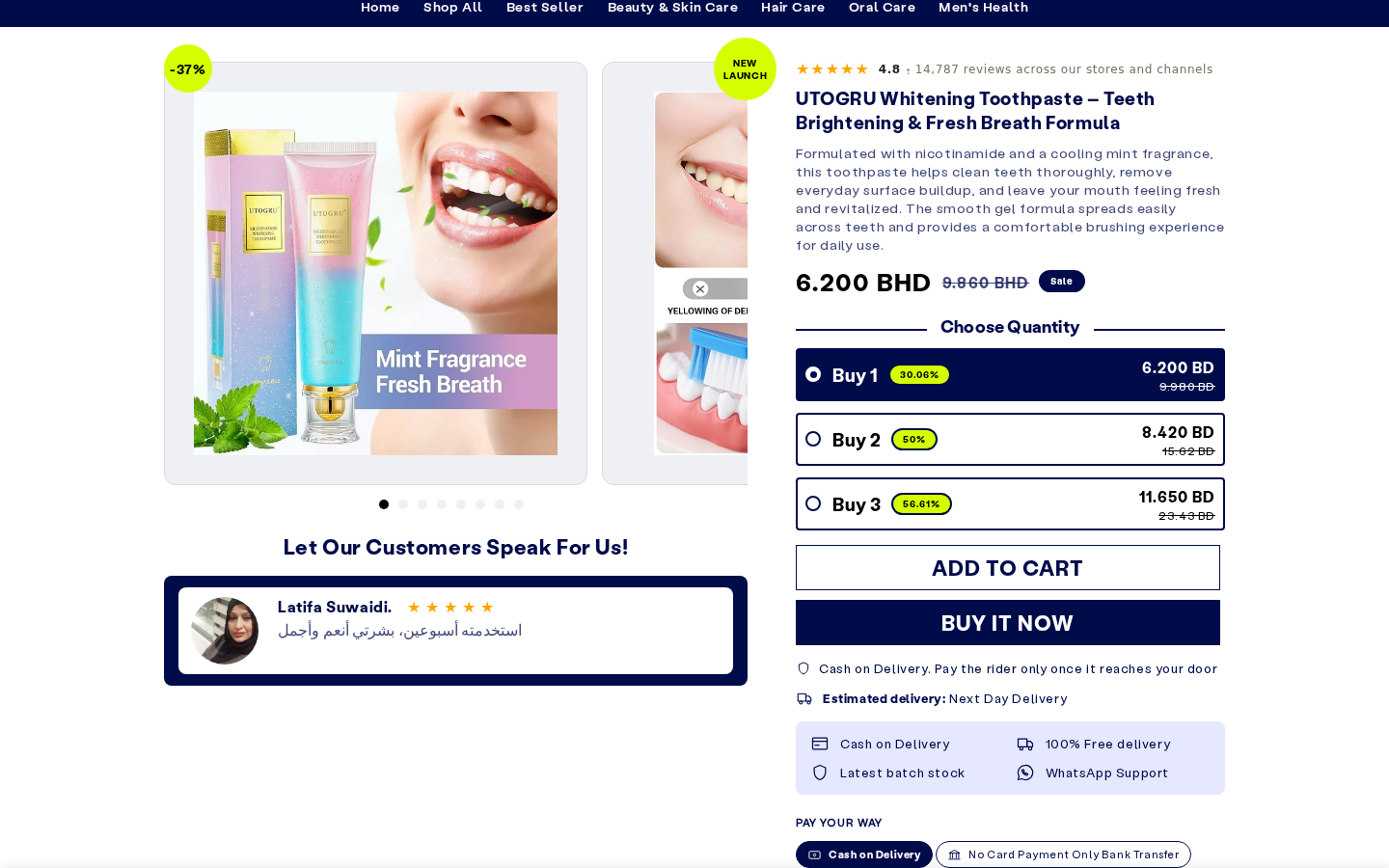
We examined the UTOGRU listing on Asal Zindage directly. Its product panel described nicotinamide, mint fragrance, surface cleaning, and fresh breath.
That wording was more restrained than some marketplace descriptions. We should not attribute another seller’s strongest claim to this page merely because both use UTOGRU branding.
The review presentation was a different matter. Several comments displayed beside the offer discussed skin glow, serums, and smoother skin rather than oral care.
Further down, additional testimonials referred to facial pores, dry patches, cream texture, and fine lines. Dental comments appeared among these unrelated experiences.
Whether those comments came from real customers of other products or were inserted another way was not established. Their irrelevance to toothpaste is directly observable.
That distinction keeps the criticism precise. We can say the presentation supplies weak product-specific evidence without claiming to know how every testimonial was created.
The page’s upper rating referred to 14,787 reviews across stores and channels. Another purchase element displayed 2,431 reviews without resolving how the two counts related.
A shopper scanning quickly could read these numbers as reassurance about the toothpaste. The broader rating label needs to remain part of that interpretation.
A meaningful review record would let readers identify the product, purchase status, date, and relevant experience. A high count on its own supplies none of that detail.
Whitening, Enamel, and Cavity Protection Are Different Claims
Start with what you want a toothpaste to do. Removing surface discoloration is a cosmetic goal; preventing decay is a dental-health goal.
The American Dental Association explains that whitening toothpastes mainly address surface stains. That is different from bleaching deeper tooth color.
A brightly photographed smile does not tell you which effect occurred. Lighting, camera settings, cleaning, and existing dental work all complicate visual comparisons.
Nor does a cleaner appearance demonstrate that enamel has been restored. Claims about rebuilding or strengthening teeth require their own evidence.
The ADA’s toothpaste guidance states that products carrying its cavity-protection Seal must contain fluoride.
This does not mean every toothpaste without fluoride is counterfeit. It means a fluoride-free label is not a reason to assume equivalent cavity protection.
Some reviewed UTOGRU listings combined fluoride-free positioning with anticavity language. Buyers should ask which active ingredient supports that benefit and what testing demonstrates it.
Niacinamide’s popularity in skin care cannot answer that question. Evidence for one ingredient, in one type of product, does not automatically transfer to a different use.
The same caution applies to coconut oil, plant extracts, and appealing fragrance descriptions. A familiar ingredient list is not a clinical performance report.
Ask for evidence about the finished toothpaste at the concentration actually sold. A study of an isolated ingredient may not reflect the final formula or normal brushing.
If you have sensitivity, persistent bleeding, pain, or unexplained tooth changes, discuss those symptoms with a dentist. Advertising should not determine their cause.
How the UTOGRU Buying Journey Works
Step 1: A recognizable tube creates a sense of familiarity
The gradient-colored packaging makes UTOGRU easy to recognize across listings. Repeated appearances can make a shopper feel they are seeing one established, consistent offer.
In practice, each listing may come from a different merchant. The storefront, payment recipient, formulation description, and return process still need checking.
Do not assume that a familiar product image authenticates a new seller. Match the actual tube, volume, ingredients, and responsible company with the listing.
Step 2: Benefits accumulate as the product is resold
One page emphasizes fresh breath. Another adds gum support. Another describes cavity protection or enamel repair. The shared brand name can hide those differences.
We found that variation while comparing seller and marketplace descriptions. It prevents a single broad verdict about what every UTOGRU offer promises.
Save the exact claim that influenced your purchase. If the product does not match its description, that wording is more useful than an unrelated advertisement.
For medical-sounding benefits, request the relevant label and evidence before ordering. The burden should not fall on the customer to infer a treatment effect from attractive packaging.
Step 3: Reviews and bundles shorten the decision
The Asal Zindage listing combined star ratings, customer comments, discount labels, and one-, two-, and three-item choices around the buying area.
In our capture, the one-item option was selected. We did not observe a forced multi-item order or a change in quantity after payment.
The capture displayed prices in Bahraini dinars, including 6.200 BHD for one item. Earlier indexed information showed a different regional offer, illustrating why live context matters.
Those amounts must not be presented as US prices. Check the storefront’s current currency, delivery country, and final total rather than relying on a search snippet.
The relevant question is what you are actually agreeing to purchase. A large discount badge does not explain the evidence behind the product or improve refund protection.
Step 4: Payment and delivery terms belong to the seller
The reviewed page promoted cash on delivery and also displayed bank-transfer wording. We did not submit an order to determine the available final payment choices.
Ask which method applies in your location. Cash on delivery does not automatically mean you can open, evaluate, and return the product before paying.
For a bank transfer, clarify the recipient and available dispute options before sending money. Do not assume the protections are identical to those of a card purchase.
A marketplace order may offer a different dispute process from an independent storefront. Preserve the transaction inside the platform where you agreed to buy.
Step 5: The delivered label becomes the crucial reference
When the package arrives, compare it with the listing before use. Check the brand spelling, tube size, seal, batch information, and ingredient panel.
Different flavor descriptions or product photos do not automatically prove counterfeiting. They do justify asking whether you received the exact advertised variant.
If the package lacks usable identification, photograph it and request clarification. Keeping the original box can help resolve both product questions and return disputes.
Do not infer an automatic subscription from this product category. Our inspected offer did not establish recurring billing, and no renewal transaction was tested.
Who Is Responsible for the Product and the Order?
The brand and the retailer are separate identities
The direct listing we captured operated under Asal Zindage. Other UTOGRU offers appeared on marketplaces, with seller details specific to each listing.
A TikTok Shop listing named a Chinese trading company as its seller. That identifies the merchant for that offer, not the manufacturer of all UTOGRU products.
For your order, record the storefront name, receipt issuer, and payment recipient. Ask the retailer to explain any mismatch before treating the transaction as verified.
Words such as official or original are claims too. They need a traceable connection to the brand owner or responsible supplier.
An address must be tied to a specific role
A seller’s registered address, dispatch location, and approved return destination may differ. None should be treated as the factory address without supporting documentation.
We did not independently authenticate a manufacturer for the captured tube. Nor did we verify an authorized return address for the direct offer.
That information gap is relevant because a buyer needs someone accountable for the product and a usable route for resolving an order problem.
It is not proof that an address is invented. Request the missing information and assess the answer against the actual receipt and package.
Support promises need an accessible process
The captured page advertised WhatsApp support and next-day delivery. Those are seller representations; we did not test a support conversation or delivery.
Before ordering, locate the full return policy and ask whether opened oral-care products are eligible. Generic easy-return language may not answer that question.
Get a written response for the item and destination involved. Avoid relying on a policy from another shop selling the same brand.
If support redirects you away from a marketplace, keep a copy of the conversation there. A platform’s order record can be important in a later dispute.
Manufacturing claims require more than a country name
The available evidence does not establish a single production source for every listing. Resellers can use shared images while describing products differently.
Country of sale or seller registration does not settle safety or quality. The useful information is the responsible manufacturer, complete ingredients, batch traceability, and relevant testing.
Check whether a claimed certification names this exact product and can be verified with the issuing organization. A decorative badge is insufficient.
We did not conduct laboratory testing, authenticate every package, or prove AI generation of the advertising images. None of those claims is necessary to explain the observed marketing problems.
What to Do If You Bought UTOGRU Toothpaste
-
Identify your actual seller. Open the receipt and record the order number, date, amount, currency, and merchant. Distinguish a marketplace from its individual vendor.
Keep the product-page address too. A complaint to a different UTOGRU retailer may lead nowhere because it did not handle your payment.
-
Preserve the claim that mattered. Save the description, ingredient picture, refund wording, and any relevant messages. Photograph the unopened package when it arrives.
Highlight specific discrepancies, such as a different variant or missing label information. A concise documented issue is easier to assess than a general accusation.
-
Clarify the formula before replacing your usual toothpaste. Show the ingredient panel to your dentist if the product’s cavity-protection or sensitivity claims are unclear.
Do not assume that a pleasant taste or immediate clean feeling demonstrates long-term dental benefits. Keep professional advice central to decisions about an existing condition.
-
Request return instructions early. Explain the problem and ask for the deadline, item eligibility, return address, postage responsibility, and expected refund.
Do not open additional tubes while eligibility remains unresolved. Keep the seller’s written response and use tracked shipping if an authorized return is required.
-
Escalate through the payment channel when necessary. For an unresolved order, ask the marketplace or payment provider about its dispute procedure and evidence requirements.
State the issue accurately: non-delivery, incorrect item, description mismatch, or an unauthorized payment. Do not describe an authorized purchase as unauthorized merely because you regret it.
-
Take irritation or dental symptoms seriously. Stop using a product that causes a concerning reaction and seek appropriate professional guidance.
Bring the tube, packaging, and ingredient information. A review page cannot determine whether a symptom comes from the toothpaste or an unrelated dental problem.
-
Report misleading listings with specific examples. A screenshot showing skin-serum comments beside toothpaste is more informative than an unsupported allegation about invented customers.
Use the platform’s reporting process and describe the mismatch. If posting publicly, separate what you observed from what you suspect.
Frequently Asked Questions
Is UTOGRU whitening toothpaste definitely a scam?
That blanket conclusion is not established. We found questionable review presentation and claims requiring verification, but different sellers must be assessed separately.
Are niacinamide and nicotinamide different ingredients?
They are names for the same form of vitamin B3. Neither spelling, by itself, proves that a toothpaste delivers its advertised whitening or cavity-prevention results.
Can whitening toothpaste repair cavities?
Do not treat a whitening claim as a cavity-treatment claim. Ask a dentist about suspected decay rather than trying to resolve it through a shopping-page promise.
Why were skin-care reviews shown beside UTOGRU?
The reviewed seller page mixed those comments with dental testimonials. We could verify the mismatch, but not the origin or authenticity of each review.
Does buying UTOGRU automatically enroll me in refills?
We did not establish an automatic refill arrangement for the inspected offer. Check your own checkout and receipt instead of assuming all toothpaste listings use subscriptions.
Does a Chinese seller mean the toothpaste is unsafe?
No. A seller’s location does not establish product safety. Evaluate the exact formula, responsible manufacturer, traceable batch, and evidence supporting the advertised benefits.
The Bottom Line
UTOGRU whitening toothpaste should be judged by its exact label and seller, not the repeated imagery or volume of stars surrounding it.
The mismatched testimonials and varying dental claims warrant caution. Hold off when product identity, evidence, or return eligibility remains unclear, and protect your established dental-care routine.








