

A designer item costs noticeably less on SENSER. The brand looks familiar, the storefront looks polished, and the saving makes another purchase tempting.
Before treating that price as a bargain, check what changing your mind could cost. Our SENSER review starts with the numbers behind that decision.
Overview
The return deduction can swallow a substantial saving
SENSER is an active fashion platform. The major finding is a published schedule of substantial per-item return and cancellation fees, not proof of a fake store.
On October 9, 2026, its US-priced policy listed $36, $98, $180, or 30% deductions depending on an item’s final payment amount.
That changes the buying decision. A lower advertised price may stop looking attractive once you factor in an uncertain fit or an unwanted item.
We would avoid a speculative order, especially multiple sizes, unless you understand and accept the precise deduction for each item.
The cancellation window has important conditions
The Orders and Shipping page describes a full refund for cancellation within 24 hours when the order has not been confirmed.
Later cancellation attracts the published fee schedule. Shipment interception can add complexity, and a failed interception leads to delivery and a possible return request.
Do not assume that a fast cancellation message is automatically accepted. Preserve the order state and ask for written confirmation of what the seller has done.
What shoppers need to establish before checkout
- The amount charged for each item, after discounts and in the actual checkout currency.
- The potential deduction for returning each unwanted item.
- Whether the item carries a final-sale designation.
- Who is responsible for a defect, wrong item, or authenticity complaint.
- The deadline and method for initiating an eligible return.
We reviewed public conditions and the live storefront. We did not purchase, authenticate a designer item, or test the handling of a real return.
SENSER Return Fees: Work Out the Exit Cost First
The fee is calculated per item
The reviewed US schedule applies the following deductions to ordinary returns, based on each item’s final paid amount:
- $600 or less: $36 per item.
- More than $600 but below $1,200: $98 per item.
- $1,200 or more but below $2,800: $180 per item.
- $2,800 or more: 30% of that item’s final payment.
It describes the fee as covering international transport and inspection, with original shipping nonrefundable. Platform-error or quality-related returns are described as exempt.
That exemption is important. An ordinary change of mind and a wrongly supplied item should not be treated as interchangeable problems.
Ask which reason support has assigned to your request. If you dispute the classification, explain the factual mismatch and request a written explanation of the deduction.
A small price difference can change the fee sharply
Using the published schedule, an illustrative $600 item falls in the $36 tier. A $601 item falls in the $98 tier.
That $1 difference in purchase price changes the stated deduction by $62. Compare your final line-item price with the boundary, not just the advertised category.
A hypothetical $3,000 item would face a $900 ordinary-return deduction at 30%, before considering original delivery costs.
These examples explain the policy arithmetic. They are not purchases we made, fees we paid, or findings that a particular deduction is legally enforceable.
Buying several sizes multiplies the exposure
Suppose you order three $200 items and return two because of fit. The stated ordinary-return deductions would total $72, rather than one $36 order-wide fee.
Many shoppers are accustomed to ordering alternatives and sending most back. That habit is expensive under a per-item fee structure.
Use measurements and construction details to narrow the choice before buying. If uncertainty remains, compare a seller that provides clearer or less costly return flexibility.
How the SENSER Ordering Journey Works
Step 1: Familiar designer names establish the appeal
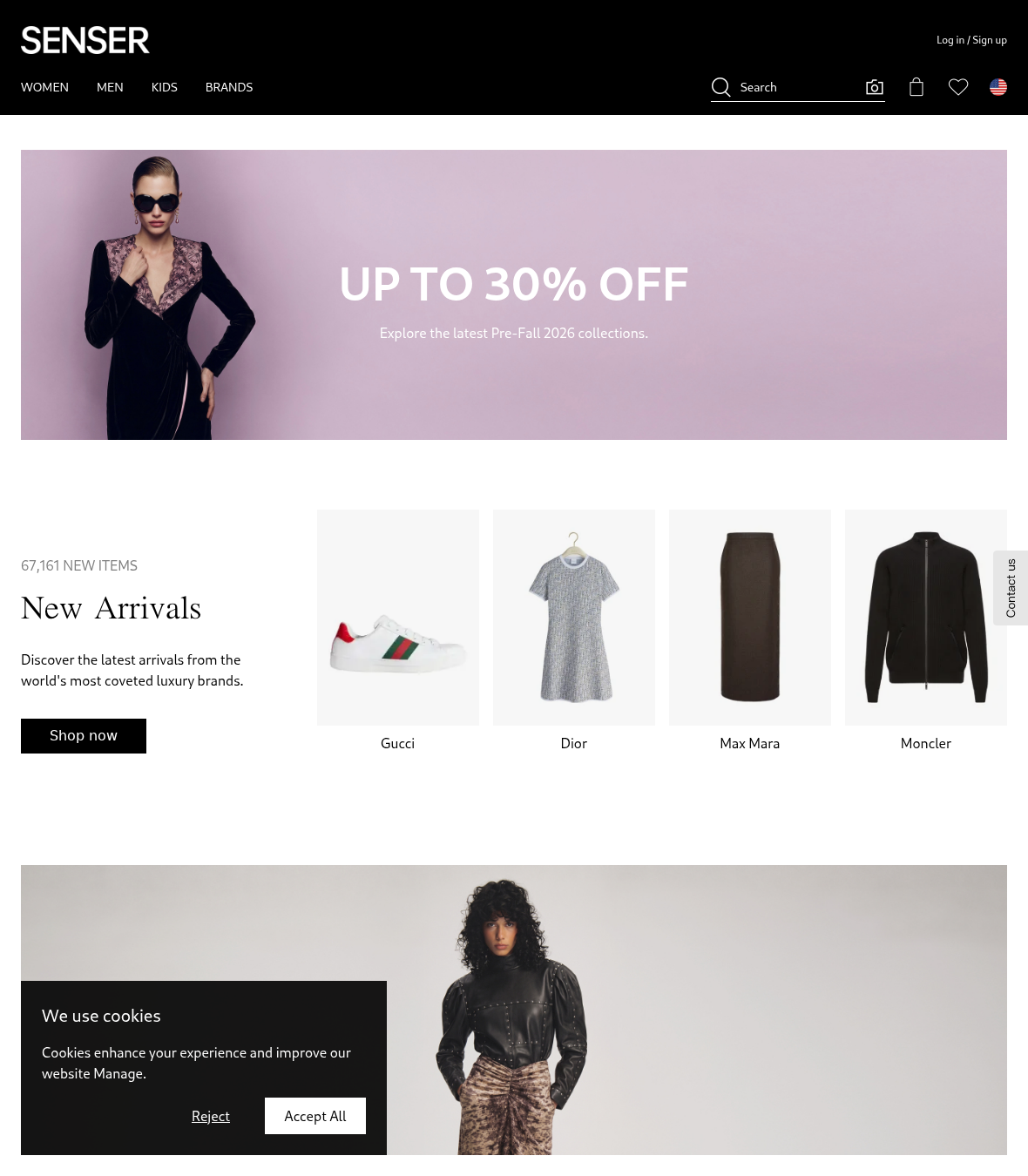
The homepage displays recognizable fashion labels and discount-led merchandising. Seeing a known designer can make the unfamiliar retailer fade into the background.
But the brand on a shoe is not the business taking your payment. Check the retailer’s conditions separately from the designer’s own store policies.
Preserve the product identifier, specifications, size system, and any authenticity assurance. A copied model name alone is insufficient to compare two listings reliably.
For footwear, confirm whether the measurements refer to the same regional size standard. Guessing from a number can lead to a costly ordinary return.
Step 2: The displayed saving needs a complete comparison
Compare the exact model and total delivered price. A cheaper listing may exclude services or flexibility that another retailer includes.
Account for the possible exit cost as part of your purchase budget. It is a real commercial condition, even if you hope never to use it.
Record currency and item-level discounts at checkout. Do not convert a policy amount from one locale into another currency without checking the applicable version.
Look for final-sale wording before paying. A promotion is not proof of final sale, and a return policy for ordinary items does not override a specific exclusion.
Step 3: Confirmation and dispatch affect cancellation
SENSER’s cancellation wording refers both to time and confirmation state. If you notice a mistake, act immediately rather than assuming 24 hours is an unconditional grace period.
Use the cancellation control shown for the order and save the result. A message saying your request was received is different from an accepted cancellation.
After shipment, the merchant describes attempting interception. Ask whether that succeeded and which charge it proposes instead of treating the initial request as completion.
If delivery proceeds, inspect the item under the applicable return rules. Refusing a parcel without instructions may complicate tracing and does not guarantee your preferred refund.
Step 4: The package needs a careful first inspection
Keep the outer box, product packaging, tags, and security seals. Photograph the condition before removing anything or using the item beyond a careful inspection.
Check that the model, size, accessories, and supplied documentation match the order. Missing parts can be important when distinguishing an ordinary return from incorrect fulfillment.
For a suspected authenticity issue, seek evidence specific to that model. A low price, unfamiliar shipping origin, or an online comment does not independently prove a counterfeit.
If professional authentication is appropriate, ask about its limitations and reporting format. Do not alter or dismantle goods merely to create material for a complaint.
Step 5: The return request determines the next practical move
The help policy gives 14 days to initiate an eligible return and says arrival at the return center may occur later. Keep the request timestamp.
Ask for the authorized shipping method, destination, and expected deduction before sending. Then preserve the carrier handover and delivery records.
For a defect or platform error, state the issue accurately and ask whether the fee exemption applies. Include photographs that connect the problem to your order.
Do not conceal wear or submit unrelated images. Honest, specific evidence gives a genuine complaint a clearer basis than escalating accusations.
SENSER Company, Contact, and Product Checks
The terms name Nexchic, but also mention Onmirror
The current terms identify Nexchic Limited, described as Delaware-registered, as the operator together with affiliates.
An indemnification clause also names Onmirror Limited. That additional name deserves clarification rather than an assumption that the document supplies one unambiguous contracting entity.
We did not independently verify those entities’ registration status. Ask which legal seller appears on the invoice and accepts responsibility for your specific order.
The returns route must match your transaction
An international return fee does not identify the actual destination or every warehouse involved. Use the address assigned through the approved order process.
For an expensive item, confirm who bears risk during return transport and what insurance the supplied method provides. Keep proof of the parcel’s contents and handover.
A registered office, dispatch location, and inspection center perform different jobs. Do not send valuable goods to one simply because it appears somewhere on a legal page.
Use the merchant’s own contact route
The Help and Contact page identifies support@senser.net. We found a published channel, not independently tested response performance.
Keep correspondence in one order thread where possible. Include the order number and requested outcome, while excluding unrelated payment credentials or account passwords.
If contacted elsewhere by someone claiming to arrange a refund, verify through your existing order account. Do not pay a separate person to release your money.
A listing does not authenticate the individual item
Designer names on the homepage establish what SENSER advertises. They do not, on their own, verify a brand-authorized relationship or every item’s provenance.
Ask for product-level assurances, the applicable invoice, and the remedy if supplied goods fail the description. Preserve those representations before placing a high-value order.
Nothing checked establishes that all SENSER goods are counterfeit or manufactured in China. The documented concern here is costly exit terms and operator clarity.
What to Do If You Ordered From SENSER
Start with your actual order state. A cancellation, non-delivery, defect, and simple change of mind require different evidence and may have different outcomes.
For a multi-item purchase, create a separate record for each item. Link its price, return reason, photographs, and proposed deduction rather than treating the basket as one problem.
That also prevents arithmetic mistakes. If one product qualifies for a fee exemption while another does not, ask for an itemized settlement.
Keep both the original quoted deduction and any revised calculation. A later correction should identify what changed, not leave you guessing which figure will reach your account.
If you accepted a replacement or partial settlement, record its scope. Clarify whether another unresolved item remains open instead of assuming the entire order has been settled.
When escalating, lead with the invoice and specific disagreement. A concise table of dates and amounts helps more than a general argument about the platform’s reputation.
-
Calculate the stated deduction. Use the amount paid for each item and the policy version shown for your locale. Save the calculation with your invoice.
Ask whether shipping, processing, or another adjustment is additional. If support quotes a different amount, request the basis in writing before agreeing.
-
Act immediately on order mistakes. Submit cancellation through the available account control and record the order status, time, and confirmation screen.
Request an explicit accepted-cancellation message. If an interception is pending, ask when you will be told whether it succeeded and what happens if it fails.
-
Document delivery before removing tags. Photograph the item, identifiers, packaging, and any obvious problem. Keep the original accessories together.
For shoes, try them on a clean indoor surface. Do not turn a sizing check into visible wear that gives the seller another reason to reject an ordinary return.
-
Choose the accurate return reason. Explain a wrong model or defect with the listing and photographs. If you changed your mind, say so.
If a platform-error case receives an ordinary-return fee, ask for reconsideration against the stated exemption. Request the explanation and the net refund figure.
-
Preserve your timely request. Initiate it within the published window and save the acknowledgment. Clarify the dispatch instructions and any deadline for posting back.
Do not confuse a request deadline with warehouse arrival. If support conflates them, point to the applicable wording and ask how it will handle your documented submission.
-
Return through the authorized route. Retain tracking, a parcel receipt, and photographs of the packaged contents. Use appropriate declared value or insurance where instructed.
The help policy describes holding rejected goods for six months before disposal. If a return is refused, promptly ask about collection and the reason for rejection.
-
Escalate a genuine unresolved dispute. Present your issuer with the invoice, representations, correspondence, and delivery evidence. Ask which protections and deadlines fit the actual issue.
A deduction you knowingly accepted is not automatically an unauthorized charge. A wrongly supplied item, missing delivery, or unissued agreed refund needs its own accurate explanation.
Frequently Asked Questions
Is SENSER a confirmed scam?
The checked evidence supports a buyer-risk investigation, not that accusation. The substantial fees and unclear entity references are concrete reasons to scrutinize an order.
How much can a SENSER return cost?
The US schedule reviewed uses per-item tiers from $36 through a 30% deduction. Check the applicable currency, paid item value, and reason before calculating your refund.
Are defective SENSER items charged the same return fee?
The help page describes an exemption for quality or platform-error returns. Document the issue and ask for written classification rather than assuming the exemption has been applied.
Can I cancel a SENSER order without a fee?
The published offer is conditional on timing and confirmation state. Act promptly and obtain acceptance. Later or shipped cancellations can involve fees or unsuccessful interception.
Does a designer label on SENSER prove authenticity?
No. A homepage listing is not independent authentication. Check the exact item’s documentation, seller representations, and remedy if it fails those representations.
Is buying multiple sizes a sensible way to shop?
Not without budgeting for each return. Per-item deductions can consume a discount quickly. Narrow the size choice or use a retailer with less costly return flexibility.
The Bottom Line
This SENSER review found that the return price can matter almost as much as the purchase price. Calculate it before treating a designer discount as a bargain.
Do not place an uncertain high-value or multi-size order without accepting the exit costs. Existing buyers should document the order and pursue the remedy matching its actual problem.








