

You need a digital gift card quickly, and Dundle promises a convenient way to get it. A few clicks seem easier than visiting a store.
But convenience is only part of the decision. This Dundle review looks at what happens when the code, payment, or verification does not go as expected.
Overview
Dundle is a retailer, not a confirmed scam operation
Dundle sells digital vouchers and gift-card codes under the trading name of Korsit B.V. Our investigation did not establish that the service is fraudulent.
That does not make every purchase risk-free. The current terms contain restrictive provisions about delivered codes, incomplete payments, and orders awaiting customer verification.
The practical verdict is straightforward: use it only when you understand the specific product and conditions. Do not buy under pressure from someone demanding a code.
Instant delivery has an important qualification
The terms checked on October 9, 2026, allow verification before or after payment. An order can be delayed while the requested checks remain incomplete.
They describe cancellation and retention of paid funds after two months without successful verification, subject to applicable law, merchant-fault exceptions, and possible discretionary relief.
That is a serious condition to read before making a purchase you cannot afford to leave unresolved. It is not a finding that every customer faces it.
The issues to resolve before spending
- Whether the code fits the recipient’s account country and currency.
- The final price, including any service or payment-method charge.
- Whether the transaction may require verification you are prepared to complete.
- What assistance is available for a code that does not redeem.
- Who asked you to buy the card and why they want its code.
We reviewed the public policies without buying a code or submitting identity documents. No purchase, verification, or refund outcome was personally tested.
Where the Real Dundle Purchase Risks Sit
Buying the wrong region is not the same as receiving an invalid code
Dundle’s refund policy says purchased and delivered digital codes cannot ordinarily be returned, while offering help with redeemability problems.
That distinction matters. A valid code for the wrong country can fail on your account without proving the retailer sold an unusable code to everyone.
Check the account’s region with the issuing service before paying. Your current location, billing currency, and account country may be different pieces of information.
Do not assume a page’s country flag answers every compatibility question. Read the product’s redemption conditions, especially when buying for someone in another country.
If a seller-supplied description was wrong, save that description. A documented misdescription is different from accidentally choosing a correctly labeled product.
The face value and checkout price are different numbers
The retailer’s terms describe service charges and payment-provider fees. Review their actual display before completing payment rather than assuming the card’s value equals the charge.
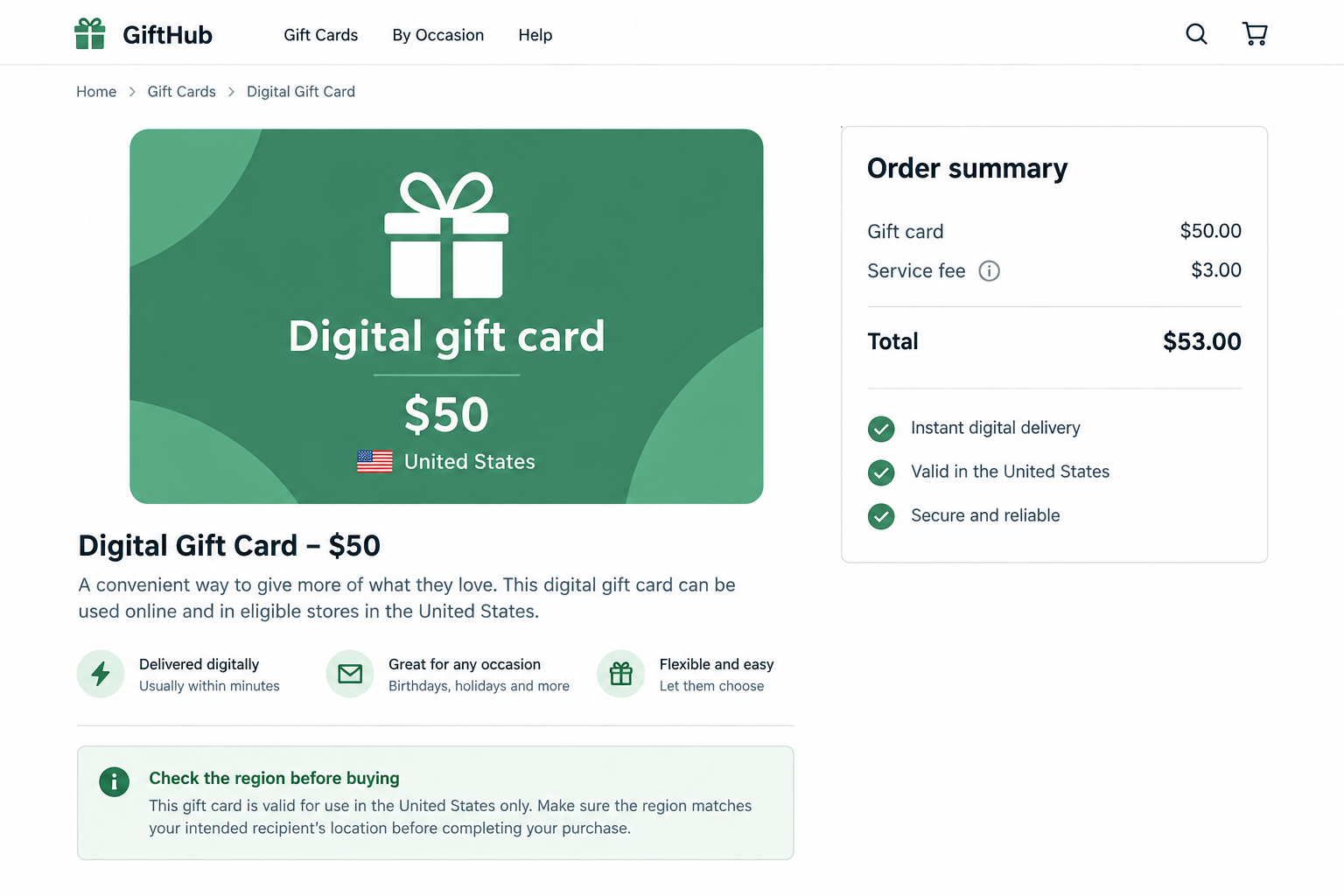
The header illustration uses a fictional $50 card, $3 fee, and $53 total to explain this distinction. Those are not a Dundle price quote.
Compare the total with purchasing directly from the issuer where available. Convenience may have a cost even when the digital product itself is genuine.
If you change payment method, check the total again. Keep the final summary so a later question can be connected to the transaction you actually authorized.
Verification can leave a paid order pending
The current terms describe checks involving identity, source of funds, and intended use. Delivery can wait for their completion.
Security screening is not inherently fraudulent. The buyer-risk question is whether the requested information, deadline, and consequences were understood before spending.
Ask what is outstanding and how to use the genuine secure submission route. Do not send documents to a stranger who approaches you outside the merchant’s support process.
If the verification tool malfunctions, document the error immediately. An unresolved technical problem needs evidence before the merchant’s stated closure period expires.
A troubleshooting clause raises a separate privacy question
Clause 5.4 requests relevant redemption evidence and says customers must provide digital access to their device to investigate a defect.
That wording does not describe the exact access method. Ask for its scope, safeguards, and alternatives before agreeing to any device-access request.
A published clause is not a reason to hand over bank credentials or leave an unknown person controlling your computer. Verify the support route independently.
How a Dundle Gift-Card Order Works
Step 1: Choose a code for a specific use
Start with the recipient’s intended purchase, account region, and eligible product. A gaming balance, shopping voucher, and prepaid payment product have different restrictions.
Confirm the amount needed and whether the issuer permits the intended use. Do not buy several small codes without checking whether they can be combined.
A familiar issuer logo identifies the product being offered. It does not make every message directing you to that product trustworthy.
If someone says buying a voucher is necessary to unlock a refund, settle a tax bill, or receive a prize, stop before continuing.
Step 2: Review the complete transaction
Read the selected denomination, region, currency, delivery email, and all charges. A typing error in the recipient address can complicate delivery and expose a code.
Separate the code’s stored value from the amount leaving your payment account. Save both numbers and the final consent screen.
Check what the retailer says about immediate digital delivery and withdrawal consent. Buying a code is not the same as buying a physical item you can post back.
Do not rush because another person is waiting on the phone. The point of purchase is where a correctable misunderstanding can become a paid digital transaction.
Step 3: Payment does not guarantee that every check is finished
After payment, distinguish a confirmation from a delivered code. Record the order reference and the status shown through the retailer’s own site.
For a held order, ask whether the issue is verification, incomplete payment, or another review. Those are not interchangeable explanations.
The terms separately address partial payments and possible retention after two months without completion. Do not send extra money simply because an unverified message demands it.
Have genuine support reconcile the exact total paid with the amount due. Preserve any payment reference without publishing sensitive financial information.
Step 4: Redeem only through the issuing service
Once received, use the issuer’s official website or application. Never paste the code into an unfamiliar balance checker found through a sponsored search result.
If redemption fails, capture the precise error without exposing the usable code publicly. Check spelling, region, and product type before making another purchase.
A short support message containing the order reference and error is more useful than repeatedly buying replacements in the hope one works.
Ask the issuer whether it can determine the status of the particular code. Different issuers have different tools, so do not assume every balance can be checked identically.
Step 5: Keep the code private or give it only to the intended recipient
A gift-card code is spending access. Sending a screenshot or the characters to another person may let that person redeem it before you can intervene.
The retailer cannot make an unrelated caller legitimate. A real digital product can become the payment instrument in a scam operated by someone else.
For an intentional gift, verify the recipient through your usual channel. An unexpected message from a supposed colleague requesting urgent cards deserves an independent callback.
Dundle Company, Address, and Code-Supply Checks
The public terms identify Korsit B.V.
Dundle identifies its operator as Korsit B.V. and publishes Dutch Chamber of Commerce number 69094438 and VAT identifier NL857730824B01.
Those are useful transaction identifiers. We did not obtain an independent current registry extract, so this article does not certify every registration detail as externally authenticated.
Match the invoice and charge to the merchant you intended to use. A separate site with a similar name requires its own verification.
The Dutch address is a company disclosure, not a place to return codes
The published address is Zwembadweg 12, 5611 KS Eindhoven, the Netherlands. We did not inspect the premises or establish its day-to-day operational role.
A digital-code dispute is handled through transaction records, not by mailing a printed code to that address. Do not expose it in unsolicited correspondence.
Keep the operator information for a formal complaint if needed. A postal address is useful identification, not proof that a purchase will qualify for a refund.
Use support linked from the real site
The terms publish support@korsit.com, while the refund page directs users to its contact form. Use the route attached to your actual order.
We did not submit a customer-service ticket. A publicly listed contact cannot substantiate an assertion that support always answers or never answers.
If correspondence requests information beyond the order, confirm its purpose and submission route. Never supply a bank login or card-security code to arrange a refund.
The retailer and the voucher issuer have different responsibilities
A retailer sells access to a digital product; its issuer controls the account and redemption environment. A problem may require information from both.
Ask who can verify code delivery, validity, and redemption status. Keep the same order reference across support conversations to avoid disconnected investigations.
Do not treat an issuer logo as proof that the retailer controls the issuer’s policies. Similarly, an account restriction is not automatically evidence of an invalid voucher.
A Real Retailer Can Be Used by a Gift-Card Scammer
The dangerous part may begin before you visit Dundle. A caller invents an urgent problem, then directs you to buy a genuine gift card.
The FTC warns about callers and messages that demand gift-card numbers or PINs as payment for invented problems.
Common pretexts involve tech support, an urgent family emergency, a government demand, or a prize fee. A genuine card purchase does not make that story genuine.
If someone demands secrecy or dictates where and how to buy, independently verify the supposed problem. Do not rely on the contact details that person provides.
Contact the issuer immediately if you already shared the code. Ask whether any balance remains and can be protected, without assuming recovery is guaranteed.
What to Do If Your Dundle Order Has a Problem
-
Classify the problem accurately. Identify missing delivery, verification hold, wrong region, redemption error, unexpected charge, or a code shared with a deceptive third party.
That distinction determines what evidence is needed. Calling every failed redemption an unauthorized payment makes a genuine complaint harder to evaluate.
-
Preserve the receipt and status. Keep the order reference, denomination, region, charge total, delivery email, and messages. Redact usable codes in public screenshots.
For non-delivery, check the correct inbox and spam folder. Confirm that your payment reference matches this order rather than a separate attempted purchase.
-
Resolve verification questions promptly. Ask which requirement remains and the exact deadline. Use the legitimate secure channel if you choose to supply the necessary information.
If you cannot or do not wish to complete it, request the available cancellation or refund options in writing. Do not leave a held order unattended.
-
Document technical barriers. Save the error, date, and support response if a verification form or payment step fails. Request acknowledgment of the problem.
Ask how the stated technical-issue exceptions apply. Do not assume the merchant will know why a process stopped unless you report it with usable evidence.
-
Ask for code-specific assistance. For redemption failure, provide the exact error and relevant account region through a private support route.
Do not post the full code on a forum or send it to an unofficial helper. Anyone who sees spending credentials may be able to use them.
-
Act immediately if a scammer received the code. Contact the voucher issuer and retailer with the receipt. Ask whether the value can be frozen or recovered.
Stop communicating with the person demanding payment, preserve their messages, and report the deception through the appropriate official channel. Do not pay an additional recovery fee.
-
Escalate a documented unresolved transaction. Request a written final explanation and ask your payment provider about available dispute routes and deadlines.
Be precise about authorization, code delivery, and any redemption. Neither a card dispute nor the retailer’s policy guarantees an outcome for every digital purchase.
Frequently Asked Questions
Is Dundle a confirmed scam website?
That was not established. It is a digital-product retailer with disclosed operator information. Restrictive conditions and a third-party gift-card scam should be assessed separately.
Can I return a delivered Dundle code?
The reviewed policy generally excludes ordinary refunds after delivery. A code that fails to redeem deserves a specific support investigation, not an automatic assumption of buyer error.
Why might a paid Dundle order be delayed?
The terms permit customer verification. Ask genuine support what is outstanding, which deadline applies, and what happens if you cannot complete the process.
Does a gift card always cost exactly its face value?
No. Check the final transaction for service and payment-related charges. Compare the full amount, not just the denomination displayed on the product tile.
Should I buy a code to get a refund from a caller?
No. A caller demanding gift-card payment to release a refund is a scam warning. Verify any supposed account issue through the real service independently.
What if I already sent the code to someone?
Notify the issuer and merchant immediately, preserve the receipt, and ask whether remaining value can be secured. Recovery is uncertain, but delaying helps the recipient use it.
The Bottom Line
This Dundle review found meaningful transaction restrictions, especially for verification holds and delivered codes. Read them before treating instant delivery as an unconditional promise.
Buy only a compatible product for a verified purpose. If an order stalls, address it promptly. If someone demands your code to solve a problem, stop and verify independently.








