

Your withdrawal is waiting, and a new message says the exchange needs to check where your funds came from. The wording sounds official.
When money is already tied up, even a routine-looking request can feel urgent. Take a moment to understand exactly what you’re being asked to provide.
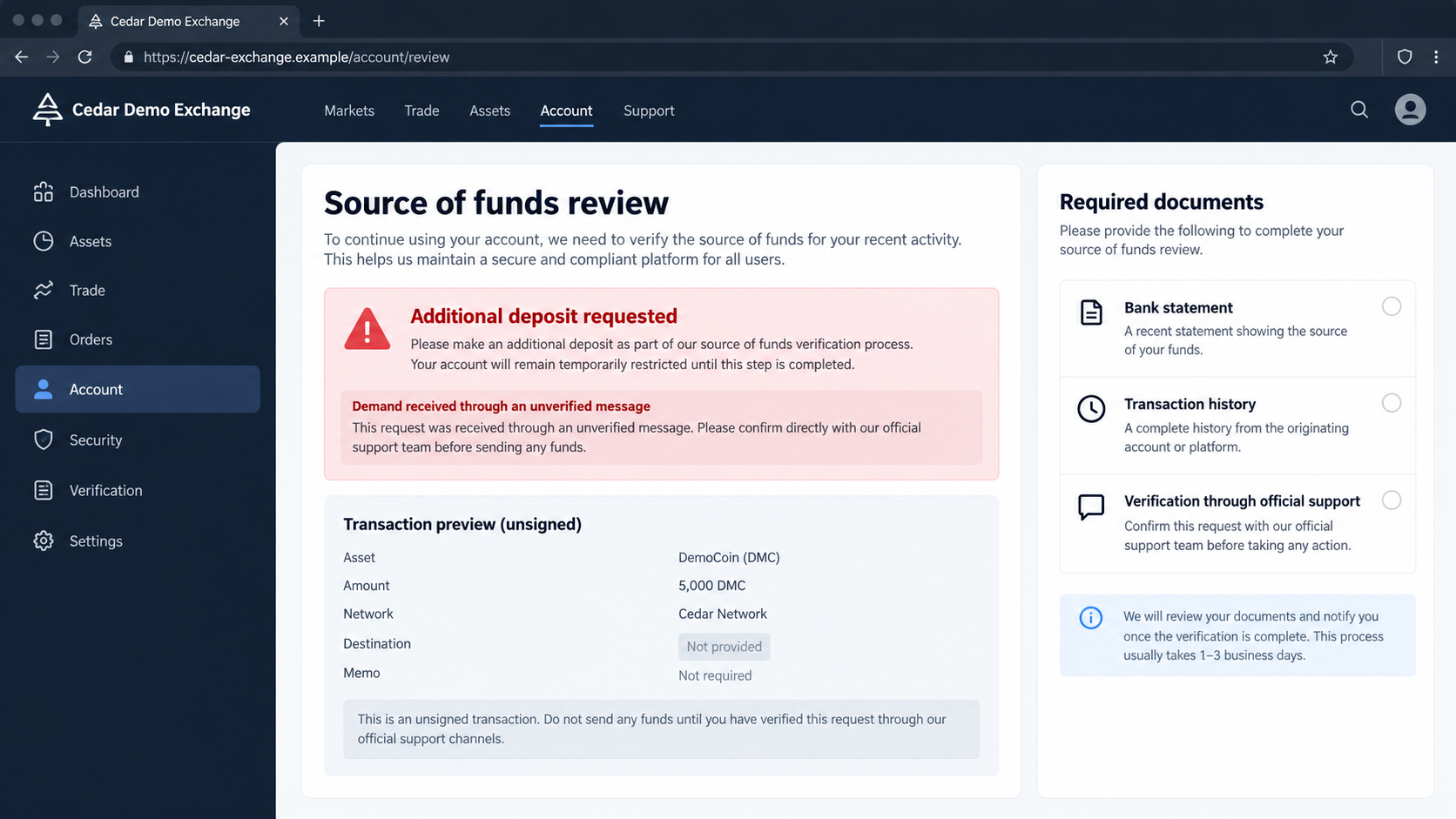
Overview
A genuine review asks you to explain existing money
A crypto source of funds request can be legitimate. Exchanges may need records showing how you acquired the money or cryptocurrency involved in a transaction.
The phrase usually concerns a particular amount. Source of wealth is a broader question about how you accumulated assets, although the requested records may overlap.
The practical distinction is between documenting funds you already own and paying a stranger to make a withdrawal possible. Those requests serve different purposes.
Criminals turn compliance language into a payment excuse
A fraudulent platform may display profits, then claim an additional deposit is necessary for compliance. Another version impersonates a genuine exchange to collect documents or credentials.
- A request visible inside an independently accessed account deserves a different assessment from an unexpected private message.
- An outside wallet supplied by a supposed compliance officer is a serious warning.
- Recovery phrases and private keys provide wallet control, not evidence of income.
- A dashboard balance cannot establish that the displayed money exists or is withdrawable.
Verify the route before sending records or money
Open the genuine exchange independently and ask its established support team about the request. Don’t use the message’s link to perform that verification.
Do not make an extra transfer to unlock alleged profits. Preserve the demand and investigate the platform before putting more money at risk.
The image uses a fictional exchange to illustrate these competing requests. It does not show a customer account or an observed charge.
What Legitimate Source of Funds Evidence Can Look Like
Coinbase publishes examples of supporting records, including funding-account statements and exchange transaction histories. Its guidance specifies secure submission routes.
The document needs to answer a particular question. A bank transfer record may establish the account that paid an exchange without explaining how the money was earned.
Likewise, a blockchain transfer can show movement between addresses while leaving the original source unexplained. Ask which part of the history remains unclear.
Suppose you bought cryptocurrency with employment savings and later moved it between exchanges. A useful explanation connects the savings, purchase, and subsequent transfers.
That is an illustrative example, not a universal document requirement. Your exchange should specify the records appropriate to your transaction and circumstances.
Keep records readable and complete enough for the requested purpose. Ask verified support before redacting material, because required identifying details can vary.
Don’t publish a bank statement in a community group to ask whether it’s acceptable. Use the provider’s secure support process for account-specific questions.
A legitimate request can still be inconvenient or unclear. Confusion warrants clarification through official channels, not an automatic conclusion that the exchange is fraudulent.
How the Crypto Source of Funds Scam Works
Step 1: The platform gives you a reason to expect a payout
You may have transferred money to an investment site and watched its dashboard grow. The apparent earnings make withdrawal feel like collecting something already yours.
The FBI describes fraudulent crypto investments that use trust and apparent returns to encourage more deposits.
A small earlier payout can deepen that trust. It doesn’t establish that a larger displayed balance is backed by assets or available for withdrawal.
Step 2: A review appears when you try to withdraw
The supposed compliance team introduces an account hold. Terms such as AML, source verification, and clearance give the obstacle an administrative explanation.
A genuine exchange can also review a transaction. The existence of a delay alone is not the deciding fact.
Focus on the request that follows: what is required, who requires it, where it goes, and how you can verify it independently.
Step 3: Documentation is replaced by another payment
The fraud becomes clearer when proving the origin of funds supposedly requires sending additional cryptocurrency. The explanation may describe a refundable deposit or release charge.
Ask how that transfer would document the original source. A new payment to an unknown destination does not explain an earlier salary, inheritance, or investment purchase.
Don’t accept a promise that the fee will immediately come back. That promise is part of the disputed transaction, not independent protection.
Step 4: Pressure makes the next payment feel smaller than the loss
The requested amount may look modest beside the apparent balance. You can start comparing the fee with the payout rather than questioning whether the payout exists.
This is the point to stop calculating how much more you can afford. Investigate what the platform has actually done with the money already transferred.
A countdown or threat of account closure should not replace verification. Keep the message and ask someone outside the investment relationship to review it.
Step 5: New obstacles keep the displayed balance out of reach
Paying may bring another demand instead of a withdrawal. Repeated requests can be renamed as taxes, insurance, or additional verification.
The FTC describes fake investment websites and difficult or blocked withdrawals. Stop sending money when release depends on another unexplained payment.
Your priority becomes protecting what remains and preserving transaction evidence. Continuing the exchange rarely gives you a better position from which to negotiate.
The Other Version: A Fake Message From a Real Exchange
You don’t need to be using a fraudulent trading platform to receive a dishonest source of funds request. Impersonation can target customers of genuine providers.
The criminal’s objective might be access rather than an immediate fee. A copied upload screen can collect a password, identity document, or financial statement.
A genuine-looking email footer isn’t enough. Start a new session with your usual official app or bookmark and check for the same account task.
If nothing appears, ask support through that account. Some legitimate communications occur by email, so let verified support establish whether the request belongs to you.
Coinbase’s impersonation guidance says its agents do not request passwords, two-step codes, seed phrases, remote access, or external crypto transfers.
Keep a distinction between a service’s advertised name and the person contacting you. The real company’s existence does not authenticate an unexpected caller.
Check the Operator Before Trusting Its Compliance Team
If the platform was introduced by an online contact, return to how you found it. A relationship can make basic verification feel unnecessary.
Write down the actual domain and claimed legal operator. Search those exact details rather than only a brand name that legitimate businesses may share.
Check any claimed authorization through the regulator’s own website. Match the entity, permissions, location, and contact details rather than trusting a copied certificate.
Registration is not a guarantee that an investment is safe. It also cannot authenticate a different website borrowing the registered business’s name.
Look at how the platform explains custody and withdrawals. A chat account that merely repeats that compliance requires payment has not answered those questions.
A polished certificate attached to the demand deserves the same skepticism as the demand itself. Independently identify its issuer before relying on it.
You don’t need to solve the entire ownership structure before refusing another payment. An unexplained release deposit is enough reason to stop.
Records Worth Keeping Before the Conversation Disappears
Separate the promised investment from the actual transfers. Keep a short chronology showing when you deposited, requested withdrawal, and received each new demand.
For every completed transfer, preserve the asset, network, amount, sending service, destination address, date, and transaction identifier. Keep exchange receipts alongside blockchain references.
A screenshot of a supposed profit is useful evidence of the representation made to you. It is not evidence that an equivalent asset belongs to you.
Save messages that explain the fee and identify the proposed recipient. Capture the actual website address rather than only the page’s logo.
Don’t give a recovery stranger access to your wallet so they can gather this information. Public transaction records do not require your recovery phrase.
If you shared financial documents, record which versions and what identifying information they contained. That determines the privacy response as well as the payment response.
What to Do if You Have Fallen Victim to This Scam
-
Stop the proposed payment. Refuse verification deposits and additional release charges. Don’t borrow money or liquidate another investment to meet a compliance deadline.
If a transfer is pending, contact the sending service immediately through its genuine support route. Ask whether it can be stopped before completion.
-
Tell the real exchange or bank what happened. Provide the destination and transaction records, and explain whether the recipient impersonated support or operated a fake platform.
Completed cryptocurrency transfers are generally difficult to reverse. Still report promptly, because the provider can assess available account protections and any possible intervention.
-
Protect accounts that received an exposed password. Change the credential on the genuine service, inspect sessions, and review recovery details and withdrawal permissions.
If the same secret protected your email, secure that account as well. Do not send verification codes to the supposed compliance officer during recovery.
-
Treat a disclosed recovery phrase as wallet exposure. Consult the genuine wallet provider’s security guidance from a trusted device before handling remaining assets.
A password change alone cannot make an exposed recovery phrase private again. Avoid a stranger’s replacement wallet or instructions that require another shared secret.
-
Respond to document exposure. Identify which account numbers, addresses, identity numbers, and signatures you submitted. Ask the relevant institutions how to protect those records.
Use appropriate identity-theft reporting and monitoring routes in your country. A document upload is a privacy issue even if you never transferred cryptocurrency.
-
Address suspicious software separately. If support persuaded you to install an application or extension, stop using it and seek appropriate device checks.
Our Malwarebytes scanning instructions cover unwanted software. AdGuard can reduce harmful advertising exposure, but neither tool releases a frozen balance.
-
Report the scheme and refuse recovery fees. Submit your evidence to local authorities and, in the US, the FBI’s Internet Crime Complaint Center.
Promises to recover everything after an advance payment deserve the same refusal as the original release demand. Keep investigators’ contact details separate from unsolicited approaches.
Preparing a Safe Reply to a Genuine Review
If verified support confirms the request, ask for the specific missing information and secure upload method. Keep the explanation limited to your relevant transaction.
For example, explain that the deposit came from savings and identify the supporting records. Don’t send an entire financial history when a narrower record would answer.
Ask whether any information can be concealed before uploading. Don’t assume that blacking out identifiers will satisfy a review that depends on matching ownership.
Keep copies of your submission and support reference. That gives you a clearer basis for following up if the review takes longer than expected.
There is no universal release deadline for every provider and transaction. Ask about the provider’s process without accepting an outside payment shortcut.
A Hold and a Release Fee Need Different Complaints
For a verified exchange review, your complaint might concern a missing explanation, an upload failure, or a delay. Keep the support reference and submitted records.
For an impersonation, describe the false sender and the destination they supplied. The genuine exchange needs to know someone is using its identity.
For a fraudulent platform, describe the original deposits and subsequent withdrawal demands. Don’t let its compliance vocabulary obscure the actual payment trail.
Write what happened in ordinary language before adding technical labels. A clear sequence helps a provider understand which account and transfer it can investigate.
If you are helping a relative, ask permission to organize their records and contact the provider together. Avoid taking control of the wallet unnecessarily.
A calm review can uncover a pending transfer or missing receipt. Blame and repeated arguments with the promoter consume the time needed for those checks.
Keep copies of official responses too. A report made through a real institution should have a reference you can distinguish from later unsolicited recovery approaches.
Frequently Asked Questions
Is every crypto source of funds request a scam?
No. Genuine exchanges may request supporting records. Verify the sender and submission route through your independently accessed account before providing sensitive documents.
Does a verification deposit prove where my money came from?
No. An extra payment to an unfamiliar address doesn’t document the original acquisition. Refuse demands to send money to unlock alleged investment profits.
Can I send a wallet screenshot instead of a bank statement?
Ask verified support what evidence answers its question. A screenshot may show a balance without explaining ownership, acquisition, or the relevant transfer history.
Should I share my seed phrase with compliance staff?
Never. It can give someone control of the wallet. A legitimate review should not require surrendering the secret that controls your assets.
Does a small successful withdrawal establish legitimacy?
No. Earlier payouts can build confidence. Assess the operator and current demand rather than assuming a previous transfer proves the entire platform is genuine.
What if I already paid the release charge?
Stop additional transfers, preserve the payment trail, contact the sending provider, and report the scheme. Another fee will not make the earlier promise trustworthy.
The Bottom Line
Verify a crypto source of funds request through the genuine exchange before sharing records. Cooperate through an authenticated route when the request is legitimate.
Do not pay an outside wallet to unlock profits or complete supposed AML clearance. If you already did, stop funding the scheme and report the transfers immediately.

Join the discussion
0 commentsShare your experience or ask a question about this article.
Discussion
Start the conversation
Have a question or something useful to share? Add the first comment.