


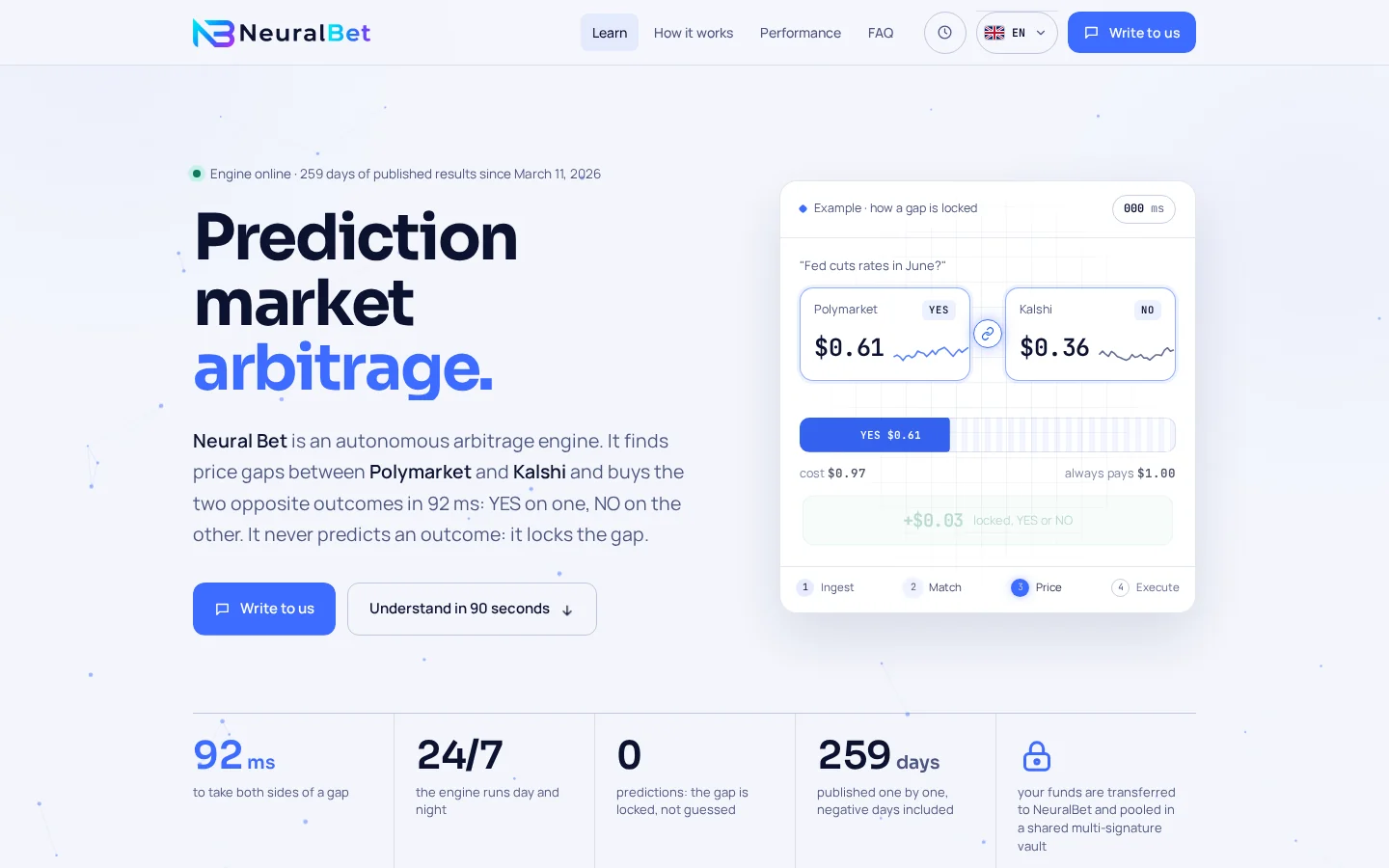
A NeuralBet animation makes two opposite trades look like a neat little equation. When you reach the payment details, another question becomes more important than the math.
You are not simply deciding whether a strategy sounds clever. Before you put money in, find out who can move it and how you could get it back.
Overview
NeuralBet offers managed trades, not just market information
NeuralBet says its software looks for differences between the prices of contracts on Polymarket and Kalshi. It describes taking opposite positions rather than predicting how events will end.
You are not simply subscribing to a list of prices. Under the terms, the operator can commit pooled funds to transactions without asking you to approve each trade.
That is the main distinction to keep in mind. Trading on your own account and giving another business authority to use your money are different decisions.
The card payment buys more than a balance
According to NeuralBet, a card payment purchases an artificial intelligence course from Académie IA. The platform says it then credits your NeuralBet account with the course price.
A 3% fee is added to the payment and does not become part of your trading credit. The terms also bar withdrawals for 30 days after a card payment.
Before paying, make sure you know which record answers which question. The checkout receipt, trading balance and outgoing transfer are three different things.
- The seller’s receipt should explain what was charged to your card and identify the merchant. It is not a statement of your investment results.
- The app’s credit is the amount NeuralBet says it assigned to your account. It does not show that the money has reached your own wallet.
- A completed withdrawal should leave a transaction you can match to a destination you control. A screen marked pending is not that record.
The headline gain comes from the operator’s records
The public chart showed $10,000 growing to $24,625 over 259 days. NeuralBet says those dashboard figures already account for its share of profits.
A graph can describe what the operator reports without establishing that an independent reviewer reconciled trades, account deposits, losses and actual withdrawals. Those are separate kinds of evidence.
The terms allow for loss of the entire deposit. That warning is worth reading before relying on the much bigger numbers presented in the marketing.
How NeuralBet Takes and Manages Money
Step 1: You choose between crypto and the course payment
The terms name USDC and USDT on Polygon, BNB Smart Chain and Ethereum. A card purchase instead passes through the course arrangement described by the operator.
For example, if the course price and promised credit were both $100, a 3% fee would make the card payment $103 before any separate charge from your own provider.
The $3 would not be waiting in your trading balance. That matters if a promoter uses the card total and the app credit as though they were interchangeable.
Do not make a small payment to learn which merchant appears. The legal terms and a quote should identify the seller before you authorize anything.
Step 2: The balance goes into a shared pool
The terms describe moving incoming stablecoins from a Neural wallet to the operator’s operational wallet. NeuralBet describes pooled funds and a shared vault that uses multiple signatures.
Multiple signatures can mean more than one approval is needed for a transfer. That does not establish that you hold one of those approvals or can independently withdraw your share.
The agreement says you can revoke the automatic transfer mandate. Revoking it stops collecting future top-ups under that mandate, but does not return transfers already made.
If someone says you stay in control because you can see a wallet address, ask who can actually authorize an outgoing transfer from that wallet.
Step 3: Profits and losses are allocated under the pool terms
The terms say profits and losses are allocated according to your share of the pool. NeuralBet says it keeps half the generated profit and pays introducers from its part.
When someone recommends the service, ask whether they receive a payment for introducing you. Someone with a financial stake in your participation is not an independent reviewer.
Separate commission disclosure from the question of whether the trades work. Disclosing the referral arrangement does not verify the profits that would fund it.
Do not assume the published chart includes a loss peculiar to your account, a period while you were not funded or a card fee you paid yourself.
Step 4: Getting out is a separate request
The terms list a $5 minimum withdrawal and say the algorithm must be paused. Any arbitrage still in progress must finish before a withdrawal is executed.
For card funding, the 30-day restriction is an additional condition. Reaching that date is not the same as having an outgoing transfer completed or confirmed.
In a dispute, record both the date you asked to withdraw and the exact reason shown. A delay because of active positions is different from a separate payment demand.
Who Controls the Account and Who Can Answer for It?
The entity on the terms is not either market venue
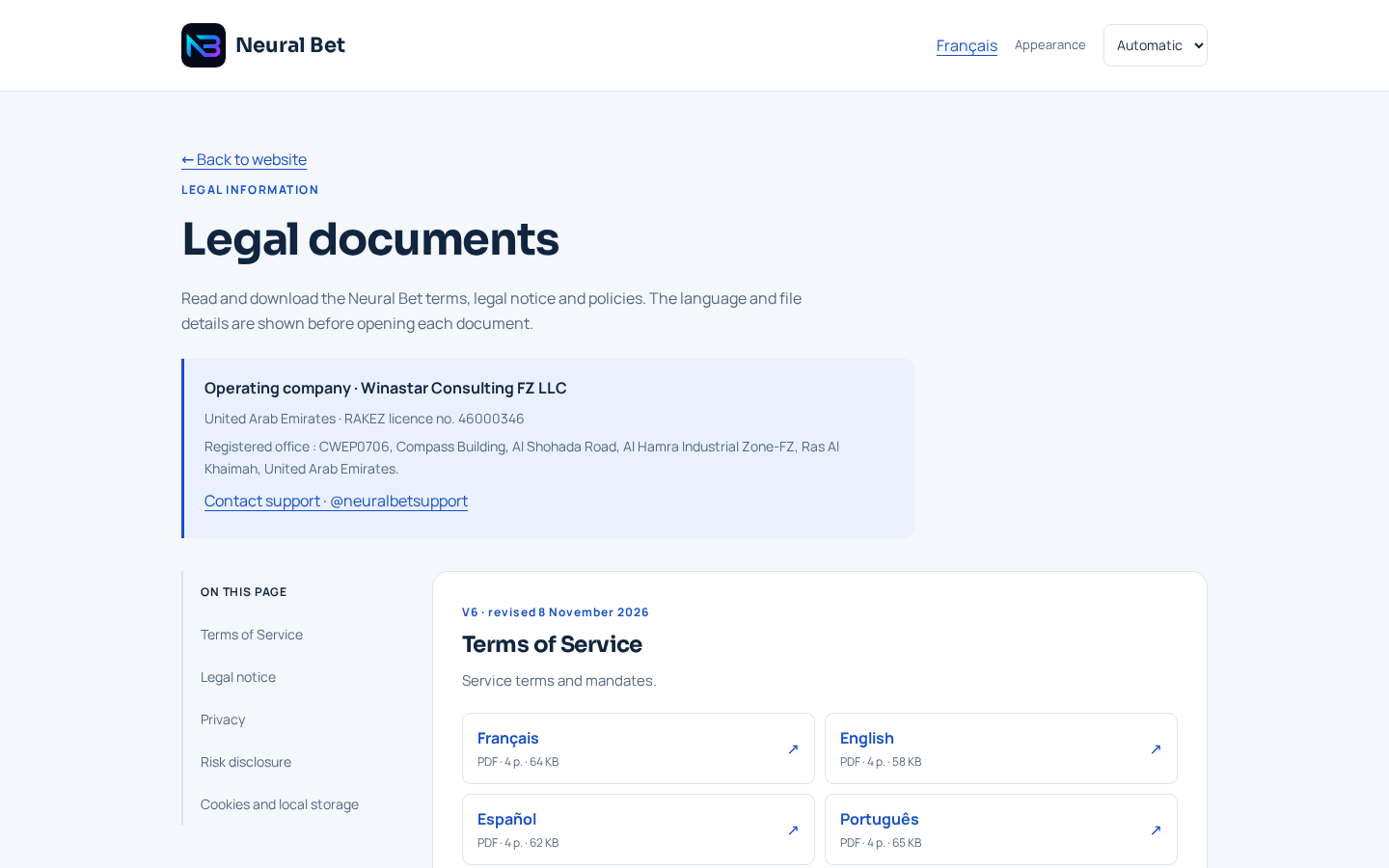
NeuralBet’s legal materials name Winastar Consulting FZ LLC as operator. A reference to Polymarket or Kalshi does not mean either venue manages the NeuralBet balance.
If you dispute something the operator did, identify which company agreed to provide the service. Contacting a market venue does not automatically open a claim against Winastar.
For card payments, match the course invoice with the statement merchant. Do not assume the app name alone tells your bank which card transaction you are disputing.
A free-zone license number does not establish investment oversight
The site lists RAKEZ license number 46000346 and an office in Ras Al Khaimah. Its own terms say the operator is not a licensed financial institution.
Business registration and permission to provide financial services are different. A registration number does not tell you which activities a regulator authorizes or what happens if an account fails.
The terms also exclude United States citizens and residents. An invitation in English or the use of USDC and USDT does not override that eligibility condition.
Support must identify what happened to a particular transaction
The site directs support inquiries to Telegram. If you already have an account, check the contact against the legal page rather than accepting a handle forwarded by another member.
Ask for a response tied to the date, asset, network and transaction reference. Do not share your recovery words, a wallet key or a one-time account code.
Any reply should identify whether the credit is pending, if an open operation is the reason, and what will indicate that a transfer has been sent.
The pool needs more evidence than a list of addresses
A public transaction can show that tokens moved between addresses. It cannot tell you who owes the funds to each customer or whether the pool can meet all withdrawals.
A useful independent review would have to reconcile amounts held with the claims against them. An apparently large wallet is not a substitute for that comparison.
No deposit, trade, course purchase or withdrawal was made to test the service. The evidence here is what the terms and public sales materials say.
Why Two Opposite Trades Are Not a Savings Product
In a simple example, two genuinely complementary positions costing $0.97 could pay $1 in total before costs. The example depends on the positions being truly complementary.
Look beyond whether two markets use similar headlines. Their contracts may specify different times, sources or ways to handle uncertainty about the same event.
Kalshi’s outcome guidance and Polymarket’s resolution guidance describe their own procedures. Neither source says every pair used by a third party will settle identically.
For instance, two markets can both ask about an announcement but count announcements made in different time zones. That can change which side pays on each venue.
There is an execution problem even when the rules match. NeuralBet’s own explanation says one order may fail while the other must be sold, sometimes at a loss.
Timing at settlement matters as well. The two positions can tie up cash for different periods, and a position that will settle later cannot pay an immediate withdrawal.
Those risks are separate from whether the pooled business keeps accurate records. A strategy that looks sound on paper does not give you control over funds sent elsewhere.
What to Do If You Already Funded NeuralBet
- Stop adding money while you work out what you control. Save the receipt, terms you saw, app balance and any messages about when withdrawals become available.
- Keep the exact card transaction if you paid for the course. Save the invoice and account credit separately. Explain both to your issuer if something was misrepresented.
- Save transaction details if you sent stablecoins. Record the asset, blockchain network, transaction hash and destination. Keep the original record from your wallet or exchange.
- Check what the app says is eligible for withdrawal. The terms call for pausing the algorithm. Record the current amount, any unfinished positions and any card-payment restriction.
- Request a written reason if a withdrawal is held. Keep the date and case reference. Do not pay another fee sent by a person who claims to help.
- Contact your original payment provider if the account cannot be reconciled. Ask about the available dispute, tracing or reporting process. Describe what actually happened rather than assuming a refund.
If an outgoing blockchain transfer is reported, ask for its transaction hash. Look it up using the explorer for the stated network and check the asset, amount and destination.
If you never made a transfer, do not authorize one to test the platform. Leave the offer and keep any unsolicited message only if you need to report it.
How to Read the Numbers if You Paid by Card
Start with the date printed on the card receipt. The agreement measures the 30-day restriction from payment, not from the day you first noticed a balance.
Next check whether you received the course. In the sales description, course access and trading credit are two things the operator says should result from the same payment.
Save any course access email even if you never planned to take the course. It can show which part of the package arrived and which part did not.
If only one part appeared, explain the missing part to your provider. Saying simply that the transaction was unauthorized can be inaccurate if you approved the charge yourself.
Keep a screenshot before and after any claimed correction. A manual change to account credit can settle a display problem without resolving a card account complaint.
If you made multiple card payments, ask how the restriction applies to your balance. The public wording gives a period after payment, not an itemized schedule for your account.
Ask support to identify the amount tied to each payment. That is more useful than a generic assurance that the app will unlock when the time is right.
For a stablecoin payment, check that support is talking about the right network. The same token name may appear on different networks, but the transaction record belongs to one.
Also distinguish the network fee you see on the transfer from the app’s profit split. One is a transfer cost; the other is how the operator is paid.
If you permitted an automatic transfer but no longer want it, ask for written confirmation of revocation. Still save the history of money already moved.
Whenever someone promises an exception to the withdrawal terms, get the reason and the terms in writing. Do not rely on a disappearing message or a recruiter’s voice note.
Do not wait for an app balance to settle before asking your bank about its own dispute deadline. The operator’s restrictions do not set your bank’s timetable.
Frequently Asked Questions
Is NeuralBet the same as Polymarket or Kalshi?
No, NeuralBet identifies a separate operator and describes using the two markets for trades. A reference to a venue is not that venue’s endorsement of this service.
Does a card payment go into the app immediately?
The operator says it credits the course price after payment validation. The 3% fee is excluded, and the terms say card-funded withdrawals cannot occur for 30 days.
Does a shared vault give me sole control?
No, the terms say funds are pooled and authorize transfers to the operator’s wallet. Individual balance displays do not establish personal control over the pool.
Can I cancel the automatic transfer permission?
The terms say you may revoke the mandate for future incoming deposits. That does not reverse completed transfers or substitute for requesting a withdrawal.
Does the performance chart guarantee any profit?
The chart reports historical figures from the operator. The current terms make no minimum-return promise and acknowledge that all of a deposit can be lost.
Should I trust a new support contact who offers to speed things up?
Verify any contact against the platform’s own legal materials. Do not send another payment or share account secrets to advance a withdrawal already in progress.
The Bottom Line
Do not fund NeuralBet based on its performance chart or the convenience of paying by card. You are handing funds to a pool, not opening a protected account.
If you already paid, stop sending more and preserve your course receipt or crypto transfer. Check what is withdrawable and raise any unresolved discrepancy with your payment provider.

Join the discussion
0 commentsShare your experience or ask a question about this article.
Community experiences
Did this happen to you?
Your experience could help someone recognize the same scam. Submit a private report for our team to review.
I experienced this tooReports are reviewed before publication. Sharing publicly is always your choice.
Discussion
Start the conversation
Have a question or something useful to share? Add the first comment.