


An old brokerage statement can send a NewAge shareholder down several different paths. The company name leads to an SEC case, a court judgment and a bankruptcy docket.
Those records do not all answer the same question. Before acting on a notice about your old shares, start by finding out which proceeding the notice actually belongs to.
Overview
The 2026 SEC file concerns missing company reports
The SEC opened administrative proceeding 3-22705 in September 2026. The issue is whether the registration of NewAge securities should be suspended or revoked because required filings were missing.
The opening order says the last periodic report covered the quarter ended September 30, 2021. It also says the company’s common stock was not publicly quoted or traded.
The later order asked NewAge to explain why the SEC should not find it in default. That is not the same thing as an order revoking registration.
A judgment against the former CEO resolves a different case
A federal court entered a final civil consent judgment against former CEO Brent David Willis in March 2026. The case concerned public statements and disclosures.
Willis agreed to the judgment without admitting or denying the allegations. The judgment includes a $175,000 civil penalty, restrictions on future conduct and a five-year officer and director bar.
A penalty can be final without creating a public payout. Before treating any number as money owed to you, look for a separate official distribution notice.
Three records matter, depending on your question
The same company name appears in several places. The fastest way to avoid reading the wrong answer is to match the record to what you need.
- Current registration question: Read the SEC administrative file and distinguish the order opening proceedings from any later final order entered under the same file number.
- Historical public statements: Read the 2022 SEC settlement order involving NewAge, then compare it with the separate 2026 Willis judgment.
- Bankruptcy claim or old shares: Use the Delaware bankruptcy docket and your own brokerage or claim records, not the civil penalty amount.
Someone can know the old ticker and still be wrong about what happens next. A case number, official docket and named parties are more reliable identifiers.
What the SEC Found About NewAge’s Public Claims
The beverage announcement sounded further along than it was
The SEC’s 2022 settlement order describes false or misleading statements about a portfolio of CBD beverages. NewAge accepted the order without admitting or denying most findings.
Among the examples was a September 2018 announcement presenting a portfolio as tested and developed. The SEC said the preliminary work had begun only days before the announcement.
This was not simply a forecast that later disappointed investors. The statements concerned work the company said it had already done and retail commitments it claimed to have secured.
An investor hearing a finished product is in production can reasonably take away something different from an investor hearing a concept is going through preliminary work.
Retail names made the distribution claims sound concrete
The SEC says NewAge announced a FamilyMart CBD order for 15,000 outlets. The agency found the business had received no orders or commitments for CBD beverages.
A retailer’s real existence is not evidence of a particular supply deal. Look for the retailer’s own statement, a confirmed agreement or sales data that actually covers the product.
In another example, the SEC described a military distribution announcement that went far beyond a trial at two stores. A trial can be real without being a worldwide rollout.
There is also a difference between a product being available in some stores and a claim about the entire chain. The number of locations was part of the story.
Read the settlement findings and the individual case separately
The SEC’s company order made findings and imposed a cease-and-desist order. NewAge generally did not admit or deny the findings, except for specified jurisdictional matters.
The SEC’s individual complaint alleged Willis made false or misleading statements and aided selective disclosure of important nonpublic information. His later consent judgment resolved that civil enforcement action.
The release for that judgment does not say the former executive was found guilty in a criminal trial. A civil consent judgment is not a criminal conviction.
Keep those labels intact when reading a settlement headline. Who agreed to what, in which case, is more useful than the broad statement that someone was penalized.
What the September and October 2026 Orders Actually Do
The September order started a proceeding under Section 12(j) of the Securities Exchange Act. It listed the alleged filing failures and the possible action the SEC could take.
The October 19 show-cause order said NewAge had not filed an answer at that point. It gave the company until November 2, 2026, to respond on the default question.
November 2 was not a deadline for investors to request checks or submit share statements. It was about the company’s answer in the SEC’s administrative file.
The SEC file page shows the September and October orders. For the outcome, look for a later document deciding the case, not a headline summarizing the request.
Even finding a registration decision would not give you an individualized account history. Your broker’s records show the shares you actually held, through which account and when.
If you see NBEV or NBEVQ in a price history, check the date. The older SEC order described those symbols in a different trading period from the 2026 proceeding.
The Bankruptcy Docket Is Where a Claim Question Belongs
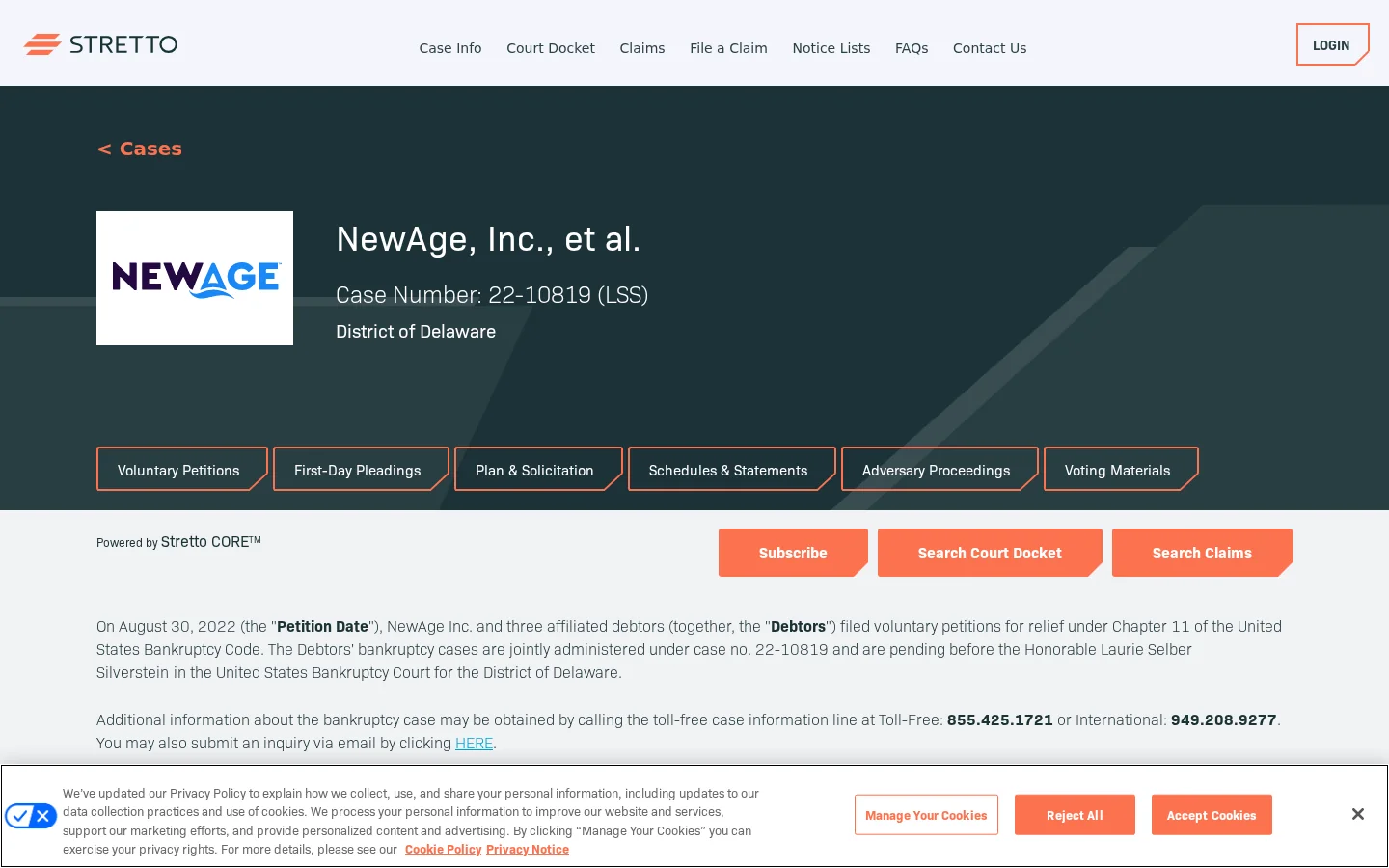
NewAge and three affiliated debtors filed for Chapter 11 in August 2022. The jointly administered bankruptcy case is numbered 22-10819 in the District of Delaware.
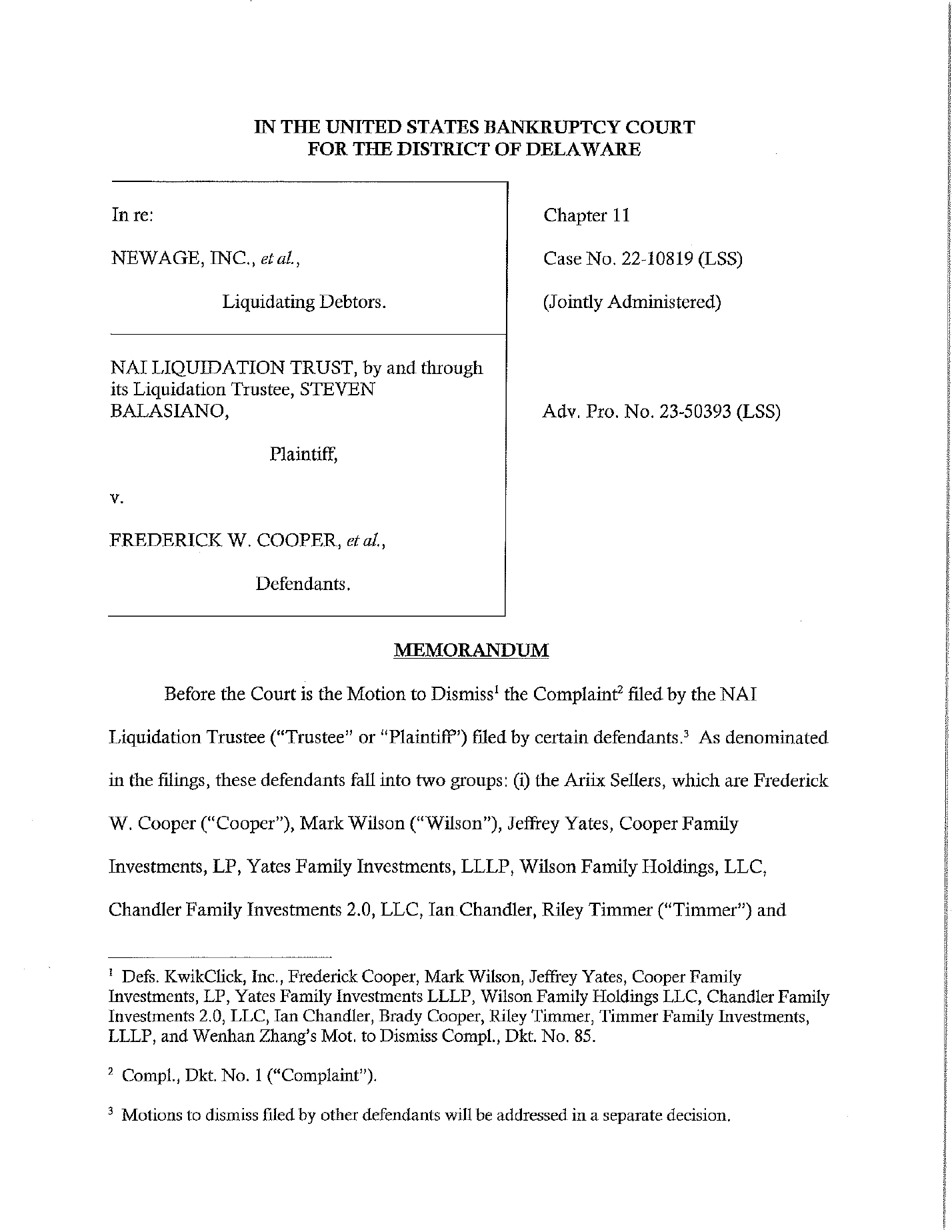
The court’s separate memorandum in adversary proceeding 23-50393, pictured below, confirms the main bankruptcy case number. It is not the order opening the SEC proceeding.
Do not use the amount from a regulator’s judgment to estimate what a creditor or former shareholder would receive. Bankruptcy distributions, if authorized, have their own rules and documentation.
Owning stock, submitting a trade-creditor claim and being owed a distribution under a plan are not interchangeable. First establish which record describes your position.
If you bought shares through a broker, download a statement from the period that shows the symbol, trade date and quantity. Ask the broker for any corporate action notices.
If you filed a bankruptcy proof of claim, retrieve the claim number, debtor name and filed amount. Keep any court order that allowed, reduced or otherwise affected it.
If your claim was against an affiliate, confirm which debtor appears on your documentation. A joint case number does not mean all debts are owed by the same company.
On the NewAge case site, select Search Court Docket. Use case 22-10819 to look for the confirmed plan and any later distribution notices.
If a docket entry is unclear, ask the court-appointed contact how to locate the document governing your position. Do not file a fresh claim simply because a form is visible.
What to Do If You Still Have NewAge Shares or a Claim
- Download your records before following a new notice. Save the brokerage statement or claim reference. Write down the legal issuer, filing number and any dates printed on it.
- Check the SEC administrative file for the latest order. Match proceeding 3-22705 and look for the document type. An order to show cause is not a payment instruction.
- Ask your broker about any old holdings still displayed. Request the trade records and relevant corporate action notices. Do not infer current trading from a historical quote.
- Use the bankruptcy docket for a claim or distribution notice. Look for the case number and an order or notice applying to your documented position.
- Refuse a fee demanded to release a supposed recovery. Save the message and verify through the official case contact before sharing identification or account details.
- Report a suspicious offer to the authority being impersonated. Include the sender, contact details and any money requested. Contact your payment provider promptly if you already sent funds.
How to Check a Recovery Message Without Following Its Link
A message can reproduce a court seal, mention the correct ticker and quote the real $175,000 penalty. None of those details proves the sender can pay you.
Start by opening the public case listing independently. Look for a distribution notice, eligibility rules and an administrator listed there, rather than the number at the bottom of the message.
If the sender says the message comes from the SEC, its investor recovery guidance warns that impersonators can charge for an invented payout.
For a new offer using this name, follow the SEC’s EDGAR guide to company search. Enter NewAge or identifier 1579823 and confirm the filer matches.
Sort the filings by date and check the form type. An old release about a product launch is not a current prospectus, and an enforcement release is not an offer.
If someone asks you to pay to replace an old certificate or activate compensation, stop. Keep the message and contact your original broker or the verified administrator directly.
How to Sort the Records You Already Have
A research file starts with which legal entity you dealt with
NewAge formerly used the name New Age Beverages Corporation. If that name appears in older paperwork, compare the SEC company identifier and the date rather than trusting spelling alone.
Write down the symbol exactly as it appears on each statement. A change from NBEV to NBEVQ can be useful evidence for identifying an old transaction period.
Do not silently replace one symbol with the other in a complaint. Tell the recipient what the original record says and attach the right dated statement.
If a share entry appears on a current account export, ask the broker whether it represents a historical position, a currently tradable security or a recorded corporate action.
When two family members held stock, keep their accounts and cost records separate. A notice applying to one owner may not identify the other person’s position.
Commercial announcements and official filings need different labels
In the 2022 order, the SEC contrasted a claimed expansion to 1,400 stores in a 7-Eleven division with actual sales limited to roughly 250 Colorado stores.
This distinction shows why a real retail relationship is not a shortcut to verifying the scale of a new claim. A store count needs a defined location and time.
If someone sends you a screenshot of a product on a shelf, ask which claim it is offered to prove. It cannot establish sales at hundreds of other stores.
Keep the relevant release and the later correction or order in chronological order. You need to know which information existed before you bought and which appeared afterward.
Make a note when a document quotes an allegation rather than making a finding. That label matters when comparing a complaint, settlement, administrative order and court decision.
Use the reference number that belongs to the next action
When contacting the broker, include the statement date and symbol. When contacting the administrator, include the bankruptcy case and claim reference if you have one.
If you are checking for an SEC distribution, have the relevant action number and document date ready. An unrelated notice may refer to a similarly named investment.
Preserve unopened correspondence if it includes dates or routing information you may need. Do not upload full statements to a link sent by someone offering to handle everything for you.
If you cannot access your old brokerage account, use the broker’s current official support route. Ask how to retrieve historical statements securely and whether a successor holds the records.
When an administrator or broker replies, save the answer beside your original request. A dated response lets you track which issue was addressed and which still needs action.
Frequently Asked Questions
What is SEC proceeding 3-22705 about?
It concerns the registration of NewAge securities following alleged reporting failures. It is separate from the former executive’s civil consent judgment and the Delaware bankruptcy.
Did the October show-cause order itself revoke the stock registration?
No, it asked the company to explain why default and revocation should not follow. Look for a later final order under file 3-22705.
Does the $175,000 civil penalty mean I can file for a payout?
The SEC’s judgment announcement describes a civil penalty. It does not provide a NewAge shareholder application or promise a distribution to individual investors.
Where should I check a bankruptcy claim?
Start with Delaware case 22-10819 and use the official docket or appointed administrator. If you filed a claim, search with the debtor and claim number you already have.
Was November 2, 2026, a deadline for shareholders?
The date in the SEC’s show-cause order applied to NewAge’s response. It was not an application deadline for former shareholders or a bankruptcy payment date.
Can a broker statement show a security that no longer trades?
Historical account records can still identify a former holding. Ask the broker to explain its current status instead of using an old statement as proof you can sell.
The Bottom Line
Do not send money based on a payout message tied to NewAge or an old ticker. Use the official docket to confirm what exists and who administers it.
If you held shares or filed a claim, keep the original records and find the proceeding that applies. Do not let a penalty headline take the place of that check.

Join the discussion
0 commentsShare your experience or ask a question about this article.
Community experiences
Did this happen to you?
Your experience could help someone recognize the same scam. Submit a private report for our team to review.
I experienced this tooReports are reviewed before publication. Sharing publicly is always your choice.
Discussion
Start the conversation
Have a question or something useful to share? Add the first comment.