

An Arrow Finance proposal promises an extra token allocation for voting early. The page has familiar menus, protocol figures, and a button waiting for your response.
Before you take part, look at where the proposal came from and what the next wallet request asks you to do.
Overview
A bonus offer wrapped in a governance proposal
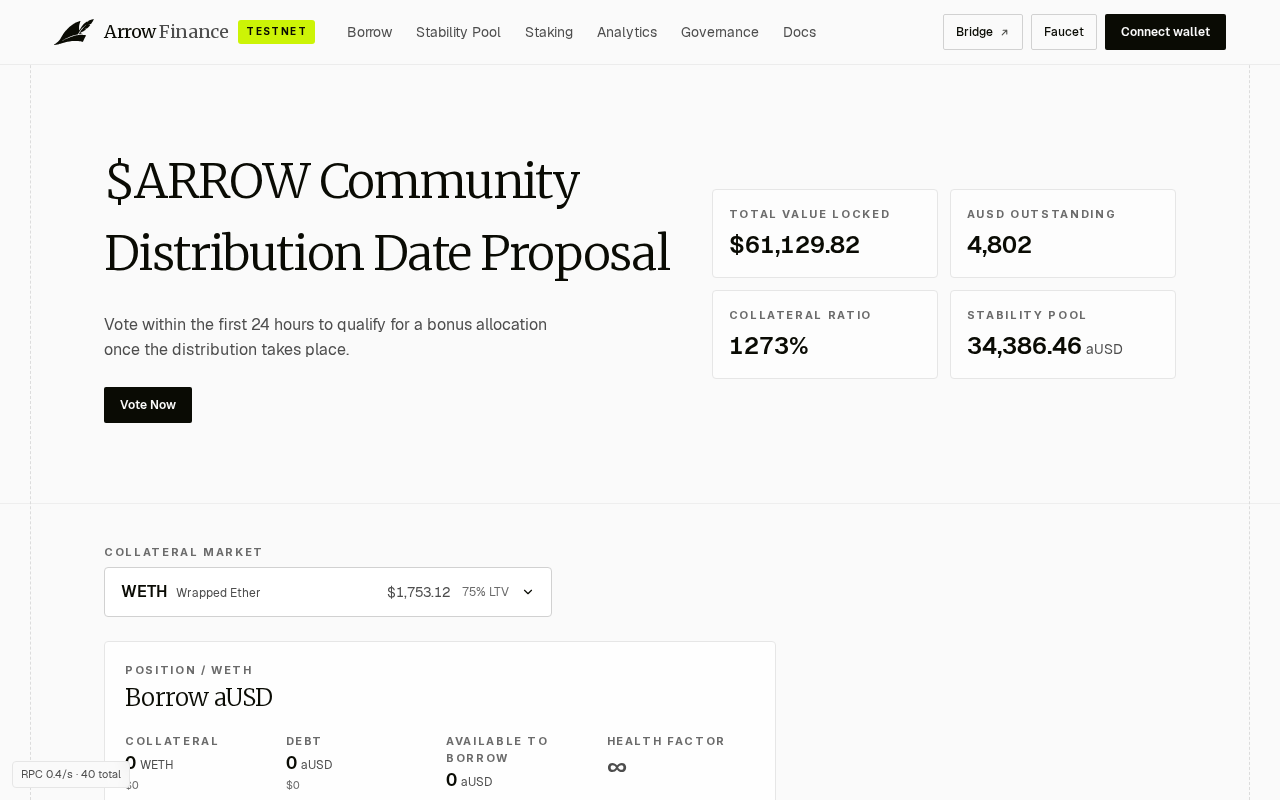
The page at proposal-arrow[.]info presents an imitation Arrow Finance interface. It promotes an $ARROW distribution-date proposal and offers a bonus allocation for early voting.
The visible offer says participation within the first 24 hours qualifies. That puts a time limit on the decision before the visitor has verified the invitation.
A distribution claim is not an entitlement. A page can display a proposal, reward, or balance without establishing that the project will deliver anything.
Do not use this imitation voting route. Its copied presentation and reward invitation belong to a reported wallet-drainer campaign, not a verified governance event.
The genuine project and the impersonating domain
Arrow Finance’s project website is arrowfinance.io. It describes a DeFi lending platform on Robinhood Chain.
Proposal-arrow[.]info is a separate domain. Putting a project’s name after another word does not make an address part of that project’s website.
The imitation displays lending-related figures and navigation, including collateral and stability-pool information. Those visual details do not authenticate the bonus offer.
- The address must match a route confirmed through the project’s own channels.
- The proposal needs an authentic announcement, not just a polished landing page.
- The wallet request must match the action you intended to perform.
- A deadline should never replace those checks.
The risk depends on what the wallet authorized
Connecting a wallet, signing a message, granting token permission, and sending a transaction are different actions. They should not be collapsed into one description.
A basic connection does not automatically give a website unrestricted control of your assets. The dangerous request can arrive after that first apparently ordinary step.
The exact historical transaction behind this campaign has not been independently reconstructed here. Your wallet activity and permissions are the right place to assess actual exposure.
Why the Borrowing Interface Helps Sell the Vote
The page does not need to look like a giveaway banner. A familiar financial dashboard can make the offer seem like part of a functioning protocol.
Its navigation places governance alongside borrowing, staking, and analytics. That arrangement encourages the reader to treat the proposal as another routine platform feature.
The figures add apparent precision. A specific collateral ratio or pool balance can feel more credible than a vague promise, even when it proves nothing about authorization.
Ask a narrower question: who confirms that this particular proposal and website belong to Arrow Finance? A dashboard cannot answer that about itself.
The real project website provides a starting point for identity checks. It is not a recommendation to borrow, invest, or accept every promotion carrying the brand.
A legitimate platform can be impersonated without participating in the deception. Keep the warning attached to the counterfeit invitation rather than to every use of the project.
How the Arrow Finance Vote Rewards Scam Works
Step 1: An invitation makes early participation feel valuable
The hook is a governance vote with a bonus. You are not being asked to buy something outright, so the invitation may feel inexpensive to explore.
The 24-hour condition changes that calculation. Waiting to verify the proposal begins to feel like losing an opportunity that costs nothing to claim.
That is the moment to step outside the invitation. Open the established project site yourself and find its current governance information.
An unsolicited social post, message, or search result is only a route to the page. Its presence does not establish who operates the offer.
If an account appears familiar, check its actual identity and links. A copied name or compromised account can carry a promotion the project never approved.
Step 2: The counterfeit page supplies visual reassurance
Proposal-arrow[.]info presents the project identity, lending menus, financial figures, and the distribution proposal together. The reward looks embedded in an ordinary interface.
The page’s testnet label is not a safety guarantee. A claim about the page’s environment does not determine which network a later wallet request will use.
Check the actual wallet prompt and network rather than trusting a label printed on the website. A website can say one thing and request another.
A precise total-value figure is not independent proof of assets or governance authority. Treat it as a displayed claim until supported through a verified route.
Do not troubleshoot an imitation page’s connection problems. Repeated attempts only keep you inside the same untrusted flow.
Step 3: The voting button becomes a wallet interaction
The offer directs the visitor from the voting button toward wallet connection. Recognizable wallet brands can make the next window feel like another endorsement.
Your wallet application can faithfully display a request from a dishonest website. Its involvement does not certify the website’s reward or identity.
At this point, stop before accepting any further request. Read what the wallet actually asks, not what the page says the request is for.
A vote should have a verifiable purpose and understandable effect. If the request asks for unrelated spending access or a transfer, the label cannot make it harmless.
You never need to reveal a recovery phrase to prove that you qualify for a governance reward. Keep that secret outside websites and support conversations.
Step 4: An authorization can put assets at risk
A malicious flow may seek a transaction or permission that enables asset movement. Some signature requests can also authorize consequential actions without an obvious immediate transfer.
Do not assume every message is safe because it is described as free or gasless. The content and protocol determine what a signature means.
Nor should a connection alone be treated as proof that a wallet was emptied. Review the completed requests, existing approvals, and recorded transfers.
This distinction matters during recovery. Disconnecting the page may remove its current connection while leaving an on-chain permission in place.
For token approvals, follow the wallet provider’s network-appropriate instructions. Do not improvise with a recovery link sent by someone who noticed your problem online.
Step 5: A missing reward can become a second demand
If the promised allocation does not appear, resist instructions to repeat the process. Another signature or transaction can create additional exposure rather than repair the first.
Claims that a reward needs activation, synchronization, or release payment deserve the same scrutiny as the original invitation. No displayed balance proves that a payout exists.
These are common follow-up risks, not confirmed steps seen in every Arrow Finance interaction. Save the actual messages if someone makes such a demand.
Do not send funds to unlock money supposedly owed to you. Seek help through the genuine wallet provider or project contact route instead.
A person promising guaranteed recovery for an upfront fee can turn one loss into another. Reporting and evidence preservation are safer than paying for that promise.
Read the Wallet Record, Not Just the Website
If you only viewed the proposal
Close the page and reject its invitation. Viewing the offer does not establish that an asset transfer occurred or that your device has malware.
If you allowed browser notifications, remove that permission through browser settings. You do not need to reopen the site to stop its notifications.
Keep the address and message if reporting is useful. There is no reason to connect a wallet merely to gather more evidence.
If you connected but declined further requests
Remove the site’s connection in the wallet interface. Review recent activity to confirm that no unwanted transaction or signature was accepted during the interaction.
Be aware that the site may have learned your public address. That is different from obtaining your recovery phrase or the private keys controlling it.
A public address can make follow-up targeting more specific. Ignore messages claiming that they must fix, validate, or protect that wallet through another unfamiliar page.
If you signed, approved, or transferred
Record the network, request type, transaction hash, asset, and destination. Your wallet history and a trusted block explorer can help establish what happened.
A revoked approval addresses future use of that permission. It does not automatically recover assets transferred before the revocation.
If a recovery phrase was entered, treat the underlying keys as exposed. Removing a website connection cannot make a copied secret unknown to the recipient.
What to Do if You Have Fallen Victim to This Scam
-
Stop interacting with the proposal. Close its page, reject pending requests, and remove the wallet connection. Do not retry the vote because the reward failed to appear.
Use the wallet’s own interface for connection management. Avoid any cleanup button supplied by the counterfeit site.
-
Document exactly what you accepted. Save transaction hashes, network names, affected assets, and the invitation. Write down whether you connected, signed, approved spending, or submitted a transfer.
Keep recovery phrases and private keys out of screenshots and reports. Support can assess a public transaction without needing control of your wallet.
-
Review and revoke unwanted permissions appropriately. Follow your wallet provider’s instructions for the actual network and token type. Connection removal and approval revocation solve different problems.
MetaMask explains how token-approval revocation works. Confirm the destination before using any linked permission-management tool.
-
Replace exposed wallet keys when necessary. If you supplied a recovery phrase or private key, establish a new wallet with fresh keys on trusted equipment.
Obtain verified guidance before moving remaining assets if transfers are being immediately intercepted. Do not deposit more funds into a compromised wallet as a test.
-
Notify relevant providers and report the loss. Contact an exchange involved in sending or receiving funds through its genuine support channel, supplying transaction references.
In the US, report cryptocurrency fraud to IC3. Elsewhere, use the appropriate local reporting route. Reporting is not a promise of reimbursement.
-
Refuse follow-up recovery offers. Do not pay a release fee, share wallet secrets, or accept remote access from someone promising to undo the transaction.
Keep further messages as evidence and block the sender. Tell others who received the same invitation without forwarding a clickable malicious claim link.
A Safer Way to Evaluate Future Governance Invitations
Keep a distinction between participation and custody. A governance website may need evidence of an address’s eligibility without needing permission to move unrelated assets.
Ask what you are authorizing at each prompt. If you cannot explain the request in ordinary terms, the deadline is not a reason to accept it.
Check whether the wallet has switched accounts or networks during the flow. The account you intended to use may not be the one shown in the request.
Before a legitimate transaction, confirm the selected network and asset. A familiar logo on the website cannot make an unexpected wallet change appropriate.
For reporting, distinguish the page’s advertised figures from your actual transaction amounts. Otherwise, a supposed reward can accidentally become part of an inaccurate loss total.
Begin from the project’s known home, not the reward link. Find a proposal identifier, explanation, and participation route through established channels.
Match the proposal to the intended action. A discussion about distribution timing should not quietly turn into unlimited access to unrelated assets.
Read the wallet’s transaction simulation or warnings when available. If the requested effect is unclear, decline until you can understand it independently.
Do not interpret urgency as technical necessity. A deadline may be part of a real event, but it cannot replace identity and authorization checks.
For substantial holdings, separate routine browsing from asset management. A dedicated wallet for limited activity can reduce exposure, but cannot make malicious requests trustworthy.
Keep the recovery phrase offline and private according to the wallet maker’s guidance. It is not a credential to enter into a proposal website.
Hardware confirmation deserves the same care as software confirmation. A physical approval step does not protect you if you approve the wrong transaction without reading it.
Finally, choose not to participate when verification fails. Missing an unverified bonus is preferable to granting access that you did not intend to give.
Frequently Asked Questions
Is proposal-arrow.info the official Arrow Finance voting website?
It is the impersonating domain discussed here. Start from Arrow Finance’s established project channels instead of using this counterfeit bonus proposal.
Does the 24-hour bonus prove there is an $ARROW distribution?
No. The imitation page’s deadline and allocation claim do not establish an authentic event or your entitlement to tokens.
Can connecting a wallet alone empty it?
A normal connection does not automatically authorize arbitrary transfers. Inspect any signatures, transactions, or spending permissions accepted afterward, along with existing wallet activity.
Will disconnecting revoke token approvals?
Not necessarily. A site’s connection and an on-chain spending approval are different. Use the provider’s appropriate permission-revocation instructions for the network involved.
Do I need a malware scan after seeing the proposal?
Viewing this page alone does not establish device infection. Wallet-authorized losses require wallet and transaction checks, not an assumption that antivirus software can reverse them.
Can someone guarantee recovery of stolen tokens?
No reliable guarantee follows from a recovery advertisement. Preserve the transaction evidence, report the incident, and refuse upfront payments or requests for wallet secrets.
The Bottom Line
Do not vote or claim through proposal-arrow[.]info. The Arrow Finance imitation uses an early-voting bonus to draw readers into a dangerous wallet interaction.
If you already participated, check what was actually authorized, revoke unwanted permissions where applicable, and replace exposed keys. Do not pay another party to release the promised allocation.








