

Bad breath can make an ordinary conversation feel uncomfortable. A little green gel promising a fresher mouth sounds easier than another round of guesswork.
Whispore puts that idea into a jar. Before making room for it in your daily routine, look closely at the offer that comes with it.
Overview
Whispore is an ingestible supplement, not a dental diagnosis
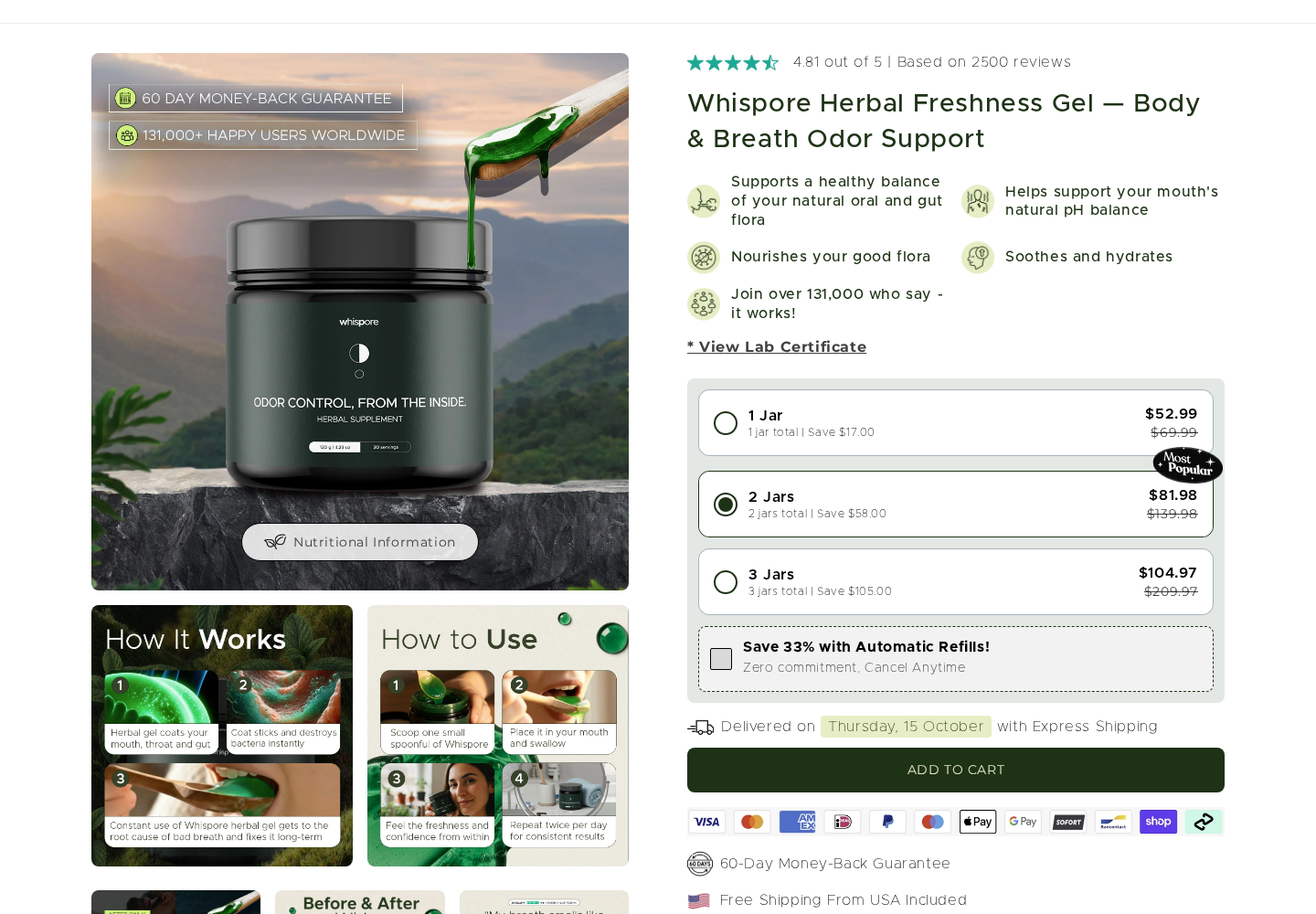
Whispore Herbal Freshness Gel is marketed for body and breath odor support. The seller promotes effects on oral and gut flora and mouth pH.
Those are seller claims. A product page cannot establish why your breath smells different or whether a particular supplement will resolve the cause.
The issue is not simply whether a jar arrives. Buyers also need to understand what they are swallowing and what future payments they have authorized.
The offer includes a visible refill choice
The product page advertises a 33% saving with automatic refills alongside cancel-anytime language. The refill checkbox was unchecked in the captured page state.
The two-jar package was selected. That makes checking both quantity and purchase type important, even for someone intending to try only one jar.
This does not prove that customers are secretly enrolled. The material concern is the inconsistent explanation of when cancellation can stop the next order.
The published rules do not tell one clear story
The separate cancellation policy and the longer terms give different stopping deadlines. The refund rules also distinguish the first purchase from recurring orders.
Before buying, the unresolved questions are practical:
- Which purchase option is selected for your actual order?
- When would the next charge and shipment occur?
- Which cancellation deadline would the seller apply?
- Does a cancellation stop the imminent shipment or only later renewals?
- Which return conditions apply to the particular order?
The warning is about the offer’s billing rules. Claims about factory location or contamination would require separate evidence.
The Cancellation Problem Buyers Should Not Have to Untangle
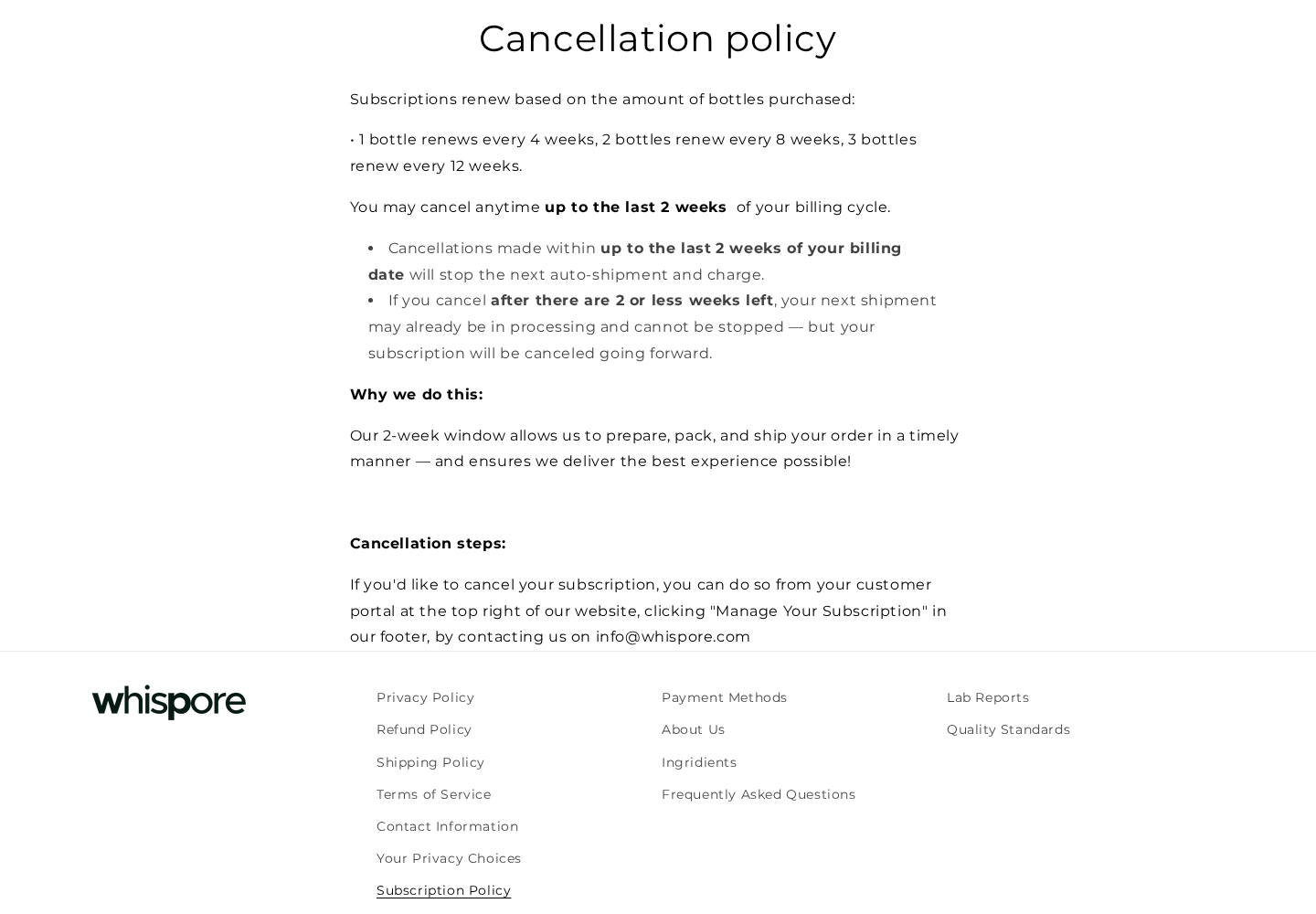
A two-week processing window appears in the separate policy
The subscription policy lists renewal cycles of four, eight, or twelve weeks for one-, two-, or three-bottle orders.
It warns that cancellation with two weeks or less remaining may not stop the upcoming shipment because processing may have begun.
The wording around that cutoff is awkward. Buyers should not have to infer a dependable deadline from language that needs repeated reading.
The difference between stopping all future orders and stopping the very next order matters. A cancellation confirmation should make that distinction explicit.
The terms describe a different cutoff
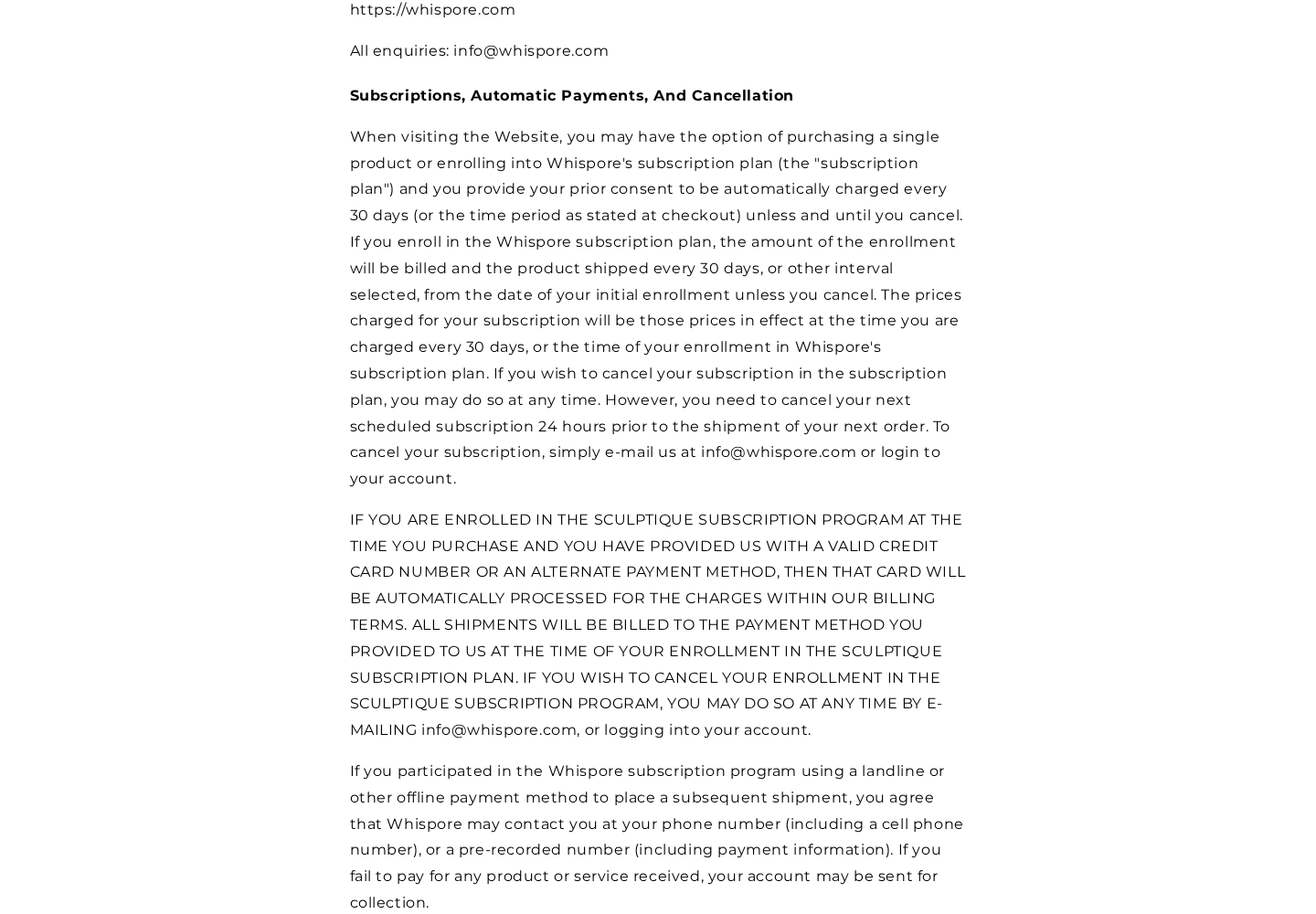
The terms page instead describes cancellation 24 hours before the next shipment. It also refers to a Sculptique subscription program.
That name and timing conflict with the simpler explanation a Whispore buyer would expect. This is a real policy inconsistency, not a completed cancellation test.
Do not assume the most favorable version will be honored. Obtain a written answer tied to your actual order before agreeing to recurring payments.
For example, a buyer deciding to stop refills shortly before delivery needs to know whether the next charge is already committed. A slogan cannot answer that.
Cancel-anytime wording is not the same as no further charge
A seller can accept a cancellation while saying an upcoming order cannot be stopped. Buyers often hear the first statement and expect the second outcome.
That gap is why the precise cutoff belongs beside the refill choice. It should not depend on customers comparing separate policy pages after a charge.
An informed subscription choice needs clear timing, quantity, price, and stopping rules. A discount does not make those details optional.
Saving money on the first package is not useful if you receive products you no longer want. Compare the entire commitment, not merely today’s discounted total.
How the Whispore Offer Works
Step 1: A personal concern becomes a supplement purchase
The offer addresses breath and body odor, concerns that can make people reluctant to ask others for help. It presents an ingestible gel as a convenient routine.
Convenience is not diagnosis. Before choosing a product, think about whether the symptom is persistent, new, or accompanied by dental discomfort.
A person may need help identifying a cause rather than another item to mask it. Keep that question separate from the seller’s checkout.
Step 2: Package quantity changes the order you are considering
The observed page offered one, two, and three jars at $52.99, $81.98, and $104.97 before selecting the refill saving.
Those figures describe the captured offer, not a guaranteed price on every advertisement or future visit. Check the total for your actual selection.
A highlighted package can feel like the recommended starting point. If you wanted a single jar, deliberately choose that quantity and review the summary afterward.
Step 3: A refill saving introduces an ongoing arrangement
Choosing automatic refills is different from buying a larger one-time package. It concerns later orders as well as the product currently in your cart.
Before proceeding, make sure the final summary names the purchase type and renewal schedule. Keep a copy of what you actually authorize.
An unchecked option in this capture does not prove what a different campaign preselects. Nor does visible disclosure excuse contradictory stopping instructions.
Step 4: The guarantee needs to be matched to the order
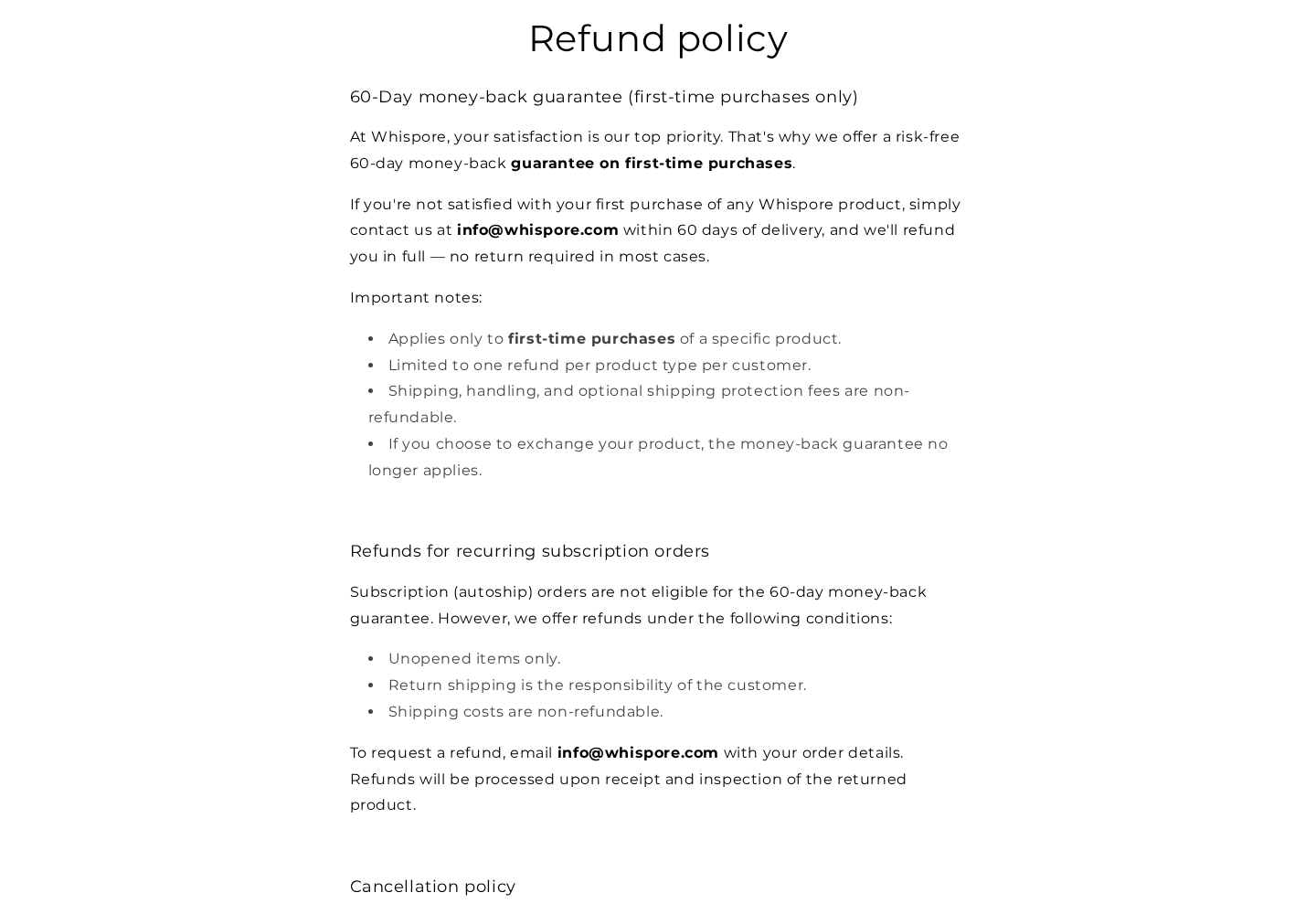
The refund policy limits the 60-day guarantee to first-time purchases. Recurring orders have separate conditions, including unopened returns and customer-paid return shipping.
This is not a blanket no-returns policy. It is also not a guarantee that every refill can be tried and refunded like the first purchase.
Clarify which order you are discussing when contacting support. A first purchase, unopened renewal, and damaged item can lead to different instructions.
Step 5: Cancellation and refund become separate tasks
Stopping future renewals does not necessarily request money back for an existing order. Returning a package does not necessarily cancel future shipments either.
If you want both outcomes, request both explicitly. Ask for confirmation of subscription status and the treatment of the specific charge.
Keep the answer with your receipt. An ambiguous “we have handled this” message is less useful than a clear statement about what remains scheduled.
Company, Address, Support, and Manufacturing Checks
The legal operator is identified, but the brand is not the whole identity
The seller’s terms identify Kandy For Equity Holdings LLC. Its privacy-policy page also names that entity and includes references to Sculptique.
Those references justify checking which company appears on your receipt and statement. They do not establish that every brand mentioned uses an identical product or offer.
Compare the legal recipient, order number, and merchant descriptor before describing a charge to your bank. Brand names alone can obscure which transaction needs attention.
The Delaware address is not proof of a US factory
The policies list 254 Chapman Rd, Newark, Delaware. The BBB profile describes the address as registered-agent or mail-forwarding only.
BBB also says the company appears to be outside the US. That is BBB’s stated observation, not independently verified proof of a particular overseas location.
A mailing address can be legitimate while telling you nothing about manufacturing. It should not be confused with a laboratory, warehouse, or place you can return goods.
Do not ship a return to the legal mailing address without authorization. The relevant return destination needs to be supplied and confirmed for your order.
The contact page provides email, not demonstrated service quality
The contact-information page lists the trade name and info@whispore.com. It does not supply a support phone number there.
The email’s responsiveness has not been tested. Publishing an address does not show how quickly the seller will resolve a billing problem.
If you need assistance, keep a written request stating the exact order and desired outcome. Save confirmation, response time, and any instructions received.
If a cancellation fails, an error screenshot and timestamp are useful. They show what you tried, rather than relying on a general complaint that the site was difficult.
Badges and a posted certificate need a narrower reading
The site displays manufacturing and ingredient-related badges. They are seller representations, not independent confirmation of the finished gel’s effectiveness or origin.
The lab-report page shows a certificate describing a liquid and a 2 mL serving. Buyers should ask how it matches their gel and batch.
A document about composition or quality is not a clinical trial demonstrating improvement in persistent bad breath. Its scope matters even if the document is genuine.
Without confirming the issuer and matching the batch, buyers cannot treat the displayed document as independent assurance about the jar they receive.
Why the Health Promise Deserves a Separate Check
Persistent breath problems have more than one possible cause
NHS guidance lists dental and gum problems among possible causes and advises dental assessment when bad breath persists despite self-care.
A product advertised for internal freshness cannot tell you whether a tooth, gum condition, dry mouth, or another issue needs attention.
Consider a hypothetical buyer repeatedly changing supplements while postponing a dental appointment. The missed opportunity is understanding the problem, not merely finding a more convenient flavor.
Seek professional advice for persistent symptoms, especially with painful or bleeding gums or toothache. Do not treat a seller’s before-and-after images as your diagnosis.
A supplement is not FDA-approved treatment
The FDA does not review supplements through the premarket safety and effectiveness approval process required for drugs.
Ask a clinician or pharmacist about the actual ingredients if you take medication, have a medical condition, or are considering the product for a child.
Do not copy a dosage from a promotional graphic without checking the product label. A serving description must be clear enough to follow consistently.
Bring the complete label to that discussion, including ingredient amounts. A familiar botanical name alone is not enough to assess the formula.
Testimonials cannot establish your likely result
A testimonial can describe how somebody says they felt. It does not show whether the product caused the change or whether your symptoms have the same cause.
A seller-controlled review count also needs context: how reviews were collected, whether purchasers were verified, and whether less favorable experiences remain visible.
The testimonials’ authenticity was not independently established. Even a genuine customer’s experience cannot replace evidence about how the finished product performs.
What to Do If You Ordered Whispore or Received an Unwanted Refill
Start by separating what you wanted from what the order records show. You do not need to decide whether the entire business is fraudulent to challenge a problem.
- Review the receipt and account.
Check the quantity, purchase type, total, and any renewal date. Save the order confirmation and relevant terms before the pages change.
If the records show a subscription you did not intend, say that clearly in your written request. Do not assume a multi-jar order necessarily means refills.
- Request cancellation immediately if you do not want renewals.
Use the seller’s subscription-management route or published support email. Ask whether the next shipment and charge are stopped, not just later renewals.
Keep a dated copy of the request and confirmation. If account access fails, record the error and send the cancellation request in writing.
- Ask the seller to resolve the conflicting deadline.
Identify your next order date and request the exact rule being applied. Refer to the differing published policies rather than relying on cancel-anytime wording.
A written answer tied to your order is more useful than a general assurance. Preserve it if a later charge contradicts what support confirmed.
- Handle the specific refund separately.
Identify whether the package is your first purchase, a renewal, damaged, or incorrect. Ask for applicable instructions and the authorized return destination.
Keep unwanted refill items unopened while you clarify the return process. Use tracked shipping if returning them, and retain the delivery record.
- Contact your payment provider if the dispute remains unresolved.
Explain the actual issue: unwanted renewal, charge after cancellation, incorrect quantity, or failure to follow promised refund terms.
Supply your receipt, cancellation evidence, and correspondence. Ask about applicable disputes and recurring-payment controls; replacing a card alone may not settle a subscription arrangement.
- Do not use a damaged or questionable product to test it.
Keep packaging, batch information, and photographs. Contact the seller about damaged seals or incorrect goods, and seek medical advice if use caused concerning symptoms.
This is a precaution, not a finding that Whispore is contaminated. Health concerns require their own assessment rather than a billing argument.
- Get appropriate help for ongoing symptoms.
Arrange dental or medical advice for a persistent odor problem. Bring the product label if you already used the gel.
Do not let a refill cycle become a reason to continue something unsuitable. Payment commitments and health decisions should be considered separately.
- Document unresolved problems accurately.
A consumer complaint should include dates, order details, promised terms, and responses. Avoid adding unproven claims about origin, ingredients, or criminal identity.
A precise report is stronger than a blanket accusation. It gives the payment provider or consumer authority facts it can actually investigate.
Frequently Asked Questions
Is Whispore a proven scam?
The reviewed pages establish conflicting subscription rules and buyer risk, not a proven criminal operation. The recommendation is to avoid the current offer until those issues are resolved.
Does every order automatically become a subscription?
That was not established. The captured page had an unchecked refill choice. Verify the purchase type on your own final order and receipt.
Why does the cancel-anytime claim need checking?
Cancellation can mean stopping later renewals while an imminent shipment remains scheduled. The seller’s published deadlines conflict, so request an order-specific written answer.
Does the first-purchase guarantee cover every refill?
No. The posted refund rules distinguish first purchases from recurring orders. Check the conditions applying to the package you want to return.
Does a Delaware address prove US manufacture?
No. A legal mailing address and a manufacturing facility are different things. The available evidence does not establish a specific country of manufacture.
Should I use the gel instead of seeing a dentist?
No. Persistent breath problems deserve assessment. A supplement page cannot identify the cause, and its testimonials cannot establish the right treatment for you.
The Bottom Line
Do not buy Whispore through the current offer while its renewal and cancellation explanations conflict. Clear billing rules should come before a supplement order, not afterward.
If you already ordered, check the purchase type and cancel unwanted renewals in writing. For persistent bad breath, prioritize a dental assessment over the marketing promise.








