

An email says you have fallen behind on energy payments. It carries the name Netbeheer Nederland and makes the supposed debt sound urgent.
If you aren’t sure who collects which part of your energy bill, the request can look more convincing than it should.
Overview
A false arrears notice borrows industry authority
The Netbeheer Nederland email scam presents an energy debt as something requiring immediate attention. The sender exploits confusion between an energy supplier and a network operator.
Liander’s official warning confirms multiple reports of these impersonation messages, including a false destination identified as netbeheer.com.
The industry association’s name is being misused. This is not evidence that the genuine association or your actual network operator is collecting fraudulent debts.
The important billing distinction
Ordinary household network charges are collected through the energy supplier’s bill. An unsolicited separate arrears demand needs checking, not immediate payment.
There is an exception worth keeping: genuine network companies can invoice certain one-off work you requested. Don’t turn a fraud warning into advice to ignore everything.
Before responding, establish these basics:
- Which organization says you owe the money?
- Does the alleged debt appear in your real supplier’s account?
- Did you request any separate work that could explain a genuine invoice?
- Can the named organization confirm the demand through independently obtained contact details?
What the documented warning does and doesn’t show
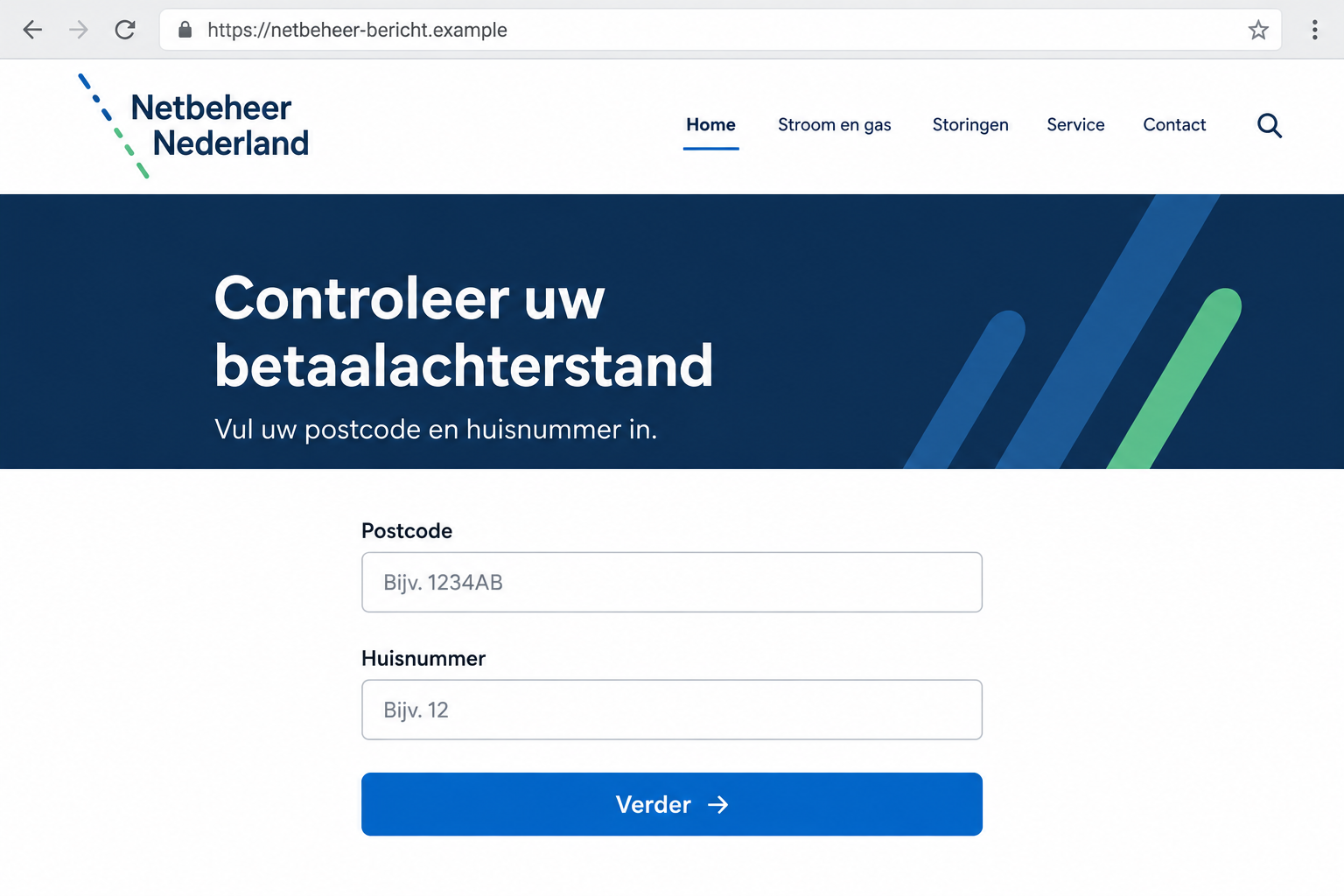
The reported false website requested details including a postcode and house number. Those familiar address fields do not authenticate a debt-checking service.
The illustration uses a fictional domain and sample layout. No payment was submitted, and no exact amount or final banking screen is established here.
Why the Name Sounds Like Someone You Should Pay
An energy bill can include several kinds of charges. You may recognize the supplier you chose without remembering the organization responsible for the local network.
An impostor doesn’t need to explain that system accurately. They only need a title that sounds sufficiently connected to your home’s electricity or gas.
A national-sounding name may make you hesitate to question the bill. You still need to know who says you owe them and why.
Ask where the supposed debt originated. A demand should connect to an account, billing period, or requested service you can check outside the message.
A threat to escalate the matter doesn’t fill those gaps. It creates a reason to rush past them.
If you’re worried about your energy supply, contact your real provider. Don’t let the unexpected sender become your only adviser about the consequences.
This is also why a broadly distributed email can be effective. Many recipients have energy accounts, even if the sender knows nothing about their balances.
How the Netbeheer Nederland Email Scam Works
Step 1: An email announces an energy payment problem
The opening claim is that you owe money to an energy supplier or network operator. The sender uses the association’s identity to make it seem official.
That leaves an immediate question: have you missed a real bill? The message tries to answer it for you before you consult your own records.
Don’t start by assuming either payment or nonpayment. Start by identifying the genuine account where such a balance should appear.
Step 2: Consequences make the debt feel time-sensitive
The reported emails warn of consequences unless the balance is addressed quickly. The pressure encourages action before the recipient checks who is collecting.
A useful pause is to ask whether this is the first time you’ve heard about the alleged charge. Find earlier genuine correspondence yourself.
If the email claims prior reminders were sent, that remains part of its story. It isn’t evidence those reminders exist.
A genuine account problem can be discussed through official support. You don’t have to accept an unknown sender’s payment route to take it seriously.
Step 3: A link moves the recipient to a false website
The documented warning identifies netbeheer.com as the false destination in that campaign. It is a reported indicator, not a website you need to visit.
Similar wording, a convincing header, or a polished page can make the transition feel natural. None proves an authorized relationship with your energy account.
Don’t rely on one exact domain as a permanent filter. The independent verification method remains useful even when a sender chooses a different address.
A page’s existence is also not proof of a real debt. The sender can display a balance without that balance appearing in any genuine customer record.
Step 4: Address details make the process feel personalized
Liander cautions against entering information such as your postcode and house number on the reported false site. Those requests can resemble routine household account checks.
But an address form has a limited meaning: you are giving information to whoever controls it. It doesn’t establish why they are entitled to it.
If you proceed further, assess any new request separately. A password, bank approval, card detail, or transfer would create additional exposure requiring its own response.
Do not assume all versions request the same data. What you actually entered is the basis for protecting yourself afterward.
The Real Bill Versus the Invented Debt
Check ordinary network charges with the energy supplier
Open your supplier’s app or independently reached website. Review the relevant invoices and payment history rather than trusting the email’s balance.
Compare the billing period, service address, customer reference, amount, and status. A plausible-looking reference needs an actual match, not just the right number of digits.
If a direct debit failed, discuss that with the real supplier. Do not use a separate unexpected request simply because it arrived around the same time.
If someone else manages the account, ask them to check their records. Share the concern without forwarding a clickable payment link as the recommended route.
Also check the service address rather than assuming the email concerns your present home. An old address or unfamiliar property needs clarification, not a rushed payment.
Find the relevant supplier in your own contract or bank records. Don’t choose a provider simply because the sender mentions it in the demand.
If you recently switched suppliers, compare each company’s actual closing and opening documents. The changeover can create confusion without making an outside debt request genuine.
A name in your bank statement can help locate a previous genuine transaction. It should lead you back to trusted paperwork, not authenticate an unrelated new link.
When the billing period is unclear, ask for an explanation through official support. Don’t invent a connection between the demand and a recent account change.
Keep any confirmed invoice reference with the support response. That gives the household a consistent record of what was checked and what remains unpaid.
If a different household member gets a similar demand, compare the actual claims. Don’t infer that two messages independently confirm the same debt.
Recognize the exception for work you requested
Enexis’s warning about false invoices distinguishes ordinary network fees from one-off charges for customer-requested work.
That matters if you recently arranged a connection or another service. Find the original request and compare the invoice with the agreed work.
Ask the genuine network company to confirm anything uncertain. Don’t accept an unexpected sender’s claim that the work was requested on your behalf.
A scam report should help you identify the wrong demand, not persuade you that a real organization can never issue a legitimate invoice.
Verify contact details outside the demand
Use the supplier or network operator’s official website, an established account, or earlier trusted paperwork. Keep the suspicious email out of that navigation path.
Tell support the precise name used in the demand. Ask whether the reference and service belong to you before discussing payment arrangements.
If you reached a genuine service but the employee can’t resolve it immediately, don’t fall back to the sender’s shortcut. Keep the case reference.
Likewise, a search result advertising urgent help isn’t automatically the official organization. Read the website address before sharing account information.
Address Disclosure Is Not the Same as Bank Access
Entering a postcode and house number can expose household information. It does not, by itself, prove the recipient can withdraw money from your bank.
That distinction is important after a scare. You can take sensible precautions without assuming every possible consequence has already happened.
Write down any extra information you supplied. Include email addresses, telephone numbers, customer references, passwords, and approvals only if they were actually involved.
Be alert to follow-up contact using those details. Someone referring to your address or the earlier debt discussion still needs independent verification.
Don’t offer more information to correct what you submitted. An impostor’s promise to remove your details isn’t a trustworthy data-protection process.
What to Do if You Have Fallen Victim to This Scam
-
Close the false account check. Stop entering information and don’t pay a supposed balance to discover whether the page is genuine.
If the sender follows up, don’t continue the conversation through a replacement link or another contact they provide.
-
List the information you disclosed. Keep a concise record of completed fields and actions. Don’t store actual passwords or security codes in the incident notes.
If only household address information was entered, describe that accurately when seeking advice. Avoid overstating the exposure as confirmed bank compromise.
-
Call the bank if money or banking access was involved. Report the transaction and any approval, code, or financial credentials supplied during the false debt process.
Use the bank’s own contact route and ask what protective or recovery measures apply. A completed transfer may not be recoverable, but still needs reporting.
-
Protect any affected login. Change an exposed password through the genuine service. Review available account activity, recovery details, and sessions for unfamiliar changes.
If the password was reused, replace those copies as well. A new password on one account doesn’t protect another account still using the old one.
-
Check the actual energy account. Confirm the balance with the real supplier and verify any separate requested-work invoice with the genuine network company.
Tell them which name the impostor used. Don’t assume payment to a fraudulent recipient has satisfied a genuine household obligation.
-
Keep the evidence together. Save the original email, visible destination, relevant screenshots, bank reference, and any messages received afterward.
Don’t publicly post an unredacted household address or customer reference. Investigators may need private details; other readers generally need the pattern, not your identity.
-
Report the impersonation. The official warnings direct recipients toward Fraudehelpdesk and, after a fraudulent payment, police reporting. Use genuine reporting websites.
Keep reference numbers from each organization. If new transactions or contacts appear, you can add them without reconstructing the entire story.
-
Handle device exposure separately. If you installed an unfamiliar program during the interaction, stop banking on that device while you remove unwanted access.
Malwarebytes can help check software exposure. AdGuard may reduce malicious advertising and redirects; it doesn’t validate debts, restore money, or reset compromised accounts.
Simply seeing an address form isn’t proof of infection. Match cleanup to the downloads, permissions, or software changes that actually occurred.
Don’t Let a Second Message Finish the Job
After you’ve stopped the first request, an unexpected contact may claim the debt was resolved incorrectly or that your previous report needs confirmation.
Judge that new request independently. Its knowledge of your concern does not establish that it comes from your supplier, bank, or an investigator.
Never transfer money to prove an account is yours or to protect it while a debt is reviewed. Ask your actual bank about unexpected instructions.
If a household member also receives the email, agree on one verified contact route. Otherwise separate conversations can turn into confusion over who has checked what.
Keep a brief note showing the genuine balance and who confirmed it. That gives you something concrete to consult if the sender keeps applying pressure.
Frequently Asked Questions
Is the Netbeheer Nederland email warning based on an actual scam?
Yes. Liander published a warning describing multiple phishing reports, false arrears claims, and a specific impostor destination using the association’s identity.
Does the industry association’s name prove I owe money?
No. Identify the actual creditor and check the relevant account. A recognizable industry name cannot establish your personal debt or authorize a payment request.
Can my network operator ever send a genuine invoice?
Yes, certain one-off services you requested can be invoiced separately. Verify the original work and request with the real organization rather than assuming universal fraud.
Should I visit netbeheer.com to compare the page?
No. It’s a domain identified in the published warning. You can check your genuine account without revisiting or testing a reported false destination.
What if I entered only my postcode and house number?
Stop and record that disclosure. Watch for tailored follow-up requests, but don’t assume those fields alone gave anyone your banking credentials or payment authority.
Do I still need to pay a real overdue energy bill?
Yes, a genuine obligation needs handling through the proper provider. Identifying a false email doesn’t erase a separate balance in your authentic account.
The Bottom Line
Do not pay an unsolicited Netbeheer Nederland arrears email. Check ordinary charges with your energy supplier and any requested-work invoice with the genuine network operator.
If the false process already received your money or banking access, contact the bank immediately. Record the information you disclosed and report the impersonation.

Join the discussion
0 commentsShare your experience or ask a question about this article.
Discussion
Start the conversation
Have a question or something useful to share? Add the first comment.