

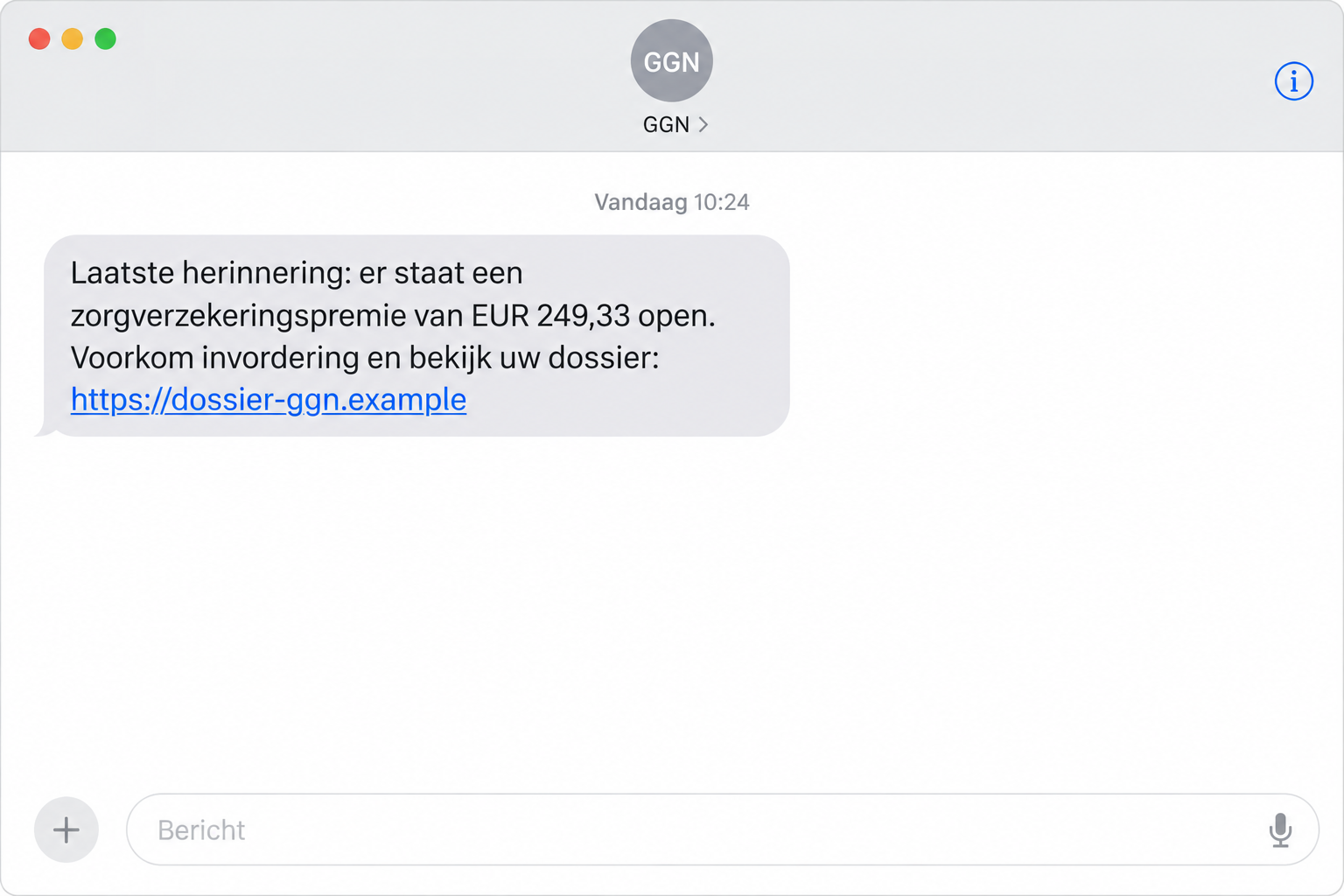
A GGN text says you still owe a health insurance premium. The amount is precise, and the message warns that collection action is close.
You don’t want a small bill becoming a bigger problem. Before opening the payment link, find out whether that supposed debt exists anywhere beyond your phone.
Overview
A supposed insurance debt becomes a reason to click
The GGN debt text scam impersonates a real Dutch collection organization. It uses an overdue health insurance claim and a threatening deadline to push a payment link.
One documented message demands €249.33 and warns about collection. The destination presented as a case portal is not the legitimate GGN website.
The accusation belongs to the fraudulent message, not to GGN or your insurer. A copied collector’s name is not evidence of an actual outstanding premium.
The collector has published its own phishing warnings
GGN’s official phishing page documents false debt emails, texts, and calls that misuse its identity.
Its examples include changing amounts and multiple lookalike addresses. That matters because recognizing just one old link will not protect you from a replacement.
The company also explains how genuine communication can look. It does not say every payment reminder or every online case portal is fraudulent.
Two separate questions need answering
First, is this particular message genuine? Second, is there a real insurance or collection issue you need to resolve through an independent route?
- A text cannot establish a debt simply by naming an amount.
- A collector’s initials inside a domain don’t establish ownership.
- A frightening deadline doesn’t justify handing over login or identity details.
- A real arrears problem should be checked through the insurer or collector directly.
The SMS pictured above is an illustration with a reserved example address. It shows the pressure tactic without reproducing a functioning payment destination.
Don’t pay through the message. Check the claimed case yourself, and keep any genuine debt question separate from the fraudulent route used to raise it.
Why an Insurance Premium Is Such a Persuasive Pretext
A fake prize asks you to believe something unusually good happened. A debt notice asks you to worry that you missed something ordinary.
Health insurance is a believable source of administration: monthly payments, account messages, adjustments, and reminders can be difficult to remember in detail.
The scam takes advantage of that uncertainty. You may start reviewing your own memory instead of checking whether the sender has established any connection to a real account.
A figure ending in cents can make the claim look calculated. It doesn’t show how the balance was derived or whether a creditor authorized collection.
Collection language adds another layer of pressure. Someone who dislikes confrontation may pay quickly just to avoid what they imagine comes next.
That reaction is understandable. The useful response is not to ignore all financial administration, but to move the question into a channel the message sender doesn’t control.
If you already suspect a missed premium, the SMS can feel especially convincing. A correct guess about your circumstances still doesn’t authenticate its payment link.
You can investigate arrears without following a stranger’s route. Your insurer’s existing app, correspondence, or independently located contact information provides a different starting point.
How the GGN Debt Text Scam Works
Step 1: A short message borrows the collector’s authority
The text names GGN and introduces an overdue bill. There is little room for explanation, so the sender relies on recognition and urgency.
Some versions may use an apparent sender name; others arrive from ordinary numbers. GGN warns that criminals can manipulate sender information to appear familiar.
The name on the message should therefore start your checking, not end it. A phone’s conversation label does not verify the organization behind the request.
Nor does the absence of an obvious spelling mistake establish legitimacy. Clean wording can carry the same invented payment demand as an untidy message.
Before doing anything else, ask whether the text identifies a case you can independently find through the collector or insurer.
Step 2: A precise amount makes the claim feel established
The reported insurance-premium message uses €249.33. That specificity can make the balance feel like the result of a real accounting process.
But the text does not become a verified invoice because it includes cents. The sender can choose a plausible amount without holding a legitimate claim.
Compare any alleged debt with statements or case information obtained separately. Check the creditor, relevant period, reference, and balance rather than just the bottom-line figure.
A mismatch deserves explanation from the real organization. Don’t let a caller or chat agent reached through the same suspicious link supply all the answers.
If you aren’t a customer of the supposed insurer, that is another reason to question the claim, not a reason to enter details to correct it.
Step 3: Collection threats make independent checking feel too slow
The message presents payment as the last chance to prevent collection. The idea is to make a pause feel more dangerous than clicking.
GGN’s warning describes threatening language in impersonation attempts, including claims about seizure or eviction in some versions. Those claims should not be treated as verified legal events.
The sender wants you to react to consequences before checking whether any underlying case exists. Urgency supplies the missing evidence emotionally.
You do not have to decide the legal status of a debt while looking at an unexpected text. First establish who actually sent the demand.
If a genuine case exists, ask the real collector about its status. A separate verification route is compatible with taking a real bill seriously.
Step 4: The link substitutes a false case or payment destination
The documented health-premium SMS points to ggn[.]ns-1[.]info. The collector’s initials appear before a different domain, ns-1[.]info.
That is not a subdomain of ggn.nl. The placement of a trusted name inside an address does not give that organization control over the site.
Don’t open the address to test whether it has a convincing logo. A copied header would not resolve the ownership problem.
If the destination asks for money, banking information, or identity documents, don’t proceed. Check the supposed case with GGN through its actual website.
What is already clear is that the message directs a supposed GGN matter away from its legitimate service. That is enough reason to reject this payment route.
Step 5: A response can expose money, information, or both
If you pay, the transfer may go to a fraudster rather than settle any genuine obligation. A confirmation screen isn’t proof the real collector received it.
If you supply bank credentials, identity information, or codes, the risk extends beyond the amount printed in the text.
Conversely, merely receiving the SMS does not establish that your bank account has been entered. Different actions require different recovery priorities.
Record whether you only viewed the page, typed information, authorized a payment, or installed something. That sequence is more useful than a general statement that you clicked.
A supposed follow-up fee to close the case is not reassurance. Don’t make another payment through the same channel to undo the first.
How to Check a Claimed GGN Debt Without Using the Text
Start with the insurer if the premium is unfamiliar
Open your insurer’s usual account environment independently. Review payment history and correspondence for the period the demand supposedly concerns.
Ask whether the insurer recognizes an arrears issue or a referral to collection. Use a number from your existing policy or the insurer’s official website.
Don’t forward banking passwords or identity documents to the sender just to establish which insurance account they mean. An unverified demand doesn’t justify that disclosure.
Use GGN’s own entry point for the case
Navigate to ggn.nl yourself and follow its debtor-account or contact options. Do not substitute an address from the text because it contains similar words.
GGN identifies mijnincasso.ggn.nl in its explanation of genuine payment communication. Reaching the portal through the official site avoids relying on a copied link’s appearance.
Have any real reference ready, but don’t treat a reference as proof on its own. What matters is whether the legitimate organization recognizes the case and details.
Keep a disagreement about a real bill in the proper channel
A fraudulent SMS and a genuine billing dispute can coexist. Discovering the fake message doesn’t automatically remove a separate balance owed to an insurer.
If the real organization confirms a case, ask for an explanation of the balance and available next steps. Keep that conversation separate from the impersonator.
Don’t assume that deleting a text resolves a verified financial matter. Equally, don’t let a real administrative worry validate an unrelated payment destination.
Why a Receipt May Not Settle the Claimed Premium
A payment receipt answers a limited question: a payment process recorded a transaction. It doesn’t establish that the insurer or its authorized collector received the money.
If you paid through the false link, keep the receipt exactly as issued. The destination and transaction reference may help your bank investigate.
Then ask the genuine creditor what its own records show. Don’t use the fraudster’s success screen as the only explanation for a balance that remains outstanding.
Equally, don’t pay a second demand automatically just because the first payment went wrong. First establish whether the actual organization recognizes a legitimate case.
That distinction is particularly important if you already had an insurance payment problem. The existence of real arrears does not authorize a third party’s unrelated payment route.
Keep two timelines if necessary: the insurer’s genuine correspondence and your interaction with the impersonator. Mixing them can make it harder to explain the issue clearly.
Ask the real organization which documents it needs to review the situation. Share them through a verified channel, without sending unnecessary personal information to the original text sender.
The goal is to resolve the real account question while pursuing the diverted payment separately. Neither task should depend on further cooperation with the phishing site.
What to Do if You Have Fallen Victim to This Scam
-
Stop using the alleged dossier link. Close the page and don’t send further information or payments to the same contact. Preserve the original message first.
If a warning page or stranger says you must complete one final payment to cancel, stop there. The fraudulent route cannot verify its own cancellation procedure.
-
Contact the actual collector independently. Explain that you received an insurance-related demand using GGN’s name, and ask how to verify any supposed case.
Give the reference and claimed creditor where available. Don’t email card security codes, banking passwords, or unnecessary identity documents with your first inquiry.
-
Tell your bank if money left or credentials were entered. Provide the payment time, amount, recipient details, and the explanation attached to the transfer.
Ask about protective account measures and whether the payment can be investigated, recalled, or disputed. A successful-looking checkout doesn’t establish where the money ultimately went.
-
Report authentication details separately. If you supplied a password, one-time code, or banking approval, describe that action even if no transaction is visible.
Protect other accounts that reused the exposed password. Ask the affected provider about sessions or permissions that may remain active after a password change.
-
Address identity exposure if it occurred. Tell the relevant organization what personal information you submitted. Keep a record of documents or identifiers disclosed.
That doesn’t mean identity theft is certain. It gives you a basis for responding to later account applications, unusual correspondence, or attempts to impersonate you.
-
Check software only where the interaction warrants it. A download, installed application, or granted device access calls for a separate security review.
Malwarebytes can help detect malicious files. It won’t settle an insurance balance, reverse a transfer, or authenticate a collection company.
-
Keep the evidence together. Save the text, destination address, receipt, transaction reference, and any subsequent conversation. Redact private details before sharing the warning publicly.
Report the impersonation through GGN’s official guidance and relevant police channels. Keep any real insurance correspondence in the same timeline but clearly identified as genuine.
-
Be wary of a second payment demand. Criminals may reuse the debt story or pretend to recover the money. Verify any new contact independently.
AdGuard may help filter harmful advertising and some unsafe destinations, but it cannot decide whether a particular debt is legally owed.
Frequently Asked Questions
Is GGN itself a scam?
No. This warning concerns messages impersonating the real organization. GGN has its own public phishing guidance and legitimate channels for checking collection cases.
Does the €249.33 amount mean the sender knows my insurance account?
Not necessarily. A precise figure can be invented. Compare the alleged balance with records obtained from your insurer or GGN through an independent contact route.
Is an address starting with GGN automatically official?
No. The full domain matters. In ggn[.]ns-1[.]info, the initials belong under ns-1[.]info, not ggn.nl. Don’t follow that address to pay.
Should I ignore all future collection reminders?
No. Verify unfamiliar demands through the real collector and creditor. Rejecting a phishing link is different from dismissing a separately confirmed financial obligation.
What if I paid but the real GGN case still shows a balance?
Contact your bank and the actual collector. Give the payment destination and receipt. A transfer to an impersonator may not have reached the genuine creditor.
Did opening the text infect my phone?
A received SMS isn’t evidence of infection. Explain whether you opened a link, downloaded software, entered data, or granted permissions so the response matches the exposure.
The Bottom Line
Don’t pay the GGN debt text through its supplied link. The documented insurance demand borrows a real collector’s name to steer people toward an unrelated destination.
Check any genuine arrears independently with your insurer or GGN. If you already paid or revealed banking information, contact your bank promptly and preserve the message.

Join the discussion
0 commentsShare your experience or ask a question about this article.
Discussion
Start the conversation
Have a question or something useful to share? Add the first comment.