

A hearing notice arrives on your phone with a Fulton County heading and a way to pay before court. Suddenly, an ordinary afternoon feels like a legal emergency.
The Fulton County court text scam is designed around that change of mood. Before you rearrange your day or reach for a card, examine the choices it gives you.
Overview
Fulton County has warned about fabricated citation notices
The county’s March 2026 warning describes fake notices alleging unpaid tolls, parking tickets, or other citations.
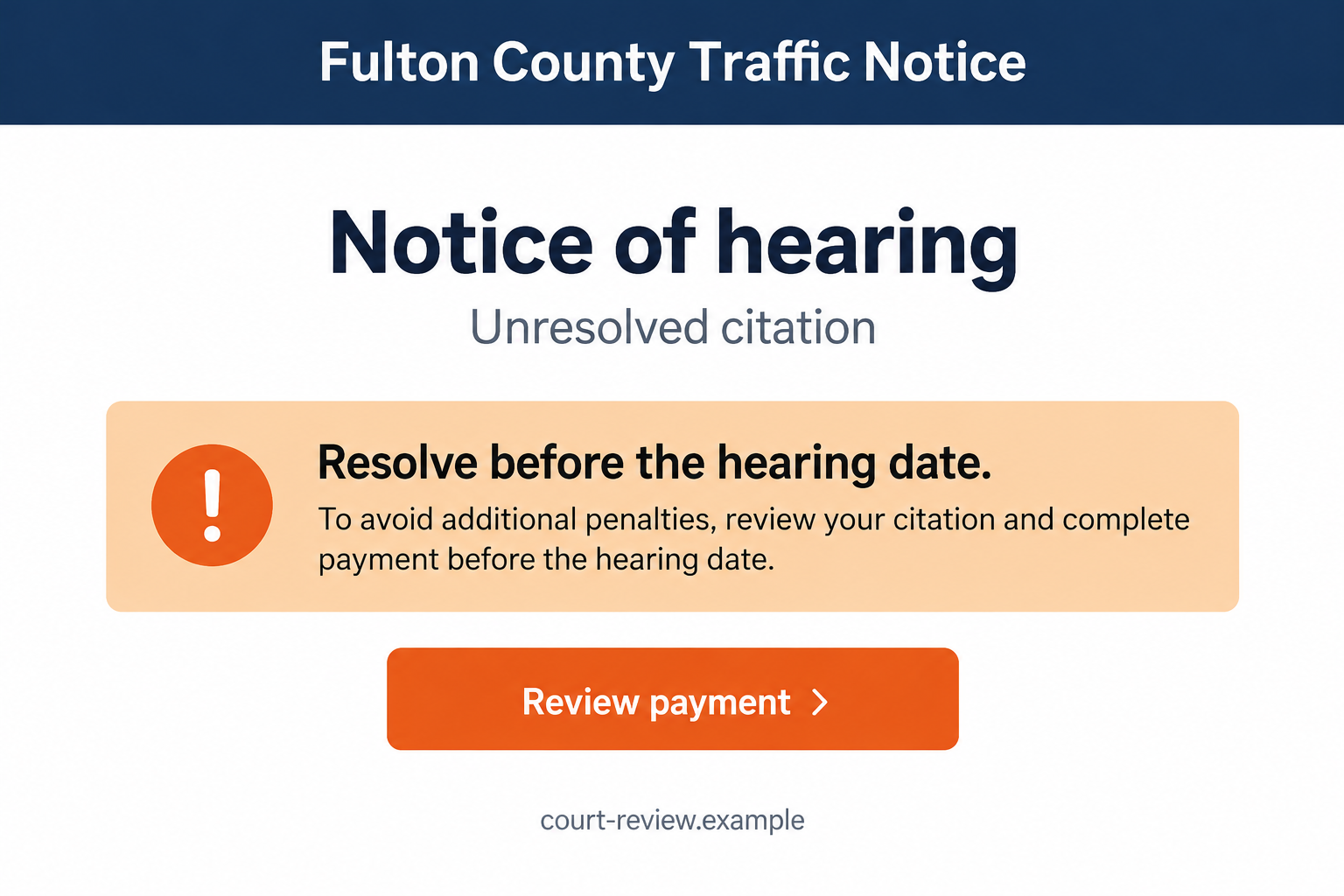
They can include a supposed case number, hearing information, copied seals, and a QR code or link for payment. Those details are part of the presentation, not verification.
The county specifically warns against unexpected text demands for money and instructions to settle through a QR code. An apparent court document can still be a stranger’s image.
This is a documented impersonation method, not evidence that every recipient has an active case. The illustration uses invented page wording rather than a genuine notice addressed to someone.
The hearing date makes a payment shortcut feel necessary
A fake notice can present two uncomfortable choices: appear at a hearing on short notice or pay immediately to make the problem disappear.
That framing discourages a third choice, checking with the real court first. The threatening document supplies both the accusation and the convenient route out.
A real case deserves a real response. That is why you should verify through an independently reached court, rather than obey or dismiss legal-looking information on appearance alone.
The important details need to match an independent record
When you make that separate check, establish what the alleged matter actually is:
- Which court is supposedly handling it?
- What event, ticket, or citation is involved?
- Does a genuine record match the person and allegation?
- What response does the actual court require?
- Is the payment destination one the court itself provides?
Do not submit identifiers to the message’s website to obtain those answers. The point is to get outside the sender’s system before disclosing anything.
Why a Photograph of Court Paperwork Can Be Persuasive
A document makes the message feel more settled than it is
Plain spam is easy to dismiss. A page with headings, signatures, legal phrases, and a case reference can look like the outcome of a process already underway.
You may assume earlier letters went missing or that someone else used your vehicle. The image lets you invent a plausible explanation for a claim you never recognized.
Pause before filling in those blanks. The sender should not gain authority simply because you can imagine circumstances in which a real notice might exist.
A copied seal is particularly weak as an identity check. It can be reproduced in a document without access to any court’s actual records or systems.
A nearby deadline can crowd out your normal questions
The county’s examples describe fabricated hearing dates and short notice. That timing can make speaking to a relative or calling an office seem like an unaffordable delay.
But the date printed in an unverified image is itself part of what needs checking. It cannot establish that you owe the sender a payment today.
Keep the concern concrete when contacting the court: explain that you received a notice and need to verify it. You do not need to prove the sender’s motive first.
If you already know about a genuine citation, mention it separately. An unrelated scam should not interfere with resolving the real matter through the correct channel.
The name on the page cannot authenticate the demand
Fraudulent notices can use official-sounding job titles, familiar names, or invented judicial information. The county warning identifies that misuse as a feature of these notices.
Do not accuse a real person whose name appears in a message. A copied name or signature says little about who created or sent it.
Equally, finding a matching name online does not validate the payment instruction. Check the actual case and the court’s route for dealing with it.
How the Fulton County Court Text Scam Works
Step 1: A supposed citation arrives outside an established conversation
The first contact claims a court matter needs attention. It can arrive as a text, email, or image resembling a notice from a local court.
The accusation may concern traffic, parking, or a toll. Several official-sounding labels can be combined even though you have no recognizable ticket or prior correspondence.
Being addressed on your own phone does not establish an official connection. Before responding, identify whether you recognize the underlying event without relying on the sender’s explanation.
Step 2: Formal details turn the allegation into apparent authority
A reference number, hearing address, seal, or signature gives you something specific to look at. Specificity can feel reassuring even when the details were simply typed into a template.
The county has warned about fake case numbers and fabricated court information. Treat those entries as claims to compare with a genuine record, not proof of one.
You do not need to solve every inconsistency yourself. A document can be well written and still direct money to someone unconnected with the court.
Step 3: The notice makes payment seem preferable to appearing
The threatened alternatives can include court penalties, enforcement, or losing driving privileges. A payment button then looks easier than taking time off work or arranging transportation.
Before weighing a day in court against a payment, find out whether the court recognizes the notice. The sender has not answered that question.
Do not negotiate with the message’s contact to buy more time. Take the claimed urgency to the independently reached court and ask what, if anything, requires action.
Step 4: A QR code or link becomes a substitute for verification
A code makes the next step feel like routine administration. You scan, a page opens, and the task changes from evaluating a notice to completing a form.
The FTC’s traffic-text warning describes this same use of hearing notices and QR payments to pressure recipients.
The resulting page may ask for identifying details or a card. A court heading on the document cannot establish who operates that separate destination.
Do not continue just to see the total. Every additional field or approval should wait until you know whose service you are using.
Step 5: A receipt can leave you believing the matter is closed
A confirmation page or email can create relief after the earlier panic. You may put away the notice without considering what information you gave the site.
However, the suspicious process cannot prove its own success. Its receipt is a record of your interaction, not confirmation from the real court.
If you paid, deal with the financial exposure now and verify the alleged case separately. Do not return to the same contact for a cancellation or refund.
Check the Court Without Following the Payment Instruction
Start with the court named, not the website supplied
Use a government website or a previously verified court contact to find the relevant office. The county’s warning is a useful independent starting point.
The State Court’s scam advisory also directs people toward its own case-record resources rather than immediate payment through a message.
Choose the route yourself. A help link inside the alleged notice can lead to another page controlled by the same sender, even if it looks different.
Ask about the record before discussing payment
Describe the notice’s court name, reference, and alleged violation. Ask the real office what information it needs to locate an authentic matter.
Keep a note of the office you reached and its explanation. If it refers you elsewhere, obtain the next contact independently before sending sensitive documents.
If the office is closed, check its published hours and save the notice for that inquiry. An after-hours payment demand does not make the sender your only option.
Avoid giving the notice to a stranger offering to handle the case for you. A trusted helper can assist without becoming a paid intermediary introduced by the text.
If a search turns up nothing, ask the court about it. Do not guess that a real deadline disappeared or that the sender’s deadline applies.
Do not let multiple helpers multiply the exposure
A worried household can easily split the work: one person calls, another scans, and a third posts the notice online. Agree on one independent verification route first.
Let a trusted helper organize paperwork and find official contacts. They should not need to enter your license or financial details into several unfamiliar websites.
Keep unredacted originals for genuine reporting. Remove identifiers from anything shared publicly, including reference numbers that could connect other information to you.
What to Do if You Have Fallen Victim to This Scam
-
Break off the message-driven payment process. Close the page and stop replying. Do not scan again, try another card, or send a document to complete verification.
Write down whether you only viewed the notice, opened a destination, entered details, approved something, paid, or installed software. Keep the actions in their actual order.
Save the original contact and any receipt you already have. You can make a useful report without reopening the suspicious destination.
-
Ask your financial provider about exposed card details or payments. Reach it using your ordinary app, card, or statement, outside the alleged court’s instructions.
Identify what you entered and what moved, if anything. Ask about securing the card, examining transactions, and the reporting options available for that particular payment.
Keep the response reference and follow-up instructions. Reporting an attempted scam to the court does not automatically open a financial dispute for you.
-
Recover any account used on the false page. If you typed a password, change it through the real service and replace it wherever else you reused it.
Review recovery details, recent access, and available sign-out controls. Tell the provider about security codes or approvals supplied during the interaction.
Do not give a follow-up caller another code to reverse the first disclosure. Use the account’s own recovery process if you can no longer sign in.
-
Address identifying information separately from a payment. A Social Security number or identity document may require protection beyond replacing a card.
IdentityTheft.gov offers steps tailored to the information involved. Explain the disclosure and any misuse discovered instead of assuming every possible consequence already occurred.
Keep notes about unfamiliar applications, accounts, or correspondence if they appear. Those details help the appropriate organization understand what needs correcting.
-
Investigate software only if the interaction involved software. A text image alone does not establish an infected phone. A download, installation, or remote session changes the question.
End unauthorized access and obtain help from someone you independently trust. Malwarebytes can help check supported devices for malicious software where a scan is appropriate.
AdGuard can limit intrusive advertising and some risky browsing exposure. Neither tool settles a citation, reverses a payment, or makes the false notice genuine.
-
Verify and report the court impersonation through official contacts. Fulton County advises recipients to contact the relevant court independently and report the scam to local law enforcement.
Share the notice through the verified reporting process, not by replying to its sender. Include the original route and any payment destination already recorded.
If a genuine court matter also exists, ask how to address it properly. Do not assume the scam report changed a real obligation or hearing.
-
Use the federal reporting and recovery routes when relevant. Submit a fraud report at ReportFraud.ftc.gov and retain your supporting records.
The FTC’s recovery guide explains why prompt contact with the payment service matters. Recovery depends on the circumstances, not a stranger’s guarantee.
Reject anyone charging to erase the notice, clear an arrest threat, or release recovered money. A new official-sounding title is not a reason to pay again.
Frequently Asked Questions
Does Fulton County send unexpected texts demanding immediate court payment?
The county warns against those demands and QR payment instructions. Do not use the message to pay; contact the relevant court through an independent official route.
Can a court seal or case number prove the notice is authentic?
No. Fulton County describes fabricated case information and copied official presentation. Verify the actual record rather than treating the document’s appearance as confirmation.
Should I attend a hearing listed only in the suspicious notice?
Ask the real court to verify the matter and any required appearance. Do not rely on the sender’s date, address, or payment alternative.
Does opening a QR preview mean my card details were stolen?
Not by itself. Identify whether you opened a page, entered information, paid, or installed anything, then take the response steps that fit those actions.
Can the real court refund money paid to the impersonator?
Contact the provider that handled your actual payment about recovery options. Verifying a court record and investigating a payment to a stranger are separate processes.
Is a named judge responsible for a notice using that name?
A name printed by a sender does not establish authorship or involvement. Keep any allegation attached to the fraudulent communication, not a person identified without verification.
The Bottom Line
Do not pay or scan a Fulton County court text to avoid its alleged hearing. Check the case through the actual court, using contact information found independently.
If you already provided information or money, secure the affected accounts and contact the payment provider. Keep that recovery work separate from resolving any genuine court matter.

Join the discussion
0 commentsShare your experience or ask a question about this article.
Community experiences
Did this happen to you?
Your experience could help someone recognize the same scam. Submit a private report for our team to review.
I experienced this tooReports are reviewed before publication. Sharing publicly is always your choice.
Discussion
Start the conversation
Have a question or something useful to share? Add the first comment.